159 books match the query 'Present' and 4 start with f

cover of Falling in Love with Statues: Artificial Humans from Pygmalion to the Present

Falling in Love with Statues

Artificial Humans from Pygmalion to the Present

George L. Hersey

University of Chicago Press, 2009

If, as a child, you conducted conversations with beloved dolls, or if, as an adult, you have entered virtual worlds inhabited by digital humans who inspire devotion in real people, you have participated in one of humanity’s most potent yet least explored traditions. Falling in love (and out of love) with statues, George Hersey reveals here, has been an instrumental practice since antiquity in our efforts to understand, improve, and empower ourselves.
            Hersey’s history of statue love begins in Cyprus, home of the legendary sculptor Pygmalion, who famously grew enamored of his own creation. Examining the island’s prehistoric images of Aphrodite—the love goddess who brought Pygmalion’s sculpture to life—Hersey traces the origins of statue love back to the Cypriot followers who adored her terra-cotta likenesses. He goes on to explore ideas about human replicas in the works of Empedocles, Aristotle, Lucretius, and Ovid, whose definitive account of the Pygmalion myth introduced the notion that statues have the potential to induce physical responses in their viewers. Finding avatars of Ovid’s living image in everything from pagan idols and early Christian statuary to eighteenth-century painting to modern action figures and marionettes, Hersey concludes by investigating the concern that these automata will eventually replace humans.
            In the process, he narrates a powerful history of artificial life at a moment when—with the development of robot soldiers, ever more sophisticated genetic engineering, and a continually expanding digital universe—it seems more real than ever.

[more]
cover of Five Lives in Music: Women Performers, Composers, and Impresarios from the Baroque to the Present

Five Lives in Music

Women Performers, Composers, and Impresarios from the Baroque to the Present

Cecelia Hopkins Porter

University of Illinois Press, 2014

Representing a historical cross-section of performance and training in Western music since the seventeenth century, Five Lives in Music brings to light the private and performance lives of five remarkable women musicians and composers. Elegantly guiding readers through the Thirty Years War in central Europe, elite courts in Germany, urban salons in Paris, Nazi control of Germany and Austria, and American musical life today, as well as personal experiences of marriage, motherhood, and widowhood, Cecelia Hopkins Porter provides valuable insights into the culture in which each woman was active.
 
Porter begins with the Duchess Sophie-Elisabeth of Braunschweig-Lueneberg, a harpsichordist who also presided over seventeenth-century North German court music as an impresario. At the forefront of French Baroque composition, composer Elisabeth-Claude Jacquet de La Guerre bridged a widening cultural gap between the Versailles nobility and the urban bourgeoisie of Paris. A century later, Josephine Lang, a prodigiously talented pianist and dedicated composer, participated at various times  in the German Romantic world of lieder through her important arts salon. Lastly, the twentieth century brought forth two exceptional women: Baroness Maria Bach, a composer and pianist of twentieth-century Vienna's upper bourgeoisie and its brilliant musical milieu in the era of Gustav Mahler, Richard Strauss, Arnold Schoenberg, and Erich Korngold; and Ann Schein, a brilliant and dauntless American piano prodigy whose career, ongoing today though only partially recognized, led her to study with the legendary virtuosos Arthur Rubinstein and Myra Hess.
 
Mining musical autographs, unpublished letters and press reviews, interviews, and music archives in the United States and Europe, Porter probes each musician's social and economic status, her education and musical training, the cultural expectations within the traditions and restrictions of each woman's society, and other factors. Throughout the lively and focused portraits of these five women, Porter finds common threads, both personal and contextual, that extend to a larger discussion of the lives and careers of female composers and performers throughout centuries of music history.
[more]
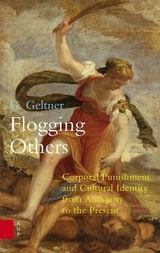
cover of Flogging Others: Corporal Punishment and Cultural Identity from Antiquity to the Present

Flogging Others

Corporal Punishment and Cultural Identity from Antiquity to the Present

G. Geltner

Amsterdam University Press, 2015

Corporal punishment is often seen as a litmus test for a society's degree of civilization. Its licit use purports to separate modernity from premodernity, enlightened from barbaric cultures. As Geltner argues, however, neither did the infliction of bodily pain typify earlier societies nor did it vanish from penal theory, policy, or practice. Far from displaying a steady decline that accelerated with the Enlightenment, physical punishment was contested throughout Antiquity and the Middle Ages, its application expanding and contracting under diverse pressures. Moreover, despite the integration of penal incarceration into criminal justice systems since the nineteenth century, modern nation states and colonial regimes increased rather than limited the use of corporal punishment. Flogging Others thus challenges a common understanding of modernization and Western identity and underscores earlier civilizations' nuanced approaches to punishment, deviance, and the human body. Today as in the past, corporal punishment thrives due to its capacity to define otherness efficiently and unambiguously, either as a measure acting upon a deviant's body or as a practice that epitomizes - in the eyes of external observers - a culture's backwardness.
[more]
cover of Fractured Politics: Peruvian Democracy Past and Present

Fractured Politics

Peruvian Democracy Past and Present

Edited by John Crabtree

University of London Press, 2011

Latin American opinion surveys consistently point to Peruvian citizens' deep distrust of their elected rulers and democratic institutions. The 2011 presidential and legislative elections in Peru, along with the regional and municipal polls of the previous year,showed once again the degree of political fragmentation in contemporary Peru andthe weakness of its party system. Fractured Politics examines the history of political exclusion in Peru, the weaknessof representative institutions, and the persistence of localized violent protest. It also evaluates the contribution of institutional reforms in bridging the gap between state and society, including Peru's Law on Political Parties, administrative decentralization, and the experience of the Defensor, or ombudsman's office. The chapters, by leading scholars of Peruvian politics, emerge from a conference, held in 2009 in Saint Antony's College Oxford. Julio Cotler, from the Instituto de Estudios Peruanos (IEP), was the keynote speaker.
[more]