Results by title
56 books match the query 'Press' and 5 start with f

F. D. R. and the Press
Graham J. White
University of Chicago Press, 1979
White challenges and disproves Roosevelt's contention that the press was unusually severe and slanted in its treatment of the Roosevelt years. His original work traces FDR's hostile assessment of the press to his own political philosophy: an ideology that ordained him a champion of the people, whose task it was to preserve American democracy against the recurring attempt by Hamiltonian minorities (newspaper publishers and captive reporters) to wrest control of their destiny from the masses.
White recounts Roosevelt's initial victory over the press corps, and the effect his wily manipulations had on press coverage of his administrations and on his own public image. He believes Roosevelt's denunciation of the press was less an accurate description of the press's behavior towards his administrations than a product of his own preconceptions about the nature of the Presidency. White concludes that Roosevelt's plan was to disarm those he saw as the foes of democracy by accusing them of unfairly maligning him.
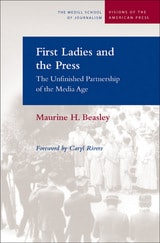
First Ladies and the Press
The Unfinished Partnership of the Media AgeMaurine H. Beasley
Northwestern University Press, 2005
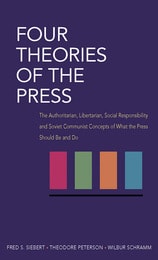
Four Theories of the Press
The Authoritarian, Libertarian, Social Responsibility, and Soviet Communist Concepts of What the Press Should Be and DoFredrick S. Siebert, Theodore Peterson, and Wilbur Schramm
University of Illinois Press, 1956
Presented here are four major theories behind the functioning of the world's presses: (1) the Authoritarian theory, which developed in the late Renaissance and was based on the idea that truth is the product of a few wise men; (2) the Libertarian theory, which arose from the works of men like Milton, Locke, Mill, and Jefferson and avowed that the search for truth is one of man's natural rights; (3) the Social Responsibility theory of the modern day: equal radio and television time for political candidates, the obligations of the newspaper in a one-paper town, etc.; (4) the Soviet Communist theory, an expanded and more positive version of the old Authoritarian theory.
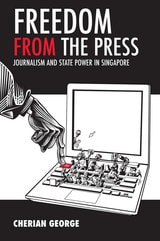
Freedom from the Press
Journalism and State Power in SingaporeCherian George
National University of Singapore Press, 2011
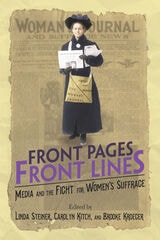
Front Pages, Front Lines
Media and the Fight for Women's SuffrageEdited by Linda Steiner, Carolyn Kitch, and Brooke Kroeger
University of Illinois Press, 2020
This collection offers new research on media issues related to the women's suffrage movement. Contributors incorporate media theory, historiography, and innovative approaches to social movements while discussing the vexed relationship between the media and debates over suffrage. Aiming to correct past oversights, the essays explore overlooked topics such as coverage by African American and Mormon-oriented media, media portrayals of black women in the movement, suffragist rhetorical strategies, elites within the movement, suffrage as part of broader campaigns for social transformation, and the influence views of white masculinity had on press coverage.
Contributors: Maurine H. Beasley, Sherilyn Cox Bennion, Jinx C. Broussard, Teri Finneman, Kathy Roberts Forde, Linda M. Grasso, Carolyn Kitch, Brooke Kroeger, Linda J. Lumsden, Jane Marcellus, Jane Rhodes, Linda Steiner, and Robin Sundaramoorthy