Results by title
8 books match the query 'Walk'
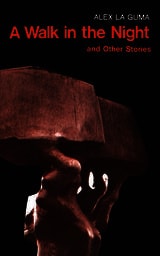
A Walk in the Night and Other Stories
Alex La Guma
Northwestern University Press, 1967
In the title story, in a Cape Town shantytown called District Six in the 1960s, Michael Adonis has lost his job at a metal sheet factory after an argument with a white supervisor. Illuminating the toxic effects of poverty, police brutality, and violence, the book paints a stark and unforgettable portrait of Adonis's emotional and physical destruction in apartheid South Africa. These works reveal the plight of non-whites in apartheid South Africa, laying bare the lives of the poor and the outcasts who filled the ghettoes and shantytowns.
Of French and Malagasy stock, involved in South African politics from an early age, Alex La Guma was arrested for treason with 155 others in 1956 and finally acquitted in 1960. During the State of Emergency following the Sharpeville massacre he was detained for five months. Continuing to write, he endured house arrest and solitary confinement. La Guma left South Africa as a refugee in 1966 and lived in exile in London and Havana. He died in 1986. A Walk in the Night and Other Stories reveals La Guma as one of the most important African writers of his time.
[more]
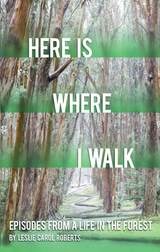
Here is Where I Walk
Episodes From a Life in the ForestLeslie Carol Roberts
University of Nevada Press, 2019
It is in the Presidio of San Francisco, California, that Leslie Carol Roberts walks. The Presidio, America’s only residential national park tucked wholly into an urban setting, is a fading historic forest. Here is where Leslie’s memories of other places, people, and travels emerge. Here is where the author’s home has been for more than a decade, and here is the place she raised her two children as a single mother.
In layered stories of her life and travels, Leslie turns her daily walks into revelations of deeper meaning. From Maryland to Iowa to Tasmania, we follow a fierce and keenly observant walker through places of exquisite beauty and complexity. Her daily walks inspire Leslie to accept the invitation of the beckoning trees where she finds herself colliding with the urban coyote, the peculiar banana slug, and the manzanita. She also notes both ridiculous and poignant aspects of human ecosystems in pursuit of what it means to live a life of creativity and creation from scientist-activists battling to save environments to the tragic realities of ordinary life.
In this finely crafted eco-memoir, each place provides Leslie with exactly the scaffolding needed to survive, with nature serving as the tonic. Here is Where I Walk provides a vivid answer to how we can find our place, not only in nature but within ourselves and the world we walk.
[more]
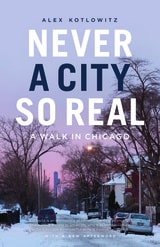
Never a City So Real
A Walk in ChicagoAlex Kotlowitz
University of Chicago Press, 2019
“Chicago is a tale of two cities,” headlines declare. This narrative has been gaining steam alongside reports of growing economic divisions and diverging outlooks on the future of the city. Yet to keen observers of the Second City, this is nothing new. Those who truly know Chicago know that for decades—even centuries—the city has been defined by duality, possibly since the Great Fire scorched a visible line between the rubble and the saved. For writers like Alex Kotlowitz, the contradictions are what make Chicago. And it is these contradictions that form the heart of Never a City So Real.
The book is a tour of the people of Chicago, those who have been Kotlowitz’s guide into this city’s – and by inference, this country’s – heart. Chicago, after all, is America’s city. Kotlowitz introduces us to the owner of a West Side soul food restaurant who believes in second chances, a steelworker turned history teacher, the “Diego Rivera of the projects,” and the lawyers and defendants who populate Chicago’s Criminal Courts Building. These empathic, intimate stories chronicle the city’s soul, its lifeblood.
This new edition features a new afterword from the author, which examines the state of the city today as seen from the double-paned windows of a pawnshop. Ultimately, Never a City So Real is a love letter to Chicago, a place that Kotlowitz describes as “a place that can tie me up in knots but a place that has been my muse, my friend, my joy.”
[more]
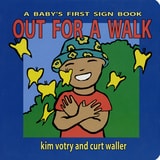
Out for a Walk
Kim Votry
Gallaudet University Press, 2003
From the team that created the Baby’s First Signs books come two new board books. A Book of Colors depicts the charming character with the favorite hat signing all of the primary and secondary colors—red, yellow, blue, orange, green, and purple—in interesting settings. The other pages display a wide variety of appealing colors, too, including pink, white, black, gray, brown, and tan, topped off with a richly rendered illustration of a rainbow.
Out for a Walk offers toddlers their first look at signs for the world around them. As they follow our distinctively hatted youngster on a stroll, they encounter familiar animals and insects, among them a dog, cat, butterfly, and squirrel, and learn which ones can be pets. They’ll enjoy imaginative images of the senses, too—sight, smell, hearing, taste, and touch. Printed on robust cardboard stock, these delightful full-color books will engage toddlers in new topics as they discover more basic signs, proven to accelerate their grasp of language.
Out for a Walk offers toddlers their first look at signs for the world around them. As they follow our distinctively hatted youngster on a stroll, they encounter familiar animals and insects, among them a dog, cat, butterfly, and squirrel, and learn which ones can be pets. They’ll enjoy imaginative images of the senses, too—sight, smell, hearing, taste, and touch. Printed on robust cardboard stock, these delightful full-color books will engage toddlers in new topics as they discover more basic signs, proven to accelerate their grasp of language.
[more]
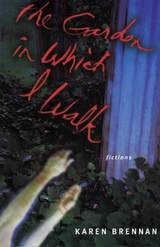
The Garden in Which I Walk
Karen Brennan
University of Alabama Press, 2004
This extraordinarily polished and sophisticated story collection investigates the unaccountable ways in which literature and life entwine. In "Three Seaside Tales" a woman at a resort imagines herself in a Chekhov story only to succumb to banal everydayness, and in "Island Time" a young bride inexorably merges with Emma Bovary. Brennan's fictions position their readers at the edge of the known world, opening onto vistas of both erotic promise and ghastly beauty. The voices, youthful and aging, maniacal and restrained, represent our world's lost, scattering their words among surrealistic ruins, as though they have come to inhabit their own dreams. The lovely protagonist of "Saw" inexplicably maims herself with a chainsaw, literalizing in this violent impulse the self-destructive passion of all of Brennan's characters to actualize romance. These characters lead the reader through a charged, personal landscape of apocalyptic and post-apocalyptic complexity. Their voices will continue to echo long after the book has been closed.
[more]
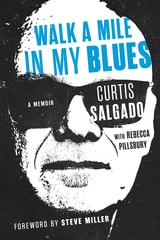
Walk a Mile in My Blues
A MemoirCurtis Salgado with Rebecca Pillsbury; Foreword by Steve Miller
University of Illinois Press, 2027
Curtis Salgado’s achievements as a rhythm and blues vocalist, harmonica player, and songwriter have won accolades from across the music world and helped inspire a cult classic. His powerhouse live shows and championing of the blues long ago made him an essential figure in Oregon’s unsung but vibrant music scene.
In this memoir, Salgado shares stories of his career against the backdrop of encounters with music legends, the Oregon scene’s cultural heyday, and his journey to overcome addiction and life-threatening health challenges. His poignant and at times humorous stories of touring and playing with artists like Robert Cray, Muddy Waters, Cab Calloway, and Stevie Ray Vaughan fuse with an invitation to embrace the blues and soul music that shaped his life and help define America.
Walk a Mile in My Blues shares the hidden and heartfelt story of a musical legend, living and loving the blues.
[more]

Walk in the Good Way
Classical Natural Law and Civic FriendshipMichael Pakaluk
Catholic University of America Press, 2027
What holds a free society together? Not law alone, and not self-interest — but something older and deeper that the classical tradition called civic friendship: the bonds of genuine goodwill and common purpose that bind citizens to one another and make a republic possible. This book recovers that idea, and argues that without it, neither natural law theory nor political life can be adequately understood.
Michael Pakaluk brings together more than two decades of scholarship on Aristotle, Aquinas, and the American Founding to show that the classical conception of natural law is fundamentally different in kind from the modern theories that have displaced it. Where contemporary natural law and liberal political theory — in their best-known versions — begin from abstract principles of practical reason, the classical tradition begins from human nature itself: from our constitution as social beings, equipped by nature and Providence to live together, and oriented toward civic friendship as the proper realization of that nature.
The argument moves across three great traditions. In Aristotle, civic friendship is the telos of political life — not an ornament added to justice, but its consummation, the common good understood as a shared form of life. In Aquinas, natural law is the rational creature's participation in divine providence, its precepts providing not a checklist of obligations but starting-points for the cultivation of virtue and the perfection of character. In the American Founders — above all in John Adams, whose Aristotelian convictions Pakaluk examines with care — the ideals of natural sociability were neither decorative nor derivative, but the animating principles of the republican experiment itself.
The result is a vision at once ancient and urgently contemporary. At a moment of deepening civic fracture, Walk in the Good Way makes the case that the path to a stable and vigorous free society runs through the recovery of something we have nearly forgotten: that we are, by nature, made for life together — and that nature itself shows us how
[more]
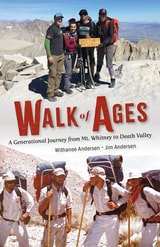
Walk of Ages
A Generational Journey from Mt. Whitney to Death ValleyWithanee Andersen
University of Nevada Press, 2024
Following in her father’s footsteps, Withanee Andersen begins the expedition of a lifetime when she and her comrades embark on a trek from Mt. Whitney to Death Valley, tracing the rugged path her father, Jim Andersen, traversed forty-three years earlier.
With hopes of being listed in the Guinness Book of World Records, Jim led the first documented walk from the highest to lowest point in the contiguous United States in 1974. He lived, albeit just barely, to tell the tale to his daughter, sparking a desire in Withanee to retrace his steps in his honor. In 2017, she took on the incredible task of recreating Jim’s legacy trek of 131 miles with the help of divine intervention, ice-cold beer, and her parents, who were following along as the support party.
Walk of Ages humorously relates the parallel journey of an epic adventure told from two perspectives—a daughter’s difficult quest, and a father who supports her through it while recalling his own experiences from four decades earlier. Throughout this momentous odyssey, readers will realize how a once-in-a-generation adventure leads to life-changing transformation, and that the bond between father and daughter knows no bounds.
[more]