Results by title
176 books match the query 'Prevention' and 6 start with f
Fevered Measures
Public Health and Race at the Texas-Mexico Border, 1848–1942John Mckiernan-González
Duke University Press, 2012
For the Prevention of Cruelty
The History and Legacy of Animal Rights Activism in the United StatesDiane L. Beers
Ohio University Press, 2006
Foreign Intervention in Africa after the Cold War
Sovereignty, Responsibility, and the War on TerrorElizabeth Schmidt
Ohio University Press, 2018
In Foreign Intervention in Africa after the Cold War—interdisciplinary in approach and intended for nonspecialists—Elizabeth Schmidt provides a new framework for thinking about foreign political and military intervention in Africa, its purposes, and its consequences. She focuses on the quarter century following the Cold War (1991–2017), when neighboring states and subregional, regional, and global organizations and networks joined extracontinental powers in support of diverse forces in the war-making and peace-building processes. During this period, two rationales were used to justify intervention: a response to instability, with the corollary of responsibility to protect, and the war on terror.
Often overlooked in discussions of poverty and violence in Africa is the fact that many of the challenges facing the continent today are rooted in colonial political and economic practices, in Cold War alliances, and in attempts by outsiders to influence African political and economic systems during the decolonization and postindependence periods. Although conflicts in Africa emerged from local issues, external political and military interventions altered their dynamics and rendered them more lethal. Foreign Intervention in Africa after the Cold War counters oversimplification and distortions and offers a new continentwide perspective, illuminated by trenchant case studies.
From Chinese Exclusion to Guantánamo Bay
Plenary Power and the Prerogative StateNatsu Taylor Saito
University Press of Colorado, 2007
From Chinese Exclusion to Guantánamo Bay also provides a larger context for understanding problems resulting from the exercise of plenary power. Saito explains how the rights of individuals and groups deemed Other by virtue of race or national origin have been violated under both the Constitution and international law. The differing treatment of José Padilla and John Walker Lindh - both Americans accused of terrorism - provides an example of such disparate approaches. Such executive actions and their sanction by Congress and the judiciary, Saito argues, undermine not just individual rights but the very foundations of our national security - democracy and the rule of law.
From Chinese Exclusion to Guantánamo Bay will interest readers concerned with the historical background of constitutional protection in times of war and peace and will provide fascinating new material for scholars, teachers, and students of law, history, and ethnic studies

From Pink to Green
Disease Prevention and the Environmental Breast Cancer MovementLey, Barbara L
Rutgers University Press, 2009
Challenging the broader cultural milieu of pink ribbon symbolism and breast cancer "awareness" campaigns, this movement has grown from a handful of community-based organizations into a national entity, shaping the cultural, political, and public health landscape. Much of the activists' everyday work revolves around describing how the so called "cancer industry" downplays possible environmental links to protect their political and economic interests and they demand that the public play a role in scientific, policy, and public health decision-making to build a new framework of breast cancer prevention.
From Pink to Green successfully explores the intersection between breast cancer activism and the environmental health sciences, incorporating public and scientific debates as well as policy implications to public health and environmental agendas.
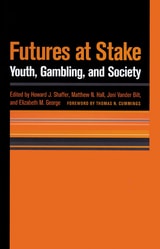
Futures At Stake
Youth, Gambling, And SocietyHoward J. Shaffer
University of Nevada Press, 2003
The widespread legalization of gambling across the U.S. has produced concerns for serious social, economic, and health problems. For the first time in this country, an entire generation of young people has reached adulthood within a context of approval and endorsement of gambling as a source of entertainment and recreation. Compared with their adult counterparts, these young people have evidenced a higher level of gambling related problems. In Futures at Stake, specialists in psychology, medicine, law, public health, economics, casino management, psychiatry, and criminal justice examine this problem from the perspective of their various disciplines, producing an intelligent, thought-provoking, and valuable survey of what is fast becoming a leading social-health problem across the nation. Foreword by Thomas N. Cummings.