101 books match the query 'Publishers & Publishing Industry' and 2 start with f

cover of Feminist Book Work: Reading with the Women's Press

Feminist Book Work

Reading with the Women's Press

Rosy Mack

Duke University Press, 2027

From the 1970s to the 1990s, a new wave of women’s writing emerged, spanning from serious feminist theoretical interventions to lesbian detective fiction. In Feminist Book Work, Rosy Mack traces how the British publisher the Women’s Press, in tandem with the booksellers and other presses that comprised the interdependent infrastructure of feminist print culture, made this proliferation of feminist publishing possible. Mack uncovers the everyday work of feminist publishing through five case studies informed by the press’s archives along with oral history interviews with former workers. She centers the care and labor that went into facilitating innovative, politically responsive, and delightfully strange women’s writing, paying close attention to the many workers and forms of work that help bring books into the world, as well as highlighting feminist publishing’s most influential contributions to leftist publications and women’s literature. In theorizing feminist textual work as a practice of care, Mack sheds light on the often-hidden labor of facilitating cultural production and makes the case for the necessity of independent and innovative publishing in the face of political crisis.
[more]
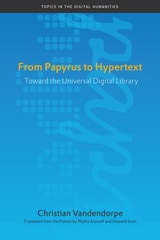
cover of From Papyrus to Hypertext: Toward the Universal Digital Library

From Papyrus to Hypertext

Toward the Universal Digital Library

Christian Vandendorpe. Translated by Phyllis Aronoff & Howard Scott.

University of Illinois Press, 2008

In this study, Christian Vandendorpe examines how digital media and the Internet have changed the process of reading and writing, significantly altering our approaches toward research and reading, our assumptions about audience and response, and our theories of memory, legibility, and context. Reflecting on the full history of the written word, Vandendorpe provides a clear overview of how materiality makes a difference in the creation and interpretation of texts.

Surveying the conventions of reading and writing that have appeared and disappeared in the Internet's wake, Vandendorpe considers various forms of organization, textual design, the use (and distrust) of illustrations, and styles of reference and annotation. He also examines the novel components of digital texts, including hyperlinks and emoticons, and looks at emergent, collaborative genres such as blogs and wikis, which blur the distinction between author and reader. Looking to the future, reading and writing will continue to evolve based on the current, contested trends of universal digitization and accessibility.

[more]