Results by title
145 books match the query 'Refugees' and 6 start with f
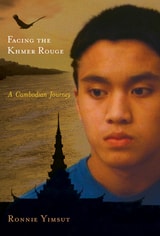
Facing the Khmer Rouge
A Cambodian JourneyRonnie Yimsut
Rutgers University Press, 2011
As a child growing up in Cambodia, Ronnie Yimsut played among the ruins of the Angkor Wat temples, surrounded by a close-knit community. As the Khmer Rouge gained power and began its genocidal reign of terror, his life became a nightmare. In this stunning memoir, Yimsut describes how, in the wake of death and destruction, he decides to live.
Escaping the turmoil of Cambodia, he makes a perilous journey through the jungle into Thailand, only to be sent to a notorious Thai prison. Fortunately, he is able to reach a refugee camp and ultimately migrate to the United States, where he attended the University of Oregon and became an influential leader in the community of Cambodian immigrants. Facing the Khmer Rouge shows Ronnie Yimsut’s personal quest to rehabilitate himself, make a new life in America, and then return to Cambodia to help rebuild the land of his birth.
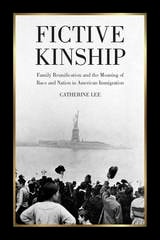
Fictive Kinship
Family Reunification and the Meaning of Race and Nation in American ImmigrationCatherine Lee
Russell Sage Foundation, 2013
Fighting Over There
U.S. War Making and Contemporary Refugee LiteratureAlaina Kaus
University of Massachusetts Press, 2023
U.S. foreign policy has long been built on a dichotomy of an irreplaceable “here” and an expendable “there.” In his 2003 announcement of the military campaign in Iraq, George W. Bush declared that we would fight in the Middle East so we wouldn’t have to fight “on the streets of our cities.” But what do the millions of people who live over “there” have to say about U.S. interventions and the displacement they provoke?
In this pathbreaking study, Alaina Kaus analyzes literature by and about refugees who fled Southeast Asia, Central America, the Caribbean, North Africa, and the Middle East, in the wake of U.S. military occupation and economic intervention. Narratives by authors such as Lan Cao, Viet Thanh Nguyen, Demetria Martínez, Héctor Tobar, Dave Eggers, Mohsin Hamid, and Riverbend reveal contradictions in the human rights pledges that undergird U.S. foreign policy, which promote freedom while authorizing intervention and displacement, and favor market-based solutions over social justice and racial equality.
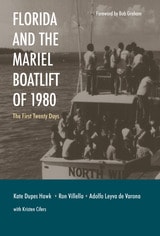
Florida and the Mariel Boatlift of 1980
The First Twenty DaysKate Dupes Hawk, Ron Villella, and Adolfo Leyva de Varona, with Kristen Cifers
University of Alabama Press, 2014
WINNER OF THE FLORIDA HISTORICAL SOCIETY'S STETSON KENNEDY AWARD
The definitive account of the first twenty days that transformed Florida, Cuba, and the American immigration debate.
The 1980 Mariel Boatlift was a profound episode in twentieth-century American history, impacting not just Florida, but the entire country. During the first twenty days of the boatlift, with little support from the federal government, the state of Florida coordinated and responded to the sudden arrival in Key West of more than thirty thousand Cuban refugees, the first wave of immigrants who became known as “Marielitos.”
Kathleen Dupes Hawk, Ron Villella, Adolfo Leyva de Varona, and Kristen Cifers combine the insights of expert observers with the experiences of actual participants. The authors organize and present a wealth of primary sources, first-hand accounts, archival research, government records, and interviews with policy-makers, volunteers, and refugees that bring into focus the many far-reaching human, political, and cultural outcomes of the Mariel Boatlift that continue to influence Florida, the United States, and Cuba today.
Emerging from these key records and accounts is a grand narrative of high human drama. Castro’s haphazard and temporary opening of Cuba spurred many thousands of Cubans to depart in calamitously rushed, unprepared, and dangerous conditions. The book tells the stories of these Cuban citizens, most legitimately seeking political asylum but also including subversive agents, convicted criminals, and the mentally ill, who began arriving in the US beginning in April 1980. It also recounts how local and state agencies and private volunteers with few directives or resources were left to improvise ways to provide the Marielitos food, shelter, and security as well as transportation away from Key West.
The book provides a definitive account of the political, legal, and administrative twists on the local, state, and federal levels in response to the crisis as well as of the often-dysfunctional attempts at collaboration between governmental and private institutions. Vivid and readable, Florida and the Mariel Boatlift of 1980 presents the significant details that illuminate and humanize this complex humanitarian, political, and logistical crisis.

Forever 17
Coming of Age in the German Asylum SystemUlrike Bialas
University of Chicago Press, 2023
Heartbreaking images of children in distress have propelled some of the most urgent calls for action on immigration crises, and that compassion often affects how state asylum policies are structured. In Germany, for example, the immigration system is engineered to protect minors, which leads to unintended consequences for migrants.
In Forever 17, Ulrike Bialas follows young African and Central Asian migrants in Germany as they navigate that system. Without official paperwork or even, in many cases, knowledge of their exact age, migrants must decide how to present their complicated life stories to government officials. They quickly realize that their age can have an outsized effect on the outcome of their cases. A migrant under 18, for example, can’t be deported, but might instead be placed in a youth home, where they will be subject to strict curfew laws. An 18-year-old adult, on the other hand, can get permission to work, but not opportunities to go to school.
Regardless of their age—actual or assumed—migrants face great difficulties. Those classified as minors must live with the psychological burden of being treated like children, while those classified as adults must live without the practical support and legal protections reserved for minors. The significance of age stands in stark contrast to the ambiguities inherent in its determination. Though Germany’s infamous bureaucracy is designed to issue clear statements about refugees and migrants, the truth is often more complicated, and officials are forced to grapple with the difficult implications of their decisions. Ultimately, Bialas shows, policies surrounding asylum seekers fall dramatically short of their humanitarian ideals. Even those policies designed to help the most vulnerable can lead to outcomes that drastically limit the possibilities for migrants in real need of protection and keep them from leading fulfilling lives.
From Migrants to Refugees
The Politics of Aid along the Tanzania-Rwanda BorderJill Rosenthal
Duke University Press, 2023