Results by title
89 books match the query 'Religion & Science' and 6 start with f
Faith In The Future
Healthcare, Aging and the Role of ReligionHarold Koenig
Templeton Press, 2012
After an interview in Newsweek about his book Spirituality in Patient Care and his research in religion and health, Dr. Harold Koenig became the international voice on spirituality, health, and aging. In this book, Faith in the Future, he is joined by two other experts on aging and human development. They present a compelling look at one of the most severe issues in today’s society: health care in America.
How will we provide quality healthcare to older adults needing it during the next thirty to fifty years? Who will provide this care? How will it be funded? How can we establish systems of care now to be in place as demographic and health-related economic pressures mount?
Alongside the sobering reality of our country’s challenges, there are reasons for optimism. Innovative programs created and maintained by volunteers and religious congregations are emerging as pivotal factors in meeting healthcare needs. Summarizing decades of scientific research and providing numerous inspirational examples and role models, the authors present practical steps that individuals and institutions may emulate for putting faith into action.
<
Faith and the Pursuit of Health
Cardiometabolic Disorders in SamoaHardin, Jessica
Rutgers University Press, 2019

Fertility and Jewish Law
Feminist Perspectives on Orthodox Responsa LiteratureRonit Irshai
Brandeis University Press, 2012
Fictions of Certitude
Science, Faith, and the Search for Meaning, 1840–1920John S. Haller Jr.
University of Alabama Press, 2020
The search for belief and meaning among nineteenth-century intellectuals
The nineteenth century’s explosion of scientific theories and new technologies undermined many deep-seated beliefs that had long formed the basis of Western society, making it impossible for many to retain the unconditional faith of their forebears. A myriad of discoveries—including Faraday’s electromagnetic induction, Joule’s law of conservation of energy, Pasteur’s germ theory, Darwin’s and Wallace’s theories of evolution by natural selection, and Planck’s work on quantum theory—shattered conventional understandings of the world that had been dictated by traditional religious teachings and philosophical systems for centuries.
Fictions of Certitude: Science, Faith, and the Search for Meaning, 1840–1920 investigates the fin de siècle search for truth and meaning in a world that had been radically transformed. John S. Haller Jr. examines the moral and philosophical journeys of nine European and American intellectuals who sought deeper understanding amid such paradigmatic upheaval. Auguste Comte, John Henry Newman, Herbert Spencer, Alfred Russel Wallace, Thomas Henry Huxley, John Fiske, William James, Lester Frank Ward, and Paul Carus all belonged to an age in which one world was passing while another world that was both astounding and threatening was rising to take its place.
For Haller, what makes the work of these nine thinkers worthy of examination is how they strove in different ways to find certitude and belief in the face of an epochal sea change. Some found ways to reconceptualize a world in which God and nature coexist. For others, the challenge was to discern meaning in a world in which no higher power or purpose can be found. As explained by D. H. Meyer, “The later Victorians were perhaps the last generation among English-speaking intellectuals able to believe that man was capable of understanding his universe, just as they were the first generation collectively to suspect that he never would.”
Flash Effect
Science and the Rhetorical Origins of Cold War AmericaDavid J. Tietge
Ohio University Press, 2002
The ways science and technology are portrayed in advertising, in the news, in our politics, and in the culture at large inform the way we respond to these particular facts of life. The better we are at recognizing the rhetorical intentions of the purveyors of information and promoters of mass culture, the more adept we become at responding intelligently to them.
Flash Effect, a startling book by David J. Tietge, documents the manner in which those at the highest levels of our political and cultural institutions conflated the rhetoric of science and technology with the rhetorics of religion and patriotism to express their policies for governance at the onset of the Cold War and to explain them to the American public.
Professor Tietge details our cultural attitudes about science in the early years of the Cold War, when on the heels of a great technological victory Americans were faced with the possibility of destruction by the very weapons that had saved them.
In Flash Effect we learn how, by symbolizing the scientist as both a father figure and a savior—and by celebrating the technological objects of his labor—the campaign to promote science took hold in the American consciousness. The products of that attitude are with us today more than ever.
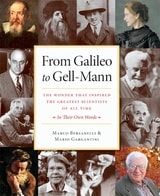
From Galileo to Gell-Mann
The Wonder that Inspired the Greatest Scientists of All Time: In Their Own WordsMarco Bersanelli
Templeton Press, 2009