Results by title
53 books match the query 'Research & Methodology' and 3 start with f
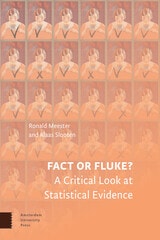
Fact or Fluke?
A Critical Look at Statistical EvidenceRonald Meester
Amsterdam University Press, 2022
Statistics is more topical than ever. Numerous decisions depend on statistical considerations: just think of the Corona crisis or decisions about approving new drugs or other products. If researchers announce they have proved some fact using statistical tests, can we then always be sure that their claim is correct? How, and more importantly why, does statistics work? What can we expect from statistics and what not? 'Fact or Fluke?' is not a textbook that explains statistical tests to the reader; instead, it discusses what comes before those tests: the philosophy behind the statistics. Should one carry out tests, or are there other ways to look at statistics?
Ronald Meester and Klaas Slooten use a variety of examples – from court cases to theoretical physics – to present different views on statistics and provide arguments for what they think is the best point of view. This book is meant for anyone who is in some way concerned with, or interested in, statistical evidence: scientific researchers, students, teachers, mathematicians, philosophers, lawyers, managers, and no doubt many others.
Ronald Meester and Klaas Slooten use a variety of examples – from court cases to theoretical physics – to present different views on statistics and provide arguments for what they think is the best point of view. This book is meant for anyone who is in some way concerned with, or interested in, statistical evidence: scientific researchers, students, teachers, mathematicians, philosophers, lawyers, managers, and no doubt many others.
[more]
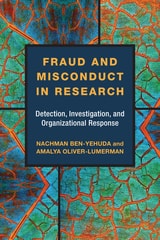
Fraud and Misconduct in Research
Detection, Investigation, and Organizational ResponseNachman Ben-Yehuda and Amalya Oliver-Lumerman
University of Michigan Press, 2017
In Fraud and Misconduct in Research, Nachman Ben-Yehuda and Amalya Oliver-Lumerman introduce the main characteristics of research misconduct, portray how the characteristics are distributed, and identify the elements of the organizational context and the practice of scientific research which enable or deter misconduct. Of the nearly 750 known cases between 1880 and 2010 which the authors examine, the overwhelming majority took place in funded research projects and involved falsification and fabrication, followed by misrepresentation and plagiarism. The incidents were often reported by the perpetrator’s colleagues or collaborators. If the accusations were confirmed, the organization usually punished the offender with temporary exclusion from academic activities and institutions launched organizational reforms, including new rules, the establishment of offices to deal with misconduct, and the creation of re-training and education programs for academic staff. Ben-Yehuda and Oliver-Lumerman suggest ways in which efforts to expose and prevent misconduct can further change the work of scientists, universities, and scientific research.
[more]
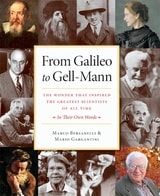
From Galileo to Gell-Mann
The Wonder that Inspired the Greatest Scientists of All Time: In Their Own WordsMarco Bersanelli
Templeton Press, 2009
From time to time, the diligent science student huddled over dense volumes of research findings and highly technical data will stumble upon a truly rare treasure: the author’s answer to the question of, “Why?” Why did the authors of these volumes commit themselves so ardently to life in the laboratory? What was it that motivated them to keep their eye to microscope for years on end? Why did the world’s greatest scientists devote their lives to research—an endeavor where failure is the exponentially more likely outcome than success?
In their new anthology, From Galileo to Gell-Mann, Marco Bersanelli and Mario Gargantini have gathered the answers to these fascinating questions from over one hundred of the brightest scientific minds from our past and our present. It is a goldmine of insight that previously could only to be found hidden deep within thousands of scattershot pages of footnotes from out-of-print journals, rare books, and unpublished papers. Throughout the work, Bersanelli and Gargantini also offer insightful commentary and discussion on the readings.
Among the most remarkable similarities that emerge when one considers together these writings from the likes of Albert Einstein, Gregor Mendel, Marie Curie, and others, is the sense of wonder and outright awe at what the study of the natural world can reveal. From Galileo to Gell-Mann makes it clear that science and all parallel attempts to understand our human existence—including fields like philosophy to theology—are viewed as nothing less than grand adventures to those that are probing the limits of what we know.
[more]