Results by title
386 books match the query 'Russia' and 13 start with f

FRAMING ANNA KARENINA
TOLSTOY, WOMEN QUESTION, & VICTORIAN NOVAMY MANDELKER
The Ohio State University Press, 1994
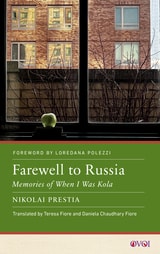
Farewell to Russia
Memories of When I Was KolaNikolai Prestia
Rutgers University Press, 2026
Growing up in 1990s Russia in a family marked by poverty, substance abuse, and neglect, Kola and his sister are eventually admitted into the orphanage system. Here, Kola comes face to face with a different but equally daunting challenge: navigating an unfamiliar and sometimes hostile world haunted by the absence of his mother. The ensuing journey, which eventually culminates in the adoption by an Italian family, alternates moments of both trauma and deliverance, while asking fundamental questions about our ability to reconcile ourselves with unfathomable loss.
Harrowing yet lyrical, Nikolai Prestia’s prize-winning 2021 novel is a testament to the duality of memory in its ability to both hurt and heal, and to the transformative power of those figures, adults and peers alike, who contribute to a child’s development. Translated into English as part of a collaboration between the author and a mother-daughter translator duo, the novel serves up a wrenching glimpse into the back stories that often precede the adoption of an older child.
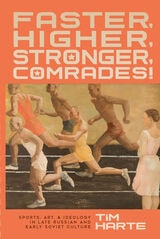
Faster, Higher, Stronger, Comrades!
Sports, Art, and Ideology in Late Russian and Early Soviet CultureTim Harte
University of Wisconsin Press, 2020
With interdisciplinary analysis of literature, painting, and film, Faster, Higher, Stronger, Comrades! traces how physical fitness had an even broader impact on culture and ideology in the Soviet Union than previously realized. From prerevolutionary writers and painters glorifying popular circus wrestlers to Soviet photographers capturing unprecedented athleticism as a means of satisfying their aesthetic ideals, the nation's artists embraced sports in profound, inventive ways. Though athletics were used for doctrinaire purposes, Tim Harte demonstrates that at their core, they remained playful, joyous physical activities capable of stirring imaginations and transforming everyday realities.
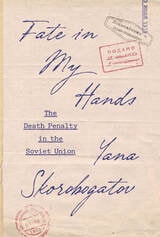
Fate in My Hands
The Death Penalty in the Soviet UnionYana Skorobogatov
University of Chicago Press, 2026
A striking examination of the death penalty in the Soviet Union that documents in heart-rending detail how its citizens, hopeful for a new life post-Stalin, lost faith that their transgressions could be forgiven.
From 1954 to 1991 in the Soviet Union, nearly forty thousand citizens were executed after the death penalty was reinstated as a punishment for homicide. Fate in My Hands introduces readers to the many citizens in this period—women and men of all ages and backgrounds—who found themselves on death row and tried to escape it in the only way available to them: asking for forgiveness.
Examining the letters and objects the dead left behind, Skorobogatov recovers their voices and allows them to speak anew. She offers a striking portrait of life in the Soviet Union and the citizens who dreamed of new possibilities even as they faced their tragic end. Using a corpus of never-before-accessed criminal court records, Fate in My Hands brings readers not just into the police interrogation rooms, courthouses, and cells where the condemned awaited their fates, but into the homes, workplaces, and psychiatric hospitals where families and friends alike came together to pursue an elusive, bitter justice in the wake of violent tragedy.
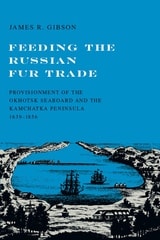
Feeding the Russian Fur Trade
Provisionment of the Okhotsk Seaboard and the Kamchatka Peninsula, 1639–1856James R. Gibson
University of Wisconsin Press, 1969
James R. Gibson offers a detailed study that is both an account of this chapter of Russian history and a full examination of the changing geography of the Okhotsk Seaboard and the Kamchatka Peninsula over the course of two centuries.
Finding the Middle Ground
Krestovskii, Tur, and the Power of Ambivalence in Nineteenth-Century Russian Women's ProseJehanne Gheith
Northwestern University Press, 2004
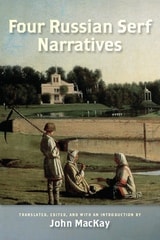
Four Russian Serf Narratives
Translated, edited, and with an introduction by John MacKay
University of Wisconsin Press, 2009
Four Russian Serf Narratives contains four of these accounts and is the first translated collection of autobiographies by serfs. Scholar and translator John MacKay brings to light for an English-language audience a diverse sampling of Russian serf narratives, ranging from an autobiographical poem to stories of adventure and escape. “Autobiography” (1785) recounts a highly educated serf’s attempt to escape to Europe, where he hoped to study architecture. The long testimonial poem “News About Russia” (ca. 1849) laments the conditions under which the author and his fellow serfs lived. In “The Story of My Life and Wanderings” (1881) a serf tradesman tells of his attempt to simultaneously escape serfdom and captivity from Chechen mountaineers. The fragmentary “Notes of a Serf Woman” (1911) testifies to the harshness of peasant life with extraordinary acuity and descriptive power.
These accounts offer readers a glimpse, from the point of view of the serfs themselves, into the realities of one of the largest systems of unfree labor in history. The volume also allows comparison with slave narratives produced in the United States and elsewhere, adding an important dimension to knowledge of the institution of slavery and the experience of enslavement in modern times.
Framing the Holocaust
Edited by Valerie Hébert
University of Wisconsin Press, 2023
While photographs are central to our memory of modern historical events, they often inhabit an ambivalent intellectual space. What separates the sincere desire to understand from voyeuristic curiosity? Comprehending atrocity photographs requires viewers to place themselves in the very positions of the perpetrators who took the images. When we engage with these photographs, do we risk replicating the original violence? In this tightly organized book, scholars of history, photography, language, gender, photojournalism, and pedagogy examine the images of the Šķēde atrocity along with other difficult images, giving historical, political, and ethical depth to the acts of looking and interpreting.
With a foreword by Edward Anders, who narrowly escaped the December 1941 shooting, Framing the Holocaust represents an original approach to an iconic series of Holocaust photographs. This book will contribute to compelling debates in the emerging field of visual history, including the challenges and responsibilities of using photographs to teach about atrocity.
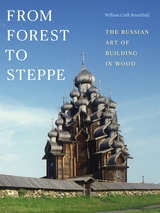
From Forest to Steppe
The Russian Art of Building in WoodWilliam Craft Brumfield
Duke University Press, 2025
In From Forest to Steppe, renowned scholar and photographer William Craft Brumfield offers a panoramic survey of Russia’s centuries-long heritage of wooden architecture. Lavishly illustrated with more than 400 color photographs, the volume links log-built barns, windmills, houses, and churches in the Far North; Buddhist shrines in the Transbaikal region; and eighteenth-century palaces on the outskirts of Moscow. Brumfield also takes readers to the estate houses of many Russian literary giants, from Chekhov and Tolstoy to Dostoevsky and Pushkin. Spanning thousands of photographed sites, five decades of field work, and seven time zones, Brumfield’s photographs offer compelling evidence of the adaptability of log construction and its ability to transcend class, cultural, and aesthetic boundaries.
In the decades since Brumfield began photographing Russian architecture, many of the buildings he has documented have been demolished or abandoned and left to rot at alarming rates. Brumfield observes a contradiction in contemporary Russia: It acknowledges the cultural importance of wooden buildings yet struggles to find and dedicate the resources and solutions needed to save them. A hymn and elegy to the long Russian practice of building with wood, From Forest to Steppe is an unparalleled look into one of the world’s most singular architectural traditions.
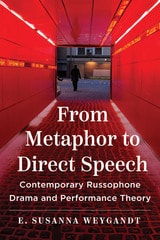
From Metaphor to Direct Speech
Contemporary Russophone Drama and Performance TheoryE. Susanna Weygandt
University of Wisconsin Press, 2025
As a result, the Russophone New Dramatists speak dissent and dramatize resistance. Ultimately, they shift theatrical productions from something constrained and limited, in both place and time, to an ephemeral but unbounded gateway for social activism. The sonic stage thus effectively functions as a social forum, transposing action from the actors to the audience. From Metaphor to Direct Speech therefore contributes to cultural as well as performance studies, offering a compelling look not just at developments in theatrical modes but also at dissent and cultural aesthetics in Russia today.
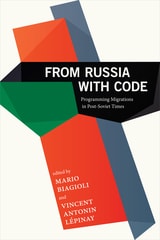
From Russia with Code
Programming Migrations in Post-Soviet TimesMario Biagioli and Vincent Antonin Lepinay, editors
Duke University Press, 2019
Contributors. Irina Antoschyuk, Mario Biagioli, Ksenia Ermoshina, Marina Fedorova, Andrey Indukaev, Alina Kontareva, Diana Kurkovsky, Vincent Lépinay, Alexandra Masalskaya, Daria Savchenko, Liubava Shatokhina, Alexandra Simonova, Ksenia Tatarchenko, Zinaida Vasilyeva, Dimitrii Zhikharevich
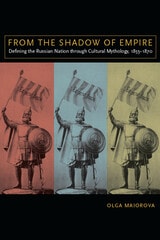
From the Shadow of Empire
Defining the Russian Nation through Cultural Mythology, 1855–1870Olga Maiorova
University of Wisconsin Press, 2010
From the Shadow of Empire traces how these nationalist writers refashioned key historical myths—the legend of the nation’s spiritual birth, the tale of the founding of Russia, stories of Cossack independence—to portray the Russian people as the ruling nationality, whose character would define the empire. In an effort to press the government to alter its traditional imperial policies, writers from across the political spectrum made the cult of military victories into the dominant form of national myth-making: in the absence of popular political participation, wars allowed for the people’s involvement in public affairs and conjured an image of unity between ruler and nation. With their increasing reliance on the war metaphor, Reform-era thinkers prepared the ground for the brutal Russification policies of the late nineteenth century and contributed to the aggressive character of twentieth-century Russian nationalism.
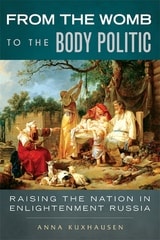
From the Womb to the Body Politic
Raising the Nation in Enlightenment RussiaAnna Kuxhausen
University of Wisconsin Press, 2012
Making innovative use of obstetrical manuals, belles lettres, children’s primers, and other primary documents from the era, Anna Kuxhausen draws together many discourses—medical, pedagogical, and political—to show the scope and audacity of new notions about childrearing. Reformers aimed to teach women to care for the bodies of pregnant mothers, infants, and children according to medical standards of the Enlightenment. Kuxhausen reveals both their optimism and their sometimes fatal blind spots in matters of implementation. In examining the implication of women in public, even political, roles as agents of state-building and the civilizing process, From the Womb to the Body Politic offers a nuanced, expanded view of the Enlightenment in Russia and the ways in which Russians imagined their nation while constructing notions of childhood.