Results by title
63 books match the query 'Scientists' and 6 start with f
Finding Mars
Ned Rozell
University of Alaska Press, 2011
Forgotten Tribe
Scientists as WritersLisa Emerson
University Press of Colorado, 2017
In The Forgotten Tribe: Scientists as Writers, Lisa Emerson offers an important corrective to the view that scientists are "poor writers, unnecessarily opaque, not interested in writing, and in need of remediation." She argues that scientists are among "the most sophisticated and flexible writers in the academy, often writing for a wider range of audiences (their immediate disciplinary peers, peers in adjacent fields, a broad scientific audience, industry, and a range of public audiences including social media) than most other faculty." Moreover, she notes, the often collaborative and multidisciplinary nature of their work results in writing practices that "may be more socially complex, and require more articulation, mediation, and interpersonal communication, and more use of advanced media and technology than those of faculty in other disciplines."
Drawing on extensive interviews with scientists, Emerson argues that writing scholars have "engaged in a form of cultural appropriation" that has worked against a deeper understanding of the contexts in which scientists work and the considerations they bring to their writing. Emerson grounds her analysis in the voices of scientists in a way that allows us to understand not only how they approach writing but also how we might usefully teach writing in the sciences. The Forgotten Tribe offers a valuable contribution to our understanding of scientific writing, allowing us to hear voices that are seldom included in our discussions of this critical area.
Formal Methods and Empirical Practices
Conversations with Patrick SuppesRoberta Ferrario and Viola Schiaffonati
CSLI, 2012
Frankenstein, or the Modern Prometheus
The 1818 TextMary Wollstonecraft Shelley
University of Chicago Press, 1982
When Mary Shelley published Frankenstein in 1818, she created a legend that, like the monster of her story, grew far beyond anything she could ever have dreamed of, or that anyone could ever control. With one book, she founded the field of science fiction, pushed the gothic into new territory, and gave us an unforgettable character capable of being monster, man, and metaphor, a symbol simultaneously of the potential and perils of science--even of humanity itself.
The novel was originally published in three volumes in March 1818. In 1831, a different publisher issued a single-volume edition that had been heavily rewritten by an older Mary Shelley. That edition served as the standard Frankenstein for well over a century. In recent decades, however, growing awareness of the role of Shelley's husband, Percy Bysshe Shelley, in the revision process, and corresponding interest in giving readers access to the original text from Mary Shelley's hand, has led to increasing attention to the original 1818 edition.
This edition reproduces the text of the 1818 edition with the addition, clearly indicated within the book, of minor changes that Mary Shelley made by hand in 1823. It also preserves the original three-volume structure within this single book, helping readers better understand the symmetries within the story as Shelley constructed it. Explanatory notes, meanwhile, explain references and provide historical and cultural context.
The result is a new look at a lasting classic, one that has as much to say to readers today as it did when first published more than two centuries ago.
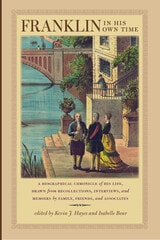
Franklin in His Own Time
A Biographical Chronicle of His Life, Drawn from Recollections, Interviews, and Memoirs by Family, Friends, and AssociatesKevin J. Hayes
University of Iowa Press, 2011
@font-face { font-family: "Courier New";}@font-face { font-family: "Times";}@font-face { font-family: "Cambria";}@font-face { font-family: "Palatino";}p.MsoNormal, li.MsoNormal, div.MsoNormal { margin: 0in 0in 0.0001pt; font-size: 12pt; font-family: "Times New Roman"; }div.Section1 { page: Section1; }
In his time Benjamin Franklin (1706–1790) was the most famous American in the world. Even those personally unacquainted with the man knew him as the author of Poor Richard’s Almanack, as a pioneer in the study of electricity and a major figure in the American Enlightenment, as the creator of such life-changing innovations as the lightning rod and America’s first circulating library, and as a leader of the American Revolution. His friends also knew him as a brilliant conversationalist, a great wit, an intellectual filled with curiosity, and most of all a master anecdotist whose vast store of knowledge complemented his conversational skills. In Franklin in His Own Time, by reprinting the original documents in which those anecdotes occur, Kevin Hayes and Isabelle Bour restore those oft-told stories to their cultural contexts to create a comprehensive narrative of his life and work.
The thirty-five recollections gathered in Franklin in His Own Time form an animated, collaborative biography designed to provide a multitude of perspectives on the “First American.” Opening with an account by botanist Peter Kalm showing that Franklin was doing all he could to encourage the development of science in North America, it includes on-the-spot impressions from Daniel Fisher’s diary, the earliest surviving interview with Franklin, recollections from James Madison and Abigail Adams, Manasseh Cutler’s detailed description of the library at Franklin Court, and extracts from Alexander Hamilton’s unvarnished Minutes of the Tuesday Club. Franklin’s political missions to Great Britain and France, where he took full advantage of rich social and intellectual opportunities, are a source of many reminiscences, some published here in new translations. Genuine memories from such old friends as Thomas Jefferson and John Adams, as opposed to memories influenced by the Autobiography, clarify Franklin’s reputation. Robert Carr may have been the last remaining person who knew Franklin personally, and thus his recollections are particularly signific
From Galileo to Gell-Mann
The Wonder that Inspired the Greatest Scientists of All Time: In Their Own WordsMarco Bersanelli
Templeton Press, 2009