94 books match the query 'Services for' and 4 start with f
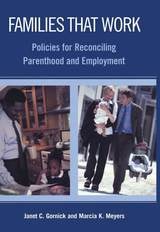
cover of Families That Work: Policies for Reconciling Parenthood and Employment

Families That Work

Policies for Reconciling Parenthood and Employment

Janet C. Gornick

Russell Sage Foundation, 2003

Parents around the world grapple with the common challenge of balancing work and child care. Despite common problems, the industrialized nations have developed dramatically different social and labor market policies—policies that vary widely in the level of support they provide for parents and the extent to which they encourage an equal division of labor between parents as they balance work and care. In Families That Work, Janet Gornick and Marcia Meyers take a close look at the work-family policies in the United States and abroad and call for a new and expanded role for the U.S. government in order to bring this country up to the standards taken for granted in many other Western nations. In many countries in Europe and in Canada, family leave policies grant parents paid time off to care for their young children, and labor market regulations go a long way toward ensuring that work does not overwhelm family obligations. In addition, early childhood education and care programs guarantee access to high-quality care for their children. In most of these countries, policies encourage gender equality by strengthening mothers' ties to employment and encouraging fathers to spend more time caregiving at home. In sharp contrast, Gornick and Meyers show how in the United States—an economy with high labor force participation among both fathers and mothers—parents are left to craft private solutions to the society-wide dilemma of "who will care for the children?" Parents—overwhelmingly mothers—must loosen their ties to the workplace to care for their children; workers are forced to negotiate with their employers, often unsuccessfully, for family leave and reduced work schedules; and parents must purchase care of dubious quality, at high prices, from consumer markets. By leaving child care solutions up to hard-pressed working parents, these private solutions exact a high price in terms of gender inequality in the workplace and at home, family stress and economic insecurity, and—not least—child well-being. Gornick and Meyers show that it is possible–based on the experiences of other countries—to enhance child well-being and to increase gender equality by promoting more extensive and egalitarian family leave, work-time, and child care policies. Families That Work demonstrates convincingly that the United States has much to learn from policies in Europe and in Canada, and that the often-repeated claim that the United States is simply "too different" to draw lessons from other countries is based largely on misperceptions about policies in other countries and about the possibility of policy expansion in the United States.
[more]
cover of Family Consequences of Children’s Disabilities

Family Consequences of Children’s Disabilities

Denis P. Hogan

Russell Sage Foundation, 2012
The Americans with Disabilities Act (ADA) and other national policies are designed to ensure the greatest possible inclusion of people with disabilities in all aspects of American life. But as a matter of national policy we still place the lion's share of responsibility for raising children with disabilities on their families. While this strategy largely works, sociologist Dennis Hogan maintains, the reality is that family financial security, the parents' relationship, and the needs of other children in the home all can be stretched to the limit. In Family Consequences of Children's Disabilities Hogan delves inside the experiences of these families and examines the financial and emotional costs of raising a child with a disability. The book examines the challenges families of children with disabilities encounter and how these challenges impact family life. The first comprehensive account of the families of children with disabilities, Family Consequences of Children's Disabilities employs data culled from seven national surveys and interviews with twenty-four mothers of children with disabilities, asking them questions about their family life, social supports, and how other children in the home were faring. Not surprisingly, Hogan finds that couples who are together when their child is born have a higher likelihood of divorcing than other parents do. The potential for financial insecurity contributes to this anxiety, especially as many parents must strike a careful balance between employment and caregiving. Mothers are less likely to have paid employment, and the financial burden on single parents can be devastating. One-third of children with disabilities live in single-parent households, and nearly 30 percent of families raising a child with a disability live in poverty. Because of the high levels of stress these families incur, support networks are crucial. Grandparents are often a source of support. Siblings can also assist with personal care and, consequently, tend to develop more helpful attitudes, be more inclusive of others, and be more tolerant. But these siblings are at risk for their own health problems: they are three times more likely to experience poor health than children in homes where there is no child with a disability. Yet this book also shows that raising a child with a disability includes unexpected rewards—the families tend to be closer, and they engage in more shared activities such as games, television, and meals. Family Consequences of Children's Disabilities offers access to a world many never see or prefer to ignore. The book provides vital information on effective treatment, rehabilitation, and enablement to medical professionals, educators, social workers, and lawmakers. This compelling book demonstrates that every mirror has two faces: raising a child with a disability can be difficult, but it can also offer expanded understanding. A Volume in the American Sociological Association's Rose Series in Sociology
[more]
cover of Fathers' Fair Share: Helping Poor Men Manage Child Support and Fatherhood

Fathers' Fair Share

Helping Poor Men Manage Child Support and Fatherhood

Earl S. Johnson

Russell Sage Foundation, 1999
One of the most challenging goals for welfare reformers has been improving the collection of child support payments from noncustodial parents, usually fathers. Often vilified as deadbeats who have dropped out of their children's lives, these fathers have been the target of largely punitive enforcement policies that give little consideration to the complex circumstances of these men's lives. Fathers' Fair Share presents an alternative to these measures with an in-depth study of the Parents Fair Share Program. A multi-state intervention run by the Manpower Demonstration Research Corporation, the program was designed to better the life skills of nonpaying fathers with children on public assistance, in the belief that this would encourage them to improve their level of child support. The men chosen for the program frequently lived on the margins of society. Chronically unemployed or underemployed, undereducated, and often earning their money on the streets, they bore the scars of drug or alcohol abuse, troubled family lives, and arrest records. Among those of African American and Hispanic descent, many felt a deep-rooted distrust of the mainstream economy. The Parents Fair Share Program offered these men the chance not only to learn the social skills needed for stable employment but to participate in discussions about personal difficulties, racism, and problems in their relationships with their children and families. Fathers' Fair Share details the program's mix of employment training services, peer support groups, and formal mediation of disputes between custodial and noncustodial parents. Equally important, the authors explore the effect of the participating fathers' expectations and doubts about the program, which were colored by their often negative views about the child support and family law system. The voices heard in Fathers' Fair Share provides a rare look into the lives of low-income fathers and how they think about their struggles and prospects, their experiences in the workplace, and their responsibilities toward their families. Parents Fair Share demonstrated that, in spite of their limited resources, these men are more likely to make stronger efforts to improve support payments and to become greater participants in their children's lives if they encounter a less adversarial and arbitrary enforcement system. Fathers' Fair Share offers a valuable resource to the design of social welfare programs seeking to reach out to this little-understood population, and addresses issues of tremendous importance for those concerned about welfare reform, child support enforcement, family law, and employment policy.
[more]
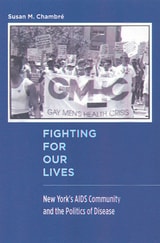
cover of Fighting For Our Lives: New York's AIDS Community and the Politics of Disease

Fighting For Our Lives

New York's AIDS Community and the Politics of Disease

Chambré, Susan M

Rutgers University Press, 2006

In the first decade of the AIDS epidemic, New York City was struck like no other. By the early nineties, it was struggling with more known cases than the next forty most infected cities, including San Francisco, combined.

Fighting for Our Lives is the first comprehensive social history of New York's AIDS community-a diverse array of people that included not only gay men, but also African Americans, Haitians, Latinos, intravenous drug users, substance abuse professionals, elite supporters, and researchers. Looking back over twenty-five years, Susan Chambré focuses on the ways that these disparate groups formed networks of people and organizations that-both together and separately-supported persons with AIDS, reduced transmission, funded research, and in the process, gave a face to an epidemic that for many years, whether because of indifference, homophobia, or inefficiency, received little attention from government or health care professionals.

Beyond the limits of New York City, and even AIDS, this case study also shows how any epidemic provides a context for observing how societies respond to events that expose the inadequacies of their existing social and institutional arrangements. By drawing attention to the major faults of New York's (and America's) response to a major social and health crisis at the end of the twentieth century, the book urges more effective and sensitive actions-both governmental and civil-in the future.

[more]