Results by title
96 books match the query 'Shadow' and 2 start with f
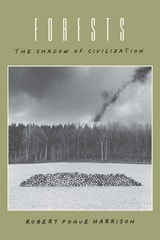
Forests
The Shadow of CivilizationRobert Pogue Harrison
University of Chicago Press, 1992
In this wide-ranging exploration of the role of forests in Western thought, Robert Pogue Harrison enriches our understanding not only of the forest's place in the cultural imagination of the West, but also of the ecological dilemmas that now confront us so urgently. Consistently insightful and beautifully written, this work is especially compelling at a time when the forest, as a source of wonder, respect, and meaning, disappears daily from the earth.
"Forests is one of the most remarkable essays on the human place in nature I have ever read, and belongs on the small shelf that includes Raymond Williams' masterpiece, The Country and the City. Elegantly conceived, beautifully written, and powerfully argued, [Forests] is a model of scholarship at its passionate best. No one who cares about cultural history, about the human place in nature, or about the future of our earthly home, should miss it.—William Cronon, Yale Review
"Forests is, among other things, a work of scholarship, and one of immense value . . . one that we have needed. It can be read and reread, added to and commented on for some time to come."—John Haines, The New York Times Book Review
[more]
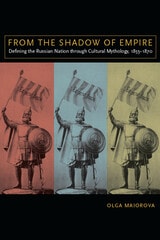
From the Shadow of Empire
Defining the Russian Nation through Cultural Mythology, 1855–1870Olga Maiorova
University of Wisconsin Press, 2010
As nationalism spread across nineteenth-century Europe, Russia’s national identity remained murky: there was no clear distinction between the Russian nation and the expanding multiethnic empire that called itself “Russian.” When Tsar Alexander II’s Great Reforms (1855–1870s) allowed some freedom for public debate, Russian nationalist intellectuals embarked on a major project—which they undertook in daily press, popular historiography, and works of fiction—of finding the Russian nation within the empire and rendering the empire in nationalistic terms.
From the Shadow of Empire traces how these nationalist writers refashioned key historical myths—the legend of the nation’s spiritual birth, the tale of the founding of Russia, stories of Cossack independence—to portray the Russian people as the ruling nationality, whose character would define the empire. In an effort to press the government to alter its traditional imperial policies, writers from across the political spectrum made the cult of military victories into the dominant form of national myth-making: in the absence of popular political participation, wars allowed for the people’s involvement in public affairs and conjured an image of unity between ruler and nation. With their increasing reliance on the war metaphor, Reform-era thinkers prepared the ground for the brutal Russification policies of the late nineteenth century and contributed to the aggressive character of twentieth-century Russian nationalism.
From the Shadow of Empire traces how these nationalist writers refashioned key historical myths—the legend of the nation’s spiritual birth, the tale of the founding of Russia, stories of Cossack independence—to portray the Russian people as the ruling nationality, whose character would define the empire. In an effort to press the government to alter its traditional imperial policies, writers from across the political spectrum made the cult of military victories into the dominant form of national myth-making: in the absence of popular political participation, wars allowed for the people’s involvement in public affairs and conjured an image of unity between ruler and nation. With their increasing reliance on the war metaphor, Reform-era thinkers prepared the ground for the brutal Russification policies of the late nineteenth century and contributed to the aggressive character of twentieth-century Russian nationalism.
[more]