Results by title
177 books match the query 'Shakespeare' and 6 start with f
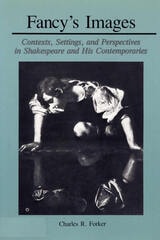
Fancy's Image
Contexts, Settings, and Perspectives in Shakespeare and His ContemporariesCharles R Forker
Southern Illinois University Press, 1990
In ten essays spanning more than three decades of scholarship, Charles R. Forker, the author of Skull Beneath the Skin: The Achievement of John Webster, explores the dramatic and poetic styles of Shakespeare and his contemporaries in relation to Elizabethan ideas of space and time, image patterns and aesthetic form in drama, cultural contexts (the family, the state, the individual), and political and religious values.
Forker has divided his essays into three sections. The essays in the first section, "The Stage," explore theatrical self-consciousness; those in "The Green World" examine the use of pastoral and natural settings as significant factors in dramatization; the essays in the final section, "The Family," discuss ideas of dramatic engagement and disengagement in major Elizabethan playwrights other than Shakespeare.
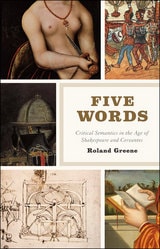
Five Words
Critical Semantics in the Age of Shakespeare and CervantesRoland Greene
University of Chicago Press, 2013
Rather than analyzing works, careers, or histories, Greene discusses a broad swath of Renaissance and transatlantic literature—including Shakespeare, Cervantes, Camões, and Milton—in terms of the development of these five words. Aiming to shift the conversation around Renaissance literature from current approaches to riskier enterprises, Greene also proposes new methods that take advantage of digital resources like full-text databases, but still depend on the interpreter to fashion ideas out of ordinary language. Five Words is an innovative and accessible book that points the field of literary studies in an exciting new direction.
Forms of Attention
Botticelli and HamletFrank Kermode
University of Chicago Press, 2011

Four Shakespearean Period Pieces
Margreta de Grazia
University of Chicago Press, 2021
Yet recent theoretical work has called for their reappraisal. Anachronisms, previously condemned as errors in the order of time, are being hailed as alternatives to that order. Conversely chronology and periods, its mainstays, are now charged with having distorted the past they have been entrusted to represent, and secularization, once considered the driving force of the modern era, no longer holds sway over the past or the present.
In light of this reappraisal, can Shakespeare studies continue unshaken? This is the question Four Shakespearean Period Pieces takes up, devoting a chapter to each term: on the rise of anachronism, the chronologizing of the canon, the staging of plays “in period,” and the use of Shakespeare in modernity’s secularizing project.
To read these chapters is to come away newly alert to how these fraught concepts have served to regulate the canon’s afterlife. Margreta de Grazia does not entirely abandon them but deftly works around and against them to offer fresh insights on the reading, editing, and staging of the author at the heart of our literary canon.
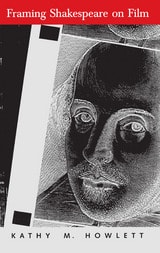
Framing Shakespeare on Film
How the Frame Reveals MeaningKathy M. Howlett
Ohio University Press, 2000
The aesthetics of frame theory form the basis of Framing Shakespeare on Film. This groundbreaking work expands on the discussion of film constructivists in its claim that the spectacle of Shakespeare on film is a problem-solving activity.
Kathy Howlett demonstrates convincingly how viewers’ expectations for understanding Shakespeare on film can be manipulated by the director’s cinematic technique. Emphasizing that the successful film can transform Shakespeare’s text while remaining rooted in Shakespearean conceptions, Howlett raises the question of how directors and audiences understand the genre of Shakespeare on film and reveals how the medium alters the patterns through which the audience views Shakespeare.
From Shakespeare to Autofiction
Approaches to Authorship after Barthes and FoucaultEdited by Martin Procházka
University College London, 2024
From Shakespeare to Autofiction focuses on salient features of authorship throughout modernity, ranging from transformations of oral tradition and the roles of empirical authors, through collaborative authorship and authorship as cultural capital, to the shifting roles of authors in recent autobiographical and biographical fiction. In response to Roland Barthes’s “removal of the Author” and its substitution by Michel Foucault’s “author function,” different historical forms of modern authorship are approached as multiplicities integrated by agency, performativity, and intensity in the theories of Pierre Bourdieu, Wolfgang Iser, Gilles Deleuze, and Félix Guattari.
The book offers a critical reassessment of recent debates on authorship in European and Latin American literature. It demonstrates that the outcomes of these debates need wider theoretical and methodological reflections, ones that take into account the historical development of authorship and shifting understandings of fiction, performativity, and new media. Individual chapters trace significant moments in the history of authorship from early modernity to the present (from Shakespeare’s First Folio to Latin American experimental autobiographical fiction), and discuss the methodologies that reinstate the author and authorship as the irreducible aspects of the literary process. It is essential reading for scholars and enthusiasts of literature seeking a deeper understanding of how authorship has evolved and continues to shape literary landscapes.