Results by title
5 books match the query 'Hesiod'
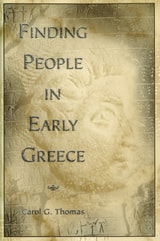
Finding People in Early Greece
Carol G. Thomas
University of Missouri Press, 2005
Progress toward a fuller understanding of preclassical Greece was steady until the 1950s, when a general crisis in all the human-centered disciplines erupted. Scholars undertook a serious reexamination of their tools and data, producing new brands of history, geography, anthropology, archaeology, economics, and sociology. Although these new approaches were widely adopted, the developments also bred a countercurrent beginning in the 1980s and 1990s. The fallout from this backlash was serious in several respects, one of the most important of which was the elimination of the human element in the products of the “new” human-centered disciplines.
In Finding People in Early Greece, Carol Thomas addresses these developments and the recent accommodation and rapprochement of the “old” and “new” that has emerged. She then offers two case studies: Jason and the voyage of the Argo, deriving from the “Age of Heroes,” and Hesiod, probably the first literate European, who lived ca. 700 BCE during the “Age of Revolution,” which catapulted Greece out of its long Dark Age into the vibrant Classical Age. With these two examples, Thomas shows that through a combination of scientific tools and historically oriented scholarship, a larger context in which individual subjects lived can be offered.
[more]
The Works and Days; Theogony; The Shield of Herakles
Hesiod
University of Michigan Press, 1991
Epic poems by one who has been called the first Greek philosopher and theologian
[more]
Theogony and Works and Days
Hesiod
University of Michigan Press, 2006
Written in the late eighth century BC by Hesiod, one of the oldest known of Greek poets, Theogony and Works and Days represent the earliest account of the origin of the Greek gods, and an invaluable compendium of advice for leading a moral life, both offering unique insights into archaic Greek society. There are a number of modern translations of Hesiod available, rendered in serviceable English, but until now no one has created a work of literature equal to the original. This translation is the result of a unique collaboration between a classicist and a poet, capturing in English fourteeners the works’ true poetic flavor while remaining faithful to the Greek text and the archaic world in which it was composed.
This translation contains a general introduction, a translator’s introduction, notes, and a glossary. It will be of interest to general readers, students of and specialists in classical literature, and lovers of poetry.
"This Schlegel-Weinfield translation of Hesiod is superbly crafted: compelling, unforgettable poetry to be read aloud with delight and gratitude."
—Allen Mandelbaum, Endowed Kenan Professor of Humanities, Wake Forest University
"This exciting and unique collaboration between a classical philologist and a poet will not just provide insight into archaic Greek society, but also offer something new: the opportunity to experience the richness of Hesiod's style, language, and modes of thought with remarkable fidelity to the ancient Greek. Weinfield and Schlegel make Hesiod sing."
—Carole Newlands, Classics Department, University of Wisconsin
"Schlegel and Weinfield have produced one of the most remarkable of a current resurgence of translations from the classics, allowing the modern world to hear a poet who may have known Homer. Hesiod’s song makes us understand why the Greeks thought a poet could draw dolphins through the seas or raise the walls of Thebes. Weinfield translates by ear and transfers what he hears to the page, resonant fourteeners, a worthy echo of the past."
—Charles Stanley Ross, Professor, Department of English, and Director, Comparative Literature, PurdueUniversity
Catherine Schlegel is Associate Professor of Classics, University of Notre Dame. Henry Weinfield is Professor and Chair of Liberal Studies, University of Notre Dame, and translator of The Collected Poems of Stephane Mallarme.
Catherine Schlegel is Associate Professor of Classics, University of Notre Dame. Henry Weinfield is Professor and Chair of Liberal Studies, University of Notre Dame, and translator of The Collected Poems of Stephane Mallarme.
[more]
Theogony and Works and Days
A New Bilingual EditionHesiod, Translated from the Greek by Kimberly Johnson
Northwestern University Press, 2017
Widely considered the first poet in the Western tradition to address the matter of his own experience, Hesiod occupies a seminal position in literary history. His Theogony brings together and formalizes many of the narratives of Greek myth, detailing the genealogy of its gods and their violent struggles for power. The Works and Days seems on its face to be a compendium of advice about managing a farm, but it ranges far beyond this scope to meditate on morality, justice, the virtues of a good life, and the place of humans in the universe. These poems are concerned with orderliness and organization, and they proclaim those ideals from small-scale to vast, from a handful of seeds to the story of the cosmos. Presented here in a bilingual edition, Johnson’s translation takes care to preserve the structure of Hesiod’s lines and sentences, achieving a sonic and rhythmic balance that enables us to hear his music across the millennia.
[more]
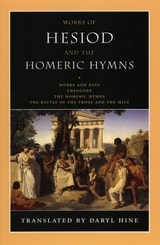
Works of Hesiod and the Homeric Hymns
Including Theogony and Works and DaysEdited by Daryl Hine
University of Chicago Press, 2004
The most faithful and lyrical translation of Works and Days, Theogony, and more
In Works of Hesiod and the Homeric Hymns, highly acclaimed poet and translator Daryl Hine brings to life the words of Hesiod and the world of Archaic Greece. While most available versions of these early Greek writings are rendered in prose, Hine's illuminating translations represent these early classics as they originally appeared, in verse. Since prose was not invented as a literary medium until well after Hesiod's time, presenting these works as poems more closely approximates not only the mechanics but also the melody of the originals.
This volume includes Hesiod's Works and Days and Theogony, two of the oldest non-Homeric poems to survive from antiquity. Works and Days is in part a farmer's almanac—filled with cautionary tales and advice for managing harvests and maintaining a good work ethic—and Theogony is the earliest comprehensive account of classical mythology—including the names and genealogies of the gods (and giants and monsters) of Olympus, the sea, and the underworld. Hine brings out Hesiod's unmistakable personality; Hesiod's tales of his escapades and his gritty and persuasive voice not only give us a sense of the author's own character but also offer up a rare glimpse of the everyday life of ordinary people in the eighth century BCE.
In contrast, the Homeric Hymns are more distant in that they depict aristocratic life in a polished tone that reveals nothing of the narrators' personalities. These hymns (so named because they address the deities in short invocations at the beginning and end of each) are some of the earliest examples of epyllia, or short stories in the epic manner in Greek.
This volume unites Hine's skillful translations of the Works of Hesiod and the Homeric Hymns—along with Hine's rendering of the mock-Homeric epic The Battle of the Frogs and the Mice—in a stunning pairing of these masterful classics.
[more]