Results by title
22279 books match the query 'Social Science' and 955 start with f

FANNY WRIGHT
REBEL IN AMERICACelia Morris
University of Illinois Press, 1992
-- New York Times Book Review

FDR's Moviemaker
Memoirs And ScriptsPare Lorentz
University of Nevada Press, 1992
"The films of Pare Lorentz are acknowledged masterpieces of world cinema. They are groundbreaking documentary records of our country in the hard years of the Depression." —William M. Drennen, Jr.
In the depths of the Great Depression, the U.S. Government produced a series of films about the pressing problems facing the nation—drought, flood, poverty, and slums. Starting with a minuscule initial budget of $6,000, Lorentz, a young film critic from New York who had never made a motion picture, was hired to head the project. The first fruit of his labor, The Plow That Broke the Plains, was a moving and dramatic account of the Dust Bowl that met with immediate and critical acclaim. Lorentz followed up his first film with The River, a history of the Mississippi River Basin and the effect of the Tennessee Valley Authority on the area. Both films demonstrated the potential of the documentary as a powerful impetus to social change, prompting widespread discussion not only of the problems they presented but also of the documentary form itself. This book combines the autobiographical history of a creative communicator and pioneer documentary filmmaker with the full scripts of The Plow That Broke the Plains, The River, Ecce Homo, and The Fight for Life.

FEASTS OF HONOR
RITUAL AND CHANGE IN THE TORAJA HIGHLANDToby Alice Volkman
University of Illinois Press, 1985
Fabrica San Jose and Middle Formative Society in the Valley of Oaxaca
Robert D. Drennan
University of Michigan Press, 2019
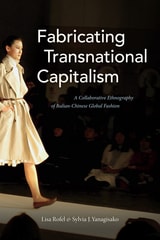
Fabricating Transnational Capitalism
A Collaborative Ethnography of Italian-Chinese Global FashionLisa Rofel and Sylvia J. Yanagisako
Duke University Press, 2018

Fabricating Women
The Seamstresses of Old Regime France, 1675–1791Clare Haru Crowston
Duke University Press, 2001
Fabricating Women examines the social institution of the seamstresses’ guild in France from the time of Louis XIV to the Revolution. In contrast with previous scholarship on women and gender in the early modern period, Clare Haru Crowston asserts that the rise of the absolute state, with its centralizing and unifying tendencies, could actually increase women’s economic, social, and legal opportunities and allow them to thrive in corporate organizations such as the guild. Yet Crowston also reveals paradoxical consequences of the guild’s success, such as how its growing membership and visibility ultimately fostered an essentialized femininity that was tied to fashion and appearances.
Situating the seamstresses’ guild as both an economic and political institution, Crowston explores in particular its relationship with the all-male tailors’ guild, which had dominated the clothing fabrication trade in France until women challenged this monopoly during the seventeenth century. Combining archival evidence with visual images, technical literature, philosophical treatises, and fashion journals, she also investigates the techniques the seamstresses used to make and sell clothing, how the garments reflected and shaped modern conceptions of femininity, and guild officials’ interactions with royal and municipal authorities. Finally, by offering a revealing portrait of these women’s private lives—explaining, for instance, how many seamstresses went beyond traditional female boundaries by choosing to remain single and establish their own households—Crowston challenges existing ideas about women’s work and family in early modern Europe.
Although clothing lay at the heart of French economic production, social distinction, and cultural identity, Fabricating Women is the first book to investigate this immense and archetypal female guild in depth. It will be welcomed by students and scholars of French and European history, women’s and labor history, fashion and technology, and early modern political economy.
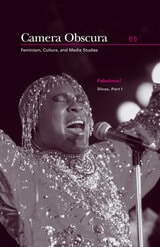
Fabulous! Divas, Part 1, Volume 22
Alexander Doty , ed.
Duke University Press, 0
The contributors to Fabulous! Divas I (the first in a two-part series) address how Baker’s dual image as sexualized black woman and multicultural mother has been used to question and invert stereotypes, how the diva witches in the Broadway musical Wicked have developed a cult following among adolescent girls, and how fans mix irony and sincerity in their admiration of daytime soap divas. One contributor explores the cultural work of camp, while another considers hair as a fetish item for diva devotees. Among the diva appreciations are a look at the life of the cross-dressing black disco diva Sylvester, a reading of Garland as a lesbian diva par excellence, an examination of Courtney Love as a martyr diva, and a consideration of how loving Julie Andrews can make people queer.
Contributors. Alexander Doty, Brett Farmer, Joshua Gamson, Chuck Jackson, Ramon Lobato, Edward R. O’Neill, Ann Pellegrini, Julie Levine Russo, Nick Salvato, Jeanne Scheper, Edward Baron Turk, Stacy Wolf
Face Value
The Entwined Histories of Money and Race in AmericaMichael O'Malley
University of Chicago Press, 2012
From colonial history to the present, Americans have passionately, even violently, debated the nature and the character of money. They have painted it and sung songs about it, organized political parties around it, and imprinted it with the name of God—all the while wondering: is money a symbol of the value of human work and creativity, or a symbol of some natural, intrinsic value?
In Face Value, Michael O’Malley provides a deep history and a penetrating analysis of American thinking about money and the ways that this ambivalence unexpectedly intertwines with race. Like race, money is bound up in questions of identity and worth, each a kind of shorthand for the different values of two similar things. O’Malley illuminates how these two socially constructed hierarchies are deeply rooted in American anxieties about authenticity and difference.
In this compelling work of cultural history, O’Malley interprets a stunning array of historical sources to evaluate the comingling of ideas about monetary value and social distinctions. More than just a history, Face Value offers us a new way of thinking about the present culture of coded racism, gold fetishism, and economic uncertainty.
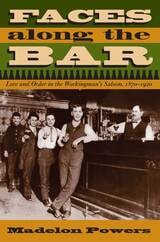
Faces along the Bar
Lore and Order in the Workingman's Saloon, 1870-1920Madelon Powers
University of Chicago Press, 1998
"A free-pouring blend of astonishing facts, folklore and firsthand period observations. . . . It's the rich details that'll inspire the casual reader to drink deep from this tap of knowledge."—Don Waller, USA Today recommended reading
"A surprise on every page."—Publishers Weekly
"Here we get social history that appreciates the bar talk even while dissecting its marvelous rituals."—Library Journal, starred review
"Careful scholarship with an anecdotal flair to please even the most sober of readers."—Nina C. Ayoub, Chronicle of Higher Education
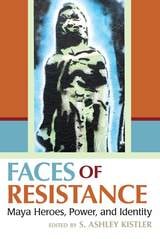
Faces of Resistance
Maya Heroes, Power, and IdentityEdited by S. Ashley Kistler
University of Alabama Press, 2018
In the sixteenth century, Q’eqchi’ Maya leader Aj Poop B’atz’ changed the course of Q’eqchi’ history by welcoming Spanish invaders to his community in peace to protect his people from almost certain violence. Today, he is revered as a powerful symbol of Q’eqchi’ identity. Aj Poop B’atz’ is only one of many indigenous heroes who has been recognized by Maya in Mexico and Guatemala throughout centuries of subjugation, oppression, and state-sponsored violence.
Faces of Resistance: Maya Heroes, Power, and Identity explores the importance of heroes through the analyses of heroic figures, some controversial and alternative, from the Maya area. Contributors examine stories of hero figures as a primary way through which Maya preserve public memory, fortify their identities, and legitimize their place in their country’s historical and political landscape. Leading anthropologists, linguists, historians, and others incorporate ethnographic, ethnohistoric, and archival material into their chapters, resulting in a uniquely interdisciplinary book for scholars as well as students.
The essays offer the first critical survey of the broad significance of these figures and their stories and the ways that they have been appropriated by national governments to impose repressive political agendas. Related themes include the role of heroic figures in the Maya resurgence movement in Guatemala, contemporary Maya concepts of “hero,” and why some assert that all contemporary Maya are heroes.

Faces of the Fremont
Anthropomorphic Figurines in Fremont SocietyDavid T. Yoder
University of Utah Press, 2025
The Fremont culture is famous for its anthropomorphic figurines—small clay figures occasionally dressed in clothing and decorated with jewelry—but surprisingly, archaeologists know very little about these important artifacts and their place in Fremont society. In Faces of the Fremont, the largest study of the subject ever undertaken, David T. Yoder takes a straightforward approach to cultural commentary through artifactual analysis as he interprets over 800 figurines and anthropomorphic objects.
Unlike previous research on the subject, this volume explores neglected topics within Fremont studies, including sex and gender, clothing and body decoration, hairstyles, and childhood. Complete with in-depth analysis and interpretation of the significance of the figurines to the Fremont people, as well as hundreds of beautiful color photographs, Faces of the Fremont provides a nuanced understanding of figurine manufacture, formalizes a classification system for figurine traits, and documents new and interesting geographic and temporal patterns.

Facets of a Harmony
The Roma and Their Locatedness in Eastern SlovakiaJan Ort
Karolinum Press, 2022
In this important contribution to contemporary Romani studies, Jan Ort focuses his anthropological research on a village in eastern Slovakia reputed for the ostensibly seamless coexistence of its ethnically and linguistically heterogeneous inhabitants. Ort offers an ethnographic critique of this idyllic view, showing how historical shifts, as well as the naturalization of inequality and hierarchies, have led to the present situation between the village’s Roma inhabitants and other ethnic populations. However, he also shows examples and methods of subversion and resistance to the village’s current power dynamics. Based primarily on participant observation within Roma families, Ort’s long-term research results in a fascinating book replete with ethnographic descriptions that allow readers to understand local experiences, contexts, and divisions. These insights about the village lead to the key question of the book: Who actually is a local?

Facing It
AIDS Diaries and the Death of the AuthorRoss Chambers
University of Michigan Press, 2001
"Groundbreaking in its approach and potentially wide in its appeal. . . . The rigor of the ideas, their dramatic nature, and the political drive of the rhetoric all should win Facing It a large readership that could extend far beyond students of narrative or queer theory." --David Bergman, Towson University, editor of Camp Grounds: Style and Homosexuality
Ross Chambers is Distinguished University Professor of French and Comparative Literature, University of Michigan, and author of Room for Maneuver: Reading (the) Oppositional (in) Narrative and Story and Situation: Narrative Seduction and the Power of Fiction.

Facing It
AIDS Diaries and the Death of the AuthorRoss Chambers
University of Michigan Press, 1999
"Groundbreaking in its approach and potentially wide in its appeal. . . . The rigor of the ideas, their dramatic nature, and the political drive of the rhetoric all should win Facing It a large readership that could extend far beyond students of narrative or queer theory." --David Bergman, Towson University, editor of Camp Grounds: Style and Homosexuality
Ross Chambers is Distinguished University Professor of French and Comparative Literature, University of Michigan, and author of Room for Maneuver: Reading (the) Oppositional (in) Narrative and Story and Situation: Narrative Seduction and the Power of Fiction.
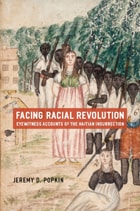
Facing Racial Revolution
Eyewitness Accounts of the Haitian InsurrectionJeremy D. Popkin
University of Chicago Press, 2008
Numerous firsthand narratives of these events survived, but their invaluable insights into the period have long languished in obscurity—until now. In Facing Racial Revolution, Jeremy D. Popkin unearths these documents and presents excerpts from more than a dozen accounts written by white colonists trying to come to grips with a world that had suddenly disintegrated. These dramatic writings give us our most direct portrayal of the actions of the revolutionaries, vividly depicting encounters with the uprising’s leaders—Toussaint Louverture, Boukman, and Jean-Jacques Dessalines—as well as putting faces on many of the anonymous participants in this epochal moment. Popkin’s expert commentary on each selection provides the necessary background about the authors and the incidents they describe, while also addressing the complex question of the witnesses’ reliability and urging the reader to consider the implications of the narrators’ perspectives.
Along with the American and French revolutions, the birth of Haiti helped shape the modern world. The powerful, moving, and sometimes troubling testimonies collected in Facing Racial Revolution significantly expand our understanding of this momentous event.
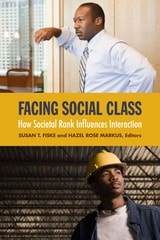
Facing Social Class
How Societal Rank Influences InteractionSusan T. Fiske
Russell Sage Foundation, 2012

Facing the Death Penalty
Essays on a Cruel and Unusual Punishmentedited by Michael L. Radelet, foreword by Henry Schwarzschild
Temple University Press, 1990
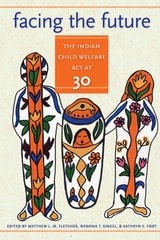
Facing the Future
The Indian Child Welfare Act at 30Matthew L.M. Fletcher
Michigan State University Press, 2009
The U.S. Congress is charged with responsibility for the protection and preservation of American Indian tribes, including Indian children. In 1978, Congress enacted the Indian Child Welfare Act (ICWA), with the intent to "protect the best interests of Indian children and to promote the stability and security of Indian tribes and families." ICWA sets federal requirements that apply to state child custody proceedings involving an Indian child who is a member of or eligible for membership in a federally recognized tribe. ICWA also sets out federal requirements regarding removal of Indian children and their placement in foster or adoptive homes, and it allows the child's tribe to intervene in the case.
The history of the Act is a tangle of legal, social, and emotional complications. Some state courts have found unusual legal arguments to avoid applying the law, while some states have gone beyond the terms of the Act to provide greater protections for Indian people. This collection brings together for the first time a multidisciplinary assessment of the law—with scholars, practitioners, lawyers, and social workers all offering perspectives on the value and importance of the Indian Child Welfare Act.

Facing the Khmer Rouge
A Cambodian JourneyRonnie Yimsut
Rutgers University Press, 2011
As a child growing up in Cambodia, Ronnie Yimsut played among the ruins of the Angkor Wat temples, surrounded by a close-knit community. As the Khmer Rouge gained power and began its genocidal reign of terror, his life became a nightmare. In this stunning memoir, Yimsut describes how, in the wake of death and destruction, he decides to live.
Escaping the turmoil of Cambodia, he makes a perilous journey through the jungle into Thailand, only to be sent to a notorious Thai prison. Fortunately, he is able to reach a refugee camp and ultimately migrate to the United States, where he attended the University of Oregon and became an influential leader in the community of Cambodian immigrants. Facing the Khmer Rouge shows Ronnie Yimsut’s personal quest to rehabilitate himself, make a new life in America, and then return to Cambodia to help rebuild the land of his birth.
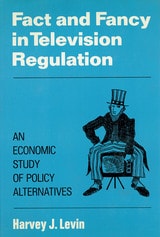
Fact and Fancy in Television Regulation
An Economic Study of Policy AlternativesHarvey J. Levin
Russell Sage Foundation, 1980
Faction and Conversion in a Plural Society
Religious Alignments in the Hindu KushRobert Leroy Canfield
University of Michigan Press, 1973

Facts on the Ground
Archaeological Practice and Territorial Self-Fashioning in Israeli SocietyNadia Abu El-Haj
University of Chicago Press, 2002
Boldly uncovering an Israel in which science and politics are mutually constituted, this book shows the ongoing role that archaeology plays in defining the past, present, and future of Palestine and Israel.
Faculties
A Dialogue on Inciting Constructive Change in Destructive TimesCathy N. Davidson and Jody Greene
Duke University Press, 2026

Faculty of Color in the Health Professions
Stories of Survival and SuccessDena Hassouneh
Dartmouth College Press, 2017

Fada
Boredom and Belonging in NigerAdeline Masquelier
University of Chicago Press, 2019

Fado Resounding
Affective Politics and Urban LifeLila Ellen Gray
Duke University Press, 2013
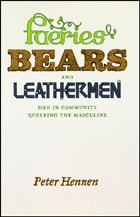
Faeries, Bears, and Leathermen
Men in Community Queering the MasculinePeter Hennen
University of Chicago Press, 2008
Hennen’s colorful study focuses on a trio of groups: the Radical Faeries, who parody effeminacy by playfully embracing it, donning prom dresses and glitter; the Bears, who strive to appear like “regular guys” and celebrate their larger, hairier bodies; and the Leathermen, who emulate hypermasculine biker culture, simultaneously paying homage to and undermining notions of manliness. Along with a historical analysis of the association between effeminacy and homosexuality, Hennen examines how this connection affects the groups’ sexual practices. Ultimately, he argues, while all three groups adopt innovative approaches to gender issues and sexual pleasure, masculine norms continue to constrain members of each community.
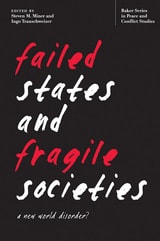
Failed States and Fragile Societies
A New World Disorder?Ingo Trauschweizer
Ohio University Press, 2014
Since the end of the Cold War, a new dynamic has arisen within the international system, one that does not conform to established notions of the state’s monopoly on war. In this changing environment, the global community must decide how to respond to the challenges posed to the state by military threats, political and economic decline, and social fragmentation. This insightful work considers the phenomenon of state failure and asks how the international community might better detect signs of state decay at an early stage and devise legally and politically legitimate responses.
This collection of essays brings military and social historians into conversation with political and social scientists and former military officers. In case studies from the former Yugoslavia, Somalia, Iraq, and Colombia, the distinguished contributors argue that early intervention to stabilize social, economic, and political systems offers the greatest promise, whereas military intervention at a later stage is both costlier and less likely to succeed.
Contributors: David Carment, Yiagadeesen Samy, David Curp, Jonathan House, James Carter, Vanda Felbab-Brown, Robert Rotberg, and Ken Menkhaus.
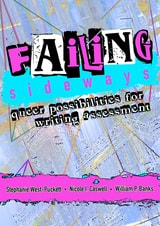
Failing Sideways
Queer Possibilities for Writing AssessmentStephanie West-Puckett
Utah State University Press, 2023
A failure-oriented assessment model unsettles some of the most common practices, like rubrics and portfolios, and challenges many deeply held assumptions about validity and reliability in order to ask what could happen if assessment was oriented toward possibility and potential. Working to engage a more capacious writing construct, the authors propose queer validity inquiry (QVI) as a model for assessment that values failure, affect, identity, and materiality. These overlapping lenses help teachers honor parts of writing and learning that writing studies faculty have struggled to hold onto in a world overly focused on quickness and efficiency in schools.
Through programmatic and classroom examples, Failing Sideways privileges what is valued in the classroom but traditionally ignored in assessments. Reimagining what matters in the teaching and learning of writing and using assessment data differently, this book demonstrates what writing can be and could do in a more diverse and just world.
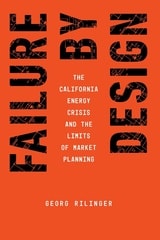
Failure by Design
The California Energy Crisis and the Limits of Market PlanningGeorg Rilinger
University of Chicago Press, 2024
The Western energy crisis was one of the great financial disasters of the past century. The crisis began in April 2000, when price spikes started to rattle California’s electricity markets. Decades later, some blame economic fundamentals and ignorant politicians, while others accuse the energy sellers who raided the markets. In Failure by Design, sociologist Georg Rilinger offers a different explanation, one that focuses on the practical challenges of market design. The unique physical attributes of electricity made it exceedingly difficult to introduce markets into the coordination of the electricity system, so market designers were brought in to construct the infrastructures that coordinate how market participants interact. An exercise in social engineering, these infrastructures were intended to guide market actors toward behavior that would produce optimal market results and facilitate grid management. Yet, though these experts spent their days worrying about incentive misalignment and market manipulation, they unintentionally created a system riddled with opportunities for destructive behavior. Rilinger’s analysis not only illuminates the California energy crisis but also develops a broader theoretical framework for thinking about markets as the products of organizational planning and the limits of social engineering, contributing broadly to sociological and economic thinking about the nature of markets.
Failure by Design
The California Energy Crisis and the Limits of Market PlanningGeorg Rilinger
University of Chicago Press, 2024
A new framework for studying markets as the product of organizational planning and understanding the practical limits of market design.
The Western energy crisis was one of the great financial disasters of the past century. The crisis began in April 2000, when price spikes started to rattle California’s electricity markets. Decades later, some blame economic fundamentals and ignorant politicians, while others accuse the energy sellers who raided the markets. In Failure by Design, sociologist Georg Rilinger offers a different explanation, one that focuses on the practical challenges of market design. The unique physical attributes of electricity made it exceedingly difficult to introduce markets into the coordination of the electricity system, so market designers were brought in to construct the infrastructures that coordinate how market participants interact. An exercise in social engineering, these infrastructures were intended to guide market actors toward behavior that would produce optimal market results and facilitate grid management. Yet, though these experts spent their days worrying about incentive misalignment and market manipulation, they unintentionally created a system riddled with opportunities for destructive behavior. Rilinger’s analysis not only illuminates the California energy crisis but also develops a broader theoretical framework for thinking about markets as the products of organizational planning and the limits of social engineering, contributing broadly to sociological and economic thinking about the nature of markets.

Fair Sex, Savage Dreams
Race, Psychoanalysis, Sexual DifferenceJean Walton
Duke University Press, 2001
Charting the fantasies of racial difference in these women’s writings, Walton establishes that race—particularly during this period—was inseparable from accounts of gender and sexuality. While arguing that these women remained notably oblivious to the racial meanings embedded in their own attempts to rearticulate feminine sexuality, Walton uses these very blindspots to understand how race and sex are deeply imbricated in the constitution of subjectivity. Challenging the notion that subjects acquire gender identities in isolation from racial ones, she thus demonstrates how white-centered psychoanalytic theories have formed the basis for more contemporary feminist and queer explorations of fantasy, desire, power, and subjectivity.
Fair Sex, Savage Dreams will appeal to scholars of psychoanalysis, literary and cinematic modernism, race studies, queer theory, feminist theory, and anthropology.
Fair Share
Senior Activism, Tiny Publics, and the Culture of ResistanceGary Alan Fine
University of Chicago Press, 2023
If you've ever been to a protest or been involved in a movement for social change, you have likely experienced a local culture, one with slogans, jargon, and shared commitments. Though one might think of a cohort of youthful organizers when imagining protest culture, this powerful ethnography from esteemed sociologist Gary Alan Fine explores the world of senior citizens on the front lines of progressive protests. While seniors are a notoriously important—and historically conservative—political cohort, the group Fine calls “Chicago Seniors Together” is a decidedly leftist organization, inspired by the model of Saul Alinsky. The group advocates for social issues, such as affordable housing and healthcare, that affect all sectors of society but take on a particular urgency in the lives of seniors. Seniors connect and mobilize around their distinct experiences but do so in service of concerns that extend beyond themselves. Not only do these seniors experience social issues as seniors—but they use their age as a dramatic visual in advocating for political change.
In Fair Share, Fine brings readers into the vital world of an overlooked political group, describing how a “tiny public” mobilizes its demands for broad social change. In investigating this process, he shows that senior citizen activists are particularly savvy about using age to their advantage in social movements. After all, what could be more attention-grabbing than a group of passionate older people determinedly shuffling through snowy streets with canes, in wheelchairs, and holding walkers to demand healthcare equity, risking their own health in the process?

Fair Trade Rebels
Coffee Production and Struggles for Autonomy in ChiapasLindsay Naylor
University of Minnesota Press, 2019
Reassessing interpretations of development with a new approach to fair trade
Is fair trade really fair? Who is it for, and who gets to decide? Fair Trade Rebels addresses such questions in a new way by shifting the focus from the abstract concept of fair trade—and whether it is “working”—to the perspectives of small farmers. It examines the everyday experiences of resistance and agricultural practice among the campesinos/as of Chiapas, Mexico, who struggle for dignified livelihoods in self-declared autonomous communities in the highlands, confronting inequalities locally in what is really a global corporate agricultural chain.
Based on extensive fieldwork, Fair Trade Rebels draws on stories from Chiapas that have emerged from the farmers’ interaction with both the fair-trade–certified marketplace and state violence. Here Lindsay Naylor discusses the racialized and historical backdrop of coffee production and rebel autonomy in the highlands, underscores the divergence of movements for fairer trade and the so-called alternative certified market, traces the network of such movements from the highlands and into the United States, and evaluates existing food sovereignty and diverse economic exchanges.
Putting decolonial thinking in conversation with diverse economies theory, Fair Trade Rebels evaluates fair trade not by the measure of its success or failure but through a unique, place-based approach that expands our understanding of the relationship between fair trade, autonomy, and economic development.

Fairhope, 1894–1954
The Story of a Single Tax ColonyPaul E. Alyea and Blanche R. Alyea, With a New Introduction by Tennant McWilliams
University of Alabama Press, 2022
The remarkable and improbable story of the utopian single-tax social experiment that gave rise to one of the most unique and colorful communities along the Gulf Coast
Paul E. and Blanche R. Alyea’s Fairhope, 1894–1954, first published in 1954, is the history of this unique and improbable community and the single-tax social experiment that gave rise to it. This new edition offers an introduction by historian and Fairhope resident Tennant McWilliams, giving invaluable context and entertaining anecdotes not just regarding Fairhope’s founding but about the Alyeas themselves—all to the abiding value of their story for today’s residents and visitors.
On November 15, 1894, a small group of men and women met on a remote stretch of Mobile Bay’s eastern shore to establish a colony. It was a decidedly utopian undertaking in a period characterized by many similar social experiments and ideal communities, most of them failures. This group, which gathered at “Stapleton’s pasture” to found Fairhope, hoped to demonstrate the benefits of the single tax as a means of curing social and economic evils, making a practical test of the doctrines of economist Henry George.
Today, the wealth of parks, public and private schools, art galleries, and restaurants, combined with quaint shops and residential areas and a vibrant nautical life, all attest to Fairhope’s unique position among many older communities in the same region. Its residents represent a diverse array of interests and talents, and with a strong civic regard for individualism and creativity, Fairhope is also a haven for painters, potters, writers, and musicians.

Fairy Tale Films
Visions of AmbiguityPauline Greenhill
Utah State University Press, 2010
This ISBN refers to the ebook edition of this text, available directly from the publisher. It has erroneously been listed as paperback by some online vendors. The true paperback edition is indeed available at online vendors. Paste this ISBN into the search box: 9780874217810.
In this, the first collection of essays to address the development of fairy tale film as a genre, Pauline Greenhill and Sidney Eve Matrix stress, "the mirror of fairy-tale film reflects not so much what its audience members actually are but how they see themselves and their potential to develop (or, likewise, to regress)." As Jack Zipes says further in the foreword, “Folk and fairy tales pervade our lives constantly through television soap operas and commercials, in comic books and cartoons, in school plays and storytelling performances, in our superstitions and prayers for miracles, and in our dreams and daydreams. The artistic re-creations of fairy-tale plots and characters in film—the parodies, the aesthetic experimentation, and the mixing of genres to engender new insights into art and life— mirror possibilities of estranging ourselves from designated roles, along with the conventional patterns of the classical tales.”
Here, scholars from film, folklore, and cultural studies move discussion beyond the well-known Disney movies to the many other filmic adaptations of fairy tales and to the widespread use of fairy tale tropes, themes, and motifs in cinema.

Fairy Tales from Before Fairy Tales
The Medieval Latin Past of Wonderful LiesJan M. Ziolkowski
University of Michigan Press, 2009
When did fairy tales begin? What qualifies as a fairy tale? Is a true fairy tale oral or literary? Or is a fairy tale determined not by style but by content? To answer these and other questions, Jan M. Ziolkowski not only provides a comprehensive overview of the theoretical debates about fairy tale origins but includes an extensive discussion of the relationship of the fairy tale to both the written and oral sources. Ziolkowski offers interpretations of a sampling of the tales in order to sketch the complex connections that existed in the Middle Ages between oral folktales and their written equivalents, the variety of uses to which the writers applied the stories, and the diverse relationships between the medieval texts and the expressions of the same tales in the "classic" fairy tale collections of the nineteenth century. In so doing, Ziolkowski explores stories that survive in both versions associated with, on the one hand, such standards of the nineteenth-century fairy tale as the Brothers Grimm, Hans Christian Andersen, and Carlo Collodi and, on the other, medieval Latin, demonstrating that the literary fairy tale owes a great debt to the Latin literature of the medieval period.
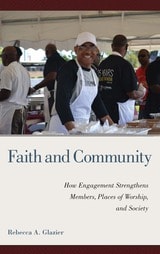
Faith and Community
How Engagement Strengthens Members, Places of Worship, and SocietyRebecca A. Glazier
Temple University Press, 2024
Faith and Community shows the benefits of religious people taking action in their communities. Through more than a decade of multi-method data collection, Rebecca Glazier surveyed over 4,000 congregants and nearly 500 clergy in Little Rock, Arkansas to gather opinions from members and leaders on community issues and engagement. Together with interviews and case studies, her findings indicate that active congregants are happier and more civically involved.
Faith and Community provides valuable insights into the relationship between religion and community engagement. The data illustrates how community engagement benefits individuals, congregations, and democracy and offers one solution to what ails religion in America today.
Faith and Feminism in Nineteenth-Century Religious Communities
Michaela Sohn-Kronthaler
SBL Press, 2019
Explore a diversity of feminist readings of the Bible
This latest volume in the Bible and Women series is concerned with documenting, through word and image, both well-known and largely unknown women and their relationship to the Bible from the period of the late eighteenth century up to the beginning of the twentieth century. The essays in this collection illustrate the broad range of treatment of the Holy Scripture. Paul Chilcote, Marion Ann Taylor, Christiana de Groot, Elizabeth M. Davis, and Pamela S. Nadell offer perspectives on the Anglo-American sphere during this period. Marina Cacchi, Adriano Valerio, Inmaculada Blasco Herranz, and Alexei Klutschewski and Eva Maria Synek illuminate the areas of southern and eastern Europe. Angela Berlis, Ruth Albrecht, Doris Brodbeck, Ute Gause, and Michaela Sohn-Kronthaler examine women from the German-speaking world and their texts. Bernhard Schneider, Magda Motté, Katharina Büttner-Kirschner, and Elfriede Wiltschnigg treat the subject area of religious literature and art.
Features
- Insight into how women participated in academic exegesis and applied biblical figures as models for structuring their own lives
- Exploration of genres used by women, including letters, diaries, autobiographical records, stories, novels, songs, poems, and specialized exegetical treatises and commentaries on individual books of the Bible
- Detailed analyses of women’s interpretations ranging from those that sought to confirm traditions to those that challenged them
Faith and Meaning in the Southern Uplands
Loyal Jones
University of Illinois Press, 1999
In Faith and Meaning, one of Appalachian religion's most eloquent spokesmen reveals a people devoted to and thoughtful about their religion, and profoundly influenced by it. Loyal Jones's three decades of conversations and interviews, supplemented by documents such as sermons, testimonies, and articles of faith, articulate Southern Upland views on basic issues of the human condition—faith, God, the world, the Word, and the devil—as well as on community issues such as racial integration and women in the church. In their own voices these people describe their beliefs, their churches, and their lives, exposing a deep conviction tempered with humanity and humor.
Faith and the Fragility of Justice
Responses to Gender-Based Violence in South AfricaMeredith Whitnah
Rutgers University Press, 2025
Faith and the Pursuit of Health
Cardiometabolic Disorders in SamoaHardin, Jessica
Rutgers University Press, 2019
Faith in the City
Preaching Radical Social Change in DetroitAngela D. Dillard
University of Michigan Press, 2009
“The dynamics of Black Theology were at the center of the ‘Long New Negro Renaissance,’ triggered by mass migrations to industrial hubs like Detroit. Finally, this crucial subject has found its match in the brilliant scholarship of Angela Dillard. No one has done a better job of tracing those religious roots through the civil rights–black power era than Professor Dillard.”
—Komozi Woodard, Professor of History, Public Policy & Africana Studies at Sarah Lawrence College and author of A Nation within a Nation: Amiri Baraka (LeRoi Jones) and Black Power Politics
“Angela Dillard recovers the long-submerged links between the black religious and political lefts in postwar Detroit. . . . Faith in the City is an essential contribution to the growing literature on the struggle for racial equality in the North.”
—Thomas J. Sugrue, University of Pennsylvania, author of The Origins of the Urban Crisis: Race and Inequality in Postwar Detroit
Spanning more than three decades and organized around the biographies of Reverends Charles A. Hill and Albert B. Cleage Jr., Faith in the City is a major new exploration of how the worlds of politics and faith merged for many of Detroit’s African Americans—a convergence that provided the community with a powerful new voice and identity. While other religions have mixed politics and creed, Faith in the City shows how this fusion was and continues to be particularly vital to African American clergy and the Black freedom struggle.
Activists in cities such as Detroit sustained a record of progressive politics over the course of three decades. Angela Dillard reveals this generational link and describes what the activism of the 1960s owed to that of the 1930s. The labor movement, for example, provided Detroit’s Black activists, both inside and outside the unions, with organizational power and experience virtually unmatched by any other African American urban community.
Angela D. Dillard is Associate Professor of Afroamerican and African Studies at the University of Michigan. She specializes in American and African American intellectual history, religious studies, critical race theory, and the history of political ideologies and social movements in the United States.
Faith, Family, and Filipino American Community Life
Cherry, Stephen M
Rutgers University Press, 2014
Stephen M. Cherry draws upon a rich set of ethnographic and survey data, collected over a six-year period, to explore the roles that Catholicism and family play in shaping Filipino American community life. From the planning and construction of community centers, to volunteering at health fairs or protesting against abortion, this book illustrates the powerful ways these forces structure and animate not only how first-generation Filipino Americans think and feel about their community, but how they are compelled to engage it over issues deemed important to the sanctity of the family.
Revealing more than intimate accounts of Filipino American lives, Cherry offers a glimpse of the often hidden but vital relationship between religion and community in the lives of new immigrants, and allows speculation on the broader impact of Filipino immigration on the nation. The Filipino American community is the second-largest immigrant community in the United States, and the Philippines is the second-largest source of Catholic immigration to this country. This ground-breaking study outlines how first-generation Filipino Americans have the potential to reshape American Catholicism and are already having an impact on American civic life through the engagement of their faith.

Faithful Deliberation
Rhetorical Invention, Evangelicalism, and #MeToo ReckoningsT J Geiger II
University of Alabama Press, 2022
Investigates the rhetorical practices used by contemporary evangelical Christian women to confront theological and cultural issues that stymie deliberation within their communities
While often perceived as an insular enclave with a high level of in-group agreement about political and social issues, predominantly white evangelicalism includes prominent voices urging deliberation about appropriate responses to sexual abuse, domestic violence, and the discourses surrounding these traumas. In Faithful Deliberation: Rhetorical Invention, Evangelicalism, and #MeToo Reckonings, T J Geiger II examines theologically reflective rhetorical invention that reconfigures trauma-minimizing commonplaces in order to facilitate community-internal deliberation.
Resting at the intersection of feminist rhetorical studies and religious rhetorics, this book contains four related theological-rhetorical case studies that consider how figures such as Beth Moore, Jen Hatmaker, Rachael Denhollander, Karen Swallow Prior, and others engaged in rhetorical invention. Each juxtaposes differing approaches to contending with rape, domestic violence, sexual abuse, and other traumas. Each case contrasts an approach based on appeals to highly circumscribed understandings of grace, purity, and other denomination-specific traditions and values with approaches rooted in those same traditions and values, but with an eye toward community transformation, healing through justice, and reinvigorated forms of forgiveness. Geiger skillfully argues that this faithful deliberation involves practices of thinking, reflecting, storytelling, and acting within a tightly bounded community that can foster change through a recommitment to core values.
These rhetorical practices exemplify the kind of inventive listening deliberative discourse requires, point to the sort of healing they may promote in response to trauma and trauma discourses, and occur within a range of genres including social media posts, blog entries, published interviews, victim impact statements, and petitions. This study of invention for evangelical-to-other-evangelical deliberative discourse contributes to rhetorical studies by demonstrating the civic and social possibilities of rhetoric within religious enclaves. By locating the case studies as recent moments in longer US public and evangelical histories of activism, deliberative practice, and politics, Faithful Deliberation brings into focus how enclaves and the dominant public sphere interact.

Faithful Generations
Race and New Asian American ChurchesJeung, Russell
Rutgers University Press, 2004
Religion—both personal faith and institutional tradition—plays a central role in the lives of the 12.5 million Asians in the United States. It provides comfort and meaning, shapes ethical and political beliefs, and influences culture and arts. Faithful Generations details the significance of religion in the construction of Asian American identity. As an institutional base for the movement toward Asian American panethnicity, churches provide a space for theological and political reflection and ethnic reinvention.
With rich description and insightful interviews, Russell Jeung uncovers why and how Chinese and Japanese American Christians are building new, pan-Asian organizations. Detailed surveys of over fifty Chinese and Japanese American congregations in the San Francisco Bay area show how symbolic racial identities structure Asian American congregations. Evangelical ministers differ from mainline Christian ministers in their construction of Asian American identity. Mobilizing around these distinct identities, evangelicals and mainline Christians have developed unique pan-Asian styles of worship, ministries, and church activities. Portraits of two churches further illustrate how symbolic racial identities affect congregational life and ministries. The book concludes with a look at Asian American–led multiethnic churches.
This engaging study of the shifting relationship between religion and ethnicity is an ideal text for classes in ethnicity, religion, and Asian American studies.

Faithful Passages
American Catholicism in Literary Culture, 1844–1931James Emmett Ryan
University of Wisconsin Press, 2013
Faithful Passages also reveals new dimensions in American religious literary culture by moving beyond the antebellum period to consider how the first important cohort of Catholic writers shaped their message for subsequent generations of readers in the late nineteenth and early twentieth centuries. Perhaps most strikingly, Ryan shows that by the early twentieth century, Roman Catholic themes and traditions in American literature would be advanced in complex ways by mainstream, non-Catholic modernist writers like Kate Chopin and Willa Cather.
Catholic literary culture in the United States took shape in a myriad of ways and at the hands of diverse participants. The process by which Roman Catholic ideas, themes, and moralities were shared and adapted by writers with highly differentiated beliefs, Ryan contends, illuminates a surprising fluidity of religious commitment and expression in early U.S. literary culture.

Faithful Transformations
Islamic Self-Help in Contemporary SingaporeNurhaizatul Jamil
University of Illinois Press, 2025
The Islamic self-help classes in this book exist at the nexus of sacred texts, aphorisms, and social media engagements, scaffolded by the neoliberal economy that shapes idealized Muslim subjectivities. Within a context whereby the Singapore state discursively frames Malayness in terms of cultural deficiency, Malay Muslim women’s inward focus on transformative ethics rather than societal change underscores the appeal of gendered pious self-help discourses. At the same time, Jamil’s referencing of Black, Indigenous, and Ethnic studies offers a compelling analytical frame that places affective transformation within the context of racial capitalism, historical trauma, and embodied healing.
A provocative and rich ethnography, Faithful Transformations tells the stories of Malay Muslim women desiring piety and self-improvement as minoritized subjects in contemporary Singapore while exploring the limitations of self-care.

Fake Gods and False History
Being Indian in a Contested Mumbai NeighbourhoodJonathan Galton
University College London, 2023
In an age where history is a global battleground and fake news proliferates, culture wars are being waged across India over its future—majoritarian or inclusive, neoliberal or socialist, religious or secular?
Fake Gods and False History takes us to the BDD Chawls, a central Mumbai neighborhood of tenement blocks (chawls) on the brink of a controversial redevelopment. It reveals how contested narratives of Indian history play out in the daily life of this divided neighborhood and how the legacies of certain godlike but very human historical figures, such as Dr. Babasaheb Ambedkar and Chhatrapati Shivaji, are invoked by different communities. Jonathan Galton draws on research conducted among the formerly untouchable Dalit Buddhist community, who are staunchly opposed to the redevelopment plans and deeply critical of the religious nationalism they perceive in their Hindu neighbors. We also meet young male migrants living in village-linked dormitory rooms called Gramastha Mandals, trapped in a liminal space between urban and rural.
Throughout the book, which is woven through with candid reflections on methodology and research ethics, readers are challenged to draw connections with their own experiences of history impinging on their lives. A story that might initially seem parochial will thus resonate with a diverse global audience.

Fake News – What’s the harm?
Four ideas for fact-checkers, policymakers & platforms on countering the consequences of false information & defending free speechPeter Cunliffe-Jones
University of Westminster Press, 2025