Results by title
107 books match the query 'Socialism' and 3 start with f

Fear Your Future
How the Deck Is Stacked against Millennials and Why Socialism Would Make It WorsePhilip Klein
Templeton Press, 2019
The aftershocks of the Great Recession, the skyrocketing cost of living, and the titanic weight of student loan debt have made the American Dream seem to be forever retreating toward the horizon. As if that weren’t enough, millennials will face the largest federal debt in history as boomers retire and extract trillions of dollars from Social Security and Medicare—far more than they contributed.
In this concise, data-driven book, Klein begins the work of brightening the future for millennials by analyzing the problem compassionately yet objectively. There are real reasons to worry about what lies ahead if nothing changes. But the facts laid out in Klein’s book can steer the conversation to realistic solutions.
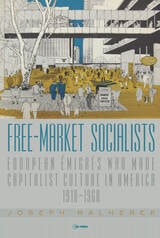
Free-Market Socialists
European Émigrés Who Made Capitalist Culture in America, 1918–1968Joseph Malherek
Central European University Press, 2022
The Hungarian artist-designer László Moholy-Nagy, the Austrian sociologist Paul Lazarsfeld, and his fellow Viennese Victor Gruen—an architect and urban planner—made careers in different fields. Yet they shared common socialist politics, Jewish backgrounds, and experience as refugees from the Nazis. This book tells the story of their intellectual migration from Central Europe to the United States, beginning with the collapse of the Habsburg Empire, and moving through the heady years of newly independent social-democratic republics before the descent into fascism. It follows their experience of exile and adaptation in a new country, and culminates with a surprising outcome of socialist thinking: the opening of the first fully enclosed, air-conditioned suburban shopping center in the United States. Although the American culture they encountered ostensibly celebrated entrepreneurial individualism and capitalistic “free enterprise,” Moholy-Nagy, Lazarsfeld, and Gruen arrived at a time of the progressive economic reforms of the New Deal and an extraordinary open-mindedness about social democracy. This period of unprecedented economic experimentation nurtured a business climate that, for the most part, did not stifle the émigrés’ socialist idealism but rather channeled it as the source of creative solutions to the practical problems of industrial design, urban planning, and consumer behavior.
Based on a vast array of original sources, Malherek interweaves the biographies of these three remarkable personalities and those of their wives, colleagues, and friends with whom they collaborated on innovative projects that would shape the material environment and consumer culture of their adopted home. The result is a narrative of immigration and adaptation that challenges the crude binary of capitalism and socialism with a story of creative economic hybridization.

From Socialism to Capitalism
Eight EssaysJanos Kornai
Central European University Press, 2008
Eight essays connected by various common strands. The most important one is the community of the main subject-matter: socialism, capitalism, democracy, change of system. These four expressions cover four phenomena of great and comprehensive importance. Each piece in the book deals with these and the connections between them.
One of the Leitmotifs is the “capitalism/socialism” pair of opposites. Capitalism has a history of several hundred years, while the socialist regime existed only for a few decades. But this pair of opposites was central to the history of the twentieth century. This antagonism put its stamp on political thinking, on the foreign policy and military preparedness of every country, and on some appallingly destructive armed conflicts. All these had great secondary influence on each country’s economic development and the standard of living and disposition of its inhabitants.
None of the studies is confined to one country—not to Hungary or to any other. Each tries to embrace the problems common to greater units. However, the greater unit comprehended is not the same in each study. One may deal with the capitalist or socialist system in general, another will all the post-socialist countries, and a third the Central East European region. But all extend the analysis beyond the borders of one country.