Results by title
479 books match the query 'Sources' and 15 start with f
Families as Sources of Strength, Healing, and Hope
Groves Monographs on Marriage and Family (Volume 9)Edited by Raeann Hamon and Chloe D. Merrill
Michigan Publishing Services, 2026
Groves Monographs on Marriage and Familyis an edited book series based on the annual meetings of the Groves Conference on Marriage and Family, an interdisciplinary, interprofessional organization of limited invited membership founded in 1934. The Groves Monographs publishes work on the leading edges of theory development and empirical research in the field of family studies. Individual volumes are edited by the chairs of the annual Groves Conferences and include peer-reviewed chapters by the conference presenters and invited authors. Topics are timely and provocative with diverse themes.
Volume 9: Families as Sources of Strength Healing and Hope This monograph elaborates on the theme of the 2022 Groves Conference on Marriage and Family held in Paradise Island, Bahamas--- Families as Sources of Strength, Hope and Healing. The authors offer insights into and the value of employing a strengths-based mindset, whether engaging in clinical work or teaching. They also identify numerous factors which empower children, couples, and families, including things like expressing love, commitment, and relational fidelity. This volume is intended to help researchers, practitioners, and the lay public to adopt a more strengths-based and hopeful approach to relationships.
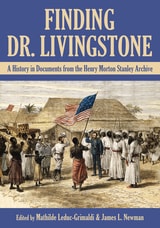
Finding Dr. Livingstone
A History in Documents from the Henry Morton Stanley ArchivesMathilde Leduc-Grimaldi
Ohio University Press, 2020
This eye-opening perspective on Stanley’s expedition reveals new details about the Victorian explorer and his African crew on the brink of the colonial Scramble for Africa.
In 1871, Welsh American journalist Henry M. Stanley traveled to Zanzibar in search of the “missing” Scottish explorer and missionary David Livingstone. A year later, Stanley emerged to announce that he had “found” and met with Livingstone on Lake Tanganyika. His alleged utterance there, “Dr. Livingstone, I presume,” was one of the most famous phrases of the nineteenth century, and Stanley’s book, How I Found Livingstone, became an international bestseller.
In this fascinating volume Mathilde Leduc-Grimaldi and James L. Newman transcribe and annotate the entirety of Stanley’s documentation, making available for the first time in print a broader narrative of Stanley’s journey that includes never-before-seen primary source documents—worker contracts, vernacular plant names, maps, ruminations on life, lines of poetry, bills of lading—all scribbled in his field notebooks.
Finding Dr. Livingstone is a crucial resource for those interested in exploration and colonization in the Victorian era, the scientific knowledge of the time, and the peoples and conditions of Tanzania prior to its colonization by Germany.

Fire Management in the American West
Forest Politics and the Rise of MegafiresMark Hudson
University Press of Colorado, 2011
Drawing on correspondence both between and within the Forest Service and the major timber industry associations, newspaper articles, articles from industry outlets, and policy documents from the late 1800s through the present, Hudson shows how the US forest industry, under the constraint of profitability, pushed the USFS away from private industry regulation and toward fire exclusion, eventually changing national forest policy into little more than fire policy.
More recently, the USFS has attempted to move beyond the policy of complete fire suppression. Interviews with public land managers in the Pacific Northwest shed light on the sources of the agency's struggles as it attempts to change the way we understand and relate to fire in the West.
Fire Management in the American West will be of great interest to environmentalists, sociologists, fire managers, scientists, and academics and students in environmental history and forestry.
Food in the American Gilded Age
Helen Zoe Veit
Michigan State University Press, 2017
Food in the Civil War Era
The NorthHelen Zoe Veit
Michigan State University Press, 2014
Food in the Civil War Era
The SouthHelen Zoe Veit
Michigan State University Press, 2015
Foundations of Information Law
Paul T. Jaeger, Jonathan Lazar, Ursula Gorham, and Natalie Greene Taylor
American Library Association, 2023
- discusses information law as part of a continuum of interrelated issues rather than an assortment of discrete topics;
- examines information law in the context of different types of libraries;
- delves into the manifold legal issues raised when interacting with patrons and communities, from intellectual freedom topics like censorship and public activities in the library to the legal issues surrounding materials and information access;
- elucidates operational and management legal issues, including library security, interacting with law enforcement, advocacy, lobbying, funding, human resources, and liability;
- promotes literacy of the law, its structures, and its terminology as a professional skill;
- gives readers the tools to find and understand different sources of legal authority and demonstrates how to interpret them when they conflict; and
- explores information law as a national and cross-national issue.
Four Russian Serf Narratives
Translated, edited, and with an introduction by John MacKay
University of Wisconsin Press, 2009
Four Russian Serf Narratives contains four of these accounts and is the first translated collection of autobiographies by serfs. Scholar and translator John MacKay brings to light for an English-language audience a diverse sampling of Russian serf narratives, ranging from an autobiographical poem to stories of adventure and escape. “Autobiography” (1785) recounts a highly educated serf’s attempt to escape to Europe, where he hoped to study architecture. The long testimonial poem “News About Russia” (ca. 1849) laments the conditions under which the author and his fellow serfs lived. In “The Story of My Life and Wanderings” (1881) a serf tradesman tells of his attempt to simultaneously escape serfdom and captivity from Chechen mountaineers. The fragmentary “Notes of a Serf Woman” (1911) testifies to the harshness of peasant life with extraordinary acuity and descriptive power.
These accounts offer readers a glimpse, from the point of view of the serfs themselves, into the realities of one of the largest systems of unfree labor in history. The volume also allows comparison with slave narratives produced in the United States and elsewhere, adding an important dimension to knowledge of the institution of slavery and the experience of enslavement in modern times.
Fragments of Truth
Residential Schools and the Challenge of Reconciliation in CanadaNaomi Angel. Edited by Dylan Robinson and Jamie Berthe.
Duke University Press, 2022
Francisco López de Gómara's General History of the Indies
Ángela Helmer
University Press of Colorado, 2023
General History of the Indies was the first universal history of the recent discoveries and conquests of the New World made available to the Old World audience. At publication it consisted of two parts: the first a general history of the European discovery, conquest, and settlement of the Americas, and the second a detailed description of Cortés’s conquest of Mexico. Part one—in the multiple Spanish editions and translations into Italian and French published at the time—was the most comprehensive, popular, and accessible account of the natural history and geography of the Americas, the ethnology of the peoples of the New World, and the history of the Spanish conquest, including the most recent developments in Peru. Despite its original and continued importance, however, it had never been translated into English.
Gómara’s history communicates Europeans’ general understanding of the New World throughout the middle and later sixteenth century. A lively, comparatively brief description of Europe’s expansion into the Americas with significant importance to today’s understanding of the early modern worldview, Francisco López de Gómara’s General History of the Indies will be of great interest to students of and specialists in Latin American history, Latin American literature, anthropology, and cultural studies, as well as specialists in Spanish American intellectual history and colonial Latin America.
Free Black Communities and the Underground Railroad
The Geography of ResistanceCheryl Janifer LaRoche
University of Illinois Press, 2013
Free Spaces
The Sources of Democratic Change in AmericaSara M. Evans and Harry C. Boyte
University of Chicago Press, 1992
In Free Spaces, Sara M. Evans and Harry C. Boyte argue for a new understanding of the foundations for democratic politics by analyzing the settings in which people learn to participate in democracy. In their new Introduction, the authors link the concept of free spaces to recent theoretical discussions about community, public life, civil society, and social movements.
From Bondage to Belonging
The Worcester Slave NarrativesB. Eugene McCarthy
University of Massachusetts Press, 2007
First published between 1842 and 1895, the autobiographical narratives gathered in this volume document the experiences of eight former slaves who eventually took up residence in Worcester, Massachusetts. Each narrative tells a gripping individual story, its author clearly visible in the dress of his or her own words. Together they illuminate not only the inhumanity of slavery but also the dreams and dilemmas of emancipation, tracing the personal journeys of seven men and one woman from bondage to freedom.
In their well-researched introduction, B. Eugene McCarthy and Thomas L. Doughton situate the Worcester slave narratives within a broader historical framework and analyze their meaning and significance. Drawing on a wide range of sources, they reconstruct the black community of Worcester and compare it with other New England black communities of the time, describing how the town evolved from a society with slaves in the colonial era to a hub for free blacks by the eve of the Civil War. They explain why these writings must be understood as part of a long-established tradition of African American self-representation, and show how the four narratives published before 1865 focus on the experience of slavery, while the four written after the war offer the fresh perspective of living in freedom. Headnotes describe the distinctive literary features of each narrative and provide additional information about the lives of the authors. The editors discuss why these ex-slaves came to Worcester, the circumstances in which each wrote his or her narrative, and the audiences they had in mind. No other collection of slave narratives offers such a diverse range of testimony within a specific historical and literary context, or a more compelling account of the transition from bondage to belonging.
From Racism to Genocide
Anthropology in the Third ReichGretchen E. Schafft
University of Illinois Press, 2007
In paperback for the first time, From Racism to Genocide is an explosive, richly detailed account of how Nazi anthropologists justified racism, developed practical applications of racist theory, and eventually participated in every phase of the Holocaust.
Using original sources and previously unpublished documentation, Gretchen E. Schafft shows the total range of anti-human activity from within the confines of a particular discipline. Based on seven years of archival research in the United States and abroad, the work includes many original photos and documents, most of which have never before been published. It uses primary data and original texts whenever possible, including correspondence written by perpetrators. The book also reveals that the United States was not merely a bystander in this research, but instead contributed professional and financial support to early racial research that continued through the first five years of Hitler’s regime.

From Solidarity to Martial Law
The Polish Crisis of 1980–1981The National Security Archive Paczkowski
Central European University Press, 2007