Results by title
254 books match the query 'Sports' and 10 start with f

Fast Break to Line Break
Poets on the Art of BasketballTodd Davis
Michigan State University Press, 2012
If baseball is the sport of nostalgic prose, basketball’s movement, myths, and culture are truly at home in verse. In this extraordinary collection of essays, poets meditate on what basketball means to them: how it has changed their perspective on the craft of poetry; how it informs their sense of language, the body, and human connectedness; how their love of the sport made a difference in the creation of their poems and in the lives they live beyond the margins. Walt Whitman saw the origins of poetry as communal, oral myth making. The same could be said of basketball, which is the beating heart of so many neighborhoods and communities in this country and around the world. On the court and on the page, this “poetry in motion” can be a force of change and inspiration, leaving devoted fans wonderstruck.
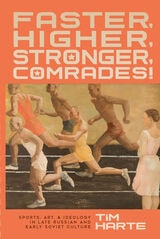
Faster, Higher, Stronger, Comrades!
Sports, Art, and Ideology in Late Russian and Early Soviet CultureTim Harte
University of Wisconsin Press, 2020
With interdisciplinary analysis of literature, painting, and film, Faster, Higher, Stronger, Comrades! traces how physical fitness had an even broader impact on culture and ideology in the Soviet Union than previously realized. From prerevolutionary writers and painters glorifying popular circus wrestlers to Soviet photographers capturing unprecedented athleticism as a means of satisfying their aesthetic ideals, the nation's artists embraced sports in profound, inventive ways. Though athletics were used for doctrinaire purposes, Tim Harte demonstrates that at their core, they remained playful, joyous physical activities capable of stirring imaginations and transforming everyday realities.

Female Gladiators
Gender, Law, and Contact Sport in AmericaSarah K. Fields
University of Illinois Press, 2004
Female Gladiators is the first book to examine legal and social battles over the right of women to participate with men in contact sports. The impetus to begin legal proceedings was the 1972 enactment of Title IX, which prohibited discrimination in educational settings, but it was the Equal Protection Clause of the U.S. Constitution and the equal rights amendments of state constitutions that ultimately opened doors. Despite court rulings, however, many in American society resisted—and continue to resist—allowing girls in dugouts and other spaces traditionally defined as male territories.
Inspired, women and girls began to demand access to the contact sports which society had previously deemed too strenuous or violent for them to play. When the leagues continued to bar girls simply because they were not boys, the girls went to court. Sarah K. Fields's Female Gladiators is the only book to examine the legal and social battles over gender and contact sport that continue to rage today.
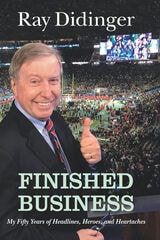
Finished Business
My Fifty Years of Headlines, Heroes, and HeartachesRay Didinger
Temple University Press, 2021
Ray Didinger opens his lively memoir Finished Business with the Philadelphia Eagles’ upset win in Super Bowl LII. When the Eagles finally hoist the Lombardi Trophy, Didinger does his best to straddle the emotions of a working reporter and a long-suffering Philly fan. His ability to do that is why he has built up such a loyal following.
Didinger began following the Eagles as a kid, hanging out in his grandfather’s bar in Southwest Philadelphia. He spent his summers at the team's training camp in Hershey. It was there he met his idol, flanker Tommy McDonald. He would later write a play, Tommy and Me, about their friendship and his efforts to see McDonald enshrined in the Pro Football Hall of Fame.
Didinger has been covering the Eagles as a newspaper columnist or TV analyst since 1970. Over the years, he wrote sports for the Philadelphia Bulletin and the Philadelphia Daily News. He later produced Emmy Award–winning documentaries for NFL Films before transitioning to sports talk radio and TV analysis.
In five decades, across multiple media platforms, he has interviewed everyone from Hank Aaron, Wayne Gretzky, Muhammad Ali, Julius Erving, Jack Nicklaus, to Mike Schmidt, as well as writing film scripts for Hollywood stars such as Bruce Willis and Alec Baldwin. He went to the White House with the U.S. Olympic team and even explored the bizarre world of professional wrestling.
His stories, told in his familiar, breezy style, capture his enthusiasm for sports and his affection for the fans who still mourn the pennant that eluded the Phillies in 1964. Didinger has become synonymous with Philadelphia sports, and his memoir is as passionate as an autumn Sunday at Lincoln Financial Field.
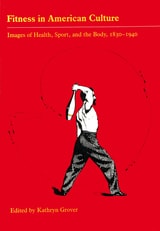
Fitness in American Culture
Images of Health, Sport, and the Body, 1830-1940Kathryn Grover
University of Massachusetts Press, 1989
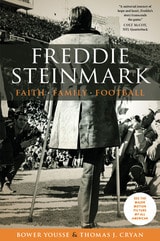
Freddie Steinmark
Faith, Family, FootballBy Bower Yousse and Thomas J. Cryan
University of Texas Press, 2015
Freddie Steinmark tells the story of a legendary University of Texas football player whose courage on the field and in battling cancer still inspires the Longhorn nation.
Freddie Steinmark started at safety for the undefeated University of Texas Longhorns in 1969. In the thrilling “Game of the Century,” a come-from-behind victory against Arkansas that ensured Texas the national championship, Steinmark played with pain in his left leg. Two days later, X-rays revealed a bone tumor so large that it seemed a miracle Steinmark could walk, let alone play football. Within a week of the Arkansas game, his leg was amputated.
A gritty, undersized player, Steinmark had quickly become a fan favorite at Texas. What he endured during the Longhorns’ memorable 1969 season, and what he encountered afterward, captivated not only Texans but the country at large. Americans watched closely as Steinmark confronted life’s ultimate challenge, and his openness during his battle against savage odds helped reframe the national conversation surrounding cancer and the ongoing race for a cure.
Written with unfettered access to the Steinmark family and archives, Freddie Steinmark: Faith, Family, Football is the exploration of a brief but full life, one that began humbly but ended on a grand stage. It is a fitting tribute to a legendary Longhorn whose photograph, emblazoned with the word “Heart,” flashes on the Freddie Steinmark Scoreboard’s Jumbotron prior to each home football game in UT’s Darrell K Royal–Texas Memorial Stadium at Joe Jamail Field.
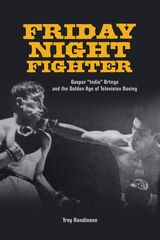
Friday Night Fighter
Gaspar "Indio" Ortega and the Golden Age of Television BoxingTroy Rondinone
University of Illinois Press, 2013
Friday Night Fighter relives a lost moment in American postwar history, when boxing ruled as one of the nation's most widely televised sports. During the 1950s and 1960s, viewers tuned in weekly, sometimes even daily, to watch widely recognized fighters engage in primordial battle; the Gillette Cavalcade of Sports Friday Night Fights was the most popular fight show. Troy Rondinone follows the dual narratives of the Friday Night Fights show and the individual story of Gaspar "Indio" Ortega, a boxer who appeared on prime-time network television more than almost any other boxer in history. From humble beginnings growing up poor in Tijuana, Mexico, Ortega personified the phenomenon of postwar boxing at its greatest, appearing before audiences of millions to battle the biggest names of the time, such as Carmen Basilio, Tony DeMarco, Chico Vejar, Benny "Kid" Paret, Emile Griffith, Kid Gavilan, Florentino Fernández, and Luis Manuel Rodriguez.
Rondinone explores the factors contributing to the success of televised boxing, including the rise of television entertainment, the role of a "reality" blood sport, Cold War masculinity, changing attitudes toward race in America, and the influence of organized crime. At times evoking the drama and spectacle of the Friday Night Fights themselves, this volume is a lively examination of a time in history when Americans crowded around their sets to watch the main event.

From Cocinas to Lucha Libre Ringsides
A Latinx Comics AnthologyEdited by Frederick Luis Aldama and Angela M. Sánchez
The Ohio State University Press, 2025
Contributors:
Aleasha Acevedo, José Alaniz, Frederick Luis Aldama, Julio Anta, Charlene Bowles, David Bowles, Adrian Carrillo, José Cabrera, Valerie Martinez Cabrera, Mauricio Alberto Cordero, Jaime Crespo, Celeste Cruz, Ernesto Cuevas Jr., Chris Escobar, Rolando Esquivel, Tim Fielder, Dustin Garcia, Eric J. García, Jorge Garza, Oscar Garza, Lucas Gattoni, Blas Goncalves-Borrego, Estella González, Carina Guevara, Aaron Guzman, Javier Hernandez, Sam Jimenez, Eric Kittelberger, Alberto Ledesma, Pablo Leon, Darren López, Patrick Lugo, Jarred A. Luján, Eliamaría Madrid, Miguel Martinez, Paloma Martínez-Cruz, Carlos Meyer, Marisol Meyer Driovínto, Paul Meyer, Rosie Murillo, Rafael Navarro, Daniel Parada, Stephanie Nina Pitsirilos, Jazmin Puente, Raúl the Third, Anna Maria Richardson, Hector Rodriguez III, Theresa Rojas, Rafael Rosado, Andrea Rosales, Justin Rueff, Irma Ruiz, Angela M. Sánchez, Serenity Serseción, Javier Solórzano, Josh Trujillo, Cayetano Valenzuela, Diana “Dianita” Vargas Sampieri, Andrés Vera Martínez
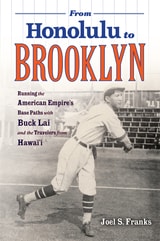
From Honolulu to Brooklyn
Running the American Empire’s Base Paths with Buck Lai and the Travelers from Hawai’iJoel S. Franks
Rutgers University Press, 2022

Futbolera
A History of Women and Sports in Latin AmericaBy Brenda Elsey and Joshua Nadel
University of Texas Press, 2019
Latin American athletes have achieved iconic status in global popular culture, but what do we know about the communities of women in sport? Futbolera is the first monograph on women’s sports in Latin America. Because sports evoke such passion, they are fertile ground for understanding the formation of social classes, national and racial identities, sexuality, and gender roles. Futbolera tells the stories of women athletes and fans as they navigated the pressures and possibilities within organized sports.
Futbolera charts the rise of physical education programs for girls, often driven by ideas of eugenics and proper motherhood, that laid the groundwork for women’s sports clubs, which began to thrive beyond the confines of school systems. Futbolera examines how women challenged both their exclusion from national pastimes and their lack of access to leisure, bodily integrity, and public space. This vibrant history also examines women’s sports through comparative case studies of Argentina, Brazil, Chile, Costa Rica, Mexico, and others. Special attention is given to women’s sports during military dictatorships of the 1970s and 1980s as well as the feminist and democratic movements that followed. The book culminates by exploring recent shifts in mindset toward women’s football and dynamic social movements of players across Latin America.