Results by title
270 books match the query 'Technology' and 10 start with f

FACTS and HVDC
Advances in technology, modelling, and regulatory requirementsEnrique Acha
The Institution of Engineering and Technology, 2025

Feed-Forward
On the Future of Twenty-First-Century MediaMark B. N. Hansen
University of Chicago Press, 2014
Drawing on the speculative empiricism of philosopher Alfred North Whitehead, Hansen reveals how new media call into play elements of sensibility that greatly affect human selfhood without in any way belonging to the human. From social media to data-mining to new sensor technologies, media in the twenty-first century work largely outside the realm of perceptual consciousness, yet at the same time inflect our every sensation. Understanding that paradox, Hansen shows, offers us a chance to put forward a radically new vision of human becoming, one that enables us to reground the human in a non-anthropocentric view of the world and our experience in it.

Feminism in Twentieth-Century Science, Technology, and Medicine
Edited by Angela N. H. Creager, Elizabeth Lunbeck, and Londa Schiebinger
University of Chicago Press, 2001
Contributors:
Ruth Schwartz Cowan
Linda Marie Fedigan
Scott Gilbert
Evelynn M. Hammonds
Evelyn Fox Keller
Pamela E. Mack
Michael S. Mahoney
Emily Martin
Ruth Oldenziel
Nelly Oudshoorn
Carroll Pursell
Karen Rader
Alison Wylie

Flash Effect
Science and the Rhetorical Origins of Cold War AmericaDavid J. Tietge
Ohio University Press, 2002
The ways science and technology are portrayed in advertising, in the news, in our politics, and in the culture at large inform the way we respond to these particular facts of life. The better we are at recognizing the rhetorical intentions of the purveyors of information and promoters of mass culture, the more adept we become at responding intelligently to them.
Flash Effect, a startling book by David J. Tietge, documents the manner in which those at the highest levels of our political and cultural institutions conflated the rhetoric of science and technology with the rhetorics of religion and patriotism to express their policies for governance at the onset of the Cold War and to explain them to the American public.
Professor Tietge details our cultural attitudes about science in the early years of the Cold War, when on the heels of a great technological victory Americans were faced with the possibility of destruction by the very weapons that had saved them.
In Flash Effect we learn how, by symbolizing the scientist as both a father figure and a savior—and by celebrating the technological objects of his labor—the campaign to promote science took hold in the American consciousness. The products of that attitude are with us today more than ever.
Fourth Revolution and the Bottom Four Billion
Making Technologies Work for the PoorNir Kshetri
University of Michigan Press, 2023
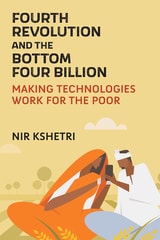
Products and services based on advanced technologies such as artificial intelligence and blockchain are normally considered to be for rich consumers in advanced countries. Fourth Revolution and the Bottom Four Billion demonstrates how marginalized and vulnerable groups with limited resources can also benefit from these technologies. Nir Kshetri suggests that the falling costs and the increased ease of developing and deploying applications based on these technologies are making them more accessible. He illustrates how key emerging technologies are transforming major industries and application areas such as healthcare and pandemic preparedness, agriculture, finance, banking, and insurance. The book also looks at how these transformations are affecting the lives of low-income people in low- and middle-income countries and highlights the areas needing regulatory attention to adequately protect marginalized and vulnerable groups from the abuse and misuse of these technologies. Kshetri discusses how various barriers such as the lack of data, low resource languages, underdeveloped technology infrastructures, lack of computing power and shortage of skill and talent have hindered the adoption of these technologies among marginalized and vulnerable groups. Fourth Revolution and the Bottom Four Billion suggests that it is the responsibility of diverse stakeholders—governments, NGOs, international development organizations, academic institutions, the private sector, and others—to ensure that marginal groups also benefit from these transformative innovations.

Frames of Mind
A Post-Jungian Look at Cinema, Television and TechnologyLuke Hockley
Intellect Books, 2007
In this illuminating psychoanalysis of our media environment, Luke Hockley probes questions such as why we have genuine emotional responses to film events we know to be fictional, why we are compulsively driven to watch television, and how advertisers use unconscious motifs to persuade viewers.
From Counterculture to Cyberculture
Stewart Brand, the Whole Earth Network, and the Rise of Digital UtopianismFred Turner
University of Chicago Press, 2006
In the early 1960s, computers haunted the American popular imagination. Bleak tools of the cold war, they embodied the rigid organization and mechanical conformity that made the military-industrial complex possible. But by the 1990s—and the dawn of the Internet—computers started to represent a very different kind of world: a collaborative and digital utopia modeled on the communal ideals of the hippies who so vehemently rebelled against the cold war establishment in the first place.
From Counterculture to Cyberculture is the first book to explore this extraordinary and ironic transformation. Fred Turner here traces the previously untold story of a highly influential group of San Francisco Bay–area entrepreneurs: Stewart Brand and the Whole Earth network. Between 1968 and 1998, via such familiar venues as the National Book Award–winning Whole Earth Catalog, the computer conferencing system known as WELL, and, ultimately, the launch of the wildly successful Wired magazine, Brand and his colleagues brokered a long-running collaboration between San Francisco flower power and the emerging technological hub of Silicon Valley. Thanks to their vision, counterculturalists and technologists alike joined together to reimagine computers as tools for personal liberation, the building of virtual and decidedly alternative communities, and the exploration of bold new social frontiers.
Shedding new light on how our networked culture came to be, this fascinating book reminds us that the distance between the Grateful Dead and Google, between Ken Kesey and the computer itself, is not as great as we might think.

Frontiers Of Illusion
Science, Technology, and the Politics of ProgressDaniel Sarewitz
Temple University Press, 1996
For the past fifty years, science and technology—supported with billions of dollars from the U.S. government—have advanced at a rate that would once have seemed miraculous, while society's problems have grown more intractable, complex, and diverse. Yet scientists and politicians alike continue to prescribe more science and more technology to cure such afflictions as global climate change, natural resource depletion, overpopulation, inadequate health care, weapons proliferation, and economic inequality.
Daniel Sarewitz scrutinizes the fundamental myths that have guided the formulation of science policy for half a century—myths that serve the professional and political interests of the scientific community, but often fail to advance the interests of society as a whole. His analysis ultimately demonstrates that stronger linkages between progress in science and progress in society will require research agendas that emerge not from the intellectual momentum of science, but from the needs and goals of society.

Furious
Technological Feminism and Digital FuturesCaroline Bassett
Pluto Press, 2019

Furious
Technological Feminism and Digital FuturesCaroline Bassett
Pluto Press, 2019