85 books match the query 'Television broadcasting' and 4 start with f
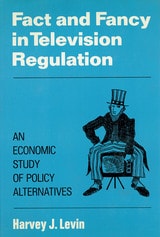
cover of Fact and Fancy in Television Regulation: An Economic Study of Policy Alternatives

Fact and Fancy in Television Regulation

An Economic Study of Policy Alternatives

Harvey J. Levin

Russell Sage Foundation, 1980
How diverse can, and should, TV programming be? And especially, in what precise ways does governmental regulation of TV affect (or fail to affect) the programs station owners produce—programs which, in the final analysis, shape in such large measure the values of Americans? It is to these timely and beguiling questions that Harvey Levin addresses his dispassionate assessment of the complex relationship between government and the TV industry. Analyzing data drawn from the history of the FCC's regulatory decisions, as well as from interviews with numerous government and industry officials, Professor Levin shows how the present form of restrictive governmental regulation almost always results in higher profits and rents for TV stations, with no concomitant increase in programming diversity. In addition, Professor Levin investigates various other aspects of the media market, from the particular kinds of crucial decisions that are made when, for example, a newspaper owns a TV station, to the kinds of problems that arise when commercial rents are taxed to fund public TV; from the brand of programming we are offered when a monopoly controls a given TV market to the nature of programming in a situation of steady and fair competition. Following a comprehensive assessment, the author makes a compelling case for diversification of station ownership, in order to be "safe rather than sorry." He also argues for the entry of new stations, more extensive support of public TV, and some form of quantitative program requirements—all of which will help bring about greater program diversity. Professor Levin's volume provides us with a fully documented and sharply focused analysis of the theories, policies, and problems of one of the most powerful and misunderstood of contemporary institutions.
[more]
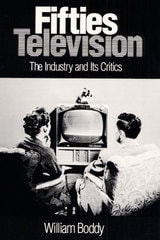
cover of Fifties Television: THE INDUSTRY AND ITS CRITICS

Fifties Television

THE INDUSTRY AND ITS CRITICS

William Boddy

University of Illinois Press, 1990
William Boddy provides a wide-ranging, rigorous analysis of the fledging American television industry during the period of its greatest economic growth, programming changes, and critical controversy. He traces the medium's development from the experimental era through the regulatory battles of the 1940s and the network programming wars of the 1950s.
 
[more]
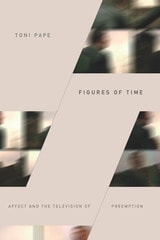
cover of Figures of Time: Affect and the Television of Preemption

Figures of Time

Affect and the Television of Preemption

Toni Pape

Duke University Press, 2019

Many contemporary television series from Modern Family to How to Get Away with Murder open an episode or season with a conflict and then go back in time to show how that conflict came to be. In Figures of Time Toni Pape examines these narratives, showing how these leaps in time create aesthetic experiences of time that attune their audiences to the political doctrine of preemption—a logic that justifies preemptive action to nullify a perceived future threat. Examining questions of temporality in Life on Mars, the political ramifications of living under the auspices of a catastrophic future in FlashForward, and how Damages disrupts the logic of preemption, Pape shows how television helps shift political culture away from a model of rational deliberation and representation toward a politics of preemption and conformity. Exposing the mechanisms through which television supports a fear-based politics, Pape contends, will allow for the rechanneling of television's affective force into building a more productive and positive politics.
[more]
cover of Framing the Past: The Historiograpy of German Cinema and Television

Framing the Past

The Historiograpy of German Cinema and Television

Edited by Bruce A. Murray and Christopher J. Wickham

Southern Illinois University Press, 1992

This collection of essays was selected from those presented in October 1988 at a conference sponsored by the National Endowment for the Humanities, "Concepts of History in German Cinema." The contributors include notable historians, film scholars, and German studies specialists who explore the complex network of social, political, and religious institutions that have influenced the historiography of German cinema and television.

Before the turn of the century, Germans began to employ the medium of film to represent the past when they attempted to document their Prussian heritage. Since then, German cinema and television have promoted history as a component of personal, cultural, and national identity by consistently providing prominent treatment of historical subjects.

Although it is relatively easy to document changes in the selection and handling of these subjects, it is more difficult to determine precisely which factors have motivated those changes.

In attempting to define these factors, the link between German cinema, television, and history has developed around three interrelated issues: (1) the reception of Weimar cinema, which for most film scholars continues to be mediated to one extent or another by Siegfried Kracauer’s work; (2) the inscribing of fascism in cinema and television; and (3) the nature of, and potential for, alternatives to mainstream cinema and television.

[more]
