Results by title
146 books match the query 'Terrorism' and 5 start with f
Fatal Future?
Transnational Terrorism and the New Global DisorderBy Richard M. Pearlstein
University of Texas Press, 2004
The nature and goals of terrorist organizations have changed profoundly since the Cold War standoff among the U.S., Soviet, and Chinese superpowers gave way to the current "polyplex" global system, in which the old rules of international engagement have been shattered by a new struggle for power among established states, non-state actors, and emerging nations. In this confusing state of global disorder, terrorist organizations that are privately funded and highly flexible have become capable of carrying out incredibly destructive attacks anywhere in the world in support of a wide array of political, religious, and ethnic causes.
This groundbreaking book examines the evolution of terrorism in the context of the new global disorder. Richard M. Pearlstein categorizes three generations of terrorist organizations and shows how each arose in response to the global conditions of its time. Focusing extensively on today's transnational (i.e., privately funded and internationally operating) terrorist organizations, he devotes thorough attention to the two most virulent types: ethnoterrorism and radical Islamic terrorism. He also discusses the terrorist race for weapons of mass destruction and the types of attacks, including cyberterrorism, that are likely to occur in coming years. Pearlstein concludes with a thought-provoking assessment of the many efforts to combat transnational terrorism in the post-September 11 period.
Foreign Intervention in Africa after the Cold War
Sovereignty, Responsibility, and the War on TerrorElizabeth Schmidt
Ohio University Press, 2018
In Foreign Intervention in Africa after the Cold War—interdisciplinary in approach and intended for nonspecialists—Elizabeth Schmidt provides a new framework for thinking about foreign political and military intervention in Africa, its purposes, and its consequences. She focuses on the quarter century following the Cold War (1991–2017), when neighboring states and subregional, regional, and global organizations and networks joined extracontinental powers in support of diverse forces in the war-making and peace-building processes. During this period, two rationales were used to justify intervention: a response to instability, with the corollary of responsibility to protect, and the war on terror.
Often overlooked in discussions of poverty and violence in Africa is the fact that many of the challenges facing the continent today are rooted in colonial political and economic practices, in Cold War alliances, and in attempts by outsiders to influence African political and economic systems during the decolonization and postindependence periods. Although conflicts in Africa emerged from local issues, external political and military interventions altered their dynamics and rendered them more lethal. Foreign Intervention in Africa after the Cold War counters oversimplification and distortions and offers a new continentwide perspective, illuminated by trenchant case studies.
Forever Suspect
Racialized Surveillance of Muslim Americans in the War on TerrorSelod, Saher
Rutgers University Press, 2018
Formations of Violence
The Narrative of the Body and Political Terror in Northern IrelandAllen Feldman
University of Chicago Press, 1991
"A sophisticated and persuasive late-modernist political analysis that consistently draws the reader into the narratives of the author and those of the people of violence in Northern Ireland to whom he talked. . . . Simply put, this book is a feast for the intellect"—Thomas M. Wilson, American Anthropologist
"One of the best books to have been written on Northern Ireland. . . . A highly imagination and significant book. Formations of Violence is an important addition to the literature on political violence."—David E. Schmitt, American Political Science Review
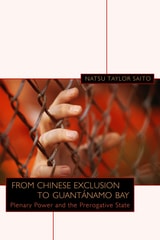
From Chinese Exclusion to Guantánamo Bay
Plenary Power and the Prerogative StateNatsu Taylor Saito
University Press of Colorado, 2007
From Chinese Exclusion to Guantánamo Bay also provides a larger context for understanding problems resulting from the exercise of plenary power. Saito explains how the rights of individuals and groups deemed Other by virtue of race or national origin have been violated under both the Constitution and international law. The differing treatment of José Padilla and John Walker Lindh - both Americans accused of terrorism - provides an example of such disparate approaches. Such executive actions and their sanction by Congress and the judiciary, Saito argues, undermine not just individual rights but the very foundations of our national security - democracy and the rule of law.
From Chinese Exclusion to Guantánamo Bay will interest readers concerned with the historical background of constitutional protection in times of war and peace and will provide fascinating new material for scholars, teachers, and students of law, history, and ethnic studies