62 books match the query 'Twain, Mark' and 2 start with f
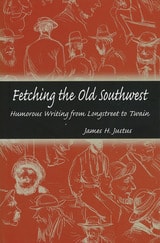
cover of Fetching the Old Southwest: Humorous Writing from Longstreet to Twain

Fetching the Old Southwest

Humorous Writing from Longstreet to Twain

James H. Justus

University of Missouri Press, 2004
For more than a quarter-century, despite the admirable excavations that have unearthed such humorists as John Gorman Barr and Marcus Lafayette, the most significant of the humorists from the Old Southwest have remained the same: Crockett, Longstreet, Thompson, Baldwin, Thorpe, Hooper, Robb, Harris, and Lewis. Forming a kind of shadow canon in American literature that led to Mark Twain’s early work, from 1834 to 1867 these authors produced a body of writing that continues to reward attentive readers.
James H. Justus’s Fetching the Old Southwest examines this writing in the context of other discourses contemporaneous with it: travel books, local histories, memoirs, and sports manuals, as well as unpublished private forms such as personal correspondence, daybooks, and journals. Like most writing, humor is a product of its place and time, and the works studied herein are no exception. The antebellum humorists provide an important look into the social and economic conditions that were prevalent in the southern “new country,” a place that would, in time, become the Deep South.
Justus’s study focuses mainly on the humor from the area categorized in the federal censuses of the mid-nineteenth century as the Southwest: Alabama, Mississippi, Louisiana, Kentucky, Tennessee, and, eventually, Arkansas and Texas. Where it is pertinent, he also includes North Carolina and Missouri in this cultural map. Although some of these pieces may not precisely reflect their cultural setting, they are assuredly refractions of it.
While previous books about Old Southwest humor have focused on individual authors, Justus has produced the first critical study to encompass all of the humor from this time period. Teachers and students of literary history will appreciate the incredible range of documentation, both primary and secondary.
[more]
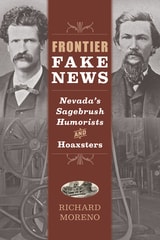
cover of Frontier Fake News: Nevada's Sagebrush Humorists and Hoaxsters

Frontier Fake News

Nevada's Sagebrush Humorists and Hoaxsters

Richard Moreno

University of Nevada Press, 2023

When readers see the names Mark Twain and Dan De Quille, fake news may not be the first thing that comes to mind. But these legendary journalists were some of the original, and most prolific, fake news writers in the early years of Nevada’s history. Frontier Fake News puts a spotlight on the hoaxes, feuds, pranks, outright lies, witty writing, and other literary devices utilized by a number of the Silver State’s frontier newsmen from the mid-nineteenth through the early twentieth centuries. Often known collectively as the Sagebrush School, these journalists were opinionated, talented, and individualistic.

While Mark Twain (Samuel Clemens), who got his start at Virginia City’s Territorial Enterprise, and Dan De Quille (William Wright), who some felt was a better writer than Twain, are the most well-known members of the Sagebrush School, author Richard Moreno includes others such as Fred Hart, who concocted a fake social club and reported on its gatherings for Austin’s Reese River Reveille, and William Forbes, who enjoyed sprinkling clever puns with political undertones in his newspaper articles.

Moreno traces the beginnings of genuine fake news from founding father Benjamin Franklin’s “Supplement to the Boston Independent Chronicle, Number 705, March 1782,” a fake newspaper aimed at swaying British public opinion, to the fake news articles of New York and Baltimore papers in the early 1800s. But these examples are only a prelude to the amazing accounts of petrified men, freeze-inducing solar armor, magically magnetic rocks, blood-curdling massacres, and other nonsense stories that appeared in Nevada’s frontier newspapers and beyond.

[more]