Results by title
80 books match the query 'Vietnam War' and 5 start with f
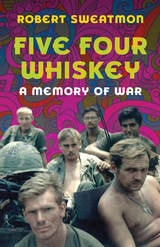
Five Four Whiskey
A Memory of WarRobert Sweatmon
Westholme Publishing, 2014
In late 1969, twenty-year-old Robert Sweatmon received a letter informing him that he had ten days to report to the United States Army. Like thousands of others, he had been drafted. Assigned as a rifleman with a mechanized unit, the author began a year-long odyssey in the Southeast Asian wilderness that would change his and his fellow soldiers’ lives forever.
Taking its title from the nighttime radio code call and response between base camp and those on ambush patrol, Five Four Whiskey: A Memory of War is a moving account of life as a combat soldier in the Vietnam War. Set mostly in the sprawling woods and rubber plantations northwest of Saigon, the author explains what his unit was asked to do and what obstacles they faced, including an elusive but deadly enemy, multiple kinds of booby traps, and antitank mines. The author, a notable television personality following the war, does not sensationalize his account; rather, his book allows a new generation to understand the emotional and physical pressures of the times. Coming of age in the maelstrom of civil rights and the free love culture, the author and his fellow soldiers saw their idealism quickly vaporize in the face of the grim realities of war. Here they learned to compartmentalize their lives as a way to survive, but it was their strong bonds that ultimately kept them from succumbing to the madness that surrounded them. Kept in the field for almost the entire time of his tour, the author was in a unit selected to conduct a clandestine reconnaissance in Cambodia and then lead the 1970 invasion, where he was wounded. Following his convalescence, he was sent to Nui Ba Den, the fabled ghost mountain haunted by the spirit of a Vietnamese princess, until he received his papers that he had completed his combat service. At that moment, his year-long mental wall between soldier and civilian fell away as he counted the last terrifying hours before he was safely out of Vietnam. A tour-de-force of military memoir, written in an objective and often literary prose, Five Four Whiskey perfectly captures how ordinary civilian-soldiers survived an ordeal set in one of the most turbulent times in American history.
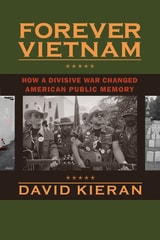
Forever Vietnam
How a Divisive War Changed American Public MemoryDavid Kieran
University of Massachusetts Press, 2014
Kieran focuses his analysis on the recent remembrance of six events, three of which occurred before the Vietnam War and three after it ended. The first group includes the siege of the Alamo in 1836, the incarceration of Union troops at Andersonville during the Civil War, and the experience of American combat troops during World War II. The second comprises the 1993 U.S. intervention in Somalia, the crash of United Airlines Flight 93 on September 11, 2001, and the Iraq and Afghanistan wars.
In each case a range of actors—military veterans, policymakers, memorial planners, and the general public—used memorial practices associated with the Vietnam War to reinterpret the contemporary significance of past events. A PBS program about Andersonville sought to cultivate a sense of national responsibility for the My Lai massacre. A group of Vietnam veterans occupied the Alamo in 1985, seeing themselves as patriotic heirs to another lost cause. A World War II veteran published a memoir in 1980 that reads like a narrative of combat in Vietnam. Through these and other examples, Forever Vietnam reveals not only the persistence of the past in public memory but also its malleability in the service of the political present.
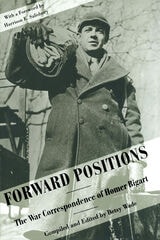
Forward Positions
The War Correspondence of Homer BigartHomer Bigart
University of Arkansas Press, 1992
Among journalists—and particularly war correspondents—Homer Bigart was both legend and example. In a career of four decades, first with the New York Herald Tribuneand then, through 1972, with The New York Times, Bigart distinguished himself as a superb writer and tireless digger for the realities that could be learned only in the field and not at headquarters. In 1943 Bigart sailed for England to cover the air war and was soon on mule-back in Sicily, and hanging on at Anzio. He then went to the Pacific, where his dispatches won him his first Pulitzer Prize for foreign correspondence. When hostilities erupted in Korea he was again on the front lines in the front lines in the Orient, and again recipient of a Pulitzer. By the time of the American involvement in Vietnam, he was an old-timer, a seasoned correspondent admired and celebrated for his wit but regarded with awe for his masterly stories, in which straightforward prose, informed by tenacious reporting, cut to the heart of the issues.
Previously available only n crumbling library copies of the Tribune and the Times, or in microfilm repositories, his dispatches, with their rare insights into warefar and he minds of those who wage war, are now collected in Forward Positions: The War Correspondence of Home Bigart, edited by Betsy Wade and introduced by Harrison E. Salisbury, himself the winner of a Pulitzer Prize for journalism.
Forward Positions does honor to a breed of journalist that had passed into history by the time of Bigart’s death. It includes one of the first accounts of the atomic annihilation of Hiroshima, a report on the war-crimes trial of Adolf Eichmann, a number of dispatches on “hot” battles of the Cold War, and a probing dispatch on Lieutenant William Calley’s testimony on the Mỹ Lai Massacre. With this representative selection of more than fifty of Bigart’s accounts of war on the ground, in the air, and in the courtroom, Wade provides a wealth of background material about his career, as well as glimpses of his impact on journalism. The book promises hours of captivating and informative reading for journalists, historians, veterans, and anyone who likes a good story tautly told.
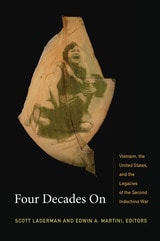
Four Decades On
Vietnam, the United States, and the Legacies of the Second Indochina WarScott Laderman and Edwin A. Martini, eds.
Duke University Press, 2013
Contributors. Alex Bloom, Diane Niblack Fox, H. Bruce Franklin, Walter Hixson, Heonik Kwon, Scott Laderman, Mariam B. Lam, Ngo Vinh Long, Edwin A. Martini, Viet Thanh Nguyen, Christina Schwenkel, Charles Waugh
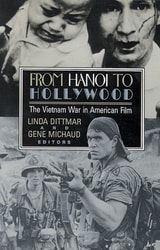
From Hanoi to Hollywood
The Vietnam War in American FilmDittmar, Linda
Rutgers University Press, 1990
The title of this anthology calls attention to the process whereby aspects of the Vietnam War have been appropriated by the American cultural industry. Probing the large body of emotion-laden, controversial films, From Hanoi to Hollywood is concerned with the retelling of history and the retrospection that such a process involves. In this anthology, an awareness of film as a cultural artifact that molds beliefs and guides action is emphasized, an awareness that the contributors bring to a variety of films. Their essays span over one hundred documentary and fiction films, and include in-depth analyses of major commercial films, ranging from Apocalypse Now to Platoon, Rambo: First Blood Part II, and Full Metal Jacket, and documentaries from In the Year of the Pig to Dear America: Letters Home from Vietnam.
The essays in this volume deal with representations of the Vietnam war in documentary film and television reporting, examining the ways the power of film is used to deliver political messages. There are surprises here, new readings, and important insights on the ways we as a society have attempted to come to terms with the experiences of the Vietnam era. The book also contains two appendixes-a detailed chronology charting the relationship between major historical events and the release of American war films from 1954 through 1988, and a filmography listing information on over four hundred American and foreign films about the Vietnam War.