Results by title
2284 books match the query 'Women' and 89 start with f
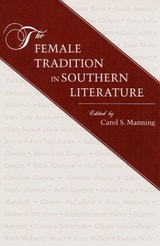
FEMALE TRADITION IN SOUTHERN LITERATURE
Carol S. Manning
University of Illinois Press, 1993
essays reclaim women's traditions which have been neglected by critics who ought to have known
better." -- Kathryn Lee Seidel, author of The Southern Belle in the American Novel
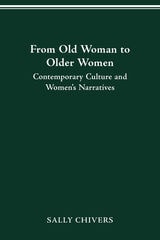
FROM OLD WOMAN TO OLDER WOMEN
Contemporary Culture and Women’s NarrativesSally Chivers
The Ohio State University Press, 2003
Sally Chivers provides a fascinating look at and challenge to how North American popular culture has portrayed old age as a time of disease, decline, and death. Within contemporary Canadian literary and film production, a tradition of articulate central elderly female characters challenges what the aging body has come to signify in a broader cultural context. Rather than seek positive images of aging, which can do their own prescriptive damage, the author focuses on constructive depictions that provide a basis on which to create new stories and readings of growing old. This type of humanities approach to the study of aging promises neither to fixate on nor avoid consideration of the role of the body in the much broader process of getting older. The progression implied in the title from the solitary symbol of The Old Woman toward a community of older women, indicates not a move toward euphemism, but rather an increasing and necessary awareness of the social and cultural dimensions of aging.

Faces in the Fire
The Women of Beowulf: Book OneDonnita L. Rogers
Arizona Center for Medieval and Renaissance Studies, 2013
Fair Rosamond
A Study of the Development of a Literary ThemeVirgil B. Heltzel
Northwestern University Press, 1947

Faith and the Fragility of Justice
Responses to Gender-Based Violence in South AfricaMeredith Whitnah
Rutgers University Press, 2025

Faith in Disguise
A NovellaMayra Santos-Febres; Translated from the Spanish by John A. Mundell
Vanderbilt University Press, 2026
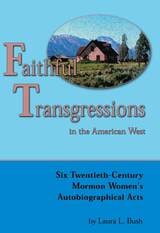
Faithful Transgressions In The American West
Six Twentieth-Century Mormon Women's Autobiographical ActsLaura L. Bush
Utah State University Press, 2004
The central issue Bush finds in these works is how their authors have dealt with the authority of Mormon Church leaders. As she puts it in her preface, "I use the phrase 'faithful transgression' to describe moments in the texts when each writer, explicitly or implicitly, commits herself in writing to trust her own ideas and authority over official religious authority while also conceiving of and depicting herself to be a 'faithful' member of the Church." Bush recognizes her book as her own act of faithful transgression. Writing it involved wrestling, she states, "with my own deeply ingrained religious beliefs and my equally compelling education in feminist theories that mean to liberate and empower women."
Faithful Transgressions examines a remarkable group of authors and their highly readable and entertaining books. In producing the first significant book-length study of Mormon women's autobiographical writing, Bush rides a wave of memoir publishing and academic interest in autobiography and other life narratives. As she elucidates these works in relation to the religious tradition that played a major role in shaping them, she not only positions them in relation to feminist theory and current work on women's life writings but ties them to the long literary tradition of spiritual autobiography.

Faithful to Our Tasks
Arkansas's Women and the Great WarElizabeth Griffin Hill
Butler Center for Arkansas Studies, 2017
The United States was a vital, if brief, participant in World War I—spending only eighteen months fighting in “the Great War.” But that short span marked an era of tremendous change for women as they moved out of the Victorian nineteenth century and came into their own as social activists during the early years of the twentieth century.
Faithful to Our Tasks provides the context for women’s actions and reactions during the war. It incorporates the mitigating factors and experiences of American women in general and compares Arkansas women’s Progressive Era actions with those of other southern women. The contextual underpinnings provide a rich tapestry as we attempt to understand our grandmothers and great-grandmothers’ responses to wartime needs.
Primary records of the World War I era, accessed in archives in central Arkansas, reveal that the state’s organized women were suddenly faced with a devastating world war for which they were expected to make a significant contribution of time and effort. “Club women” were already tackling myriad problems to be found in abundance within a poor, rural state as they worked for better schools, a centralized education system, children’s well-being, and improved medical care.
Under wartime conditions, their contributions were magnified as the women followed a barrage of directions from Washington, DC, within a disconcerting display of micromanagement by the federal government. The important takeaway, however, is that the Great War created a scenario in which Arkansas’s organized women—as well as women throughout the nation—would step forward and excel as men and governments stood up and took notice. After the war, these same organized women won the right to vote.

Family Fortunes
Men and Women of the English Middle Class, 1780-1850Leonore Davidoff and Catherine Hall
University of Chicago Press, 1987
"The book explores how the middle class constructed its own institutions, material culture and values during the industrial revolution, looking at two settings—urban manufacturing Birmingham and rural Essex—both centers of active capitalist development. The use of sources is dazzling: family business records, architectural designs, diaries, wills and trusts, newspapers, prescriptive literature, sermons, manuscript census tracts, the papers of philanthropic societies, popular fiction, and poetry.
"Family Fortunes occupies a place beside Mary Ryan's The Cradle of the Middle Class and Suzanne Lebsock's Free Women of Petersburg. It provides scholars with a definitive study of the middle class in England, and facilitates a comparative perspective on the history of middle-class women, property, and the family."—Judith Walkowitz, Johns Hopkins University

Fan Phenomena
MermaidsEdited by Matthieu Guitton
Intellect Books, 2016
Mermaids, and merfolk more generally, are everywhere you look. Merfolk devotees march in themed parades and practice mermaid-ing—swimming with a mermaid tail. There’s mermaid fiction and mermaid virtual reality; mermaid art and #mermaid trends. You may not know it, but transgenerational merfolk fan communities stretch around the world—from sea to shining sea. And their popularity is only growing.
In Fan Phenomena: Mermaids, Matthieu Guitton assembles a star-studded cast of scholars and popular culture insiders to decode the mermaid phenomenon. The book explores how merfolk have evolved in popular culture and what it is that grants them their privileged status among fantasy creatures. Illustrated throughout with fan photographs and stills from a plethora of films and TV shows, this new addition to the Fan Phenomena series promises to both fascinate and delight readers—earthbound and ocean-going alike.

Fangirls
Scenes from Modern Music CultureBy Hannah Ewens
University of Texas Press, 2020
"To be a fan is to scream alone together." This is the discovery Hannah Ewens makes in Fangirls: how music fandom is at once a journey of self-definition and a conduit for connection and camaraderie; how it is both complicated and empowering; and how now, more than ever, fandoms composed of girls and young queer people create cultures that shape and change an entire industry.
This book is about what it means to be a fangirl.
Speaking to hundreds of fans from the UK, US, Europe, and Japan, Ewens tells the story of music fandom using its own voices, recounting previously untold or glossed-over scenes from modern pop and rock music history. In doing so, she uncovers the importance of fan devotion: how Ariana Grande represents both tragedy and resilience to her followers, or what it means to meet an artist like Lady Gaga in person. From One Directioners, to members of the Beyhive, to the author's own fandom experiences, this book reclaims the "fangirl" label for its young members, celebrating their purpose, their power, and, most of all, their passion for the music they love.

Fannie Barrier Williams
Crossing the Borders of Region and RaceWanda A. Hendricks
University of Illinois Press, 2014

Fanning the Flames
The Women of Beowulf Book 2Donnita L. Rogers
Arizona Center for Medieval and Renaissance Studies, 2014

Fantasizing the Feminine in Indonesia
Laurie J. Sears, ed.
Duke University Press, 1996
The contributors examine the ways in which Indonesian women and men are enmeshed in networks of power and then pursue the stories of those who, sometimes at great political risk, challenge these powers. In this juxtaposition of voices and stories, we see how indigenous patriarchal fantasies of feminine behavior merged with Dutch colonial notions of proper wives and mothers to produce the Indonesian government’s present approach to controlling the images and actions of women. Facing the theoretical challenge of building a truly cross-cultural feminist analysis, Fantasizing the Feminine takes us into an ongoing conversation that reveals the contradictions of postcolonial positionings and the fragility of postmodern identities.
This book will be welcomed by readers with interests in contemporary Indonesian politics and society as well as historians, anthropologists, and other scholars concerned with literature, gender, and cultural studies.
Contributors. Benedict R. O’G. Anderson, Sita Aripurnami, Jane Monnig Atkinson, Nancy K. Florida, Daniel S. Lev, Dédé Oetomo, Laurie J. Sears, Ann Laura Stoler, Saraswati Sunindyo, Julia I. Suryakusuma, Jean Gelman Taylor, Sylvia Tiwon, Anna Lowenhaupt Tsing, Diane L. Wolf

Farewell Tangier
Salma El Moumni
Seagull Books, 2026
For Alia, being a teenager in Tangier means constantly facing a gauntlet of unwanted encounters by men in the streets who look her over, grab her, or make comments about her body. At night, in the privacy of her bedroom, Alia begins to take photos of her body in order to understand what those men see when they look at her, becoming her own voyeur. When Alia’s photos somehow end up on the internet, she decides to flee the country, as the photos violate Moroccan law. She seeks refuge in Lyon, France, but is unable to escape the past.
Farewell Tangier is a searing exploration of the male gaze and its potential to shatter a young woman’s life, exploring themes of desire, dissociation, and exile. It is both a feminist critique of the policing of female bodies and an affecting narrative of one young woman’s struggle with her identity.
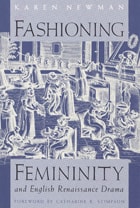
Fashioning Femininity and English Renaissance Drama
Karen Newman
University of Chicago Press, 1991
Through the critical lens of poststructuralism, Newman reads anatomies, conduct and domesticity handbooks, sermons, homilies, ballads, and court cases to delineate the ideologies of femininity they represented and produced. Arguing that drama, as spectacle, provides a peculiarly useful locus for analyzing the management of femininity, Newman considers the culture of early modern London to reveal how female subjectivity was fashioned and staged in the plays of Shakespeare, Jonson, and others.
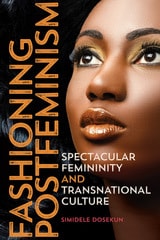
Fashioning Postfeminism
Spectacular Femininity and Transnational CultureSimidele Dosekun
University of Illinois Press, 2020
Simidele Dosekun's interviews and critical analysis consider the female subjectivities these women are performing and desiring. She finds that the women embody the postfeminist idea that their unapologetically immaculate beauty signals—but also constitutes—feminine power. As empowered global consumers and media citizens, the women deny any need to critique their culture or to take part in feminism's collective political struggle. Throughout, Dosekun unearths evocative details around the practical challenges to attaining their style, examines the gap between how others view these women and how they view themselves, and engages with ideas about postfeminist self-fashioning and subjectivity across cultures and class.
Intellectually provocative and rich with theory, Fashioning Postfeminism reveals why women choose to live, embody, and even suffer for a fascinating performative culture.

Fast Lives
Women Who Use Crack CocaineClaire E. Sterk
Temple University Press, 1999
Focusing on active crack users, Fast Lives compiles information from participant observation, informal conversations, individual interviews, and group discussions. Sterk details the ways in which use affects the lives of these crack users. She captures how these women arrived at their use; how they survive under current circumstances, such as the constant threat of HIV/AIDS and violence; how they combine the multiple social roles of mother and drug user; and how -- as they share their aspirations and expectations for the future -- their stories underscore the effects of poverty, sexism, and racism on their lives.
Many of these women recognize their own responsibility for ensuring positive change. Sterk's book, which includes an argument for a harm reduction approach, reminds us that their strength and courage will too often be futile without social policies that are realistic and appropriate for women.
Fast Lives will engage readers interested in social problems as well as students of cultural anthropology, sociology, criminology, public health, ethnography, substance abuse, and women's health.

Fatty
A NovelNatalie Rogers
Northwestern University Press, 2027
A poignant coming-of-age novel inspired by martial arts films and family lore about powerful ghost brides
Fatty Wong is a streetwise eleven-year-old in 1960s colonial Hong Kong who dreams of ruling the world. She fights daily for a better life, but in an era of great political turmoil, Fatty faces struggles in the streets of her working-class village—and inside her own home. As the city’s youth begins protesting British rule and local communists mimic the Cultural Revolution that has ignited chaos across mainland China, Fatty grapples with her own desire for freedom and spars with the neighborhood kids to discover her strength through kung fu. She takes a job at a convenience store to carve a space of her own, only to be sexually abused by the owner. Increasingly attuned to the spirit world, Fatty is visited by a neighbor boy who was shot and killed during a riot; his ghost offers to help her escape her anguish if she cares for his grieving mother. Now Fatty must embark on an adventure that will demand she discover her true identity—and raise a fist to anyone attempting to stifle her spirit.
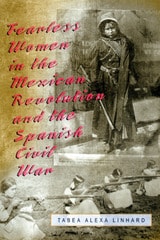
Fearless Women in the Mexican Revolution and the Spanish Civil War
Tabea Alexa Linhard
University of Missouri Press, 2005
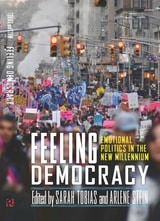
Feeling Democracy
Emotional Politics in the New MillenniumSarah Tobias
Rutgers University Press, 2024
The essays in Feeling Democracy examine how both reactionary and progressive politics are driven largely by emotional appeals to the public. The contributors in this collection cover everything from immigrants’ rights movements to white nationalist rallies to show how solidarities forged around gender, race, and sexuality become catalysts for a passionate democratic politics. Some essays draw parallels between today’s activist strategies and the use of emotion in women-led radical movements from the 1960s and 1970s, while others expand the geographic scope of the collection by considering Asian decolonial politics and Egyptian pro-democracy protests.
Incorporating scholarship from fields as varied as law, political science, philosophy, psychoanalysis, and history, Feeling Democracy considers how emotional rhetoric in politics can be a double-edged sword—often wielded by authoritarian populists who seek to undermine democracy but sometimes helping to bring about a genuine renewal of participatory democracy.
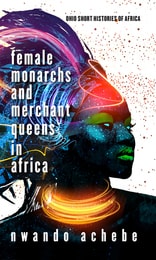
Female Monarchs and Merchant Queens in Africa
Nwando Achebe
Ohio University Press, 2020

Feminism And Anthropology
Henrietta Moore
University of Minnesota Press, 1989

Feminism and Affect at the Scene of Argument
Beyond the Trope of the Angry FeministAuthored by Barbara Tomlinson
Temple University Press, 2010
Are feminists really angry, unreasoning, man-haters who argue only from an emotional perspective as some claim? Does the incessant repetition of this trope make anti-feminism and misogyny a routine element in everyday speech? And does this repetition work towards delegitimizing feminist arguments and/or undermining feminist politics? How do skilled feminist writers deploy affect to advance feminist ideas? In Feminismand Affect at the Scene of Argument, Barbara Tomlinson addresses these questions, providing a lucid examination of the role of affect in feminist and antifeminist academic arguments.
Using case studies from controversies in socio-legal studies, musicology, and science studies, among other disciplines, Tomlinson examines the rhetorics of anger, contempt, betrayal, intensification, and ridicule. She employs a set of critical tools—feminist “socio-forensic” discursive analysis—that will prove indispensible for understanding and countering tropes like that of the angry feminist. Moreover, these tools will advance feminism, which, she argues, is generated in and by arguments with allies and antagonists.
In an era of debates that generate more heat than light, Feminism and Affectat the Scene of Argument offers a timely provocation for transforming the terms of reading and writing in scholarship and civic life.

Feminism and Political Theory
Edited by Cass R. Sunstein
University of Chicago Press, 1990

Feminism and the Biological Body
Birke, Lynda
Rutgers University Press, 2000
What is a body? What are our perceptions of our inner bodies? How are these perceptions influenced?
In recent years, thinking about the body has become highly fashionable. However, the renewed focus, while certainly welcome, seems to always end at the corporeal surface. While recent sociological and feminist theory has made important claims about the process of cultural inscription on the body, and about the cultural representation of the body, what actually appears in this new theory seems to be, ironically, disembodied. If this newly theorized form has interiority, it is one that is explained predominantly through psychoanalysis. The physiological processes remain a mystery to be explained, if at all, only in the esoteric language of biomedicine.
As a trained biologist, Lynda Birke was frustrated by the gap between feminist cultural analysis and her own scientific background. In this book, she seeks to bridge this gap using ideas in anatomy and physiology to develop the feminist view that the biological body is socially and culturally constructed. Birke rejects the assumption that bodily function is somehow fixed and unchanging, claiming that biology offers more than just a deterministic narrative of how nature works. Feminism and the Biological Body brings natural science and feminist theory together and suggests that we need a new politics that includes, rather than denies, our flesh.
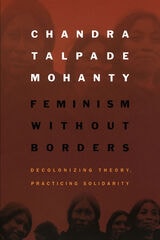
Feminism without Borders
Decolonizing Theory, Practicing SolidarityChandra Talpade Mohanty
Duke University Press, 2003
Feminism without Borders opens with Mohanty's influential critique of western feminism ("Under Western Eyes") and closes with a reconsideration of that piece based on her latest thinking regarding the ways that gender matters in the racial, class, and national formations of globalization. In between these essays, Mohanty meditates on the lives of women workers at different ends of the global assembly line (in India, the United Kingdom, and the United States); feminist writing on experience, identity, and community; dominant conceptions of multiculturalism and citizenship; and the corporatization of the North American academy. She considers the evolution of interdisciplinary programs like Women's Studies and Race and Ethnic Studies; pedagogies of accommodation and dissent; and transnational women's movements for grassroots ecological solutions and consumer, health, and reproductive rights. Mohanty's probing and provocative analyses of key concepts in feminist thought—"home," "sisterhood," "experience," "community"—lead the way toward a feminism without borders, a feminism fully engaged with the realities of a transnational world.

Feminism
A Brief Introduction to the Ideas, Debates, and Politics of the MovementDeborah Cameron
University of Chicago Press, 2019
In the era of #MeToo, Trump, and online harassment, innovative progressive feminist voices are more essential than ever. With her latest book, Deborah Cameron considers feminism from all sides—as an idea, as a theoretical approach, and as a political movement. Written in the succinct, sharp style that has made Cameron’s feminist linguistics blog so popular, this short book lays out past and present debates on seven key topics: domination, rights, work, femininity, sex, culture, and the future. Feminism emphasizes the diversity of feminist thought, including queer, women-of-color, and trans perspectives. Cameron’s clear and incisive account untangles the often confusing strands of one of history’s most important intellectual and political movements.
Broad in scope but refreshingly concise, this book is perfect for anyone who needs a straightforward primer on the complex history of feminism, a nuanced explanation of key issues and debates, or strategic thinking about the questions facing activists today.
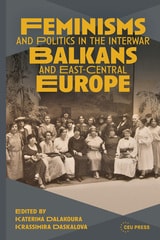
Feminisms and Politics in the Interwar Balkans and East-Central Europe
Katerina Dalakoura
Central European University Press, 2026
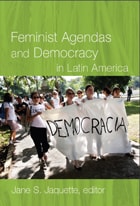
Feminist Agendas and Democracy in Latin America
Jane S. Jaquette, ed.
Duke University Press, 2009
The book is organized around three broad topics. The first, women’s access to political power at the national level, is addressed by essays on the election of Michelle Bachelet in Chile, gender quotas in Argentina and Brazil, and the responses of the women’s movement to the “Bolivarian revolution” in Venezuela. The second topic, the use of legal strategies, is taken up in essays on women’s rights across the board in Argentina, violence against women in Brazil, and gender in the work of the Truth and Reconciliation Commission in Peru. Finally, the international impact of Latin American feminists is explored through an account of their participation in the World Social Forum, an assessment of a Chilean-led project carried out by women’s organizations in several countries to hold governments to the promises they made at international conferences in Cairo and Beijing, and an account of cross-border organizing to address femicides and domestic abuse in the Juárez-El Paso border region. Jane S. Jaquette provides the historical and political context of women’s movement activism in her introduction, and concludes the volume by engaging contemporary debates about feminism, civil society, and democracy.
Contributors. Jutta Borner, Mariana Caminotti, Alina Donoso, Gioconda Espina, Jane S. Jaquette, Beatriz Kohen, Julissa Mantilla Falcón, Jutta Marx, Gabriela L. Montoya, Flávia Piovesan, Marcela Ríos Tobar, Kathleen Staudt, Teresa Valdés, Virginia Vargas
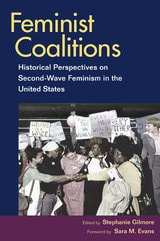
Feminist Coalitions
Historical Perspectives on Second-Wave Feminism in the United StatesEdited by Stephanie Gilmore. Foreword by Sara Evans.
University of Illinois Press, 2007
Much of the scholarship on second-wave feminism has focused on divisions within the women's movement and its narrow conception of race and class, but the contributors to this volume remind readers that feminists in the 1960s and 1970s also formed many strong partnerships, often allying themselves with a diverse range of social justice efforts on a local grassroots level. These essays focus on coalitions and alliances in which feminists and other activists joined forces to address crucial social justice issues such as reproductive rights, the peace movement, women's health, Christianity and other religions, and neighborhood activism, as well as alliances crossing boundaries of race, class, political views, and sexual identity. The contributors bring fresh perspectives to feminist history by calling attention to how women struggled to include and represent diverse women without minimizing the difficulties of conceptualizing a singular feminism.
Contributors are Maria Bevacqua, Tamar Carroll, Marisa Chappell, Andrea Estepa, Sara M. Evans, Amy Farrell, Stephanie Gilmore, Cynthia Harrison, Elizabeth Kaminski, Wendy Kline, Premilla Nadasen, Caryn Neumann, Anne M. Valk, and Emily Zuckerman.

Feminist Comedy
Women Playwrights of LondonWillow White
University of Delaware Press, 2024
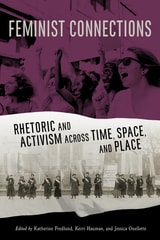
Feminist Connections
Rhetoric and Activism across Time, Space, and PlaceEdited by Katherine Fredlund, Kerri Hauman, and Jessica Ouellette
University of Alabama Press, 2020
Tracing the rhetoric of feminist activism across generations, cultures, and movements.
In 1917, Alice Paul and other suffragists famously picketed in front of the White House while holding banners with short, pithy sayings such as “Mr. President: How long must women wait for Liberty?” Their juxtaposition of this short phrase with the image of the White House (a symbol of liberty and justice) relies on the same rhetorical tactics as memes, a genre contemporary feminists use frequently to make arguments about reproductive rights, Black Lives Matter, sex-positivity, and more. Many such connections between feminists of different spaces, places, and eras have yet to be considered, let alone understood. Feminist Connections: Rhetoric and Activism across Time, Space, and Place reconsiders feminist rhetorical strategies as linked, intergenerational, and surprisingly consistent despite the emergence of new forms of media and intersectional considerations.
Contributors to this volume highlight continuities in feminist rhetorical practices that are often invisible to scholars, obscured by time, new media, and wildly different cultural, political, and social contexts. Thus, this collection takes a nonchronological approach to the study of feminist rhetoric, grouping chapters by rhetorical practice rather than time, content, or choice of media.
By connecting historical, contemporary, and future trajectories, this collection develops three feminist rhetorical frameworks: revisionary rhetorics, circulatory rhetorics, and response rhetorics. A theorization of these frameworks explains how feminist rhetorical practices (past and present) rely on similar but diverse methods to create change and fight oppression. Identifying these strategies not only helps us rethink feminist rhetoric from an academic perspective but also allows us to enact feminist activist rhetorics beyond the academy during a time in which feminist scholarship cannot afford to remain behind its hallowed yet insular walls.

Feminist Literacies, 1968-75
Kathryn Thoms Flannery
University of Illinois Press, 2010
In the late 1960s and early 1970s, ordinary women affiliated with the women's movement were responsible for a veritable explosion of periodicals, poetry, and manifestos, as well as performances designed to support "do-it-yourself" education and consciousness-raising. Kathryn Thoms Flannery discusses this outpouring and the group education, brainstorming, and creative activism it fostered as the manifestation of a feminist literacy quite separate from women's studies programs at universities or the large-scale political workings of second-wave feminism. Seeking to break down traditional barriers such as the dichotomies of writer/reader or student/teacher, these new works also forged polemical alternatives to the forms of argumentation traditionally used to silence women, creating a space for fresh voices. Feminist Literacies explores these truly radical feminist literary practices and pedagogies that flourished during a brief era of volatility and hope.
Feminist Messages
CODING IN WOMEN'S FOLK CULTUREEdited by Joan Newlon Radner
University of Illinois Press, 1993

Feminist Organizations
Harvest of the New Women's Movementedited by Myra Marx Ferree and Patricia Yancey Martin
Temple University Press, 1995
This collection of twenty-six original essays looks at contemporary feminist organizations, how they've survived, the effects of their work, the problems they face, the strategies they develop, and where the women's movement is headed. The contributors, leading feminist scholars from nine social science disciplines, examine a wide variety of local feminist organizations, past and preset, illuminating the struggles of feminist organizers and activists.
In the series Women in the Political Economy, edited by Ronnie J. Steinberg.
Feminist Post-Liberalism
Judith A. Baer
Temple University Press, 2020
Feminism and liberalism need each other, argues Judith Baer. Her provocative book, Feminist Post-Liberalism, refutes both conservative and radical critiques. To make her case, she rejects classical liberalism in favor of a welfare—and possibly socialist—post-liberalism that will prevent capitalism and a concentration of power that reinforces male supremacy. Together, feminism and liberalism can better elucidate controversies in American politics, law, and society.
Baer emphasizes that tolerance and self-examination are virtues, but within both feminist and liberal thought these virtues have been carried to extremes. Feminist theory needs liberalism's respect for reason, while liberal theory needs to incorporate emotion. Liberalism focuses too narrowly on the individual, while feminism needs a dose of individualism.
Feminist Post-Liberalism includes anthropological foundations of male dominance to explore topics ranging from crime to cultural appropriation. Baer develops a theory that is true to the principles of both feminist and liberal ideologies.
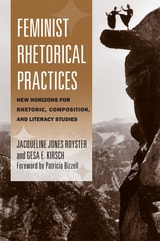
Feminist Rhetorical Practices
New Horizons for Rhetoric, Composition, and Literacy StudiesJacqueline Jones Royster and Gesa E. Kirsch
Southern Illinois University Press, 2012
To contextualize a new and changed landscape for narratives in the history of rhetoric, Royster and Kirsch present four critical terms of engagement—critical imagination, strategic contemplation, social circulation, and globalization—as the foundation for a new analytical model for understanding, interpreting, and evaluating feminist rhetorical inquiry and the study and teaching of rhetoric in general. This model draws directly on the wealth of knowledge and understanding gained from feminist rhetorical practices, especially sensitivity toward meaningfully and respectfully rendering the work, lives, cultures, and traditions of historical and contemporary women in rhetorical scholarship.
Proposing ambitious new standards for viewing and valuing excellence in feminist rhetorical practice, Royster and Kirsch advocate an ethos of respect and humility in the analysis of communities and specific rhetorical performances neglected in rhetorical history, recasting rhetorical studies as a global phenomenon rather than a western one. They also reflect on their own personal and professional development as researchers as they highlight innovative feminist research over the past thirty years to articulate how feminist work is changing the field and pointing to the active participation of women in various discourse arenas and to the practices and genres they use.
Valuable to new and established scholars of rhetoric, Feminist Rhetorical Practice: New Horizons for Rhetoric, Composition, and Literacy Studies is essential for understanding the theoretical, methodological, and ethical impacts of feminist rhetorical studies on the wider field.
Winner, 2014 Winifred Bryan Horner Outstanding Book Award
Feminist Rhetorical Resilience
Elizabeth A. Flynn, Patricia Sotirin, and Ann Brady
Utah State University Press, 2012
Although it is well known in other fields, the concept of “resilience” has not been addressed explicitly by feminist rhetoricians. This collection develops it in readings of rhetorical situations across a range of social contexts and national cultures. Contributors demonstrate that resilience offers an important new conceptual frame for feminist rhetoric, with emphasis on agency, change, and hope in the daily lives of individuals or groups of individuals disempowered by social or material forces. Collectively, these chapters create a robust conception of resilience as a complex rhetorical process, redeeming it from its popular association with individual heroism through an important focus on relationality, community, and an ethics of connection. Resilience, in this volume, is a specifically rhetorical response to complicated forces in individual lives. Through it, Feminist Rhetorical Resilience widens the interpretive space within which rhetoricians can work.

Feminist Technology
Edited by Linda L. Layne, Sharra L. Vostral, and Kate Boyer
University of Illinois Press, 2010
Is there such a thing as a "feminist technology"? If so, what makes a technology feminist? Is it in the design process, in the thing itself, in the way it is marketed, or in the way it is used by women (or by men)?
In this collection, feminist scholars trained in diverse fields consider these questions by examining a range of products, tools, and technologies that were specifically designed for and marketed to women. Evaluating the claims that such products are liberating for women, the contributors focus on case studies of menstrual-suppressing birth control pills, home pregnancy tests, tampons, breast pumps, Norplant, anti-fertility vaccines, and microbicides. In examining these various products, this volume explores ways of actively intervening to develop better tools for designing, promoting, and evaluating feminist technologies. Recognizing the different needs and desires of women and acknowledging the multiplicity of feminist approaches, Feminist Technology offers a sustained debate on existing and emergent technologies that share the goal of improving women's lives.
Contributors are Jennifer Aengst, Maia Boswell-Penc, Kate Boyer, Frances Bronet, Shirley Gorenstein, Anita Hardon, Deborah G. Johnson, Linda L. Layne, Deana McDonagh, and Sharra L. Vostral.

Feminist Theory and the Study of Folklore
Edited by Susan Tower Hollis, Linda Pershing, and M. Jane Young
University of Illinois Press, 1994
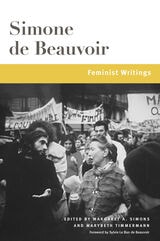
Feminist Writings
Simone de Beauvoir; Edited by Margaret A. Simons and Marybeth Timmermann; Foreword by Sylvie Le Bon de Beauvoir
University of Illinois Press, 2015
By turns surprising and revelatory, this sixth volume in the Beauvoir Series presents newly discovered writings and lectures while providing new translations and contexts for Simone de Beauvoir's more familiar writings. Spanning Beauvoir's career from the 1940s through 1986, the pieces explain the paradoxes in her political and feminist stances, including her famous 1972 announcement of a "conversion to feminism" after decades of activism on behalf of women.
Feminist Writings documents and contextualizes Beauvoir's thinking, writing, public statements, and activities in the services of causes like French divorce law reform and the rights of women in the Iranian Revolution. In addition, the volume provides new insights into Beauvoir's complex thinking and illuminates her historic role in linking the movements for sexual freedom, sexual equality, homosexual rights, and women's rights in France.

Fetal Rights, Women's Rights
Gender Equality in the WorkplaceSuzanne U. Samuels
University of Wisconsin Press, 1995
In the late 1970s and throughout the 1980s, many private employers in the United States enacted fetal protection policies that barred fertile women—that is, women who had not been surgically sterilized—from working in jobs that might expose fetuses to toxins. In Fetal Rights, Women’s Rights, Suzanne Samuels analyzes these policies and the ambiguous responses to them by federal and state courts, legislatures, administrative agencies, litigants, and interest groups. She poses provocative questions about the implicit links between social welfare concerns and paternalism in the workplace, including: are women workers or wombs?
Placing the fetal protection controversy within the larger societal debate about gender roles, Samuels argues that governmental decision-makers confuse sex, which is based solely on biological characteristics, with gender, which is based on societal conceptions. She contends that the debate about fetal protection policies brought this ambiguity into stark relief, and that the response of policy-makers was rooted in assumptions about gender roles. Judges, legislators, and regulators used gender as a proxy, she argues, to sidestep the question of whether fetal protection policies could be justified by the biological differences between women and men.
The fetal protection controversy raises a number of concerns about women's role in the workplace. Samuels discusses the effect on governmental policies of the ongoing controversy over abortion rights and the debates between egalitarian and relational feminists about the treatment of women at work. A timely and engrossing study, Fetal Rights, Women's Rights details the pattern of gender politics in the United States and demonstrates the broader ramifications of gender bias in the workplace.

Fictions Of Feminist Ethnography
Kamala Visweswaran
University of Minnesota Press, 1994
Although feminist ethnography is an emerging genre, the question of what the term means remains open. Recent texts that fall under this rubric rely on unexamined notions of "sisterhood" and the recovery of "lost" voices. Writing about her work with women in Southern India, Kamala Visweswaran addresses such troubled questions in the essays that make up Fictions of Feminist Ethnography. Blurring distinctions between ethnographic and literary genres, the author employs the narrative strategies of history, fiction, autobiography and biography, deconstruction, and postcolonial discourse to reveal the fictions of ethnography and the ethnography in fiction. In the process of reflecting on the nature of anthropology itself Visweswaran devises an experimental approach to writing feminist ethnography.
What sets this work apart from other self-reflexive feminist ethnographies is its rigorous engagement with the concrete inequalities, refusals, and misunderstandings between the author and the women she worked with in India. In each essay, she takes up the specific ellipses of power differentials in her field research and works out their epistemological consequences. The result is a series of contextualizations of the politics of identity in the field, at "home," and within the lives of women who particpated in the Indian nationalist movement. We learn in lucid detail about the partiality of knowledge and the inevitable difficulties and violations involved in representing the lives of women, both inside and outside the United States. Clearly and forcefully written, this book should be of interest not only to anthropologists but also to cultural theorists and critics, feminist scholars and writers, and other social scientists who grapple with epistemological and political issues in their fields.Fictions of Modesty
Women and Courtship in the English NovelRuth Bernard Yeazell
University of Chicago Press, 1991
Combining evidence from conduct books and ladies' magazines with the arguments of influential theorists like Hume, Rousseau, and Wollstonecraft, this book begins by asking why writers were devoted to the anxious remaking of women's "nature" and to codifying rules for their porper behavior. Fictions of Modesty shows how the culture at once tried to regulate young women's desires and effectively opened up new possibilities of subjectivity and individual choice.
Yeazell goes on to demonstrate that modest delaying actions inform a central tradition of English narrative. On the Continent, the English believed, the jeune fille went from the artificial innocence of the convent to an arranged marriage and adultery; the natural modesty of the Englishwoman, however, enabled her to choose her own mate and to marry both prudently and with affection. Rather than taking its narrative impetus from adultery, then, English fiction concentrated on courtship and the consciousness of the young woman choosing. After paired studies of Richardson's Pamela and Cleland's Memoirs of a Woman of Pleasure (even Fanny Hill, Yeazell argues, is a modest English heroine at heart), Yeazell investigates what women novelists made of the virtues of modesty in works by Burney, Austen, Charlotte Bronte, and Gaskell.
A speculative postscript briefly addresses the discourse of late nineteenth-century science in order to show how Darwin's theory of sexual selection and Havelock Ellis's psychology of sex replicate fictions of female modesty. While those who sought to codify modest behavior in previous centuries often appealed to Nature for support, our modern understanding of the natural, Yeazell suggests, owes something to the work of the novelists.
Sharply reasoned and witty, Fictions of Modesty will appeal to all those interested in women's studies, the English novel, and the continuing history of relations between the sexes.

Fiela's Child
Dalene Matthee
University of Chicago Press, 1992
Set in nineteenth-century rural Africa, Fiela's Child tells the gripping story of Fiela Komoetie and a white, three-year old child, Benjamin, whom she finds crying on her doorstep. For nine years Fiela raises Benjamin as one of her own children. But when census takers discover Benjamin, they send him to an illiterate white family of woodcutters who claim him as their son. What follows is Benjamin's search for his identity and the fundamental changes affecting the white and black families who claim him.
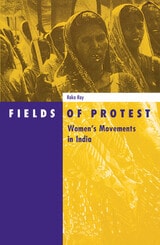
Fields Of Protest
Women’s Movement in IndiaRaka Ray
University of Minnesota Press, 1999
A comparative analysis of women’s struggle for change in India.
The women’s movement in India has a long and rich history in which millions of women live, work, and struggle to survive in order to remake their family, home, and social lives. Whether fighting for safe contraception, literacy, water, and electricity or resisting sexual harassment, they are participating in vibrant and active women’s movements that are thriving in many parts of India today.
Fields of Protest explores the political and cultural circumstances under which groups of women organize to fight for their rights and self-worth. Starting with Bombay and Calcutta, Raka Ray discusses the creation of “political fields”-structured, unequal, and socially constructed political environments within which organizations exist, flourish, or fail. Women’s organizations are not autonomous or free agents; rather, they inherit a “field” and its accompanying social relations, and when they act, they act in response to it and within it. Drawing on the literature of both social movements and feminism, Ray analyzes the striking differences between the movements in these two cities.Using an innovative and comparative perspective, Ray offers a unique look at Indian activist women and adds a new dimension to the study of women’s movements on a global level.
Fighting for Equality
A Life of May Wright SewallRay E. Boomhower
Indiana Historical Society Press, 2007

Fighting for NOW
Diversity and Discord in the National Organization for WomenKelsy Kretschmer
University of Minnesota Press, 2019
An unparalleled exploration of NOW’s trajectory, from its founding to the present—and its future
A new wave of feminist energy has swept the globe since 2016—from women’s marches and the #MeToo movement to transwomen’s inclusion and exclusion in feminism and participation in institutional politics. Amid all this, an organization declared dead or dying for thirty years—the National Organization for Women—has seen a membership boom. NOW presents an intriguing puzzle for scholars and activists alike. Considered one of the most stable organizations in the feminist movement, it has experienced much conflict and schism. Scholars have long argued that factionalism is the death knell of organizations, yet NOW continues to thrive despite internal conflicts.
Fighting for NOW seeks to better understand how bureaucratic structures like NOW’s simultaneously provide stability and longevity, while creating space for productive and healthy conflict among members. Kelsy Kretschmer explores these ideas through an examination of conflict in NOW’s local chapters, its task forces and committees, and its satellite groups. NOW’s history provides evidence for three basic arguments: bureaucratic groups are not insulated from factionalism; they are important sites of creativity and innovation for their movements; and schisms are not inherently bad for movement organizations. Hence, Fighting for NOW is in stark contrast to conventional scholarship, which has conceptualized factionalism as organizational failure. It also provides one of the few book-length explorations of NOW’s trajectory, from its founding to the modern context.
Scholars will welcome the book’s insights that draw on open systems and resource dependency theories, as well as its rethinking of how conflict shapes activist communities. Students will welcome its clear and compelling history of the feminist movement and of how feminist ideas have changed over the past five decades.
Figure Skating in the Formative Years
Singles, Pairs, and the Expanding Role of WomenJames R. Hines
University of Illinois Press, 2015
Renowned sports historian James R. Hines chronicles figure skating's rise from its earliest days through its head-turning debut at the 1908 Olympics and its breakthrough as entertainment in the 1930s. Hines credits figure skating's explosive expansion to an ever-increasing number of women who had become proficient skaters and wanted to compete, not just in singles but with partners as well.
Matters reached a turning point when British skater Madge Syers entered the otherwise-male 1902 World Championship held in London and finished second. Called skating's first feminist, Syers led a wave of women who made significant contributions to figure skating and helped turn it into today's star-making showcase at every Winter Olympics.
Packed with stories and hard-to-find details, Figure Skating in the Formative Years tells the early history of a sport loved and followed by fans around the world.