Results by title
52 books match the query 'Women in motion pictures' and 5 start with f
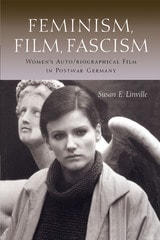
Feminism, Film, Fascism
Women's Auto/biographical Film in Postwar GermanyBy Susan E. Linville
University of Texas Press, 1998
German society's inability and/or refusal to come to terms with its Nazi past has been analyzed in many cultural works, including the well-known books Society without the Father and The Inability to Mourn. In this pathfinding study, Susan Linville challenges the accepted wisdom of these books by focusing on a cultural realm in which mourning for the Nazi past and opposing the patriarchal and authoritarian nature of postwar German culture are central concerns—namely, women's feminist auto/biographical films of the 1970s and 1980s.
After a broad survey of feminist theory, Linville analyzes five important films that reflect back on the Third Reich through the experiences of women of different ages—Marianne Rosenbaum's Peppermint Peace, Helma Sanders-Brahms's Germany, Pale Mother, Jutta Brückner's Hunger Years, Margarethe von Trotta's Marianne and Juliane, and Jeanine Meerapfel's Malou. By juxtaposing these films with the accepted theories on German culture, Linville offers a fresh appraisal not only of the films' importance but especially of their challenge to misogynist interpretations of the German failure to grieve for the horrors of its Nazi past.
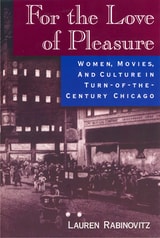
For the Love of Pleasure
Women, Movies, and Culture in Turn-of-the-Century ChicagoRabinovitz, Lauren
Rutgers University Press, 1998
--Gaylyn Studlar, atuhor of This Mad Masquerade: Stardom and Masculinity in the Jazz Age
The period from the 1880s until the 1920s saw the making of a consumer society, the inception of the technological, economic, and social landscape in which we currently live. Cinema played a key role in the changing urban landscape. For working-class women, it became a refuge from the factory. For middle-class women, it presented a new language of sexual danger and pleasure. Women found greater freedom in big cities, entering the workforce in record numbers and moving about unchaperoned in public spaces. Turn-of-the-century Chicago surpassed even New York as a proving ground for pleasure and education, attracting women workers at three times the national rate. Using Chicago as a model, Lauren Rabinovitz analyzes the rich interplay among demographic, visual, historical, and theoretical materials of the period. She skillfully links cinema theory and women's studies for a fuller understanding of cultural history. She also demonstrates how cinema dramatically affected social conventions, ultimately shaping modern codes of masculinity and feminity.
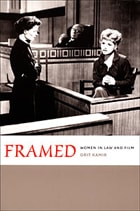
Framed
Women in Law and FilmOrit Kamir
Duke University Press, 2006
Through innovative readings of a dozen movies made between 1928 and 2001 in Europe, Japan, and the United States, Orit Kamir shows that in representing “gender crimes,” feature films have constructed a cinematic jurisprudence, training audiences worldwide in patterns of judgment of women (and men) in such situations. Offering a novel formulation of the emerging field of law and film, Kamir combines basic legal concepts—murder, rape, provocation, insanity, and self-defense—with narratology, social science methodologies, and film studies.
Framed not only offers a unique study of law and film but also points toward new directions in feminist thought. Shedding light on central feminist themes such as victimization and agency, multiculturalism, and postmodernism, Kamir outlines a feminist cinematic legal critique, a perspective from which to evaluate the “cinematic legalism” that indoctrinates and disciplines audiences around the world. Bringing an original perspective to feminist analysis, she demonstrates that the distinction between honor and dignity has crucial implications for how societies construct women, their social status, and their legal rights. In Framed, she outlines a dignity-oriented, honor-sensitive feminist approach to law and film.
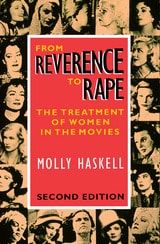
From Reverence to Rape
The Treatment of Women in the MoviesMolly Haskell
University of Chicago Press, 1987
"An incisive, exceedingly thoughtful look at the distorted lens through which Hollywood has historically viewed women. It is a valuable contribution not just of film criticism but to a society in which the vital role of women is just beginning to emerge."—Christian Science Monitor
"Haskell is interested in women—how they are used in movies, how they use movies, and how the parts they play function as projections and verifications of our myths about women's lot and woman's psyche and even, lately, women's lib."—Jane Kramer, Village Voice
"In examining the goddesses worshipped by an entire nation, Molly Haskell reveals a good deal about our national character and our most cherished sexual myths. . . . Concerned with the deeply ingrained belief of women's inferiority, she analyzes movies as a social product as well as a social arbiter, and she effectively demonstrates how women are encouraged to impose limitations on themselves by fashioning those selves after flickering shadows in a darkened auditorium—sexual creatures who possess neither ability nor ambition beyond their bodies. . . . Both as an examination of film and as sociology, From Reverence to Rape is excellent."—Harriet Kriegel, The Nation
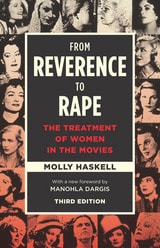
From Reverence to Rape
The Treatment of Women in the Movies, Third EditionMolly Haskell
University of Chicago Press, 2016