Results by title
211 books match the query 'Working class' and 10 start with f
False Promises
The Shaping of American Working Class ConsciousnessStanley Aronowitz
Duke University Press, 1992
Fighting for Total Person Unionism
Harold Gibbons, Ernest Calloway, and Working-Class CitizenshipRobert Bussell
University of Illinois Press, 2015
Finns in Michigan
Gary Kaunonen
Michigan State University Press, 2009
In Finns in Michigan Gary Kaunonen probes the intricacies of immigration, labor, and ideology among the members of this intriguing and historically important ethnic group. He skillfully traces the evolution of a vibrant, diverse, dramatic, and at times deeply quarrelsome people who left an indelible mark on the state's history.
Kaunonen examines the many schisms and splits that define the course of Finnish social life in Michigan. Michigan's Finns flocked to diverse cultural organizations that span a broad ideological spectrum. This book examines an extraordinarily wide range of organizations, including religious institutions, temperance societies, working-class political and labor groups, the cooperative movement, and a nationalist association of Finns.
Finns in Michigan is a study of the contributions of Michigan's Finns in the workplace, in society, and in cultural life. Unlike previous, sometimes mythologized, histories of the Finns in Michigan, Kaunonen's rendition strives to be a more accurate representation of "the good, the bad, and the other" activities of a group he calls "possibly America's most diverse family."
For Dignity, Justice, and Revolution
An Anthology of Japanese Proletarian LiteratureEdited by Heather Bowen-Struyk and Norma Field
University of Chicago Press, 2015
Contextualized by introductory essays, forty expertly translated stories touch on topics like perilous factories, predatory bosses, ethnic discrimination, and the myriad indignities of poverty. Together, they show how even intensely personal issues form a pattern of oppression. Fostering labor consciousness as part of an international leftist arts movement, these writers, lovers of literature, were also challenging the institution of modern literature itself. This anthology demonstrates the vitality of the “red decade” long buried in modern Japanese literary history.
For Their Own Good
The Transformation of English Working-Class Health Culture, 1880–1970Lucinda Mccray Beier
The Ohio State University Press, 2008
Fort Necessity
David Gewanter
University of Chicago Press, 2018
Haunted by his father’s autopsy of a workman he witnessed as a child, Gewanter forges intensely personal poems that explore the fate of our laboring bodies, from the Carnegie era’s industrial violence and convict labor to our present day of broken trust, profiteering, and the Koch brothers. Guided by a moral vision to document human experience, this unique collection takes raw historical materials—newspaper articles, autobiography and letters, court testimony, a convict ledger, and even a menu—and shapes them into sonnets, ballads, free verse, and prose poems. The title poem weaves a startling lyric sequence from direct testimony by steelworkers and coal-miners, strikers and members of prison chain-gangs, owners and anarchists, revealing an American empire that feeds not just on oil and metal, but also on human energy, impulse, and flesh. Alongside Gewanter’s family are hapless souls who dream of fortune, but cannot make their fates, confronting instead the dark outcomes of love, loyalty, fantasy, and betrayal.
Free Labor
The Civil War and the Making of an American Working ClassMark A. Lause
University of Illinois Press, 2015
Mark A. Lause describes how the working class radicalized during the war as a response to economic crisis, the political opportunity created by the election of Abraham Lincoln, and the ideology of free labor and abolition. His account moves from battlefield and picket line to the negotiating table, as he discusses how leaders and the rank-and-file alike adapted tactics and modes of operation to specific circumstances. His close attention to women and African Americans, meanwhile, dismantles notions of the working class as synonymous with whiteness and maleness.
In addition, Lause offers a nuanced consideration of race's role in the politics of national labor organizations, in segregated industries in the border North and South, and in black resistance in the secessionist South, creatively reading self-emancipation as the largest general strike in U.S. history.
From Cottage to Bungalow
Houses and the Working Class in Metropolitan Chicago, 1869-1929Joseph C. Bigott
University of Chicago Press, 2001
Joseph C. Bigott takes on all of these fields in From Cottage to Bungalow, a sophisticated study of domestic structures and ethnic working-class neighborhoods in Chicago during the critical period of 1869 to 1929, when the city attracted huge numbers of immigrants. Exploring the meaning of home ownership in this context, Bigott develops two case studies that combine the intimate lives of ordinary people (primarily in Chicago's Polish and German communities) with broad analysis of everything from real estate markets to the very carpentry practices used to construct houses. His progressive methods and the novel conclusions they support chronicle not only the history of housing in Chicago, but also the organizations of people's lives, and the ways in which housing has affected notions of who is—and who is not—a worthy American citizen.
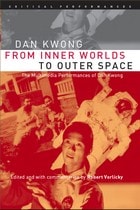
From Inner Worlds to Outer Space
The Multimedia Performances of Dan KwongDan Kwong
University of Michigan Press, 2004
"Somehow, Kwong has held onto his sense of childlike wonder about the cosmos, and that awe informs his free-wheeling and uproarious performance."
-Asian Week
"He weaves striking, multi-focus stage pictures around simple monologues about his Chinese and Japanese grandfathers, ironic accounts of his own childhood, and litanies of the trials facing Asian American males."
-L.A. Times
"Saturated with high-spirited enthusiasm . . . a refreshingly forthright approach to his often dark material."
-Chicago Tribune
"Kwong's humor is warm and loving . . . it stems from a delightfully twisted taste for the absurdity of human behavior. . . . Be prepared to laugh, to be moved, and to fall in love with a performer."
-L.A. Reader
Dan Kwong's performances delve into the complexities of growing up as a working-class Chinese-Japanese-American male in L.A., land of Hollywood and Disney. Kwong's remarkable performances, a potent array of multimedia effects and athletic physicalization, investigate questions of identity and the intersecting effects of race, culture, class, gender, and sexuality. From Inner Worlds to Outer Space brings together Kwong's scripts with illuminating commentary by critic Robert Vorlicky. The book includes interviews that reveal Kwong's personal and artistic influences, his evolution as an artist, and his philosophical and technical approach to art-making.
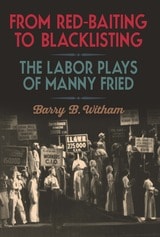
From Red-Baiting to Blacklisting
The Labor Plays of Manny FriedBarry B. Witham
Southern Illinois University Press, 2020
Author Barry B. Witham reclaims the work of Manny Fried, an essential American playwright so thoroughly blacklisted after he defied the House Committee on Un-American Activities in 1954, and again in 1964, that his work all but completely disappeared from the canon. Witham details Manny Fried’s work inside and outside the theatre and examines his three major labor plays and the political climate that both nurtured and disparaged their productions. Drawing on never-before-published interview materials, Witham reveals the details of how the United States government worked to ruin Fried’s career.
From Red-Baiting to Blacklisting includes the complete text of Fried’s major labor plays, all long out of print. In Elegy for Stanley Gorski, Fried depicts one of the many red-baiting campaigns that threatened countless unions in the wake of the Taft-Hartley Act and the collusion of the Catholic Church with these activities. In Drop Hammer, Fried tackles the issues of union dues, misappropriation, and potential criminal activities. In the third play, The Dodo Bird, perhaps his most popular, Fried achieves a remarkable character study of a man outsourced from his job by technology and plant closures.
Manny Fried’s plays portray the hard edges of capitalism and government power and illuminate present-day struggles with hostility to labor unions and the passage in several states of right-to-work laws. Fried had no illusions about the government’s determination to destroy communism and unionism—causes to which he was deeply committed.