Results by title
28167 books match the query 'History' and 1092 start with f
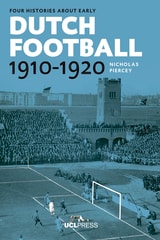
Four Histories about Early Dutch Football, 1910-1920
Constructing DiscoursesNicholas Piercey
University College London, 2016
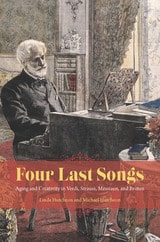
Four Last Songs
Aging and Creativity in Verdi, Strauss, Messiaen, and BrittenLinda Hutcheon and Michael Hutcheon
University of Chicago Press, 2015
Giuseppe Verdi (1813–1901), Richard Strauss (1864–1949), Olivier Messiaen (1908–92), and Benjamin Britten (1913–76) all wrote operas late in life, pieces that reveal unique responses to the challenges of growing older. Verdi’s Falstaff, his only comedic success, combated Richard Wagner’s influence by introducing young Italian composers to a new model of national music. Strauss, on the other hand, struggling with personal and political problems in Nazi Germany, composed the self-reflexive Capriccio, a “life review” of opera and his own legacy. Though it exhausted him physically and emotionally, Messiaen at the age of seventy-five finished his only opera, Saint François d’Assise, which marked the pinnacle of his career. Britten, meanwhile, suffering from heart problems, refused surgery until he had completed his masterpiece, Death in Venice. For all four composers, age, far from sapping their creative power, provided impetus for some of their best accomplishments.
With its deft treatment of these composers’ final years and works, Four Last Songs provides a valuable look at the challenges—and opportunities—that present themselves as artists grow older.
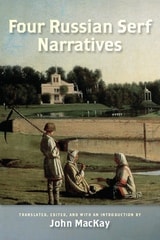
Four Russian Serf Narratives
Translated, edited, and with an introduction by John MacKay
University of Wisconsin Press, 2009
Four Russian Serf Narratives contains four of these accounts and is the first translated collection of autobiographies by serfs. Scholar and translator John MacKay brings to light for an English-language audience a diverse sampling of Russian serf narratives, ranging from an autobiographical poem to stories of adventure and escape. “Autobiography” (1785) recounts a highly educated serf’s attempt to escape to Europe, where he hoped to study architecture. The long testimonial poem “News About Russia” (ca. 1849) laments the conditions under which the author and his fellow serfs lived. In “The Story of My Life and Wanderings” (1881) a serf tradesman tells of his attempt to simultaneously escape serfdom and captivity from Chechen mountaineers. The fragmentary “Notes of a Serf Woman” (1911) testifies to the harshness of peasant life with extraordinary acuity and descriptive power.
These accounts offer readers a glimpse, from the point of view of the serfs themselves, into the realities of one of the largest systems of unfree labor in history. The volume also allows comparison with slave narratives produced in the United States and elsewhere, adding an important dimension to knowledge of the institution of slavery and the experience of enslavement in modern times.

Four Shakespearean Period Pieces
Margreta de Grazia
University of Chicago Press, 2021
Yet recent theoretical work has called for their reappraisal. Anachronisms, previously condemned as errors in the order of time, are being hailed as alternatives to that order. Conversely chronology and periods, its mainstays, are now charged with having distorted the past they have been entrusted to represent, and secularization, once considered the driving force of the modern era, no longer holds sway over the past or the present.
In light of this reappraisal, can Shakespeare studies continue unshaken? This is the question Four Shakespearean Period Pieces takes up, devoting a chapter to each term: on the rise of anachronism, the chronologizing of the canon, the staging of plays “in period,” and the use of Shakespeare in modernity’s secularizing project.
To read these chapters is to come away newly alert to how these fraught concepts have served to regulate the canon’s afterlife. Margreta de Grazia does not entirely abandon them but deftly works around and against them to offer fresh insights on the reading, editing, and staging of the author at the heart of our literary canon.

Four Years in Izumi
Village Japan in the Early Sixteenth CenturyLee Butler
University of Michigan Press, 2026
Four Years in Izumi takes an in-depth and critical approach to understanding Japanese village life through analysis of the diary of Kujō Masamoto, the former chancellor of the imperial court who resided briefly in one of his provincial estates from 1501 to 1504. For a high ranking courtier to travel to the countryside and manage a family estate was unheard of during the era of Sengoku, the “country at war.” The diary Masamoto kept offers a remarkably rich and vivid portrait of village Japan, which has seen no significant study in English-language scholarship.
Through extensive examination of the diary and close and critical reading of it and complementary sources, Lee Butler provides a window into the inner workings of late-medieval village life that challenges typical portrayals of the period. In Four Years in Izumi, we see the complexity of relations between commoners and elites in action. We also see the ways in which an estate functioned in practice at the heart of the medieval economy and local social structure.
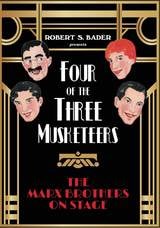
Four of the Three Musketeers
The Marx Brothers on StageRobert S. Bader
Northwestern University Press, 2022
An updated paperback version of the book heralded as “a new benchmark in Marx scholarship” by the Los Angeles Times
Before film made them international comedy legends, the Marx Brothers developed their comic skills on stage for twenty-five years. In Four of the Three Musketeers: The Marx Brothers on Stage, Robert S. Bader offers the first comprehensive history of the foursome’s hardscrabble early years honing their act in front of live audiences.
From Groucho’s debut in 1905 to their final live performances of scenes from A Night in Casablanca in 1945, the brothers’ stage career shows how their characters and routines evolved before their arrival in Hollywood. Four of the Three Musketeers draws on an unmatched array of sources, many not referenced elsewhere. Bader’s detailed portrait of the struggling young actors both brings to vivid life a typical night on the road for the Marx Brothers and illuminates the inner workings of the vaudeville business, especially during its peak in the 1920s.
As Bader traces the origins of the characters that would later come to be beloved by filmgoers, he also skillfully scrapes away the accretion of rumors and mythology perpetuated not only by fans and writers but by the Marx Brothers themselves. Revealing, vital, and entertaining, Four of the Three Musketeers has taken its place as an essential reference for this legendary American act. Now, the updated edition adds newly discovered performances—some submitted by readers—and additional information provided by descendants of long-departed vaudevillians mentioned in the book.

Fourth of July, Asbury Park
A History of the Promised LandDaniel Wolff
Rutgers University Press, 2022
Fourth of July, Asbury Park tells the tale of the city’s first 150 years, guiding us through the development of its lavish amusement parks and bandstands, as well as the decay of its working-class neighborhoods and spread of its racially-segregated ghettos. Featuring exclusive interviews with Springsteen and other prominent Asbury Park residents, Daniel Wolff uncovers the history of how this Jersey shore resort town came to epitomize both the promises of the American dream and the tragic consequences when those promises are broken.
Hailed by The New York Times as a “wonderfully evocative…grand, sad story” when first published in 2006, this revised and expanded edition considers how Asbury Park has changed in the twenty-first century, experiencing both gentrification and new forms of segregation.
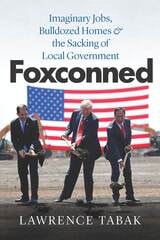
Foxconned
Imaginary Jobs, Bulldozed Homes, and the Sacking of Local GovernmentLawrence Tabak
University of Chicago Press, 2021
When Wisconsin governor Scott Walker stood shoulder to shoulder with President Trump and Speaker of the House Paul Ryan at the White House in July 2017, they painted a glorious picture of his state’s future. Foxconn, the enormous China-based electronics firm, was promising to bring TV manufacturing back to the United States with a $10 billion investment and 13,000 well-paying jobs. They actually were making America great again, they crowed.
Two years later, the project was in shambles. Ten thousand construction workers were supposed to have been building what Trump had promised would be “the eighth wonder of the world.” Instead, land had been seized, homes had been destroyed, and hundreds of millions of municipal dollars had been committed for just a few hundred jobs—nowhere near enough for Foxconn to earn the incentives Walker had shoveled at them. In Foxconned, journalist Lawrence Tabak details the full story of this utter collapse, which was disturbingly inevitable.
As Tabak shows, everything about Foxconn was a disaster. But worse, he reveals how the economic incentive infrastructure across the country is broken, leading to waste, cronyism, and the steady transfer of tax revenue to corporations. Tabak details every kind of financial chicanery, from eminent domain abuse to good old-fashioned looting—all to benefit a coterie of consultants, politicians, and contractors. With compassion and care, he also reports the distressing stories of the many individuals whose lives were upended by Foxconn.
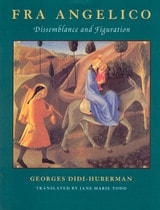
Fra Angelico
Dissemblance and FigurationGeorges Didi-Huberman
University of Chicago Press, 1995
A Florentine painter who took Dominican vows, Fra Angelico (1400-1455) approached his work as a largely theological project. For him, the problems of representing the unrepresentable, of portraying the divine and the spiritual, mitigated the more secular breakthroughs in imitative technique. Didi-Huberman explores Fra Angelico's solutions to these problems—his use of color to signal approaching visibility, of marble to recall Christ's tomb, of paint drippings to simulate (or stimulate) holy anointing. He shows how the painter employed emptiness, visual transformation, and displacement to give form to the mystery of faith.
In the work of Fra Angelico, an alternate strain of Renaissance painting emerges to challenge rather than reinforce verisimilitude. Didi-Huberman traces this disruptive impulse through theological writings and iconographic evidence and identifies a widespread tradition in Renaissance art that ranges from Giotto's break with Byzantine image-making well into the sixteenth century. He reveals how the techniques that served this ultimately religious impulse may have anticipated the more abstract characteristics of modern art, such as color fields, paint spatterings, and the absence of color.
Fractal Repair
Queer Histories of Modern JamaicaMatthew Chin
Duke University Press, 2024

Fractured Politics
Peruvian Democracy Past and PresentEdited by John Crabtree
University of London Press, 2011
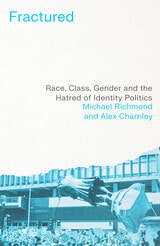
Fractured
Race, Class, Gender and the Hatred of Identity PoliticsMichael
Pluto Press, 2022
Identity politics has smeared political discourse for over a decade. The right uses it to lament the loss of free speech, while many on the left bemoan that it will be the end of class politics. It has been used to dismiss movements such as Black Lives Matter and brought seemingly progressive people into the path of fascism. It has armed the march of the transphobes.
In Fractured, the authors move away from the identity politics debate. Instead of crudely categorizing race, gender, and sexuality as 'identities', or forcing them under the heading of 'diversity', they argue that the interconnectedness of these groupings has always been inseparable from the history of class struggle under British and American capitalism.
Through an appraisal of pivotal historical moments in Britain and the US, and a sharp look at contemporary debates, the authors tame the frenzied culture war, offering a refreshing and reasoned way to understand how class struggle is formed and creating the possibilities for new forms of solidarity in an increasingly fractured world.
Fragile Dreams
Tales of Liberalism and Power in Central EuropeJohn A. Gould
University of Michigan Press, 2021
In Fragile Dreams, John A. Gould examines Central European communism, why it failed, and what has come since. Moving loosely chronologically from 1989 to the present, each chapter focuses on topics of importance to the fields of comparative politics, sociology, and feminist and gender studies. He draws heavily from his own research and experience as well as case studies of the former Czechoslovakia, Western Balkans, and Hungary—but much of the analysis has general applicability to the broader postcommunist region.
Broad in its coverage, this academically rigorous book is ideal for students, travelers, and general readers. Gould writes in the first person and seamlessly blends theory with stories both from the existing literature and from 30 years of regional personal experience with family and friends. Throughout, Gould introduces key concepts, players, and events with precise definitions. Wherever possible, he emphasizes marginalized narratives, centering theory and stories that are often overlooked in standard comparative political science literature.
Fragile but Resilient?
Turkish Electoral Dynamics, 2002-2015Ali Çarkoglu and Ersin Kalaycioglu
University of Michigan Press, 2021
Ersin Kalaycıoğlu and Ali Çarkoğlu, who conducted surveys comparable to the American National Election Survey for the 2002 and 2015 national elections in Turkey, chart the dynamics that brought the pro-Islamist conservative Justice and Development Party (Adalet ve Kalkınma Partisi-AKP) to power in 2002, and that continue to influence electoral politics. The authors trace the uneven course of democratization in Turkey, as revealed through elections, since the first competitive, multi-party elections in 1950. Since the market liberalization reforms of 1980, Turkey has been rapidly evolving from a closed, agricultural, comparatively underdeveloped polity into an open and industrial state primarily integrated with the global economy. Kalaycıoğlu and Çarkoğlu analyze different dimensions of five elections surveys in 2002-2015 period to show how the consequent socio-economic changes and traditional socio-cultural divisions have affected elections, political parties, and individual voters. The authors conclude that the historical-cultural divide between rural, peripheral, conservative groups and more urban, centrist, and modernized groups not only persists but shapes elections more than ever. This book not only provides an original comprehensive and critical evaluation of the Turkish electoral and party politics, it also offers a case study of voting behavior in a state undergoing both democratization and market liberalization in a rapidly changing and volatile international environment.
Fragmented Memories
Struggling to be Tai-Ahom in IndiaYasmin Saikia
Duke University Press, 2004
Assamese herself, Saikia lived in several different Tai-Ahom villages between 1994 and 1996. She spoke with political activists, intellectuals, militant leaders, shamans, and students and observed and participated in Tai-Ahom religious, social, and political events. She read Tai-Ahom sacred texts and did archival research—looking at colonial documents and government reports—in Calcutta, New Delhi, and London. In Fragmented Memories, Saikia reveals the different narratives relating to the Tai-Ahom as told by the postcolonial Indian government, British colonists, and various texts reaching back to the thirteenth century. She shows how Tai-Ahom identity is practiced in Assam and also in Thailand. Revealing how the “dead” history of Tai-Ahom has been transformed into living memory to demand rights of citizenship, Fragmented Memories is a landmark history told from the periphery of the Indian nation.
Fragments and Assemblages
Forming Compilations of Medieval LondonArthur Bahr
University of Chicago Press, 2013
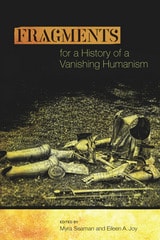
Fragments for a History of a Vanishing Humanism
Edited by Myra Seaman and Eileen A. Joy
The Ohio State University Press, 2016
This volume, edited by Myra Seaman and Eileen A. Joy, insists on the always provisional and contingent formations of the human, and of various humanisms, over time, while also aiming to demonstrate the different ways these formations emerge (and also disappear) in different times and places, from the most ancient past to the most contemporary present. The essays are offered as “fragments” because the authors do not believe there can ever be a “total history” of either the human or the post/human as they play themselves out in differing historical contexts. At the same time, the volume as a whole argues that defining what “the human” (or “post/human”) is has always been an ongoing, never finished cultural project.
Fragments of Lives
Chronicles of the GulagJacques Rossi
Karolinum Press, 2018
An impassioned reminder to always question one’s beliefs, to have the courage to give up one’s illusions at the risk of one’s life, Fragments of Lives lays bare, with acute observations and biting wit, the falsity of the Soviet utopia that transformed Rossi’s home into a “huge Potemkin village, a farcical sham dissimulating oceans of mud and blood.”
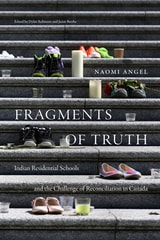
Fragments of Truth
Residential Schools and the Challenge of Reconciliation in CanadaNaomi Angel. Edited by Dylan Robinson and Jamie Berthe.
Duke University Press, 2022
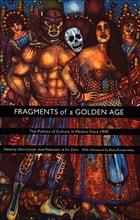
Fragments of a Golden Age
The Politics of Culture in Mexico Since 1940Gilbert M. Joseph, Anne Rubenstein, and Eric Zolov, eds.
Duke University Press, 2001
Each essay in its own way addresses the fragmentation of a cultural consensus that prevailed during the “golden age” of post–revolutionary prosperity, a time when the state was still successfully bolstering its power with narratives of modernization and shared community. Combining detailed case studies—both urban and rural—with larger discussions of political, economic, and cultural phenomena, the contributors take on such topics as the golden age of Mexican cinema, the death of Pedro Infante as a political spectacle, the 1951 “caravan of hunger,” professional wrestling, rock music, and soap operas.
Fragments of a Golden Age will fill a particular gap for students of modern Mexico, Latin American studies, cultural studies, political economy, and twentieth century history, as well as to others concerned with rethinking the cultural dimensions of nationalism, imperialism, and modernization.
Contributors. Steven J. Bachelor, Quetzil E. Castañeda, Seth Fein, Alison Greene, Omar Hernández, Jis & Trino, Gilbert M. Joseph, Heather Levi, Rubén Martínez, Emile McAnany, John Mraz, Jeffrey M. Pilcher, Elena Poniatowska, Anne Rubenstein, Alex Saragoza, Arthur Schmidt, Mary Kay Vaughan, Eric Zolov
Fragments of a World
William of Auvergne and His Medieval LifeLesley Smith
University of Chicago Press, 2023
Today, William of Auvergne (1180?–1249) is remembered for his scholarship about the afterlife as well as the so-called Trial of the Talmud. But the medieval bishop of Paris also left behind nearly 600 sermons delivered to all manner of people—from the royal court to the poorest in his care. In Fragments of a World, Lesley Smith uses these sermons to paint a vivid picture of this extraordinary cleric, his parishioners, and their bustling world. The first modern biography of the influential teacher, bishop, and theologian, Fragments of a World casts a new image of William of Auvergne for our times—deeply attuned to both the spiritual and material needs of an ever-changing populace in the medieval city.

Fragonard
Art and EroticismMary D. Sheriff
University of Chicago Press, 1990
Sheriff begins her inquiry with an appraisal of Fragonard criticism, followed by an extensive and thoroughly original reading of selected works by Fragonard and of the eroticism encoded in them. Art and eroticism converge in a discussion of execution, in which Sheriff explores the changing conception of execution and elucidates its complex rhetorical and cultural underpinnings. Drawing on analytic methods from contemporary critical theory and an understanding of each work's cultural milieu, Sheriff pays particular attention throughout to the relation between beholder and work of art, which she views as manifest in the artist's preoccupation with the play between the real and the fictive. Scholars and students of art history, eighteenth-century culture and history, critical theory, literary criticism, and all those drawn to the work of this great French painter will find this work essential reading.
Framed Narratives
Diderot’s Genealogy of the BeholderJay CaplanAfterword by Jochen Schulte-Sasse
University of Minnesota Press, 1985
Framed Narratives was first published in 1985. Minnesota Archive Editions uses digital technology to make long-unavailable books once again accessible, and are published unaltered from the original University of Minnesota Press editions.
The work of French philosophe Denis Diderot (1713-1784) has inspired conflicting reactions in those who encounter him. Diderot has been admired and despised; he has moved his readers and irritated them - often at the same time. His work continually shifts between mutually exclusive positions - neither of which provides an entirely satisfactory answer to the question at hand, yet neither of which can be disregarded. The nature of these paradoxes has been the fundamental problem in Diderot, a problem that his interpreters have approached by imagining synthetic perspectives or frames within which the paradoxes could be resolved.
In Framed Narratives, Jay Caplan focuses on the problem of framing in and of Diderot. He proposes an interpretive model that draws upon the notion of dialogue developed by Mikhail Bakhtin. For Bakhtin, no utterance can be reduced to a univocal meaning; one's discourse is always marked by other voices. In Diderot, Caplan shows, the narrative device of the tableau engages the reader (or beholder) in a dialogic relationship with the author and the characters. Diderot defines the players of those roles as members of a family, one of whom is always missing, and that sacrificial relationship becomes an integral part of the text. Caplan then uses the concept of the tableau to interpret the rhetoric of gender, genre, and pathos in Diderot's works for and about the theater, his novel The Nun, the philosophical dialogue D'Alembert's Dream,and his correspondence.
What emerges from these readings is not only an interpretation of certain texts, but a description of Diderot's—and, by implication, early bourgeois—poetics. Framed Narratives is, in addition, one of the first attempts to rely upon Bakhtin's concepts in the interpretation of specific texts, in this case the work of an essentially dialogic writer. A socio-historical supplement to Framed Narratives is provided in Jochen Schulte-Sasse's afterword.
Framed Spaces
Photography and Memory in Contemporary Installation ArtMonica E. McTighe
Dartmouth College Press, 2012
Framed Visions
Popular Culture, Americanization, and the Contemporary German and Austrian ImaginationGerd Gemunden
University of Michigan Press, 1998
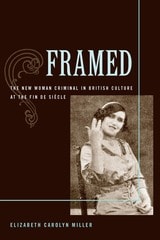
Framed
The New Woman Criminal in British Culture at the Fin de SiecleElizabeth Carolyn Miller
University of Michigan Press, 2008
Framed uses fin de siècle British crime narrative to pose a highly interesting question: why do female criminal characters tend to be alluring and appealing while fictional male criminals of the era are unsympathetic or even grotesque?
In this elegantly argued study, Elizabeth Carolyn Miller addresses this question, examining popular literary and cinematic culture from roughly 1880 to 1914 to shed light on an otherwise overlooked social and cultural type: the conspicuously glamorous New Woman criminal. In so doing, she breaks with the many Foucauldian studies of crime to emphasize the genuinely subversive aspects of these popular female figures. Drawing on a rich body of archival material, Miller argues that the New Woman Criminal exploited iconic elements of late nineteenth- and early twentieth-century commodity culture, including cosmetics and clothing, to fashion an illicit identity that enabled her to subvert legal authority in both the public and the private spheres.
"This is a truly extraordinary argument, one that will forever alter our view of turn-of-the-century literary culture, and Miller has demonstrated it with an enrapturing series of readings of fictional and filmic criminal figures. In the process, she has filled a gap between feminist studies of the New Woman of the 1890s and more gender-neutral studies of early twentieth-century literary and social change. Her book offers an extraordinarily important new way to think about the changing shape of political culture at the turn of the century."
---John Kucich, Professor of English, Rutgers University
"Given the intellectual adventurousness of these chapters, the rich material that the author has brought to bear, and its combination of archival depth and disciplinary range, any reader of this remarkable book will be amply rewarded."
---Jonathan Freedman, Professor of English and American Culture, University of Michigan
Elizabeth Carolyn Miller is Assistant Professor of English at the University of California, Davis.
digitalculturebooks is an imprint of the University of Michigan and the Scholarly Publishing Office of the University of Michigan Library dedicated to publishing innovative and accessible work exploring new media and their impact on society, culture, and scholarly communication. Visit the website at www.digitalculture.org.
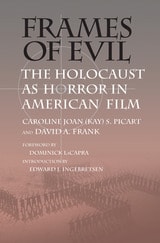
Frames of Evil
The Holocaust as Horror in American FilmCaroline J. S. Picart, and David A. Frank. Foreword by Dominick LaCapra. Introduction by Edward J. Ingebretsen
Southern Illinois University Press, 2006
Challenging the classic horror frame in American film
American filmmakers appropriate the “look” of horror in Holocaust films and often use Nazis and Holocaust imagery to explain evil in the world, say authors Caroline Joan (Kay) S. Picart and David A. Frank. In Frames of Evil: The Holocaust as Horror in American Film, Picart and Frank challenge this classic horror frame—the narrative and visual borders used to demarcate monsters and the monstrous. After examining the way in which directors and producers of the most influential American Holocaust movies default to this Gothic frame, they propose that multiple frames are needed to account for evil and genocide.
Using Schindler’s List, The Silence of the Lambs, and Apt Pupil as case studies, the authors provide substantive and critical analyses of these films that transcend the classic horror interpretation. For example, Schindler’s List, say Picart and Frank, has the appearance of a historical docudrama but actually employs the visual rhetoric and narrative devices of the Hollywood horror film. The authors argue that evil has a face: Nazism, which is configured as quintessentially innate, and supernaturally crafty.
Frames of Evil, which is augmented by thirty-six film and publicity stills, also explores the commercial exploitation of suffering in film and offers constructive ways of critically evaluating this exploitation. The authors suggest that audiences will recognize their participation in much larger narrative formulas that place a premium on monstrosity and elide the role of modernity in depriving millions of their lives and dignity, often framing the suffering of others in a manner that allows for merely “documentary” enjoyment.
Framing Disease
Studies in Cultural HistoryRosenberg, Charles E
Rutgers University Press, 1992
"In some ways disease does not exist until we have agreed that it does, by perceiving, naming, and responding to it, " writes Charles E. Rosenberg in his introduction to this stimulating set of essays. Disease is both a biological event and a social phenomenon. Patient, doctor, family, and social institutions—including employers, government, and insurance companies—all find ways to frame the biological event in terms that make sense to them and serve their own ends.
Many diseases discussed here—endstage renal disease, rheumatic fever, parasitic infectious diseases, coronary thrombosis—came to be defined, redefined, and renamed over the course of several centuries. As these essays show, the concept of disease has also been used to frame culturally resonant behaviors: suicide, homosexuality, anorexia nervosa, chronic fatigue syndrome. Disease is also framed by public policy, as the cases of industrial disability and of forensic psychiatry demonstrate. Medical institutions, as managers of people with disease, come to have vested interests in diagnoses, as the histories of facilities to treat tuberculosis or epilepsy reveal. Ultimately, the existence and conquest of disease serves to frame a society's sense of its own "healthiness" and to give direction to social reforms.
The contributors include Steven J. Peitzman, Peter C. English, John Farley, Christopher Lawrence, Michael MacDonald, Bert Hansen, Joan Jacobs Brumberg, Robert A. Aronowitz, Gerald Markowitz, David Rosner, Janet A. Tighe, Barbara Bates, Ellen Dwyer, John M. Eyler, and Elizabeth Fee. For any student of disease and society, this book is essential, compelling reading.
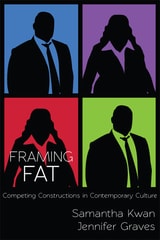
Framing Fat
Competing Constructions in Contemporary CultureKwan, Samantha
Rutgers University Press, 2013
Alongside public health officials at the Centers for Disease Control and Prevention are advertisers of the fashion-beauty complex, food industry advocates at the Center for Consumer Freedom, and activists at the National Association to Advance Fat Acceptance.
Framing Fat takes a bird’s-eye view of how these multiple actors construct the fat body by identifying the messages these groups put forth, particularly where issues of beauty, health, choice and responsibility, and social justice are concerned. Samantha Kwan and Jennifer Graves examine how laypersons respond to these conflicting messages and illustrate the gendered, raced, and classed implications within them. In doing so, they shed light on how dominant ideas about body fat have led to the moral indictment of body nonconformists, essentially “framing” them for their fat bodies.
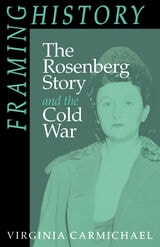
Framing History
The Rosenberg Story and the Cold WarVirginia Carmichael
University of Minnesota Press, 1993

Framing Oak Cliff
A Visual Diary of a Dallas NeighborhoodRichard Doherty
University of North Texas Press, 2024
Framing Public Memory
Edited by Kendall R. Phillips
University of Alabama Press, 2007
A collection of essays by prominent scholars from many disciplines on the construction of public memories
The study of public memory has grown rapidly across numerous disciplines in recent years, among them American studies, history, philosophy, sociology, architecture, and communications. As scholars probe acts of collective remembrance, they have shed light on the cultural processes of memory. Essays contained in this volume address issues such as the scope of public memory, the ways we forget, the relationship between politics and memory, and the material practices of memory.Stephen Browne’s contribution studies the alternative to memory erasure, silence, and forgetting as posited by Hannah Arendt in her classic Eichmann in Jerusalem. Rosa Eberly writes about the Texas tower shootings of 1966, memories of which have been minimized by local officials. Charles Morris examines public reactions to Larry Kramer’s declaration that Abraham Lincoln was homosexual, horrifying the guardians of Lincoln’s public memory. And Barbie Zelizer considers the impact on public memory of visual images, specifically still photographs of individuals about to perish (e.g., people falling from the World Trade Center) and the sense of communal loss they manifest.
Whether addressing the transitory and mutable nature of collective memories over time or the ways various groups maintain, engender, or resist those memories, this work constitutes a major contribution to our understanding of how public memory has been and might continue to be framed.
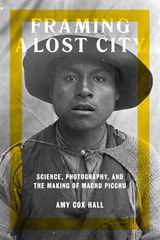
Framing a Lost City
Science, Photography, and the Making of Machu PicchuBy Amy Cox Hall
University of Texas Press, 2017
When Hiram Bingham, a historian from Yale University, first saw Machu Picchu in 1911, it was a ruin obscured by overgrowth whose terraces were farmed a by few families. A century later, Machu Picchu is a UNESCO world heritage site visited by more than a million tourists annually. This remarkable transformation began with the photographs that accompanied Bingham’s article published in National Geographic magazine, which depicted Machu Picchu as a lost city discovered. Focusing on the practices, technologies, and materializations of Bingham’s three expeditions to Peru (1911, 1912, 1914–1915), this book makes a convincing case that visualization, particularly through the camera, played a decisive role in positioning Machu Picchu as both a scientific discovery and a Peruvian heritage site.
Amy Cox Hall argues that while Bingham’s expeditions relied on the labor, knowledge, and support of Peruvian elites, intellectuals, and peasants, the practice of scientific witnessing, and photography specifically, converted Machu Picchu into a cultural artifact fashioned from a distinct way of seeing. Drawing on science and technology studies, she situates letter writing, artifact collecting, and photography as important expeditionary practices that helped shape the way we understand Machu Picchu today. Cox Hall also demonstrates that the photographic evidence was unstable, and, as images circulated worldwide, the “lost city” took on different meanings, especially in Peru, which came to view the site as one of national patrimony in need of protection from expeditions such as Bingham’s.
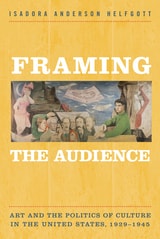
Framing the Audience
Art and the Politics of Culture in the United States, 1929-1945Isadora Helfgott
Temple University Press, 2015
Framing the Audience explores the cultural politics of the Great Depression and World War II through the prism of art appreciation. Isadora Helfgott interrogates the ideological and political motivations for breaking down barriers between fine art and popular culture. She charts the impact that changes in art appreciation had on the broader political, social, cultural, and artistic landscape.
Framing the Audience argues that efforts to expand the social basis of art became intertwined with—and helped shape—broader debates about national identity and the future of American political economy. Helfgott chronicles artists’ efforts toinfluence the conditions of artistic production and display. She highlights the influence of the Federal Art Project, the impact of the Museum of Modern Art as an institutional home for modernism in America and as an organizer of traveling exhibitions, and the efforts by LIFE and Fortune magazines to integrate art education into their visual record of modern life. In doing so, Helfgott makes critical observations about the changing relationship between art and the American public.

Framing the Black Panthers
The Spectacular Rise of a Black Power IconJane Rhodes
University of Illinois Press, 2017
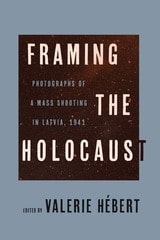
Framing the Holocaust
Edited by Valerie Hébert
University of Wisconsin Press, 2023
While photographs are central to our memory of modern historical events, they often inhabit an ambivalent intellectual space. What separates the sincere desire to understand from voyeuristic curiosity? Comprehending atrocity photographs requires viewers to place themselves in the very positions of the perpetrators who took the images. When we engage with these photographs, do we risk replicating the original violence? In this tightly organized book, scholars of history, photography, language, gender, photojournalism, and pedagogy examine the images of the Šķēde atrocity along with other difficult images, giving historical, political, and ethical depth to the acts of looking and interpreting.
With a foreword by Edward Anders, who narrowly escaped the December 1941 shooting, Framing the Holocaust represents an original approach to an iconic series of Holocaust photographs. This book will contribute to compelling debates in the emerging field of visual history, including the challenges and responsibilities of using photographs to teach about atrocity.

Framing the Past
The Historiograpy of German Cinema and TelevisionEdited by Bruce A. Murray and Christopher J. Wickham
Southern Illinois University Press, 1992
This collection of essays was selected from those presented in October 1988 at a conference sponsored by the National Endowment for the Humanities, "Concepts of History in German Cinema." The contributors include notable historians, film scholars, and German studies specialists who explore the complex network of social, political, and religious institutions that have influenced the historiography of German cinema and television.
Before the turn of the century, Germans began to employ the medium of film to represent the past when they attempted to document their Prussian heritage. Since then, German cinema and television have promoted history as a component of personal, cultural, and national identity by consistently providing prominent treatment of historical subjects.
Although it is relatively easy to document changes in the selection and handling of these subjects, it is more difficult to determine precisely which factors have motivated those changes.
In attempting to define these factors, the link between German cinema, television, and history has developed around three interrelated issues: (1) the reception of Weimar cinema, which for most film scholars continues to be mediated to one extent or another by Siegfried Kracauer’s work; (2) the inscribing of fascism in cinema and television; and (3) the nature of, and potential for, alternatives to mainstream cinema and television.

Framing the Problem
Causes and Consequences of a Shrinking Great Salt LakeKevin D. Perry
University of Utah Press, 2024

Framing the Sixties
The Use and Abuse of a Decade from Ronald Reagan to George W. BushBernard von Bothmer
University of Massachusetts Press, 2010
Over the past quarter century, American liberals and conservatives alike have invoked memories of the 1960s to define their respective ideological positions and to influence voters. Liberals recall the positive associations of what might be called the “good Sixties”—the “Camelot” years of JFK, the early civil rights movement, and the dreams of the Great Society—while conservatives conjure images of the “bad Sixties”—a time of urban riots, antiwar protests, and countercultural revolt.
In Framing the Sixties, Bernard von Bothmer examines this battle over the collective memory of the decade primarily through the lens of presidential politics. He shows how four presidents—Ronald Reagan, George H. W. Bush, Bill Clinton, and George W. Bush—each sought to advance his political agenda by consciously shaping public understanding of the meaning of “the Sixties.” He compares not only the way that each depicted the decade as a whole, but also their commentary on a set of specific topics: the presidency of John F. Kennedy, Lyndon Johnson's “Great Society” initiatives, the civil rights movement, and the Vietnam War.
In addition to analyzing the pronouncements of the presidents themselves, von Bothmer draws on interviews he conducted with more than one hundred and twenty cabinet members, speechwriters, advisers, strategists, historians, journalists, and activists from across the political spectrum—from Julian Bond, Daniel Ellsberg, Todd Gitlin, and Arthur Schlesinger to James Baker, Robert Bork, Phyllis Schlafly, and Paul Weyrich.
It is no secret that the upheavals of the 1960s opened fissures within American society that have continued to affect the nation's politics and to intensify its so-called culture wars. What this book documents is the extent to which political leaders, left and right, consciously exploited those divisions by “framing” the memory of that turbulent decade to serve their own partisan interests.

Fran and Frederick Hamerstrom
Wildlife Conservation PioneersSusan Tupper
Wisconsin Historical Society Press, 2016
Learn how Fran and Frederick Hamerstrom worked to save the greater prairie chicken from extinction in the Wisconsin Historical Society Press’s new book for young readers, "Fran and Frederick Hamerstrom: Wildlife Conservation Pioneers." Fran and Frederick grew up in New England, and married in 1935. They both loved nature and wanted to dedicate their lives to understanding and preserving wildlife. As students of the famous naturalist, Aldo Leopold, they learned about new ways for humans to think about saving land for animals. Fran was a brave, outgoing woman who cared more about interacting with animals than wearing pretty dresses. Frederick was a calm, thoughtful man who loved to study and conduct research. Together, they spent over thirty years mentoring many future scientists, and working to save the greater prairie chicken, and other animals, from extinction. "Fran and Frederick Hamerstrom: Wildlife Conservation Pioneers" is the newest addition to the Society Press’s Badger Biographies Series.

France and Algeria
A History of Decolonization and TransformationPhillip Naylor
University of Texas Press, 2024
An examination of the complicated history between France and Algeria since the latter’s independence.
While most related studies concentrate on the colonial era and Algeria's War of Independence, France and Algeria details the nations' postcolonial relationship. Phillip Naylor provides a philosophical approach, contending that France reformulated, rather than repudiated, “essential” strategic values during decolonization. It thus continued to pursue grandeur and independence, especially with regard to the Third World and Algeria, an essentialism that expedited France’s postcolonial transformation. But as a new nation, Algeria needed to pursue the “existential” project of self-definition. It became involved in state-building while also promulgating socialism, and it recognized how French oil concessions in the Sahara impeded its independence, leading to the industry's postcolonial decolonization. Finally, the postcolonial relationship has featured a human dimension involving immigrants, pieds-noirs (colonial settlers), and harkis (Algerian soldiers loyal to France), all of them central to bilateral relations.
In this revised and updated edition of his seminal work, first published over twenty years ago, Naylor expands his coverage of the decolonization era, drawing on new information while continuing to study the ever-evolving relationship between the two countries. These new additions expose the continually shifting relations of power, perception, and identity between the two states.

France and her Eastern Allies, 1919-1925
French-Czechoslovak-Polish Relations from the Paris Peace Conference in LocarnoPiotr S. Wandycz
University of Minnesota Press, 1962
France and her Eastern Allies, 1919–1925 was first published in 1962. Minnesota Archive Editions uses digital technology to make long-unavailable books once again accessible, and are published unaltered from the original University of Minnesota Press editions.
Relations between France, Czechoslovakia, and Poland occupied an important position in European diplomacy in the years between World War I and World War II. Beginning with the breakdown of the old political, social, and economic order on the Continent during the first World War, these relations went through many changes. This book deals with the crucial period from the Paris Peace Conference of 1919 to the signing of the Locarno Pact in 1925. During this time France attempted to establish an eastern barrier of buffer states with Poland and Czechoslovakia at the core, with the aim of keeping Germany and Bolshevik Russia apart. This, France hoped, would guarantee European peace and security. Although an effective eastern barrier was never realized, the attempt to create one was a worthy and important undertaking.
Professor Wandycz considers in detail the various aspects of the complex relationship between France and the two western Slav states — geographic, economic, social, and political. In addition, he provides a clear and interesting picture of some of the personalities involved. Through the use of hitherto unpublished source material, he throws new light on many events of general European diplomatic history as well as on Polish, French, and Czechoslovak foreign policy in particular.
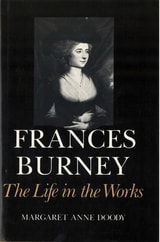
Frances Burney
The Life in the WorksDoody, Margaret A
Rutgers University Press, 1988
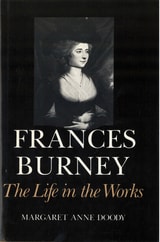
Frances Burney
The Life in the WorksDoody, Margaret A
Rutgers University Press, 1988

Frances Hodgson Burnett
The Unexpected Life of the Author of the Secret GardenGerzina, Gretchen H
Rutgers University Press, 2006
Hugely successful in her own time for adult novels and plays, Frances Hodgson Burnett (1849-1924) would be astounded to find out she is remembered for a handful of books for children, but most of all for the enormously popular Secret Garden. This fascinating biography-the first to have the full cooperation of Burnett's descendants and relatives-examines her life with lively intelligence, sensitivity, and fascinating new, never-before-published material.
Burnett's life was full of those reversals of fortune that mark her work. Following modest beginnings in mid-Victorian Manchester, she arrived in post-Civil War Tennessee at the age of fifteen with her widowed mother and two sisters. Burnett was the breadwinner of the family from the age of seventeen, eventually publishing a total of fifty-two books and writing and producing thirteen plays. She made and spent a fortune in her lifetime, was generous and profligate, yet anxious about money and obsessively hardworking.
Constantly restless and inventive, Burnett's personal life was as complex as her professional one. Her first marriage to a southern doctor disintegrated as a result of her notorious flirtations and a scandalous affair, and her subsequent marriage to an English doctor turned actor suffered a similar fate. She understood the intensity and loneliness of the thoughtful child, but was herself a largely absent mother of two sons-overwhelmed by guilt when tragedy struck one of them; the other one never got over being the model for Little Lord Fauntleroy.
A woman of contrasts and paradoxes, this quintessentially British writer was equally at home in the United States, which honored her with a memorial in Central Park. Frances Hodgson Burnett reinvented for herself and for generations to come in both countries the magic and the mystery of the childhood she never had.
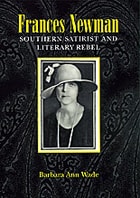
Frances Newman
Southern Satirist and Literary RebelBarbara Ann Wade
University of Alabama Press, 1998
This first biographical and literary assessment of Frances Newman highlights one of the most experimental writers of the Southern Renaissance
Frances Newman was born into a prominent Atlanta family and was educated at private schools in the South and the Northeast. Her first novel, The Hard-Boiled Virgin, was hailed by James Branch Cabell as “the most brilliant, the most candid, the most civilized, and the most profound yet written by any American woman.” Cabell and H. L. Mencken became Newman’s literary mentors and loyally supported her satire of southern culture, which revealed the racism, class prejudice, and religious intolerance that reinforced the idealized image of the white southern lady. Writing within a nearly forgotten feminist tradition of southern women’s fiction, Newman portrayed the widely acclaimed social change in the early part of the century in the South as superficial rather than substantial, with its continued restrictive roles for women in courtship and marriage and limited educational and career opportunities.
Barbara Wade explores Newman’s place in the feminist literary tradition by comparing her novels with those of her contemporaries Ellen Glasgow, Mary Johnston, and Isa Glenn. Wade draws from Newman’s personal correspondence and newspaper articles to reveal a vibrant, independent woman who simultaneously defied and was influenced by the traditional southern society she satirized in her writing.
Francesca Caccini at the Medici Court
Music and the Circulation of PowerSuzanne G. Cusick
University of Chicago Press, 2009
Suzanne G. Cusick argues that Caccini’s career depended on the usefulness of her talents to the political agenda of Grand Duchess Christine de Lorraine, Tuscany’s de facto regent from 1606 to 1636. Drawing on Classical and feminist theory, Cusick shows how the music Caccini made for the Medici court sustained the culture that enabled Christine’s power, thereby also supporting the sexual and political aims of its women.
In bringing Caccini’s surprising story so vividly to life, Cusick ultimately illuminates how music making functioned in early modern Italy as a significant medium for the circulation of power.
Francis Bacon
The Logic of SensationGilles Deleuze
University of Minnesota Press, 2005
Afterword by Tom Conley
Gilles Deleuze had several paintings by Francis Bacon hanging in his Paris apartment, and the painter’s method and style as well as his motifs of seriality, difference, and repetition influenced Deleuze’s work. This first English translation shows us one of the most original and important French philosophers of the twentieth century in intimate confrontation with one of that century’s most original and important painters.
In considering Bacon, Deleuze offers implicit and explicit insights into the origins and development of his own philosophical and aesthetic ideas, ideas that represent a turning point in his intellectual trajectory. First published in French in 1981, Francis Bacon has come to be recognized as one of Deleuze’s most significant texts in aesthetics. Anticipating his work on cinema, the baroque, and literary criticism, the book can be read not only as a study of Bacon’s paintings but also as a crucial text within Deleuze’s broader philosophy of art.
In it, Deleuze creates a series of philosophical concepts, each of which relates to a particular aspect of Bacon’s paintings but at the same time finds a place in the “general logic of sensation.” Illuminating Bacon’s paintings, the nonrational logic of sensation, and the act of painting itself, this work—presented in lucid and nuanced translation—also points beyond painting toward connections with other arts such as music, cinema, and literature. Francis Bacon is an indispensable entry point into the conceptual proliferation of Deleuze’s philosophy as a whole.
Gilles Deleuze (1925–1995) was professor of philosophy at the University of Paris, Vincennes–St. Denis. He coauthored Anti-Oedipus and A Thousand Plateaus with Félix Guattari. These works, as well as Cinema 1, Cinema 2, The Fold, Proust and Signs, and others, are published in English by Minnesota.
Daniel W. Smith teaches in the Department of Philosophy at Purdue University.

Francis Warrington Dawson and the Politics of Restoration
South Carolina, 1874-1889E. Culpepper Clark
University of Alabama Press, 1980
A revealing biography of a powerful Southern editor at the center of South Carolina’s post‑Reconstruction political transformation.
In the decades following the Civil War, South Carolina—like much of the South—struggled to redefine its political identity amid the collapse of Reconstruction and the rise of conservative “Redeemer” governments. In Francis Warrington Dawson and the Politics of Restoration, historian E. Culpepper Clark offers a deeply researched and incisive study of this transformation through the life and work of Francis Warrington Dawson, one of the state’s most influential newspaper editors.
Dawson was far more than a chronicler of events. As a powerful voice in South Carolina’s political press, he helped shape public opinion, broker alliances among conservative factions, and articulate the ideological foundations of post‑Reconstruction governance. Clark situates Dawson at the center of the struggles among Redeemers, Straight‑Out Democrats, agrarian reformers, and emerging political leaders such as Ben Tillman, revealing a political landscape marked by rivalry, class conflict, and competing visions of the New South.
Drawing on extensive manuscript collections, newspapers, and political correspondence, Clark explores the close relationship between journalism and power in the late nineteenth century and demonstrates how newspapers functioned as active political actors rather than neutral observers. The result is both a compelling political biography and a broader analysis of how restoration politics operated at the state level.
Francis Warrington Dawson and the Politics of Restoration is an essential work for readers interested in Southern history, Reconstruction and its aftermath, the history of American journalism, and the forces that shaped the political culture of the modern South.
Francisco López de Gómara's General History of the Indies
Ángela Helmer
University Press of Colorado, 2023
General History of the Indies was the first universal history of the recent discoveries and conquests of the New World made available to the Old World audience. At publication it consisted of two parts: the first a general history of the European discovery, conquest, and settlement of the Americas, and the second a detailed description of Cortés’s conquest of Mexico. Part one—in the multiple Spanish editions and translations into Italian and French published at the time—was the most comprehensive, popular, and accessible account of the natural history and geography of the Americas, the ethnology of the peoples of the New World, and the history of the Spanish conquest, including the most recent developments in Peru. Despite its original and continued importance, however, it had never been translated into English.
Gómara’s history communicates Europeans’ general understanding of the New World throughout the middle and later sixteenth century. A lively, comparatively brief description of Europe’s expansion into the Americas with significant importance to today’s understanding of the early modern worldview, Francisco López de Gómara’s General History of the Indies will be of great interest to students of and specialists in Latin American history, Latin American literature, anthropology, and cultural studies, as well as specialists in Spanish American intellectual history and colonial Latin America.