Results by title
1218 books match the query 'African Americans' and 59 start with f
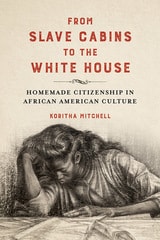
From Slave Cabins to the White House
Homemade Citizenship in African American CultureKoritha Mitchell
University of Illinois Press, 2021
Koritha Mitchell analyzes canonical texts by and about African American women to lay bare the hostility these women face as they invest in traditional domesticity. Instead of the respectability and safety granted white homemakers, black women endure pejorative labels, racist governmental policies, attacks on their citizenship, and aggression meant to keep them in "their place."
Tracing how African Americans define and redefine success in a nation determined to deprive them of it, Mitchell plumbs the works of Frances Harper, Zora Neale Hurston, Lorraine Hansberry, Toni Morrison, Michelle Obama, and others. These artists honor black homes from slavery and post-emancipation through the Civil Rights era to "post-racial" America. Mitchell follows black families asserting their citizenship in domestic settings while the larger society and culture marginalize and attack them, not because they are deviants or failures but because they meet American standards.
Powerful and provocative, From Slave Cabins to the White House illuminates the links between African American women's homemaking and citizenship in history and across literature.
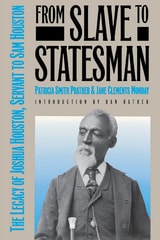
From Slave to Statesman
The Legacy of Joshua Houston, Servant to Sam HoustonPatricia Smith Prather
University of North Texas Press, 1993
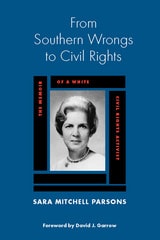
From Southern Wrongs to Civil Rights
The Memoir of a White Civil Rights ActivistSara Mitchell Parsons
University of Alabama Press, 2009
This first-hand account tells the story of turbulent civil rights era Atlanta through the eyes of a white upper-class woman who became an outspoken advocate for integration and racial equality
As a privileged white woman who grew up in segregated Atlanta, Sara Mitchell Parsons was an unlikely candidate to become a civil rights agitator. After all, her only contacts with blacks were with those who helped raise her and those who later helped raise her children. As a young woman, she followed the conventional path expected of her, becoming the dutiful wife of a conservative husband, going to the country club, and playing bridge. But unlike many of her peers, Parsons harbored an increasing uneasiness about racial segregation.In a memoir that includes candid diary excerpts, Parsons chronicles her moral awakening. With little support from her husband, she runs for the Atlanta Board of Education on a quietly integrationist platform and, once elected, becomes increasingly outspoken about inequitable school conditions and the slow pace of integration. Her activities bring her into contact with such civil rights leaders as Martin Luther King, Jr., and his wife, Coretta Scott King. For a time, she leads a dual existence, sometimes traveling the great psychic distance from an NAACP meeting on Auburn Avenue to an all-white party in upscale Buckhead. She eventually drops her ladies' clubs, and her deepening involvement in the civil rights movement costs Parsons many friends as well as her first marriage.
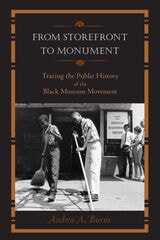
From Storefront to Monument
Tracing the Public History of the Black Museum MovementAndrea A. Burns
University of Massachusetts Press, 2013
Winner of the 2015 National Council on Public History Book Award
Today well over two hundred museums focusing on African American history and culture can be found throughout the United States and Canada. Many of these institutions trace their roots to the 1960s and 1970s, when the struggle for racial equality inspired a movement within the black community to make the history and culture of African America more “public.”
This book tells the story of four of these groundbreaking museums: the DuSable Museum of African American History in Chicago (founded in 1961); the International Afro-American Museum in Detroit (1965); the Anacostia Neighborhood Museum in Washington, D.C. (1967); and the African American Museum of Philadelphia (1976). Andrea A. Burns shows how the founders of these institutions, many of whom had ties to the Black Power movement, sought to provide African Americans with a meaningful alternative to the misrepresentation or utter neglect of black history found in standard textbooks and most public history sites. Through the recovery and interpretation of artifacts, documents, and stories drawn from African American experience, they encouraged the embrace of a distinctly black identity and promoted new methods of interaction between the museum and the local community.
Over time, the black museum movement induced mainstream institutions to integrate African American history and culture into their own exhibits and educational programs. This often controversial process has culminated in the creation of a National Museum of African American History and Culture, now scheduled to open in the nation's capital in 2015.
From Whence Cometh My Help
The African American Community at Hollins CollegeEthel Morgan Smith
University of Missouri Press, 2000
In 1842 Charles Lewis Cocke arrived in Roanoke, Virginia, with sixteen slaves; there, he founded Hollins College, an elite woman's school. Many of the early students also brought their slaves to the college with them. Upon Emancipation some of the African Americans of the community "mostly women" stayed on as servants, forming what is now called the Hollins Community. Although the servants played an integral part in the college's success, students were strongly discouraged from acknowledging them as people. Rules forbidding any "familiarity" with the servants perpetuated a prejudicial attitude toward the African American community that would persist well into the 1940s.
Determined to give voice to the African American community that served as the silent workforce for Hollins College, Ethel Morgan Smith succeeded in finding individuals to step forward and tell their stories. From Whence Cometh My Help examines the dynamics of an institution built on the foundations of slavery and so steeped in tradition that it managed to perpetuate servitude for generations. Interviewing senior community members, Smith gives recognition to the invisible population that provided and continues to provide the labor support for Hollins College for more than 150 years.
Although African American students have been admitted to the college for roughly thirty years, to date only one person from the Hollins Community has graduated from the college. From Whence Cometh My Help explores the subtle and complex relationship between the affluent white world of Hollins College and the proud African American community that has served it since its inception. Interweaving personal observations, historical documents, and poetry throughout a revealing oral history, Smith shares her fascinating discoveries and the challenges involved in telling a story silenced for so long.
From the Fiery Furnace to the Promise Land
Stories of a Tennessee Reconstruction CommunitySerina K. Gilbert and Learotha Williams Jr.
Vanderbilt University Press, 2025
In time the community encompassed approximately 1,000 acres with more than 50 homes, several stores, three churches, and an elementary school. But by the mid‑twentieth century, the community had dwindled to just a handful of families. Now all that remains physically is a church and the old school building. But in the hearts of the descendants of those families, Promise Land remains a vital and thriving community of friends, family, and, albeit virtual, neighbors who continue to support each other.
This is the story of this town told through the memories of the people who lived there. Serina Gilbert grew up in the community and is now one of the revered storytellers and story‑keepers of Promise Land. Along with historian Learotha Williams, she is sharing the history of a community that thrived and continues to thrive in the face of almost insurmountable obstacles.
Frontiers of Freedom
Cincinnati’s Black Community 1802–1868Nikki M. Taylor
Ohio University Press, 2004
Funk the Erotic
Transaesthetics and Black Sexual CulturesL.H. Stallings
University of Illinois Press, 2015
Stallings uses funk to highlight the importance of the erotic and eroticism in Black cultural and political movements, debunking "the truth of sex" and its histories. Brandishing funk as a theoretical tool, Stallings argues that Western theories of the erotic fail as universally applicable terms or philosophies, and thus lack utility in discussions of black bodies, subjects, and culture. In considering the Victorian concept of freak in black funk, Stallings proposes that black artists across all media have fashioned a tradition that embraces the superfreak, sexual guerrilla, sexual magic, mama's porn, black trans narratives, and sex work in a post-human subject position. Their goal: to ensure survival and evolution in a world that exploits black bodies in capitalist endeavors, imperialism, and colonization.
Revitalizing and wide-ranging, Funk the Erotic offers a needed examination of black sexual cultures, a discursive evolution of black ideas about eroticism, a critique of work society, a reexamination of love, and an articulation of the body in black movements.
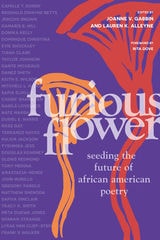
Furious Flower
Seeding the Future of African American PoetryEdited by Joanne V. Gabbin and Lauren K. Alleyne; Foreword by Rita Dove
Northwestern University Press, 2020