Results by title
1882 books match the query 'Criticism and interpretation' and 62 start with f
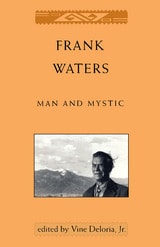
Frank Waters
Man and MysticVine Deloria Jr.
Ohio University Press, 1993
“In addition to his accomplishments as a talented novelist, a thorough historian, and an excellent essayist, Frank Waters is that rare breed of man who has merged heart and mind early in his life and moved forward to confront ultimate questions. This dilemma of faith and heritage, religion and identity, and commitment and comfort has never been resolved intellectually. Even with profound faith and rigorous discipline of self, mystics have found it difficult to resolve through action and prayer…I look at the life and writing of Frank Waters…and find…a remarkable journey of inquiry spanning nearly a century and illuminating questions which I did not think possible to formulate.”
—Vine Deloria, Jr., editor
Contributors to this volume are Alvin M. Josephy, Jr., Bobby Bridger, Steven Wall, Will Wright, William Eastlake, Larry Evers, David Jongeward, Max Evans, Win Blevins, Barbara Waters, Rudolfo Anaya, Thomas J. Lyon, Joe Gordon, Robert Kostka, Charles Adams, Father Peter J. Powell, Quay Grigg, Alexander Blackburn, and T. N. Luther.
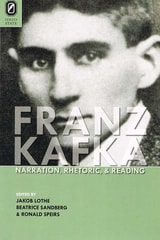
Franz Kafka
Narration, Rhetoric, and ReadingEdited by Jakob Lothe, Beatrice Sandberg, and Ronald Speirs
The Ohio State University Press, 2011
Franz Kafka: Narration, Rhetoric, and Reading presents essays by noted Kafka critics and by leading narratologists who explore Kafka’s original and innovative uses of narrative throughout his career. Collectively, these essays by Stanley Corngold, Anniken Greve, Gerhard Kurz, Jakob Lothe, J. Hillis Miller, Gerhard Neumann, James Phelan, Beatrice Sandberg, Ronald Speirs, and Benno Wagner examine a number of provocative questions that arise in narration and narratives in Kafka’s fiction. The arguments of the essays relate both to the peculiarities of Kafka’s story-telling and to general issues in narrative theory. They reflect, for example, the complexity of the issues surrounding the “somebody” doing the telling, the attitude of the narrator to what is told, the perceived purpose(s) of the telling, the implied or actual reader, the progression of events, and the progression of the telling. As the essays also demonstrate, Kafka’s narratives still present a considerable challenge to, as well as a great resource for, narrative theory and analysis.
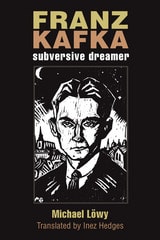
Franz Kafka
Subversive DreamerMichael Löwy, translated by Inez Hedges
University of Michigan Press, 2016
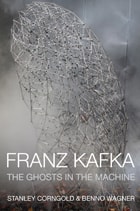
Franz Kafka
The Ghosts in the MachineStanley Corngold
Northwestern University Press, 2011
Corngold and Wagner frame Kafka’s writings as cultural events, each work reflecting the economic and cultural discourses of his epoch. In pursuing Kafka’s avowed interest in the theory and practice of insurance, the authors view the two systems of his literary worlds—the official and the personal—as a “bundling” together of the various cultural accidents of Kafka’s time. The work of two of the leading scholars of the single most influential writer of literary modernity, Franz Kafka: The Ghosts in the Machine constitutes a breathtakingly original advance in the study of both the more famous and less well-known works of this enigmatic master.
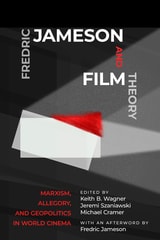
Fredric Jameson and Film Theory
Marxism, Allegory, and Geopolitics in World CinemaKeith B. Wagner
Rutgers University Press, 2022
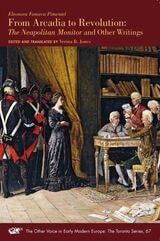
From Arcadia to Revolution
The Neapolitan Monitor and Other WritingsEleonora Fonseca Pimentel
Iter Press, 2019
The Other Voice in Early Modern Europe: The Toronto Series, Volume 67
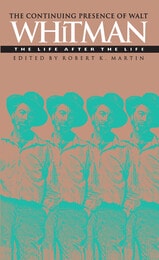
From Blue Mills to Columbia
Cedar Falls and the Civil WarRobert K. Martin
University of Iowa Press, 1992
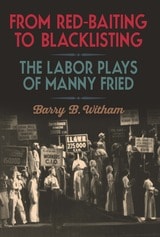
From Red-Baiting to Blacklisting
The Labor Plays of Manny FriedBarry B. Witham
Southern Illinois University Press, 2020
Author Barry B. Witham reclaims the work of Manny Fried, an essential American playwright so thoroughly blacklisted after he defied the House Committee on Un-American Activities in 1954, and again in 1964, that his work all but completely disappeared from the canon. Witham details Manny Fried’s work inside and outside the theatre and examines his three major labor plays and the political climate that both nurtured and disparaged their productions. Drawing on never-before-published interview materials, Witham reveals the details of how the United States government worked to ruin Fried’s career.
From Red-Baiting to Blacklisting includes the complete text of Fried’s major labor plays, all long out of print. In Elegy for Stanley Gorski, Fried depicts one of the many red-baiting campaigns that threatened countless unions in the wake of the Taft-Hartley Act and the collusion of the Catholic Church with these activities. In Drop Hammer, Fried tackles the issues of union dues, misappropriation, and potential criminal activities. In the third play, The Dodo Bird, perhaps his most popular, Fried achieves a remarkable character study of a man outsourced from his job by technology and plant closures.
Manny Fried’s plays portray the hard edges of capitalism and government power and illuminate present-day struggles with hostility to labor unions and the passage in several states of right-to-work laws. Fried had no illusions about the government’s determination to destroy communism and unionism—causes to which he was deeply committed.
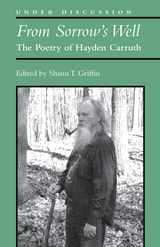
From Sorrow's Well
The Poetry of Hayden CarruthShaun T. Griffin
University of Michigan Press, 2015
Hayden Carruth survived isolation, mental health problems, and long struggle with drink and smoke to produce a vision of modern poetry rooted in the New England tradition but entirely his own. Many feel his best poems emerged from the isolation of rural Vermont, and his poems often are concerned with rural images and metaphors reflecting the land and hardscrabble people around him. Together with his second love, jazz, Carruth’s rural experiences infuse his poems with engaging and provocative ideas even as they present sometimes stark topics.
This volume collects essays and poems from such notable contributors as Donald Hall, Marilyn Hacker, Adrienne Rich, Philip Booth, Matthew Miller, and Sascha Feinstein, among many others. The book’s sections concern the kinds of writings, and the values expressed in his writings, for which Carruth was most famous, including what editor Shaun T. Griffin calls “social utility,” jazz, his impoverished rural environment, and “innovation” in poetic form.
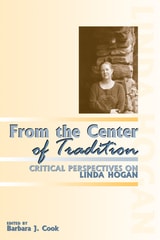
From the Center of Tradition
Critical Perspective on Linda HoganBarbara J. Cook
University Press of Colorado, 2003
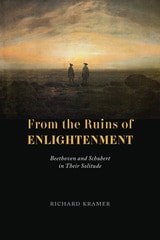
From the Ruins of Enlightenment
Beethoven and Schubert in Their SolitudeRichard Kramer
University of Chicago Press, 2023
Here is Vienna, hosting a congress in 1815 that would redraw national boundaries and reconfigure the European community for a full century. A snapshot captures two of its citizens, each seemingly oblivious to this momentous political environment: Franz Schubert, not yet twenty years old and in the midst of his most prolific year—some 140 songs, four operas, and much else; and Ludwig van Beethoven, struggling through a midlife crisis that would yield the song cycle An die ferne Geliebte, two strikingly original cello sonatas, and the two formidable sonatas for the “Hammerklavier,” opp. 101 and 106. In Richard Kramer’s compelling reading, each seemed to be composing “against”—Beethoven, against the Enlightenment; Schubert, against the looming presence of the older composer even as his own musical imagination took full flight.
From the Ruins of Enlightenment begins in 1815, with the discovery of two unique projects: Schubert’s settings of the poems of Ludwig Hölty in a fragmentary cycle and Beethoven’s engagement with a half dozen poems by Johann Gottfried Herder. From there, Kramer unearths previously undetected resonances and associations, illuminating the two composers in their “lonely and singular journeys” through the “rich solitude of their music.”
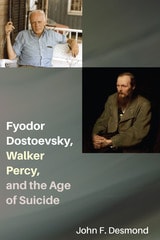
Fyodor Dostoevsky, Walker Percy, and the Age of Suicide
John F. Desmond
Catholic University of America Press, 2019