Results by title
2706 books match the query 'European' and 104 start with f
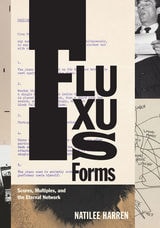
Fluxus Forms
Scores, Multiples, and the Eternal NetworkNatilee Harren
University of Chicago Press, 2020
While today the Fluxus collective is recognized for its radical neo-avant-garde works of performance, publishing, and relational art and its experimental, interdisciplinary approach, it was not taken seriously in its own time. With Fluxus Forms, Natilee Harren captures the magnetic energy of Fluxus activities and collaborations that emerged at the intersections of art, music, performance, and literature. The book offers insight into the nature of art in the 1960s as it traces the international development of the collective’s unique intermedia works—including event scores and Fluxbox multiples—that irreversibly expanded the boundaries of contemporary art.
Folgore da San Gimignano and his Followers
The Complete PoemsFabian Alfie
Arizona Center for Medieval and Renaissance Studies, 2019
For Love or for Money
Balzac's Rhetorical RealismArmine Kotin Mortimer
The Ohio State University Press, 2011
Forays into Swedish Poetry
By Lars Gustafsson
University of Texas Press, 1978
When poet/critic Lars Gustafsson was the editor of Bonniers Litterära Magasin, he was bombarded with the question, “What makes a good poem?” Forays into Swedish Poetry is his answer.
The fifteen poems in this volume range across the history of Swedish poetry from the 1640s, at the beginning of the Period of Great Power, to the late twentieth century. Poets as diverse as Skogekär Bergbo, Erik Johan Stagnelius, August Strindberg, and Vilhelm Ekelund are discussed from historical, psychological, and sociopolitical viewpoints. However, Gustafsson includes only those poems he considers excellent.
Each essay begins with a presentation of the poem both in Swedish and in English translation. Gustafsson’s analyses are built upon his subjective experiences with poems and poets and upon a more objective structural approach that investigates the actual machinery of the poems. Thus, Gustafsson enlightens us with his always imaginative, sometimes daring analyses, and we learn a great deal about the critic himself in the process. One of his main concerns is what he calls, in his discussion of Edith Södergran, the very mysteriousness of human existence. Time and again, Gustafsson emphasizes the enigmatic, arcane aspects of life in his analyses. In contrast, his vocabulary and approach also bespeak a constant interest in science and technology.
In his introduction, Robert T. Rovinsky, the volume’s translator, presents examples of Gustafsson’s various thematic interests as voiced in his poems, several of which are translated here for the first time. While “The Machines” explores his theory of people as automatons and “Conversation between Philosophers” his linguistic pessimism, Gustafsson’s work as a whole shows his enchantment with its major theme: the intrinsic mystery of life.
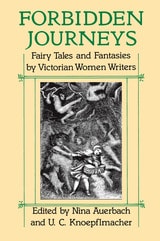
Forbidden Journeys
Fairy Tales and Fantasies by Victorian Women WritersEdited by Nina Auerbach and U. C. Knoepflmacher
University of Chicago Press, 1992
"Forbidden Journeys is not only a darkly entertaining book to read for the fantasies and anti-fantasies told, but also is a significant contribution to nineteenth-century cultural history, and especially feminist studies."—United Press International
"A service to feminists, to Victorian Studies, to children's literature and to children."—Beverly Lyon Clark, Women's Review of Books
"These are stories to laugh over, cheer at, celebrate, and wince at. . . . Forbidden Journeys is a welcome reminder that rebellion was still possible, and the editors' intelligent and fascinating commentary reveals ways in which these stories defied the Victorian patriarchy."—Allyson F. McGill, Belles Lettres
Forbidden Journeys
Fairy Tales and Fantasies by Victorian Women WritersEdited by Nina Auerbach and U. C. Knoepflmacher
University of Chicago Press, 1992
As these eleven dark and wild stories demonstrate, fairy tales by Victorian women constitute a distinct literary tradition, one startlingly subversive of the society that fostered it. From Anne Thackeray Ritchie's adaptations of "The Sleeping Beauty in the Wood" to Christina Rossetti's unsettling antifantasies in Speaking Likenesses, these are breathtaking acts of imaginative freedom, by turns amusing, charming, and disturbing. Besides their social and historical implications, they are extraordinary stories, full of strange delights for readers of any age.
"Forbidden Journeys is not only a darkly entertaining book to read for the fantasies and anti-fantasies told, but also is a significant contribution to nineteenth-century cultural history, and especially feminist studies."—United Press International
"A service to feminists, to Victorian Studies, to children's literature and to children."—Beverly Lyon Clark, Women's Review of Books
"These are stories to laugh over, cheer at, celebrate, and wince at. . . . Forbidden Journeys is a welcome reminder that rebellion was still possible, and the editors' intelligent and fascinating commentary reveals ways in which these stories defied the Victorian patriarchy."—Allyson F. McGill, Belles Lettres
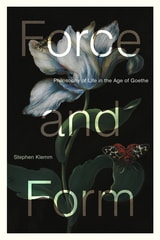
Force and Form
Philosophy of Life in the Age of GoetheStephen Klemm
Bucknell University Press, 2027
This book offers a bold rethinking of how modern ideas of life, nature, and subjectivity took shape in late-eighteenth- and early-nineteenth-century German thought. Moving beyond familiar narratives based on Kantian autonomy or Romantic irrationalism, it uncovers a vitalist tradition stretching from Herder to Schiller and Goethe, one that understood nature as dynamic, self-forming, and internally animated by life-force. Drawing on philosophy, the life sciences, and aesthetics, this innovative study reveals how these thinkers challenged mechanistic models of matter and resisted strict divisions between mind and nature. In doing so, they developed a historically contingent and embodied concept of subjectivity in which reason emerges from natural, cultural, and physiological processes rather than standing outside them. By situating this tradition within debates about epigenesis, form, and development, the book not only reshapes our understanding of German intellectual history but also sheds new light on contemporary debates about naturalism, posthumanism, and theories of life.
Published by Bucknell University Press. Distributed worldwide by Rutgers University Press.
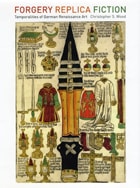
Forgery, Replica, Fiction
Temporalities of German Renaissance ArtChristopher S. Wood
University of Chicago Press, 2008
But Wood shows that over the course of the fifteenth and early sixteenth centuries, emerging replication technologies—such as woodcut, copper engraving, and movable type—altered the relationship between artifacts and time. Mechanization highlighted the artifice, materials, and individual authorship necessary to create an object, calling into question the replica’s ability to represent a history that was not its own. Meanwhile, print catalyzed the new discipline of archaeological scholarship, which began to draw sharp distinctions between true and false claims about the past. Ultimately, as forged replicas lost their value as historical evidence, they found a new identity as the intentionally fictional image-making we have come to understand as art.
Forget Me Not
The Rise of the British Literary Annual, 1823–1835Katherine D. Harris
Ohio University Press, 2015
By November 1822, the British reading public had already voraciously consumed both Walter Scott’s expensive novels and Rudolf Ackermann’s exquisite lithographs. The next decade, referred to by some scholars as dormant and unproductive, is in fact bursting with Forget Me Nots, Friendship’s Offerings, Keepsakes, and Literary Souvenirs. By wrapping literature, poetry, and art into an alluring package, editors and publishers saturated the market with a new, popular, and best-selling genre, the literary annual. In Forget Me Not, Katherine D. Harris assesses the phenomenal rise of the annual and its origins in other English, German, and French literary forms as well as its social influence on women, its redefinition of the feminine, and its effects on late nineteenth- and early twentieth-century print culture. Harris adopts an interdisciplinary approach that uses textual and social contexts to explore a forum of subversive femininity, where warfare and the masculine hero were not celebrated.
Initially published in diminutive, decoratively bound volumes filled with engravings of popularly recognized artwork and “sentimental” poetry and prose, the annuals attracted a primarily middle-class female readership. The annuals were released each November, making them an ideal Christmas gift, lover’s present, or token of friendship. Selling more than 100,000 copies during each holiday season, the annuals were accused of causing an epidemic and inspiring an “unmasculine and unbawdy age” that lasted through 1860 and lingered in derivative forms until the early twentieth century in both the United States and Europe. The annual thrived in the 1820s and after despite—or perhaps because of—its “feminine” writing and beautiful form.
Form and Instability
Eastern Europe, Literature, Postimperial DifferenceAnita Starosta
Northwestern University Press, 2015
Located at the intersection of comparative literature, area studies, and literary theory, this interdisciplinary study has a twofold commitment: to Eastern Europe on the one hand and to literature on the other. It aims to intervene in the way we conceive of Eastern Europe by seeking to develop a more equitable way of thinking, one that avoids subordinating it to Eurocentric narratives of progress. At the same time, it marshals literature as both object and method of this rethinking, in order to extend existing conceptions of the usefulness and of the proper organization of literary studies. The three terms in the title of this book mark a passage—via literature—from “Eastern Europe” as an inadequate and obsolescent category to “post-imperial difference” as a more accurate, if provisional, account of the region. By way of original readings of particular texts, and by attending to literature as a critical
Formalities
Seeing Script in Art of the Early Modern Spanish WorldAaron M. Hyman
University of Chicago Press, 0
Examines the visual qualities of written words in works of art created from 1540 to 1700 across the transatlantic Spanish Empire.
Pieces of text are found across paintings produced in the early modern Spanish Empire, but their role as aesthetic elements has long been overlooked. With Formalities, Aaron M. Hyman argues that these words were important, not only because of their literal content but also because of their forms, which artists and their audiences across the Spanish world understood in terms of meanings beyond semantic content.
The widespread phenomenon of writing in or on works of art is one of the most distinctive features of art in the early modern Spanish world, yet it has received little art historical attention. Hyman focuses on this feature, demonstrating how artists mobilized particular scripts and carefully integrated the pictorial qualities of the written word. He explores how letterforms of the era were strictly codified, with different forms being particular to different genres and contexts. Chapters look at painted, embroidered, and incised words alongside texts in archival documents, books, and prints, showing how the visual arts drew on sources including calligraphy manuals, notarial documents, merchant account books, liturgical texts, and pictograms. Artists relied on their audiences’ understanding of the contexts in which such objects were used and connotations that texts thus produced, using visual languages to make meaning in addition to—or in spite of—what the words themselves actually said.
Forming Humanity
Redeeming the German Bildung TraditionJennifer A. Herdt
University of Chicago Press, 2019
Kant’s proclamation of humankind’s emergence from “self-incurred immaturity” left his contemporaries with a puzzle: What models should we use to sculpt ourselves if we no longer look to divine grace or received authorities? Deftly uncovering the roots of this question in Rhineland mysticism, Pietist introspection, and the rise of the bildungsroman, Jennifer A. Herdt reveals bildung, or ethical formation, as the key to post-Kantian thought. This was no simple process of secularization, in which human beings took responsibility for something they had earlier left in the hands of God. Rather, theorists of bildung, from Herder through Goethe to Hegel, championed human agency in self-determination while working out the social and political implications of our creation in the image of God. While bildung was invoked to justify racism and colonialism by stigmatizing those deemed resistant to self-cultivation, it also nourished ideals of dialogical encounter and mutual recognition. Herdt reveals how the project of forming humanity lives on in our ongoing efforts to grapple with this complicated legacy.
Forms of Attention
Botticelli and HamletFrank Kermode
University of Chicago Press, 2011
Forms of Modern British Fiction
Edited by Alan Warren Friedman
University of Texas Press, 1975
In Forms of Modern British Fiction six individualistic and strongminded critics delineate the "age of modernism" in British fiction. Dating the age and the movement from later Hardy works through the deaths of Joyce and Woolf, they present British fiction as a cohesive, self-contained unit of literary history.
Hardy appears as the first of the modern British novelists, Lawrence as the central, and Joyce and Woolf as the last. The writers and the modern movement are framed by precursors, such as Galsworthy, and by successors, Durrell, Beckett, and Henry Green—the postmoderns. The pattern of the essays suggests a growing self-consciousness on the part of twentieth-century writers as they seek not only to refine their predecessors but also to deny (and sometimes obliterate) them. The moderns thus deny the novel itself, a genre once firmly rooted in history and forms of social life. Their works do not assume that comfortable mimetic relationship between the fictive realities of art and life.
Consequently, there has now evolved a poetics of the novel that is virtually identifiable with modern fiction, a poetics still highly problematical in its attempt to denote a medium in whose name eclectic innovativeness and incessant revitalizing are proclaimed. Forms of Modern British Fiction refines and advances the discussion of the modern novel and the world it and we inhabit.
Forms of Nationhood
The Elizabethan Writing of EnglandRichard Helgerson
University of Chicago Press, 1992
Fortino Sámano
The Overflowing of the PoemVirginie Lalucq and Jean-Luc Nancy
Omnidawn, 2012
Fortune’s Wheel
Dickens and the Iconography of Women’s TimeElizabeth A. Campbell
Ohio University Press, 2003
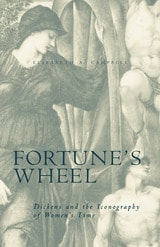
In the first half of the nineteenth century, England became quite literally a world on wheels. The sweeping technological changes wrought by the railways, steam-powered factory engines, and progressively more sophisticated wheeled conveyances of all types produced a corresponding revolution in Victorian iconography: the image of the wheel emerged as a dominant trope for power, modernity, and progress.
In Fortune’s Wheel, an original and illuminating study, Elizabeth Campbell explores the ways in which Charles Dickens appropriated and made central to his novels the dominant symbol of his age. Between 1840 and 1860, a transformation took place in Dickens’ thinking about gender and time, and this revolution is recorded in iconographic representations of the goddess Fortune and wheel imagery that appear in his work.
Drawing on a rich history of both literary and visual representations of Fortune, Professor Campbell argues that Dickens’ contribution to both the iconographic and narrative traditions was to fuse the classical image of the wheel with the industrial one. As the wheel was increasingly identified as the official Victorian symbol for British industrial and economic progress, Dickens reacted by employing this icon to figure a more pessimistic historical vision—as the tragic symbol for human fate in the nineteenth century.
Fortune’s Wheel ably portrays the concept that, in both text and illustrations, images of fortune and the wheel in Dickens’ work record his abandonment of a linear, progressive, and arguably masculine view of history to embrace a cyclical model that has been identified with “women’s time.”
Founders of the Future
The Science and Industry of Spanish ModernizationÓscar Iván Useche
Bucknell University Press, 2022
Fragments and Assemblages
Forming Compilations of Medieval LondonArthur Bahr
University of Chicago Press, 2013
Framed Visions
Popular Culture, Americanization, and the Contemporary German and Austrian ImaginationGerd Gemunden
University of Michigan Press, 1998
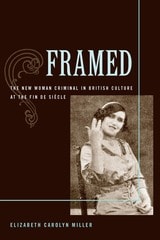
Framed
The New Woman Criminal in British Culture at the Fin de SiecleElizabeth Carolyn Miller
University of Michigan Press, 2008
Framed uses fin de siècle British crime narrative to pose a highly interesting question: why do female criminal characters tend to be alluring and appealing while fictional male criminals of the era are unsympathetic or even grotesque?
In this elegantly argued study, Elizabeth Carolyn Miller addresses this question, examining popular literary and cinematic culture from roughly 1880 to 1914 to shed light on an otherwise overlooked social and cultural type: the conspicuously glamorous New Woman criminal. In so doing, she breaks with the many Foucauldian studies of crime to emphasize the genuinely subversive aspects of these popular female figures. Drawing on a rich body of archival material, Miller argues that the New Woman Criminal exploited iconic elements of late nineteenth- and early twentieth-century commodity culture, including cosmetics and clothing, to fashion an illicit identity that enabled her to subvert legal authority in both the public and the private spheres.
"This is a truly extraordinary argument, one that will forever alter our view of turn-of-the-century literary culture, and Miller has demonstrated it with an enrapturing series of readings of fictional and filmic criminal figures. In the process, she has filled a gap between feminist studies of the New Woman of the 1890s and more gender-neutral studies of early twentieth-century literary and social change. Her book offers an extraordinarily important new way to think about the changing shape of political culture at the turn of the century."
---John Kucich, Professor of English, Rutgers University
"Given the intellectual adventurousness of these chapters, the rich material that the author has brought to bear, and its combination of archival depth and disciplinary range, any reader of this remarkable book will be amply rewarded."
---Jonathan Freedman, Professor of English and American Culture, University of Michigan
Elizabeth Carolyn Miller is Assistant Professor of English at the University of California, Davis.
digitalculturebooks is an imprint of the University of Michigan and the Scholarly Publishing Office of the University of Michigan Library dedicated to publishing innovative and accessible work exploring new media and their impact on society, culture, and scholarly communication. Visit the website at www.digitalculture.org.
Framing the Polish Home
Postwar Cultural Constructions of Hearth, Nation, and SelfBozena Shallcross
Ohio University Press, 2002
As the subject of ideological, aesthetic, and existential manipulations, the Polish home and its representation is an ever-changing phenomenon that absorbs new tendencies and, at the same time, retains its centrality to Polish literature, whether written in Poland or abroad. Framing the Polish Home is a pioneering work that explores the idea of home as fundamental to the question of cultural and national identity within Poland's recent history and its tradition.
In this inaugural volume of the Polish and Polish-American Studies Series, the Polish home emerges in its rich verbal and visual representations and multiple material embodiments, as the discussion moves from the loss of the home during wartime to the Sovietized politics of housing and from the exilic strategies of having a home to the the idyllic evocation of the abodes of the past.
Although, as Bożena Shallcross notes in her introduction, “few concepts seem to have such universal appeal as the notion of the home,” this area of study is still seriously underdeveloped. In essays from sixteen scholars, Framing the Polish Home takes a significant step to correct that oversight, covering a broad range of issues pertinent to the discourse on the home and demonstrating the complexity of the home in Polish literature and culture.
Frances Burney and Narrative Prior to Ideology
Brian McCrea
University of Delaware Press, 2014
Frances Burney and Narrative Prior to Ideology works between Burney’s Journals and Letters and her fiction more thoroughly than any study of her in the past twenty-five years. By doing so, it offers significant reinterpretations of Burney’s four novels: Evelina, Cecilia, Camilla, and The Wanderer. It describes Burney’s eluding the major modern–isms through which critics have tried to read her: Feminism (with its “gendering” of beauty and reversal of gender roles); Capitalism and its Marxist critique (here the details of Burney’s housekeeping become important); Professionalism (as a response to status inconsistency and class conflict); and Ian Watt’s “Formal Realism” (Burney perhaps saved the novel from a sharp decline it suffered in the 1770s, even as she tried to distance herself from the genre).
Burney’s most successful writing appeared before the coining of “ideology.” But her standing “prior to ideology” is not a matter of chronological accident. Rather, she quietly but forcefully resisted shared explanations—domesticity as model for household management, debt as basis for family finance, professional status as a means to social confidence, the novel as the dominant literary genre—that became popular during her long and eventful life.
Frederic Jameson has described Paul de Man, “in private conversation,” claiming, “Marxism . . . has no way of understanding the eighteenth century.” Frances Burney and Narrative Prior to Ideology conjoins Burney’s “eighteenth-centuryness” with her modernity.
Published by University of Delaware Press. Distributed worldwide by Rutgers University Press.
Francophonie and the Orient
French-Asian Transcultural Crossings (1840-1940)Mathilde Kang
Amsterdam University Press, 2018
Francophonie en Orient
Aux croisements France-Asie (1840-1940)Mathilde Kang
Amsterdam University Press, 2017
Frankenstein and STEAM
Essays for Charles E. RobinsonRobin Hammerman
University of Delaware Press, 2022
Charles E. Robinson, Professor Emeritus of English at The University of Delaware, definitively transformed study of the novel Frankenstein with his foundational volume The Frankenstein Notebooks and, in nineteenth century studies more broadly, brought heightened attention to the nuances of writing and editing. Frankenstein and STEAM consolidates the generative legacy of his later work on the novel's broad relation to topics in science, technology, engineering, arts, and mathematics (STEAM). Seven chapters written by leading and emerging scholars pay homage to Robinson's later perspectives of the novel and a concluding postscript contains remembrances by his colleagues and students. This volume not only makes explicit the question of what it means to be human, a question Robinson invited students and colleagues to examine throughout his career, but it also illustrates the depth of the field and diversity of those who have been inspired by Robinson's work. Frankenstein and STEAM offers direction for continuing scholarship on the intersections of literature, science, and technology.
Published by the University of Delaware Press. Distributed worldwide by Rutgers University Press.
Franz Kafka
Narration, Rhetoric, and ReadingEdited by Jakob Lothe, Beatrice Sandberg, and Ronald Speirs
The Ohio State University Press, 2011
Franz Kafka: Narration, Rhetoric, and Reading presents essays by noted Kafka critics and by leading narratologists who explore Kafka’s original and innovative uses of narrative throughout his career. Collectively, these essays by Stanley Corngold, Anniken Greve, Gerhard Kurz, Jakob Lothe, J. Hillis Miller, Gerhard Neumann, James Phelan, Beatrice Sandberg, Ronald Speirs, and Benno Wagner examine a number of provocative questions that arise in narration and narratives in Kafka’s fiction. The arguments of the essays relate both to the peculiarities of Kafka’s story-telling and to general issues in narrative theory. They reflect, for example, the complexity of the issues surrounding the “somebody” doing the telling, the attitude of the narrator to what is told, the perceived purpose(s) of the telling, the implied or actual reader, the progression of events, and the progression of the telling. As the essays also demonstrate, Kafka’s narratives still present a considerable challenge to, as well as a great resource for, narrative theory and analysis.
Franz Kafka
Subversive DreamerMichael Löwy, translated by Inez Hedges
University of Michigan Press, 2016

Freaks of History
Two Performance TextsJames MacDonald
Intellect Books, 2017
MacDonald, who is cerebral palsied, recognizes that disability narratives are rarely written by and for disabled people. Therefore his plays, accompanied by critical essays and director’s notes, are a welcome addition to the emerging discourse of Crip theory, and essential reading for disability students and academics alike.
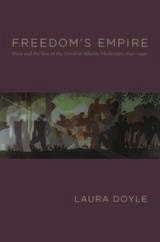
Freedom's Empire
Race and the Rise of the Novel in Atlantic Modernity, 1640-1940Laura Doyle
Duke University Press, 2007
Doyle brings together authors often separated by nation, race, and period, including Aphra Behn, Eliza Haywood, Olaudah Equiano, Nathaniel Hawthorne, Harriet Wilson, Pauline Hopkins, George Eliot, and Nella Larsen. In so doing, she reassesses the strategies of early women novelists, reinterprets the significance of rape and incest in the novel, and measures the power of race in the modern English-language imagination.

Freethinkers, Libertines and Schwarmer
Heterodoxy in German Literature, 1750-1800K. F. Hilliard
University of London Press, 2010
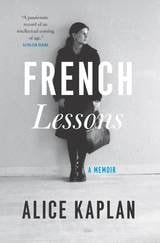
French Lessons
A MemoirAlice Kaplan
University of Chicago Press, 2018
The daughter of a Jewish lawyer who prosecuted Nazi war criminals at Nuremburg, Kaplan grew up in the 1960s in the Midwest. After her father's death when she was seven, French became her way of "leaving home" and finding herself in another language and culture. In spare, midwestern prose, by turns intimate and wry, Kaplan describes how, as a student in a Swiss boarding school and later in a junior year abroad in Bordeaux, she passionately sought the French "r," attentively honed her accent, and learned the idioms of her French lover.
When, as a graduate student, her passion for French culture turned to the elegance and sophistication of its intellectual life, she found herself drawn to the language and style of the novelist Louis-Ferdinand Celine. At the same time she was repulsed by his anti-Semitism. At Yale in the late 70s, during the heyday of deconstruction she chose to transgress its apolitical purity and work on a subject "that made history impossible to ignore:" French fascist intellectuals. Kaplan's discussion of the "de Man affair" — the discovery that her brilliant and charismatic Yale professor had written compromising articles for the pro-Nazi Belgian press—and her personal account of the paradoxes of deconstruction are among the most compelling available on this subject.
French Lessons belongs in the company of Sartre's Words and the memoirs of Nathalie Sarraute, Annie Ernaux, and Eva Hoffman. No book so engrossingly conveys both the excitement of learning and the moral dilemmas of the intellectual life.
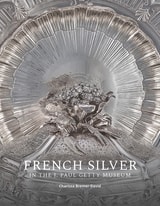
French Silver in the J. Paul Getty Museum
Charissa Bremer-David
J. Paul Getty Trust, The, 2023
The collection of seventeenth- and eighteenth-century French silver at the J. Paul Getty Museum is of exceptional quality and state of preservation. Each piece is remarkable for its beauty, inventive form, skillful execution, illustrious provenance, and the renown of its maker. This volume is the first complete study of these exquisite objects, with more than 250 color photographs bringing into focus extraordinary details such as minuscule makers’ marks, inscriptions, and heraldic armorials.
The publication details the formation of the Museum’s collection of French silver, several pieces of which were selected by J. Paul Getty himself, and discusses the regulations of the historic Parisian guild of gold- and silversmiths that set quality controls and consumer protections. Comprehensive entries catalogue a total of thirty-three pieces with descriptions, provenance, exhibition history, and technical information. The related commentaries shed light on the function of these objects and the roles they played in the daily lives of their prosperous owners. The book also includes maker biographies and a full bibliography.
The free online edition of this open-access publication is available at getty.edu/publications/french-silver/ and includes 360-degree views and zoomable high-resolution photography. Also available are free PDF and EPUB downloads of the book, and JPG downloads of the main catalogue images.
French Women Authors
The Significance of the Spiritual, 1400–2000Kelsey L. Haskett
University of Delaware Press, 2013
Published by University of Delaware Press. Distributed worldwide by Rutgers University Press.
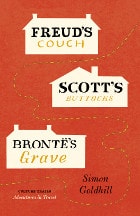
Freud's Couch, Scott's Buttocks, Brontë's Grave
Simon Goldhill
University of Chicago Press, 2011
The Victorian era was the high point of literary tourism. Writers such as Charles Dickens, George Eliot, and Sir Walter Scott became celebrities, and readers trekked far and wide for a glimpse of the places where their heroes wrote and thought, walked and talked. Even Shakespeare was roped in, as Victorian entrepreneurs transformed quiet Stratford-upon-Avon into a combination shrine and tourist trap.
Stratford continues to lure the tourists today, as do many other sites of literary pilgrimage throughout Britain. And our modern age could have no better guide to such places than Simon Goldhill. In Freud's Couch, Scott’s Buttocks, Brontë's Grave, Goldhill makes a pilgrimage to Sir Walter Scott's baronial mansion, Wordsworth's cottage in the Lake District, the Bront ë parsonage, Shakespeare's birthplace, and Freud's office in Hampstead. Traveling, as much as possible, by methods available to Victorians—and gamely negotiating distractions ranging from broken bicycles to a flock of giggling Japanese schoolgirls—he tries to discern what our forebears were looking for at these sites, as well as what they have to say to the modern mind. What does it matter that Emily Brontë’s hidden passions burned in this specific room? What does it mean, especially now that his fame has faded, that Scott self-consciously built an extravagant castle suitable for Ivanhoe—and star-struck tourists visited it while he was still living there? Or that Freud's meticulous recreation of his Vienna office is now a meticulously preserved museum of itself? Or that Shakespeare’s birthplace features student actors declaiming snippets of his plays . . . in the garden of a house where he almost certainly never wrote a single line?
Goldhill brings to these inquiries his trademark wry humor and a lifetime's engagement with literature. The result is a travel book like no other, a reminder that even today, the writing life still has the power to inspire.
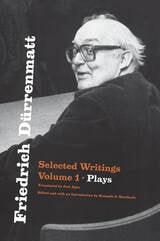
Friedrich Dürrenmatt
Selected Writings, Volume 1, PlaysFriedrich Dürrenmatt
University of Chicago Press, 2006
These translations of Friedrich Dürrenmatt’s plays introduce the writer to a new generation of readers.
The Swiss writer Friedrich Dürrenmatt (1921–90) was one of the most important literary figures of the second half of the twentieth century. During the years of the cold war, arguably only Beckett, Camus, Sartre, and Brecht rivaled him as a presence in European letters. Yet outside Europe, this prolific author is primarily known for only one work, The Visit.
Dürrenmatt’s concerns are timeless, but they are also the product of his Swiss vantage during the cold war: his key plays, gathered in the first volume of Selected Writings, explore such themes as guilt by passivity, the refusal of responsibility, greed and political decay, and the tension between justice and freedom. In The Visit, for instance, an old lady who becomes the wealthiest person in the world returns to the village that cast her out as a young woman and offers riches to the town in exchange for the life of the man, now its mayor, who once disgraced her. Joel Agee’s crystalline translation gives a fresh lease to this play, as well as four others: The Physicists, Romulus the Great, Hercules and the Augean Stables, and The Marriage of Mr. Mississippi.
Dürrenmatt has long been considered a great writer, but one unfairly neglected in the modern world of letters. With these elegantly conceived and expertly translated volumes, a new generation of readers will rediscover his greatest works.
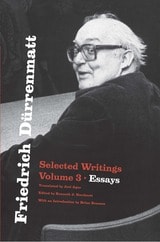
Friedrich Dürrenmatt
Selected Writings, Volume 3, EssaysFriedrich Dürrenmatt
University of Chicago Press, 2006
These translations of Friedrich Dürrenmatt’s essays introduce the writer to a new generation of readers.
The Swiss writer Friedrich Dürrenmatt (1921–90) was one of the most important literary figures of the second half of the twentieth century. During the years of the cold war, arguably only Beckett, Camus, Sartre, and Brecht rivaled him as a presence in European letters. Yet outside Europe, this prolific author is primarily known for only one work, The Visit. With these long-awaited translations of his plays, fictions, and essays, Dürrenmatt becomes available again in all his brilliance to the English-speaking world.
Dürrenmatt’s essays, gathered in this third volume of Selected Writings, are among his most impressive achievements. Their range alone is astonishing: he wrote with authority and charm about art, literature, philosophy, politics, and the theater. The selections here include Dürrenmatt’s best-known essays, such as “Theater Problems” and “Monster Essay on Justice and Law,” as well as the notes he took on a 1970 journey in America (in which he finds the United States “increasingly susceptible to every kind of fascism”). This volume also includes essays that shade into fiction, such as “The Winter War in Tibet,” a fantasy of a third world war waged in a vast subterranean labyrinth—a Plato’s Cave allegory rewritten for our own troubled times.
Dürrenmatt has long been considered a great writer, but one unfairly neglected in the modern world of letters. With these elegantly conceived and expertly translated volumes, a new generation of readers will rediscover his greatest works.

Friendship and Literature
Spirit and FormRonald A. Sharp
Duke University Press, 1986
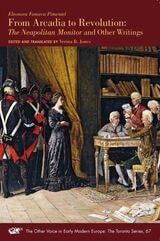
From Arcadia to Revolution
The Neapolitan Monitor and Other WritingsEleonora Fonseca Pimentel
Iter Press, 2019
The Other Voice in Early Modern Europe: The Toronto Series, Volume 67
From Communism to European Governance
The European Commission’s Support for Administrative Reforms in Romania, Serbia,and MoldovaClaudia Badulescu
Central European University Press, 2027

From Jane Austen to Joseph Conrad
Robert C. Rathburn and Martin Steinmann Jr., Editors
University of Minnesota Press, 1967
From Jane Austen to Joseph Conrad was first published in 1967. Minnesota Archive Editions uses digital technology to make long-unavailable books once again accessible, and are published unaltered from the original University of Minnesota Press editions.
David Daisches, Douglas Bush, Robert B. Heilman, Arthur Mizener, and William Van O'Connor are among the contributors to this volume of essays on the nineteenth-century British novel. Each of the selections has been written expressly for this book and is published here for the first time.
There are a total of 20 essays, each by a different contributor. In addition, Rathburn, in an introductory essay, relates the nineteenth-century novel to that of the eighteenth century and Steinmann, in the concluding essay, discusses the nineteenth-century novel in relation to that of the present century.
The contributors, in addition to the two editors of the volume, and the novelists they discuss are the following: Charles Murrah, Jane Austen; Alan D Mckillop, Jane Austen; David Dasches, Walter Scott; Curtis Dahl, Edward Bulwer-Lytton; J. Y T. Greig, William Makepeace Thackeray; Douglas Bush, Charles Dickens; George H. Ford, Dickens; Melvin; R. Watson, the Brontes; Robert B. Heilman, Charlotte Bronte; Yvonne French, Elizabeth Gaskell; Bradford A. Booth, Anthony Trollope; Arthur Mizener, Anthony Trollope; Gordon S. Haight, George Eliot; Sumner J. Ferris, George Eliot; Wayne Burns, Charles Reade; Fabian Gudas, George Meredith; John Holloway, Thomas Hardy; Jacob Korg, George Gissing; William Van O'Connor, Samuel Burlter; W. Y. Tindall, Joseph Conrad. Although each essay is focused on a single novel or on one aspect of the novelist, all of them are written to give the reader sense of the novelist's whole achievement.
From Laughter to Forgetting
A Sourcebook of Czech Avant-Garde DiscoursesEdited by Zuzana Ríhová
Karolinum Press, 2023
In recent years a prominent trend in the study of European modernism and the avant-garde has been increased attention to texts and traditions that have long stood in the shadow of the French, German, and British traditions that dominate the canon. Yet this more expansive view of European modernism and the avant-garde has been hindered by the limited range of texts available outside the original languages. This book addresses that problem by offering a wide-ranging selection of literary, theoretical, and documentary sources from one of the most dynamic and original European avant-garde traditions: that of the first Czechoslovak Republic and of the Bohemian lands. The Czech avant-garde is in many respects the ideal “alternative” avant-garde to present in detail to a wider readership: it tracks Central European developments and was often influential internationally while being deeply embedded in particular cultural dynamics that produced original forms. This volume returns interwar Czech avant-garde writings to their place as a firmly embedded component of the European avant-garde.
From Many Gods to One
Divine Action in Renaissance EpicTobias Gregory
University of Chicago Press, 2006
Epic poets of the Renaissance looked to emulate the poems of Greco-Roman antiquity, but doing so presented a dilemma: what to do about the gods? Divine intervention plays a major part in the epics of Homer and Virgil—indeed, quarrels within the family of Olympian gods are essential to the narrative structure of those poems—yet poets of the Renaissance recognized that the cantankerous Olympians could not be imitated too closely. The divine action of their classical models had to be transformed to accord with contemporary tastes and Christian belief.
From Many Gods to One offers the first comparative study of poetic approaches to the problem of epic divine action. Through readings of Petrarch, Vida, Ariosto, Tasso, and Milton, Tobias Gregorydescribes the narrative and ideological consequences of the epic’s turn from pagan to Christian. Drawing on scholarship in several disciplines—religious studies, classics, history, and philosophy, as well as literature—From Many Gods to One sheds new light on two subjects of enduring importance in Renaissance studies: the precarious balance between classical literary models and Christian religious norms and the role of religion in drawing lines between allies and others.
From Misa to Mise en Scène
Fra Francesc Moner’s Prototype of the Spanish Sacramental Theater of the Fifteenth CenturyPeter Cocozzella
Arizona Center for Medieval and Renaissance Studies, 2020
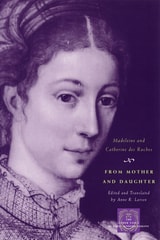
From Mother and Daughter
Poems, Dialogues, and Letters of Les Dames des RochesMadeleine and Catherine des Roches
University of Chicago Press, 2006
Madeleine and Catherine spent their entire lives in civil war–torn Poitiers, where a siege of the city, vandalism, and desecration of churches fueled their political and religious commentary. Members of an elite literary circle that would inspire salon culture during the next century, the Dames des Roches addressed the issues of the day, including the ravages of religious civil wars, the weak monarchy, education for women, marriage and the family, violence against women, and the status of women intellectuals. Through their collaborative engagement in shared public discourse, both mother and daughter were models of moral, political, and literary agency.
From Page to Performance
Essays in Early English DramaJohn A. Alford
Michigan State University Press, 1995
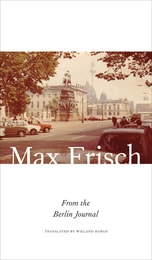
From the Berlin Journal
Max Frisch
Seagull Books, 2017
Max Frisch (1911–91) was a giant of twentieth-century German literature. When Frisch moved into a new apartment in Berlin’s Sarrazinstrasse, he began keeping a journal, which he came to call the Berlin Journal. A few years later, he emphasized in an interview that this was by no means a “scribbling book,” but rather a book “fully composed.” The journal is one of the great treasures of Frisch’s literary estate, but the author imposed a retention period of twenty years from the date of his death because of the “private things” he noted in it. From the Berlin Journal now marks the first publication of excerpts from Frisch’s journal. Here, the unmistakable Frisch is back, full of doubt, with no illusions, and with a playfully sharp eye for the world.
From the Berlin Journal pulls from the years 1946–49 and 1966–71. Observations about the writer’s everyday life stand alongside narrative and essayistic texts, as well as finely-drawn portraits of colleagues like Günter Grass, Uwe Johnson, Wolf Biermann, and Christa Wolf, among others. Its foremost quality, though, is the extraordinary acuity with which Frisch observed political and social conditions in East Germany while living in West Berlin.
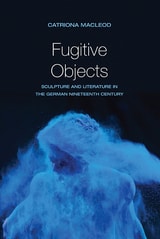
Fugitive Objects
Sculpture and Literature in the German Nineteenth CenturyCatriona MacLeod
Northwestern University Press, 2014
Winner of the 2014 Jean-Pierre Barricelli Prize for Best Book on Romanticism
In Fugitive Objects, Catriona MacLeod examines the question of why sculpture is both intensively discussed and yet rendered immaterial in German literature. She focuses on three forms of disappearance: sculpture’s vanishing as a legitimate art form at the beginning of the nineteenth century in German aesthetics, statues’ migration from the domain of high art into mass reproduction and popular culture, and sculpture’s dislodging and relocation into literary discourse. Through original readings of Clemens Brentano, Achim von Arnim, Adalbert Stifter, Leopold von Sacher-Masoch, and others, MacLeod reveals that if sculpture has disappeared from much of nineteenth-century German literature and aesthetics, it is a vanishing act that paradoxically relocates the statue back onto another cultural pedestal, attesting to the powerful force of the medium.
Further on, Nothing
Tadeusz Kantor’s TheatreMichal Kobialka
University of Minnesota Press, 2009
A new encounter with the work of a master of avant-garde theatre
Tadeusz Kantor (1915–1990) was one of the twentieth century’s most innovative visual artists, stage directors, and theoreticians. His theatre productions and manifestos challenged the conventions of creating art in post–World War II culture and expanded the boundaries of Dada, surrealist, Constructivist, and happening theatre forms. Kantor’s most widely known productions—The Dead Class (1975), Wielopole, Wielopole (1980), Let the Artists Die (1985), and Today Is My Birthday (1990)—have had a profound impact on playwrights and artists who continue today to engage with his radical theatre.
In Further on, Nothing, Michal Kobialka explores Kantor’s theatre practice from the critical perspective of current debates about representation, memory, and history. He pursues the intriguing proposition that Kantor gave material form to a theatre practice that defined the very mode of postmodern operation and that many of its theoretical notions are still in circulation. According to Kobialka, Kantor’s theatre still offers an answer to reality rather than a portrayal of a utopian alternative. Further on, Nothing includes new translations of Kantor’s work, presented in conversation with Kobialka’s own theoretical analyses, to show us a Kantor who continues to offer—and deliver on—the promise of the avant-garde.
Fury
Elfriede Jelinek
Seagull Books, 2022
In Greek mythology, it is Hera who blinds the hero Heracles, so that, in a fit of fury, he kills his own family. In the twenty-first century, the gods have another name. So did the three young men who stormed a magazine’s editorial office and a Jewish supermarket in Paris in January 2015 and murdered twelve people. The blind fury, however, remained and more virulent than ever, not least because the weapons were so much more effective.
In this raging text, arguably one of her darkest, Nobel Prize winner Elfriede Jelinek investigates topical political events in the context of enduring history and myths. Fury expresses itself not only multi-voiced and from the changing perspective of Islamist terrorists (and their special hatred of Jews), in the shape of furious German citizens, individual narcissistic humiliation, or brutal distribution battles around the globe. Rather, fury also appears as the motor that has driven people with a devastating force for centuries.
With her characteristic linguistic power, Jelinek articulates her own disconcertedness in the face of these crimes. In passing, she returns repeatedly to the contradiction between religious laws against representation and the deluge of images online, where movies of assassination, severed heads, and other atrocities are exhibited for millions to see. Fury is a compact grand epic that starts in primal times and attempts to describe the indescribable, relating the inexplicable in our times.