455 books match the query 'Feminism' and 71 start with f

cover of Feminist Surveillance Studies

Feminist Surveillance Studies

Rachel E. Dubrofsky and Soshana Amielle Magnet, eds.

Duke University Press, 2015

Questions of gender, race, class, and sexuality have largely been left unexamined in surveillance studies. The contributors to this field-defining collection take up these questions, and in so doing provide new directions for analyzing surveillance. They use feminist theory to expose the ways in which surveillance practices and technologies are tied to systemic forms of discrimination that serve to normalize whiteness, able-bodiedness, capitalism, and heterosexuality. The essays discuss the implications of, among others, patriarchal surveillance in colonial North America, surveillance aimed at curbing the trafficking of women and sex work, women presented as having agency in the creation of the images that display their bodies via social media, full-body airport scanners, and mainstream news media discussion of honor killings in Canada and the concomitant surveillance of Muslim bodies. Rather than rehashing arguments as to whether or not surveillance keeps the state safe, the contributors investigate what constitutes surveillance, who is scrutinized, why, and at what cost. The work fills a gap in feminist scholarship and shows that gender, race, class, and sexuality should be central to any study of surveillance.

Contributors. Seantel Anaïs, Mark Andrejevic, Paisley Currah, Sayantani DasGupta, Shamita Das Dasgupta, Rachel E. Dubrofsky, Rachel Hall, Lisa Jean Moore, Yasmin Jiwani, Ummni Khan, Shoshana Amielle Magnet, Kelli Moore, Lisa Nakamura, Dorothy Roberts, Andrea Smith, Kevin Walby, Megan M. Wood, Laura Hyun Yi Kang
[more]
cover of Feminist Theory and Literary Practice

Feminist Theory and Literary Practice

Deborah L. Madsen

Pluto Press, 2000

[more]
cover of Feminist Theory: A Critique of Ideology

Feminist Theory

A Critique of Ideology

Edited by Nannerl Keohane, Michelle Z. Rosaldo, and Barbara C. Gelpi

University of Chicago Press, 1982

"A crucial task for feminst scholars," wrote Michelle Rosaldo over two years ago in Signs, "emerges, then, not as the relatively limited one of documenting pervasive sexism as a social fact–or showing how we can now hope to change or have in the past been able to survive it. Instead, it seems that we are challenged to provide new ways of linking the particulars of women's lives, activities, and goals to inequalities wherever they exist."

Feminist Theory: A Critique of Ideology meets that challenge. Collected from several issues of Signs–Journal of Women in Culture and Society, these essays explore the relationships between objectivity and masculinity, between psychology and political theory, and between family and state. In pursuing these critical explorations, the contributors–liberal, Marxist, socialist, and radical feminists–examine the foundations of power, of sexuality, of language, and of scientific thought.

[more]
cover of Feminist and Human Rights Struggles in Peru: Decolonizing Transitional Justice

Feminist and Human Rights Struggles in Peru

Decolonizing Transitional Justice

Pascha Bueno-Hansen

University of Illinois Press, 2015

In 2001, following a generation of armed conflict and authoritarian rule, the Peruvian state created a Truth and Reconciliation Committee (TRC). Pascha Bueno-Hansen places the TRC, feminist and human rights movements, and related non-governmental organizations within an international and historical context to expose the difficulties in addressing gender-based violence. Her innovative theoretical and methodological framework based on decolonial feminism and a critical engagement with intersectionality facilitates an in-depth examination of the Peruvian transitional justice process based on field studies and archival research. Bueno-Hansen uncovers the colonial mappings and linear temporality underlying transitional justice efforts and illustrates why transitional justice mechanisms must reckon with the societal roots of atrocities, if they are to result in true and lasting social transformation. Original and bold, Feminist and Human Rights Struggles in Peru elucidates the tension between the promise of transitional justice and persistent inequality and impunity.
[more]
cover of Feminists Who Changed America, 1963-1975

Feminists Who Changed America, 1963-1975

Edited by Barbara J. Love: Foreword by Nancy F. Cott

University of Illinois Press, 2006

Documenting key feminists who ignited the second wave women's movement

Barbara J. Love’s Feminists Who Changed America, 1963-1975 will be the first comprehensive directory to document many of the founders and leaders (including both well-known and grassroots organizers) of the second wave women's movement.  It tells the stories of more than two thousand individual women and a few notable men who together reignited the women's movement and made permanent changes to entrenched customs and laws.

The biographical entries on these pioneering feminists represent their many factions, all parts of the country, all races and ethnic groups, and all political ideologies. Nancy Cott's foreword discusses the movement in relation to the earlier first wave and presents a brief overview of the second wave in the context of other contemporaneous social movements. 

[more]
cover of Fields Of Protest: Women’s Movement in India

Fields Of Protest

Women’s Movement in India

Raka Ray

University of Minnesota Press, 1999

A comparative analysis of women’s struggle for change in India.

The women’s movement in India has a long and rich history in which millions of women live, work, and struggle to survive in order to remake their family, home, and social lives. Whether fighting for safe contraception, literacy, water, and electricity or resisting sexual harassment, they are participating in vibrant and active women’s movements that are thriving in many parts of India today.

Fields of Protest explores the political and cultural circumstances under which groups of women organize to fight for their rights and self-worth. Starting with Bombay and Calcutta, Raka Ray discusses the creation of “political fields”-structured, unequal, and socially constructed political environments within which organizations exist, flourish, or fail. Women’s organizations are not autonomous or free agents; rather, they inherit a “field” and its accompanying social relations, and when they act, they act in response to it and within it. Drawing on the literature of both social movements and feminism, Ray analyzes the striking differences between the movements in these two cities.Using an innovative and comparative perspective, Ray offers a unique look at Indian activist women and adds a new dimension to the study of women’s movements on a global level.

[more]
cover of Fifty Years of Exponent II

Fifty Years of Exponent II

Katie Ludlow Rich

Signature Books, 2024

On a sweltering day in June 1974, a group of housewives, graduate students, and young professionals gathered in the Boston suburbs. Their mission: to produce the first issue of Exponent II, a “humble yet sincere” newspaper “poised on the dual platforms of Mormonism and Feminism.” They viewed their work as an act of devotion, not rebellion, and were naïve of the cold reception they would soon receive from LDS Church leaders. Nevertheless, the paper became a national platform connecting Mormon feminists. It provided a vital space for them to question and integrate different aspects of their dual—and sometimes dueling—identities. From the Equal Rights Amendment to queer identity, Exponent II has hosted some of the most urgent conversations of its time while also embracing life’s dailiness.

This comprehensive history and anthology celebrate five decades of Exponent II. Through meticulous research and compelling storytelling, the authors chronicle the organization’s evolution from a kitchen-table-style newspaper to a quarterly magazine, blog, and annual retreat. Its transformative impact on the lives of its participants stands as a testament to the power of connection, resilience, and community over ideological purity.
[more]
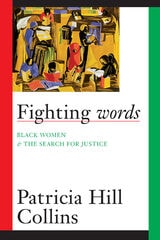
cover of Fighting Words: Black Women and the Search for Justice

Fighting Words

Black Women and the Search for Justice

Patricia Hill Collins

University of Minnesota Press, 1998

When Black Feminist Thought by Patricia Hill Collins was published in 1990, reviewers called it "remarkable," "rich and valuable," and proclaimed, "with the publication of this book, Black feminism has moved to a new level." Now, in Fighting Words, Collins expands and extends the discussion of the "outsider within" presented in her earlier work, investigating how effectively Black feminist thought confronts the injustices African American women currently face. Collins takes on a broad range of issues-poverty, mothering, white supremacy and Afrocentrism, the resegregation of American society by race and class, the ideas of Sojourner Truth and how they can serve as a springboard for more liberating social theory. Contrasting social theories that support unjust power relations of race, class, gender, and nation with those that challenge inequalities, Collins investigates why some ideas are granted the status of "theory" while others remain "thought." "It is not that elites produce theory while everyone else produces mere thought," she writes. "Rather, elites possess the power to legitimate the knowledge that they define as theory as being universal, normative, and ideal." Collins argues that because African American women and other historically oppressed groups seek economic and social justice, their social theories may emphasize themes and work from assumptions that are different from those of mainstream American society, generating new angles of vision on injustice. Collins also puts such oppositional social theory to the test: while the words of these theories may challenge injustice, do the ideas make a difference in the lives of the people they claim to represent? Throughout, Collins provides an essential understanding of how "outsiders" resist mainstream perspectives, and what the mainstream can learn from such "outsiders." Historically situated yet transcending the specific, Fighting Words provides a new interpretive framework for both thinking through and overcoming social injustice. "In her perceptive book, Fighting Words, Patricia Hill Collins, a leading scholar in critical theory, argues that intellectuals who break with conventional wisdom are more of a threat to the establishment than their numbers might suggest." Joe R. Feagin in The Chronicle of Higher Education "Fighting Words is a treatise, if you will, encouraging all black women to engage in dialogue and to reach out to each other, regardless of education, income, or class. Fighting Words is an amazing work in the way it seamlessly combines the histories of black women and feminism. Even more impressive is the way Collins blends her personal experiences as a black woman, educator, and sociologist. Collins is all about telling the truth, now. That is probably why Fighting Words is such a revelation." Black Issues Book Review "Fighting Words ably demonstrates that Collins is still our leading theorist. Those who understand black women in terms of reductionist categories and who need to read this book probably won't. But it gives the rest of us another sharp implement with which to saw at the ropes." Women's Review of Books "Collins argues that the political gains of black women's 'talking back' now must be measured against changes brought on by the postmodern criticism of social science and Afrocentricism. Collins calls for a critical social theory that not only encourages black women's full participation in social life but actually grounds its own authority in its ability to enable black women's full participation." American Journal of Sociology "Collins' exploration of the question, 'What is knowledge?' demonstrates the value of a perspective that brings together the complex interrelationships of race, gender and social ranking. The text is both counter-theoretical and practical­­a readable, persuasive and important source. Highly recommended." The Diversity Factor "Advances a much needed discussion, beyond feminism and identity politics for black women and, presumably, for women of color generally." National Women's Studies Association Journal "Hill Collins provides a refreshing new look at theory that is not mired in obscure language but purposely written in multiple languages to welcome a broader audience. By using accessible/inclusive language and drawing on many schools of intellectual thought, she informs and educates across disciplines ­ a unique characteristic in academia. She delivers a critical and passionate work that is inspiring to a new generation of scholars and renews the spirit of existing scholars." Gender and Society "Collins has offered an excellent text that helps us understand not only Black feminist thought and its relationship to Black women's experiences, but also how it may help those of us truly working for social justice." Feminist Collections "This book has many suggestive ideas and well-thought-through social theoretical analyses. In line with her earlier work, Collins continues to argue that group positions generate epistemological standpoints from which people ask and answer questions of social knowledge in different ways. She considers whether recent theories of Black women as having 'intersectional' positions is a better conceptualization of the specific standpoint of Black women. Collins's book offers much to think about and to discuss for those involved in struggles generated by encounters and events beyond theory." Hypatia "This is a work that is both theoretically rich and yet deeply personal in its expressive voice. Collins points us toward the construction of new critical theoretical approaches that can effectively advance the struggles for social justice. Fighting Words is a powerful and passionate work." --Manning Marable Patricia Hill Collins is Charles Phelps Taft Professor of Sociology in the Department of African American Studies at the University of Cincinnati.
[more]
cover of Fighting for NOW: Diversity and Discord in the National Organization for Women

Fighting for NOW

Diversity and Discord in the National Organization for Women

Kelsy Kretschmer

University of Minnesota Press, 2019

An unparalleled exploration of NOW’s trajectory, from its founding to the present—and its future

A new wave of feminist energy has swept the globe since 2016—from women’s marches and the #MeToo movement to transwomen’s inclusion and exclusion in feminism and participation in institutional politics. Amid all this, an organization declared dead or dying for thirty years—the National Organization for Women—has seen a membership boom. NOW presents an intriguing puzzle for scholars and activists alike. Considered one of the most stable organizations in the feminist movement, it has experienced much conflict and schism. Scholars have long argued that factionalism is the death knell of organizations, yet NOW continues to thrive despite internal conflicts. 

Fighting for NOW seeks to better understand how bureaucratic structures like NOW’s simultaneously provide stability and longevity, while creating space for productive and healthy conflict among members. Kelsy Kretschmer explores these ideas through an examination of conflict in NOW’s local chapters, its task forces and committees, and its satellite groups. NOW’s history provides evidence for three basic arguments: bureaucratic groups are not insulated from factionalism; they are important sites of creativity and innovation for their movements; and schisms are not inherently bad for movement organizations. Hence, Fighting for NOW is in stark contrast to conventional scholarship, which has conceptualized factionalism as organizational failure. It also provides one of the few book-length explorations of NOW’s trajectory, from its founding to the modern context. 

Scholars will welcome the book’s insights that draw on open systems and resource dependency theories, as well as its rethinking of how conflict shapes activist communities. Students will welcome its clear and compelling history of the feminist movement and of how feminist ideas have changed over the past five decades.

[more]
cover of Finding the Movement: Sexuality, Contested Space, and Feminist Activism

Finding the Movement

Sexuality, Contested Space, and Feminist Activism

Finn Enke

Duke University Press, 2007

In Finding the Movement, Anne Enke reveals that diverse women’s engagement with public spaces gave rise to and profoundly shaped second-wave feminism. Focusing on women’s activism in Detroit, Chicago, and Minneapolis-St. Paul during the 1960s and 1970s, Enke describes how women across race and class created a massive groundswell of feminist activism by directly intervening in the urban landscape. They secured illicit meeting spaces and gained access to public athletic fields. They fought to open bars to women and abolish gendered dress codes and prohibitions against lesbian congregation. They created alternative spaces, such as coffeehouses, where women could socialize and organize. They opened women-oriented bookstores, restaurants, cafes, and clubs, and they took it upon themselves to establish women’s shelters, health clinics, and credit unions in order to support women’s bodily autonomy.

By considering the development of feminism through an analysis of public space, Enke expands and revises the historiography of second-wave feminism. She suggests that the movement was so widespread because it was built by people who did not identify themselves as feminists as well as by those who did. Her focus on claims to public space helps to explain why sexuality, lesbianism, and gender expression were so central to feminist activism. Her spatial analysis also sheds light on hierarchies within the movement. As women turned commercial, civic, and institutional spaces into sites of activism, they produced, as well as resisted, exclusionary dynamics.
[more]
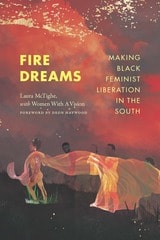
cover of Fire Dreams: Making Black Feminist Liberation in the South

Fire Dreams

Making Black Feminist Liberation in the South

Laura McTighe, with Women With A Vision

Duke University Press, 2024

For thirty-five years, the New Orleans-based Black feminist collective Women With A Vision (WWAV) has fought for the liberation of their communities through reproductive justice, harm reduction, abolition feminism, racial justice, and sex workers' rights. In 2012, shortly after one of WWAV's biggest organizing victories, arsonists firebombed and destroyed their headquarters. Fire Dreams is an innovative collaboration between WWAV and Laura McTighe, who work in community to build a social movement ethnography of the organization’s post-arson rebirth. Rooting WWAV in the geography of the South and the living history of generations of Black feminist thinkers, McTighe and WWAV weave together stories from their founders’ pioneering work during the Black HIV/AIDS crisis in the 1980s and their groundbreaking organizing to end criminalization in the aftermath of Hurricane Katrina---with other movements for liberation as accomplices. Together, the authors refuse the logics of racial capitalism and share WWAV’s own world-building knowledges, as well as their methods for living these Black feminist futures now. Fire Dreams is a vital toolkit for grassroots organizers, activist-scholars, and all those who dream to make the world otherwise.
[more]
cover of Fireweed: A Political Autobiography

Fireweed

A Political Autobiography

Gerda Lerner

Temple University Press, 2003

In Fireweed, Gerda Lerner, a pioneer and leading scholar in women's history, tells her story of moral courage and commitment to social change with a novelist's skill and a historian's command of context. Lerner's memoir focuses on the formative experiences that made her an activist for social justice before her academic career began. The child of a well-to-do Viennese Jewish family, she was still a teenager when a fascist regime came to power in 1934, and she became involved in the underground resistance movement. The Nazi takeover of Austria cast her into prison, then forced her and her family into exile; she alone was able to leave Europe. Once in the United States, she experienced the harshness of the Depression and despair over the fate of her family. Still, she persisted in adapting to the new culture and to becoming a writer. Here she met and married her life-long partner, Carl Lerner, a film editor and director. Together they become deeply involved in left-wing activities, from struggling to unionize the film industry and resisting the blacklist in Hollywood to community organizing for peace, for an interracial civil rights movement, and for better schools in New York City. Lerner insists that her decades of grassroots organizing largely account for the theoretical insights she was later able to bring to the development of women's history. In Fireweed, Lerner presents her life in the context of the major historical events of the twentieth century and the repression of dissent. Hers is a gripping story about surviving hardship and summoning the courage to live according to one's convictions.
[more]
cover of Fleshing the Archive: An Intimate Genealogy of Chicana Knowledge Praxis

Fleshing the Archive

An Intimate Genealogy of Chicana Knowledge Praxis

María Eugenia Cotera

University of Texas Press, 2025

The history of the Chicana por mi Raza Digital Memory Collective, an archive dedicated to preserving Chicana feminist knowledge of the 1970s and memory work.

The late 1960s and early 1970s witnessed an explosion of publishing by Chicana activists as they took part in the Movimiento against oppression of ethnic Mexicans in the United States. Today, thousands of these documents, including written works and oral histories, have been assembled by the Chicana por mi Raza Digital Memory Collective. Drawing on these unique resources, Fleshing the Archive traces the innovative Chicana knowledge projects of the Movimiento years.

Seeking to think with the past rather than about it, María Cotera explores transgressive sites and discourses of Chicana knowledge, from poems and essays to newspapers, bibliographies, and testimonies. Often published independently and distributed by readers themselves, these works embodied a praxis of feminist and queer consciousness-raising. Observing the startling convergences between Chicana praxis of the 1970s and digital knowledge production in the present, Cotera argues that the Chicana archive enables transformative moments of recognition across time that unsettle supposedly objective accounts of history. The materials preserved by Chicana por mi Raza offer Chicana scholars a model of teaching and learning liberated from a corporate academy that is increasingly hostile to intellectual inquiry.

[more]
cover of For the Love of God: The Bible as an Open Book

For the Love of God

The Bible as an Open Book

Ostriker, Alicia Suskin

Rutgers University Press, 2009

Quoting King Solomon’s famous prayer to God at the Temple in Jerusalem, “Behold, the heaven of heavens cannot contain thee; how much less this house that I have builded,” Alicia Suskin Ostriker posits a God who cannot be contained by dogma and doctrine.  Troubled by the way the Bible has become identified in our culture with a monolithic authoritarianism, Ostriker focuses instead on the extraordinary variability of Biblical writing.

For the Love of God is a provocative and inspiring re-interpretation of six essential Biblical texts: The Song of Songs, the Book of Ruth, Psalms, Ecclesiastes, Jonah, and Job.  In prose that is personal and probing, analytically acute and compellingly readable, Ostriker sees these writings as “counter-texts,” deviating from convention yet deepening and enriching the Bible, our images of God, and our own potential spiritual lives. Attempting to understand “some of the wildest, strangest, most splendid writing in Western tradition,” she shows how the Bible embraces sexuality and skepticism, boundary crossing and challenges to authority, how it illuminates the human psyche and mirrors our own violent times, and how it asks us to make difficult choices in the quest for justice.  

For better or worse, our society is wedded to the Bible.  But according to Talmud, “There is always another interpretation.” Ostriker demonstrates that the Bible, unlike its reputation, offers a plenitude of surprises.

[more]
cover of Frankly Feminist: Short Stories by Jewish Women from Lilith Magazine

Frankly Feminist

Short Stories by Jewish Women from Lilith Magazine

Edited by Susan Weidman Schneider and Yona Zeldis McDonough

Brandeis University Press, 2022

A groundbreaking Jewish feminist short story collection.
 
Short story collections focusing on Jewish writers have—no surprise—typically given women authors short shrift. This new volume represents the best Jewish feminist fiction published in Lilith magazine, and does what no other collection has done before in its geographic scope, its inclusion of twenty-first-century stories, and its Jewish feminist focus.

This collection showcases a wide range of stories offering variegated cultures and contexts and points of view: Persian Jews; a Biblical matriarch; an Ethiopian mother in modern Israel; suburban American teens; Eastern European academics; a sexual questioner; a Jew by choice; a new immigrant escaping her Lower East Side sweatshop; a Black Jewish marcher for justice; in Vichy France, a toddler’s mother hiding out; and more.

Organized by theme, the stories in this book emphasize a breadth of content, and our hope is that in reading you’ll appreciate the liveliness of the burgeoning self-awareness brought to life in each tale, and the occasional funny, call-your-friend-and-tell-her-about-it moment. Skip around, encounter an author whose other work you may know, be enticed by a title, or an opening line. We hope you’ll find both pleasure and enlightenment—and sometimes revelation—within these pages.
 
[more]
cover of Friends of Alice Wheeldon

Friends of Alice Wheeldon

Sheila Rowbotham

Pluto Press, 1986

[more]
cover of From Black Power to Hip Hop: Racism, Nationalism, and Feminism

From Black Power to Hip Hop

Racism, Nationalism, and Feminism

Patricia Hill Collins

Temple University Press, 2006
Despite legislation designed to eliminate unfair racial practices, the United States continues to struggle with a race problem. Some thinkers label this a "new" racism and call for new political responses to it. Using the experiences of African American women and men as a touchstone for analysis, Patricia Hill Collins examines new forms of racism as well as political responses to it.In this incisive and stimulating book, renowned social theorist Patricia Hill Collins investigates how nationalism has operated and re-emerged in the wake of contemporary globalization and offers an interpretation of how black nationalism works today in the wake of changing black youth identity. Hers is the first study to analyze the interplay of racism, nationalism, and feminism in the context of twenty-first century black America.From Black Power to Hip Hop covers a wide range of topics including the significance of race and ethnicity to the American national identity; how ideas about motherhood affect population policies; African American use of black nationalism ideologies as anti-racist practice; and the relationship between black nationalism, feminism and women in the hip-hop generation.
[more]
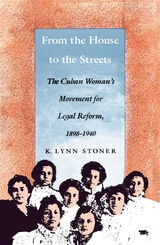
cover of From the House to the Streets: The Cuban Woman's Movement for Legal Reform, 1898-1940

From the House to the Streets

The Cuban Woman's Movement for Legal Reform, 1898-1940

K. Lynn Stoner

Duke University Press, 1991

From the House to the Streets is the first study on feminists and the feminist movement in Cuba between 1902 and 1940. In the four decades following its independence form Spain in 1898, Cuba adopted the most progressive legislation for women in the western hemisphere. K. Lynn Stoner explains how a small group of women and men helped to shape broad legal reforms: she describes their campaigns, the version of feminism they adopted with all its contradictions, and contrasts it to the model of feminism North Americans were transporting to Cuba.
Stoner draws on rich primary sources—texts, personal letters, journal essays, radio broadcasts, memoirs from women’s congresses—which allow these women to speak in their own voices. In reconstructing the mentalité of Cuban feminists, who came primarily from a privileged social status, Stoner shows how feminism drew from traditional notions of femininity and a rejection of gender equality to advance a cause that assumed women’s expanded roles were necessary for social progress. She also examines the values of the progressive male politicians who supported feminists and worked to change Cuban laws.

[more]
cover of Furious: Technological Feminism and Digital Futures

Furious

Technological Feminism and Digital Futures

Caroline Bassett

Pluto Press, 2019

As digital transformations continue to accelerate in the world, discourses of big data have come to dominate in a number of fields, from politics and economics, to media and education. But how can we really understand the digital world, ask the authors of Furious, when so much of the writing through which we grapple with it remains deeply problematic? In a compelling new work of feminist critical theory, Bassett, Kember and O'Riordan scrutinise many of the assumptions of a masculinist digital world, highlighting the tendency of digital humanities scholarship to venerate and essentialise technical forms, and to adopt gendered writing and citation practices. Contesting these writings, practices and politics, the authors foreground feminist traditions and contributions to the field, offering alternative modes of knowledge production, and a radically different, poetic writing style. Through this prism, Furious brings into focus themes including the automation of home and domestic work, the Anthropocene, and intersectional feminist technofutures.
[more]
cover of Further To Fly: Black Women and the Politics of Empowerment

Further To Fly

Black Women and the Politics of Empowerment

Sheila Radford-Hill

University of Minnesota Press, 2000

How feminism has failed African American women and why they must fight back.

Amid the longest-running economic boom in American history and despite the emergence of a significant black middle class, the lot of low-income black people in general-and black women in particular-seems more troubling than ever. Their plight, Sheila Radford-Hill argues in this book, is directly related to the diminution of black women’s traditional power as culture bearers and community builders. A cogent critique of feminist theory and practice, Further to Fly identifies the failure of feminism to connect with the social realities it should seek to explain, in particular the decline of black women’s empowerment.

Further to Fly searches out the causes and effects of this decline, describing the ways in which, since the 1960s, black women have been stripped of their traditional status as agents of change in the community-and how, as a result, the black community has faltered. Radford-Hill explores the shortcomings of second-wave black and white feminism, revealing how their theoretical underpinnings have had unintended (and often unacknowledged) negative consequences for black women’s lives and their communities.While acknowledging that African American women have made significant contributions to the black struggle for justice in America, Radford-Hill argues that more needs to be done. She combines social criticism and critical analysis to argue that black women must revive their legacy of activism and reclaim the tradition of nurturing in the black community, proposing specific tactics that can be used to revive the support networks that help determine the obligations of community members and guide how people interact on an everyday level. As a deft account of genesis and effects of black women’s diminishing power, and as a sobering analysis of the devastating blunders of feminist theory and practice, this work makes a compelling argument for an "authentic feminism," one that aggressively connects the realities of women’s experiences, needs, aspirations, and responsibilities.
[more]