Results by title
4030 books match the query 'Language Arts & Disciplines' and 150 start with f
Fitter, Happier
The Eugenic Strain in Twentieth-Century Cancer RhetoricLois Peters Agnew
University of Alabama Press, 0
A critical investigation into how eugenic logics quietly animated twentieth‑century cancer rhetoric, reshaping cultural narratives of health, risk, and human worth.
Fitter, Happier: The Eugenic Strain in Twentieth-Century Cancer Rhetoric is a thought-provoking exploration of the relationship between cancer rhetoric, American ideals, and eugenic influences in the twentieth century. This groundbreaking work delves into the paradoxical interplay between acknowledging the genuine threat of cancer and the ingrained American ethos of confidence and control.
Agnew’s meticulous research traces the topic’s historical context, unveiling how cancer discourses evolved from a hushed personal concern to a public issue thanks to the rise of cancer research centers and advocacy organizations. However, she unearths a troubling dimension to these discussions—subtle yet persistent eugenic ideologies that taint cancer arguments and advocacy groups. By dissecting prevailing cancer narratives, Agnew brings into focus how ideals rooted in eliminating imperfections and embracing progress converge with concerns for safeguarding societal fitness.
Fitter, Happier scrutinizes the military origins and metaphors that permeate government policies and medical research, the transformation of cancer’s association with melancholy into a rallying cry for a positive outlook, and the nuanced implications of prevention-focused dialogues. Reflecting on the varied experiences of actual cancer patients, Agnew resists the neat assimilation of these stories into a eugenic framework. Agnew’s insights prompt readers to contemplate the societal meanings of disease and disability as well as how language constructs our shared reality.
Five Steps of Outcome-Based Planning & Evaluation for Youth Services
Melissa Gross, Cindy Mediavilla, and Virginia A. Walter
American Library Association, 2022
Outcome-based planning and evaluation (OBPE), with its straightforward approach built on a flexible framework, is the perfect model to enable youth services professionals to deliver effective services regardless of uncertainties. An outcome-based approach can help youth services stay grounded in producing desired outcomes with and for youth through responsive programs, services, and processes that can adapt to changing conditions. Clarifying the relationship between planning, program development, and evaluation, the five simple steps outlined in this book will help youth services staff conduct solid community assessments and integrate OBPE into their work. Inside its pages you will learn
- a short history of OBPE and its evolution;
- why it is crucially important to involve youth in all stages of program development, with guidance on navigating challenges;
- how to think about planning as the need to react quickly, whether due to natural or human-made disasters, changing demographics, or economic swings;
- the five steps of OBPE, from gathering information about your community and determining the outcomes that will serve your community to crafting accurate outcome statements, developing an evaluation plan, and maximizing the results of successful outcome-based programs;
- how to visualize the steps needed to successfully plan, implement, and evaluate an outcome-based program, using the template included in the book;
- ways to share your data to let people know the library’s important role in the community; and
- additional useful tools to bolster your work, including environmental scan forms and ideas for creating relevant family storytimes.

Five Steps of Outcome-Based Planning and Evaluation for Public Libraries
Melissa Gross, Cindy Mediavilla, Virginia A. Walter
American Library Association, 2016
Flexible Semantics for Reinterpretation Phenomena
Markus Egg
CSLI, 2005
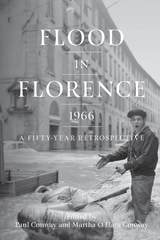
Flood in Florence, 1966
A Fifty-Year RetrospectivePaul Conway and Martha O’Hara Conway
Michigan Publishing Services, 2018
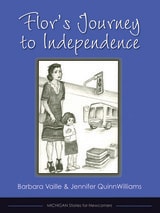
Flor's Journey to Independence
Barbara Vaille and Jennifer QuinnWilliams
University of Michigan Press, 2005
A modified version of this story is also available on our website, www.press.umich.edu/esl/stories.
The MICHIGAN Stories for Newcomers are original fiction written for adult English learners who wish to improve their reading and English skills
Focus Projection in Serbo-Croatian
Svetlana Godjevac
CSLI, 2004
Svetlana Godjevac explores the development of focus projection. Further distinguishing her work from the numerous studies of the English language, she analyzes how focus projection in Serbo-Croatian also depends on the semantic type of the prominence bearing element. This volume is an innovative analysis of linguistic theory as well as a study of a lesser examined language.
Folktales Aloud
Practical Advice for Playful StorytellingJanice M. Del Negro
American Library Association, 2013
Following Searle on Twitter
How Words Create Digital InstitutionsAdam Hodgkin
University of Chicago Press, 2017
Combining theoretical perspective with a down-to-earth exposition of present-day digital institutions, Following Searle on Twitter explores how all of our interactions with these emerging institutions are deeply rooted in language, and are the true foundation of social media and contemporary institutions.
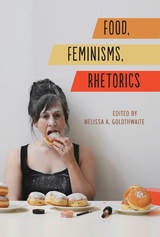
Food, Feminisms, Rhetorics
Edited by Melissa A. Goldthwaite
Southern Illinois University Press, 2017
Contributors analyze messages about food and bodies—from what a person watches and reads to where that person shops—taken from sources mundane and literary, personal and cultural. This collection begins with analyses of the historical, cultural, and political implications of cookbooks and recipes; explores definitions of feminist food writing; and ends with a focus on bodies and cultures—both self-representations and representations of others for particular rhetorical purposes. The genres, objects, and practices contributors study are varied—from cookbooks to genre fiction, from blogs to food systems, from product packaging to paintings—but the overall message is the same: food and its associated practices are worthy of scholarly attention.
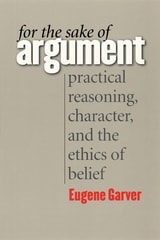
For the Sake of Argument
Practical Reasoning, Character, and the Ethics of BeliefEugene Garver
University of Chicago Press, 2004
Garver roots deliberation and persuasion in political friendship instead of a neutral, impersonal framework of justice. Through incisive readings of examples in modern legal and political history, from Brown v. Board of Education to the South African Truth and Reconciliation Commission, he demonstrates how acts of deliberation and persuasion foster friendship among individuals, leading to common action amid diversity. In an Aristotelian sense, there is a place for pathos and ethos in rational thought. Passion and character have as pivotal a role in practical reasoning as logic and language.

Forbidden Signs
American Culture and the Campaign against Sign LanguageDouglas C. Baynton
University of Chicago Press, 1996
The ensuing debate over sign language invoked such fundamental questions as what distinguished Americans from non-Americans, civilized people from "savages," humans from animals, men from women, the natural from the unnatural, and the normal from the abnormal. An advocate of the return to sign language, Baynton found that although the grounds of the debate have shifted, educators still base decisions on many of the same metaphors and images that led to the misguided efforts to eradicate sign language.
"Baynton's brilliant and detailed history, Forbidden Signs, reminds us that debates over the use of dialects or languages are really the linguistic tip of a mostly submerged argument about power, social control, nationalism, who has the right to speak and who has the right to control modes of speech."—Lennard J. Davis, The Nation
"Forbidden Signs is replete with good things."—Hugh Kenner, New York Times Book Review
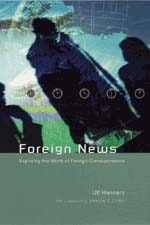
Foreign News
Exploring the World of Foreign CorrespondentsUlf Hannerz
University of Chicago Press, 2003
Hannerz draws on extensive interviews with correspondents in cities as diverse as Jerusalem, Tokyo, and Johannesburg. He shows not only how different story lines evolve in different correspondent beats, but also how the correspondents' home country and personal interests influence the stories they write. Reporting can go well beyond coverage of a specific event, using the news instead to reveal deeper insights into a country or a people to link them to long-term trends or structures of global significance. Ultimately, Hannerz argues that both anthropologists and foreign correspondents can learn from each other in their efforts to educate a public about events and peoples far beyond our homelands.
The result of nearly a decade's worth of work, Foreign News is a provocative study that will appeal to both general readers and those concerned with globalization.

Foreign Policy Rhetorics in a Global Era
Concepts and Case StudiesAllison M. Prasch
Michigan State University Press, 2024
Among the cases researched in this collection are foreign policy rhetoric from Cold War foreign policy in Latin America, the rhetoric of Vladimir Putin’s Ukraine war messages, and the development challenges of the Ford Foundation and the Kenya Women Finance Trust, among many others.
Forging the Future of Special Collections
Arnold Hirshon
American Library Association, 2016

Forgotten Tribe
Scientists as WritersLisa Emerson
University Press of Colorado, 2017
In The Forgotten Tribe: Scientists as Writers, Lisa Emerson offers an important corrective to the view that scientists are "poor writers, unnecessarily opaque, not interested in writing, and in need of remediation." She argues that scientists are among "the most sophisticated and flexible writers in the academy, often writing for a wider range of audiences (their immediate disciplinary peers, peers in adjacent fields, a broad scientific audience, industry, and a range of public audiences including social media) than most other faculty." Moreover, she notes, the often collaborative and multidisciplinary nature of their work results in writing practices that "may be more socially complex, and require more articulation, mediation, and interpersonal communication, and more use of advanced media and technology than those of faculty in other disciplines."
Drawing on extensive interviews with scientists, Emerson argues that writing scholars have "engaged in a form of cultural appropriation" that has worked against a deeper understanding of the contexts in which scientists work and the considerations they bring to their writing. Emerson grounds her analysis in the voices of scientists in a way that allows us to understand not only how they approach writing but also how we might usefully teach writing in the sciences. The Forgotten Tribe offers a valuable contribution to our understanding of scientific writing, allowing us to hear voices that are seldom included in our discussions of this critical area.
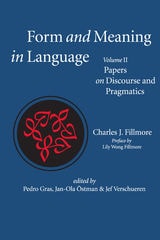
Form and Meaning in Language, Volume II
Papers on Discourse and PragmaticsCharles J. Fillmore
CSLI, 2020
Divided into four parts, the papers collected in Volume II explore language in use; semantics and pragmatics; text and discourse; and language in society.
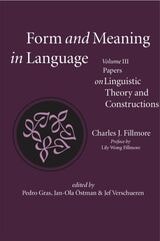
Form and Meaning in Language, Volume III
Papers on Linguistic Theory and ConstructionsCharles J. Fillmore
CSLI, 2020
Divided into four parts, the papers collected in Volume III explore the organization of linguistic knowledge; the foundations of constructing grammar; construction grammar analyses; and constructions and language in use.
Form and Meaning in Language
Volume I, Papers on Semantic RolesCharles Fillmore
CSLI, 2003
Form, Meaning, and Focus in American Sign Language
Miako N. P. Rankin
Gallaudet University Press, 2013
The meaning of any linguistic expression resides not only in the words, but also in the ways that those words are conveyed. In her new study, Miako N. P. Rankin highlights the crucial interrelatedness of form and meaning at all levels in order to consider specific types of American Sign Language (ASL) expression. In particular, Form, Meaning, and Focus in American Sign Language considers how ASL expresses non-agent focus, similar to the meaning of passive voice in English.
Rankin’s analyses of the form-meaning correspondences of ASL expressions of non-agent focus reveals an underlying pattern that can be traced across sentence and verb types. This pattern produces meanings with various levels of focus on the agent. Rankin has determined in her meticulous study that the pattern of form-meaning characteristic of non-agent focus in ASL is used prolifically in day-to-day language. The recognition of the frequency of this pattern holds implications regarding the acquisition of ASL, the development of curricula for teaching ASL, and the analysis of ASL discourse in effective interpretation.
Formal Issues in Lexical-Functional Grammar
Edited by Mary Dalrymple, Ronald M. Kaplan, John Maxwell III, and Annie Zaenen
CSLI, 1994
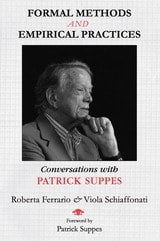
Formal Methods and Empirical Practices
Conversations with Patrick SuppesRoberta Ferrario and Viola Schiaffonati
CSLI, 2012
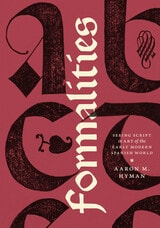
Formalities
Seeing Script in Art of the Early Modern Spanish WorldAaron M. Hyman
University of Chicago Press, 0
Examines the visual qualities of written words in works of art created from 1540 to 1700 across the transatlantic Spanish Empire.
Pieces of text are found across paintings produced in the early modern Spanish Empire, but their role as aesthetic elements has long been overlooked. With Formalities, Aaron M. Hyman argues that these words were important, not only because of their literal content but also because of their forms, which artists and their audiences across the Spanish world understood in terms of meanings beyond semantic content.
The widespread phenomenon of writing in or on works of art is one of the most distinctive features of art in the early modern Spanish world, yet it has received little art historical attention. Hyman focuses on this feature, demonstrating how artists mobilized particular scripts and carefully integrated the pictorial qualities of the written word. He explores how letterforms of the era were strictly codified, with different forms being particular to different genres and contexts. Chapters look at painted, embroidered, and incised words alongside texts in archival documents, books, and prints, showing how the visual arts drew on sources including calligraphy manuals, notarial documents, merchant account books, liturgical texts, and pictograms. Artists relied on their audiences’ understanding of the contexts in which such objects were used and connotations that texts thus produced, using visual languages to make meaning in addition to—or in spite of—what the words themselves actually said.

Formalizing the Dynamics of Information
Edited by Martina Faller, Stefan Kaufmann, and Marc Pauly
CSLI, 2000
Forming the Public
A Critical History of Journalism in the United StatesFrank D. Durham and Thomas P. Oates
University of Illinois Press, 2024
Weaving eyewitness history through US history, Forming the Public reveals what understanding the journalism landscape can teach us about the nature of journalism’s own interests in race, gender, and class while tracing the factors that shaped the contours of dominant American culture.
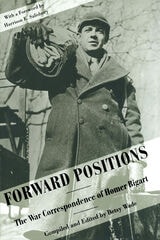
Forward Positions
The War Correspondence of Homer BigartHomer Bigart
University of Arkansas Press, 1992
Among journalists—and particularly war correspondents—Homer Bigart was both legend and example. In a career of four decades, first with the New York Herald Tribuneand then, through 1972, with The New York Times, Bigart distinguished himself as a superb writer and tireless digger for the realities that could be learned only in the field and not at headquarters. In 1943 Bigart sailed for England to cover the air war and was soon on mule-back in Sicily, and hanging on at Anzio. He then went to the Pacific, where his dispatches won him his first Pulitzer Prize for foreign correspondence. When hostilities erupted in Korea he was again on the front lines in the front lines in the Orient, and again recipient of a Pulitzer. By the time of the American involvement in Vietnam, he was an old-timer, a seasoned correspondent admired and celebrated for his wit but regarded with awe for his masterly stories, in which straightforward prose, informed by tenacious reporting, cut to the heart of the issues.
Previously available only n crumbling library copies of the Tribune and the Times, or in microfilm repositories, his dispatches, with their rare insights into warefar and he minds of those who wage war, are now collected in Forward Positions: The War Correspondence of Home Bigart, edited by Betsy Wade and introduced by Harrison E. Salisbury, himself the winner of a Pulitzer Prize for journalism.
Forward Positions does honor to a breed of journalist that had passed into history by the time of Bigart’s death. It includes one of the first accounts of the atomic annihilation of Hiroshima, a report on the war-crimes trial of Adolf Eichmann, a number of dispatches on “hot” battles of the Cold War, and a probing dispatch on Lieutenant William Calley’s testimony on the Mỹ Lai Massacre. With this representative selection of more than fifty of Bigart’s accounts of war on the ground, in the air, and in the courtroom, Wade provides a wealth of background material about his career, as well as glimpses of his impact on journalism. The book promises hours of captivating and informative reading for journalists, historians, veterans, and anyone who likes a good story tautly told.
Foundations of Information Ethics
John T. F. Burgess
American Library Association, 2019
As discussions about the roles played by information in economic, political, and social arenas continue to evolve, the need for an intellectual primer on information ethics that also functions as a solid working casebook for LIS students and professionals has never been more urgent. This text, written by a stellar group of ethics scholars and contributors from around the globe, expertly fills that need. Organized into twelve chapters, making it ideal for use by instructors, this volume from editors Burgess and Knox
- thoroughly covers principles and concepts in information ethics, as well as the history of ethics in the information professions;
- examines human rights, information access, privacy, discourse, intellectual property, censorship, data and cybersecurity ethics, intercultural information ethics, and global digital citizenship and responsibility;
- synthesizes the philosophical underpinnings of these key subjects with abundant primary source material to provide historical context along with timely and relevant case studies;
- features contributions from John M. Budd, Paul T. Jaeger, Rachel Fischer, Margaret Zimmerman, Kathrine A. Henderson, Peter Darch, Michael Zimmer, and Masooda Bashir, among others; and
- offers a special concluding chapter by Amelia Gibson that explores emerging issues in information ethics, including discussions ranging from the ethics of social media and social movements to AI decision making.
This important survey will be a key text for LIS students and an essential reference work for practitioners
Foundations of Information Law
Paul T. Jaeger, Jonathan Lazar, Ursula Gorham, and Natalie Greene Taylor
American Library Association, 2023
- discusses information law as part of a continuum of interrelated issues rather than an assortment of discrete topics;
- examines information law in the context of different types of libraries;
- delves into the manifold legal issues raised when interacting with patrons and communities, from intellectual freedom topics like censorship and public activities in the library to the legal issues surrounding materials and information access;
- elucidates operational and management legal issues, including library security, interacting with law enforcement, advocacy, lobbying, funding, human resources, and liability;
- promotes literacy of the law, its structures, and its terminology as a professional skill;
- gives readers the tools to find and understand different sources of legal authority and demonstrates how to interpret them when they conflict; and
- explores information law as a national and cross-national issue.
Foundations of Information Literacy
Natalie Greene Taylor
American Library Association, 2021
It’s not hyperbole to conclude that in today’s world, information literacy is essential for survival and success; and also that, if left unchecked, the social consequences of widespread misinformation and information illiteracy will only continue to grow more dire. Thus its study must be at the core of every education. But while many books have been written on information literacy, this text is the first to examine information literacy from a cross-national, cross-cultural, and cross-institutional perspective. From this book, readers will
- learn about information literacy in a wide variety of contexts, including academic and school libraries, public libraries, special libraries, and archives, through research and literature that has previously been siloed in specialized publications;
- come to understand why information literacy is not just an issue of information and technology, but also a broader community and societal issue;
- get an historical overview of advertising, propaganda, disinformation, misinformation, and illiteracy;
- gain knowledge of both applied strategies for working with individuals and for addressing the issues in community contexts;
- find methods for combating urgent societal ills caused and exacerbated by misinformation; and
- get tools and techniques for advocacy, activism, and self-reflection throughout one’s career.
Foundations of Information Policy
Paul T. Jaeger
American Library Association, 2019
Foreword by Alan S. Inouye; Afterword by Nancy Kranich
The first of its kind, this important new text provides a much-needed introduction to the myriad information policy issues that impact information professionals, information institutions, and the patrons and communities served by those institutions. In this key textbook for LIS students and reference text for practitioners, noted scholars Jaeger and Taylor
- draw from current, authoritative sources to familiarize readers with the history of information policy;
- discuss the broader societal issues shaped by policy, including access to infrastructure, digital literacy and inclusion, accessibility, and security;
- elucidate the specific laws, regulations, and policies that impact information, including net neutrality, filtering, privacy, openness, and much more;
- use case studies from a range of institutions to examine the issues, bolstered by discussion questions that encourage readers to delve more deeply;
- explore the intersections of information policy with human rights, civil rights, and professional ethics; and
- prepare readers to turn their growing understanding of information policy into action, through activism, advocacy, and education.
Foundations of Intellectual Freedom
Emily J. M. Knox
American Library Association, 2022
- the historical and legal roots of intellectual freedom, with an in-depth examination of John Stuart Mill’s “On Liberty” and Article 19 of the U.N Declaration of Human Rights, and its central concepts and principles;
- the intersection of intellectual freedom, freedom of expression, and social justice;
- professional values, codes of ethics, ALA’s Library Bill of Rights, and Freedom to Read/View Statements;
- pro- and anti- censorship arguments and their use in impeding and facilitating access to information;
- book banning and internet filtering;
- privacy and its relationship to information services;
- U.S. case law and precedents;
- the basics of U.S. copyright law, including fair use, and how it differs from international copyright law; and
- emerging global issues and their impact on future intellectual freedom.
Foundations of Library and Information Science
Richard E. Rubin
American Library Association, 2020
Richard E. Rubin’s book has served as the authoritative introductory text for generations of library and information science practitioners, with each new edition taking in its stride the myriad societal, technological, political, and economic changes affecting our users and institutions and transforming our discipline. Rubin teams up with his daughter, Rachel G. Rubin, a rising star in the library field in her own right, for the fifth edition. Spanning all types of libraries, from public to academic, school, and special, it illuminates the major facets of LIS for students as well as current professionals. Continuing its tradition of excellence, this text addresses
- the history and mission of libraries from past to present, including the history of service to African Americans;
- critical contemporary social issues such as services to marginalized communities, tribal libraries, and immigrants;
- the rise of e-government and the crucial role of political advocacy;
- digital devices, social networking, digital publishing, e-books, virtual reality, and other technology;
- forces shaping the future of libraries, including Future Ready libraries, and sustainability as a core value of librarianship;
- the values and ethics of the profession, with new coverage of civic engagement, combatting fake news, the importance of social justice, and the role of critical librarianship;
- knowledge infrastructure and organization, including Resource Description and Access (RDA), linked data, and the Library Research Model;
- the significance of the digital divide and policy issues related to broadband access and net neutrality;
- intellectual freedom, legal issues, and copyright-related topics;
- contemporary issues in LIS education such as the ongoing tensions between information science and library science; and
- the changing character of collections and services including the role of digital libraries, preservation, and the digital humanities.
In its newest edition, Foundations of Library and Information Science remains the field’s essential resource.
Foundations of Library and Information Science
Richard E. Rubin
American Library Association, 2016
Founding Fictions
Jennifer R. Mercieca
University of Alabama Press, 2010
Founding Fictions develops the concept of a “political fiction,” or a narrative that people tell about their own political theories, and analyzes how republican and democratic fictions positioned American citizens as either romantic heroes, tragic victims, or ironic partisans. By re-telling the stories that Americans have told themselves about citizenship, Mercieca highlights an important contradiction in American political theory and practice: that national stability and active citizen participation are perceived as fundamentally at odds.
Four Theories of the Press
The Authoritarian, Libertarian, Social Responsibility, and Soviet Communist Concepts of What the Press Should Be and DoFredrick S. Siebert, Theodore Peterson, and Wilbur Schramm
University of Illinois Press, 1956
Presented here are four major theories behind the functioning of the world's presses: (1) the Authoritarian theory, which developed in the late Renaissance and was based on the idea that truth is the product of a few wise men; (2) the Libertarian theory, which arose from the works of men like Milton, Locke, Mill, and Jefferson and avowed that the search for truth is one of man's natural rights; (3) the Social Responsibility theory of the modern day: equal radio and television time for political candidates, the obligations of the newspaper in a one-paper town, etc.; (4) the Soviet Communist theory, an expanded and more positive version of the old Authoritarian theory.
Framing Information Literacy (PIL#73) Volume Five
Scholarship as ConversationJanna L. Mattson
American Library Association, 0
Framing Information Literacy (PIL#73) Volume Four
Information Creation as a ProcessJanna L. Mattson
American Library Association, 0
Framing Information Literacy (PIL#73) Volume One
Research as InquiryJanna L. Mattson
American Library Association, 0
Framing Information Literacy (PIL#73) Volume Six
Authority is Constructed and ContextualJanna L. Mattson
American Library Association, 0
Framing Information Literacy (PIL#73) Volume Three
Searching as Strategic ExplorationJanna L. Mattson
American Library Association, 0
Framing Information Literacy (PIL#73) Volume Two
Information Has ValueJanna L. Mattson
American Library Association, 2018
Framing Information Literacy 6-Volume Set
Mary K. Oberlies
American Library Association, 2018

Framing Library Instruction
John Budd
Assoc of College & Research Libraries, 2011
Framing Library Instruction
John Budd
Assoc of College & Research Libraries, 2011
Francisco López de Gómara's General History of the Indies
Ángela Helmer
University Press of Colorado, 2023
General History of the Indies was the first universal history of the recent discoveries and conquests of the New World made available to the Old World audience. At publication it consisted of two parts: the first a general history of the European discovery, conquest, and settlement of the Americas, and the second a detailed description of Cortés’s conquest of Mexico. Part one—in the multiple Spanish editions and translations into Italian and French published at the time—was the most comprehensive, popular, and accessible account of the natural history and geography of the Americas, the ethnology of the peoples of the New World, and the history of the Spanish conquest, including the most recent developments in Peru. Despite its original and continued importance, however, it had never been translated into English.
Gómara’s history communicates Europeans’ general understanding of the New World throughout the middle and later sixteenth century. A lively, comparatively brief description of Europe’s expansion into the Americas with significant importance to today’s understanding of the early modern worldview, Francisco López de Gómara’s General History of the Indies will be of great interest to students of and specialists in Latin American history, Latin American literature, anthropology, and cultural studies, as well as specialists in Spanish American intellectual history and colonial Latin America.
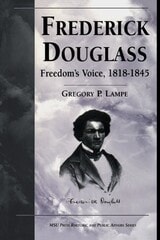
Frederick Douglass
Freedom's Voice, 1818-1845Gregory P. Lampe
Michigan State University Press, 1998
This work in the MSU Press Rhetoric and Public Affairs Series chronicles Frederick Douglass's preparation for a career in oratory, his emergence as an abolitionist lecturer in 1841, and his development and activities as a public speaker and reformer from 1841 to 1845. Lampe's meticulous scholarship overturns much of the conventional wisdom about this phase of Douglass's life and career uncovering new information about his experiences as a slave and as a fugitive; it provokes a deeper and richer understanding of this renowned orator's emergence as an important voice in the crusade to end slavery.
Contrary to conventional wisdom, Douglass was well prepared to become a full-time lecturer for the Massachusetts Anti-Slavery Society in 1841. His emergence as an eloquent voice from slavery was not as miraculous as scholars have led us to believe. Lampe begins by tracing Douglass's life as slave in Maryland and as fugitive in New Bedford, showing that experiences gained at this time in his life contributed powerfully to his understanding of rhetoric and to his development as an orator. An examination of his daily oratorical activities from the time of his emergence in Nantucket in 1841 until his departure for England in 1845 dispels many conventional beliefs surrounding this period, especially the belief that Douglass was under the wing of William Lloyd Garrison. Lampe's research shows that Douglass was much more outspoken and independent than previously thought and that at times he was in conflict with white abolitionists.
Included in this work is a complete itinerary of Douglass's oratorical activities, correcting errors and omissions in previously published works, as well as two newly discovered complete speech texts, never before published.
Free Speech On Trial
Communication Perspectives on Landmark Supreme Court DecisionsEdited by Richard A. Parker
University of Alabama Press, 2008
Describes landmark free speech decisions of the Supreme Court while highlighting the issues of language, rhetoric, and communication that underlie them.
At the intersection of communication and First Amendment law reside two significant questions: What is the speech we ought to protect, and why should we protect it? The 20 scholars of legal communication whose essays are gathered in this volume propose various answers to these questions, but their essays share an abiding concern with a constitutional guarantee of free speech and its symbiotic relationship with communication practices.
Free Speech on Trial fills a gap between textbooks that summarize First Amendment law and books that analyze case law and legal theory. These essays explore questions regarding the significance of unregulated speech in a marketplace of goods and ideas, the limits of offensive language and obscenity as expression, the power of symbols, and consequences of restraint prior to publication versus the subsequent punishment of sources. As one example, Craig Smith cites Buckley vs. Valeo to examine how the context of corruption in the 1974 elections shaped the Court's view of the constitutionality of campaign contributions and expenditures.
Collectively, the essays in this volume suggest that the life of free speech law is communication. The contributors reveal how the Court's free speech opinions constitute discursive performances that fashion, deconstruct, and reformulate the contours and parameters of the Constitution’s guarantee of free expression and that, ultimately, reconstitute our government, our culture, and our society.
Free for All
The Internet's Transformation of JournalismElliot King
Northwestern University Press, 2010
In Free for All, longtime scholar of digital media Elliot King begins with a brief history of the technological development of news media from the appearance of newspapers in the sixteenth century to the rise of broadcasting and the Internet.
Within that context, King demystifies the emergence of online communication and social media as the third major technological platform for news, making the current pace of change appear less vertiginous. Free for All provides anyone with an interest in the future of journalism the grounding necessary for an informed discussion.
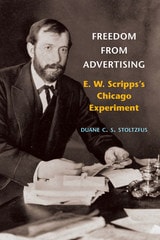
Freedom from Advertising
E. W. Scripps's Chicago ExperimentDuane C. S. Stoltzfus
University of Illinois Press, 2006
Though the Day Book’s financial losses steadily declined over the years, it never became profitable, and publication ended in 1917. Nevertheless, Stoltzfus explains that the Day Book served as an important ally of workers, a keen watchdog on advertisers, and it redefined news by providing an example of a paper that treated its readers first as citizens with rights rather than simply as consumers.
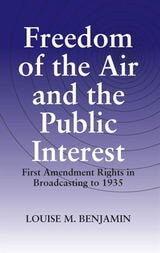
Freedom of the Air and the Public Interest
First Amendment Rights in Broadcasting to 1935Louise M. Benjamin
Southern Illinois University Press, 2006
Drawing on primary resources from sixteen archives plus contemporary secondary sources, Benjamin analyzes interactions among the players involved and argues that First Amendment rights in radio evolved in the 1920s and 1930s through the interaction of many entities having social, political, or economic interests in radio. She shows how free speech and First Amendment rights were defined and perceived up to 1935.
Focusing on the evolution of various electronic media rights, Benjamin looks at censorship, speakers’ rights of access to the medium, broadcasters’ rights to use radio as they desired, and listeners’ rights to receive information via the airwaves. With many interested parties involved, conflict was inevitable, resulting in the establishment of industry policies and government legislation—particularly the Radio Act of 1927. Further debate led to the Communications Act of 1934, which has provided the regulatory framework for broadcasting for over sixty years. Controversies caused by new technology today continue to rage over virtually the same rights and issues that Benjamin deals with.