1917 books match the query 'Law' and 55 start with f
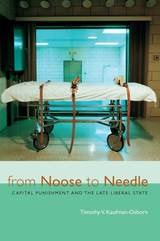
cover of From Noose to Needle: Capital Punishment and the Late Liberal State

From Noose to Needle

Capital Punishment and the Late Liberal State

Timothy V. Kaufman-Osborn

University of Michigan Press, 2002
From Noose to Needle contributes a new perspective on the controversial topic of capital punishment by asking how the conduct of state killing reveals broader contradictions in the contemporary liberal state, especially, but not exclusively, in the United States. Moving beyond more familiar legal and sociological approaches to this matter, Timothy V. Kaufman-Osborn asks several questions. Why do executions no longer take the form of public spectacles? Why are certain methods of execution considered barbaric? Why must the liberal state strictly segregate the imposition of a death sentence, whether by judge or jury, from its actual infliction, whether by a state official or an ordinary citizen? Why are women so infrequently sentenced to death and executed? How does the state seek to hide the suffering inflicted by capital punishment through its endorsement of a bio-medical conception of pain? How does the nearly-universal shift to lethal injection pose problems for the late liberal state by confusing its punitive and welfare responsibilities?
Drawing on a wide range of theoretical sources, including John Locke, Max Weber, Nicos Poulantzas, Friedrich Nietzsche, J. L. Austin, Michel Foucault, Judith Butler, Pierre Bourdieu, Elaine Scarry, and others, Kaufman-Osborn grounds his appropriation of these authors in analyses of specific recent executions, including that of Wesley Allan Dodd and Charles Campbell in Washington, Karla Faye Tucker in Texas, and Allen Lee Davis in Florida.
From Noose to Needle will be of interest to students of law, political theory, and sociology as well as more general readers interested in the troublesome issue of capital punishment.
Timothy V. Kaufman-Osborn is Baker Ferguson Professor of Politics and Leadership, Whitman College.
[more]
cover of From Patrician to Professional Elite

From Patrician to Professional Elite

Walter Powell

Russell Sage Foundation, 1988
The Association of the Bar of the City of New York (ABCNY) is no ordinary professional organization. Formed in 1870 and housed in an imposing mid-town edifice, it was the first modern bar association, nationally known for its eminent membership, its reformist stance—and its intimidating selectivity. During much of its history, the ABCNY appeared to be more an upper-class, WASP legal club than an open, collegial association. How did such an organization fare in the face of post-war pressures for inclusiveness? From Patrician to Professional Elite offers a rare view of the internal dynamics of an institution adapting to a changed environment. The ABCNY maintained its elite identity by adopting a meritocratic organizational model in place of a class-based model. By shedding its overt exclusivity, the ABCNY asserted its legitimacy; by embracing an "open elite" or meritocratic model, the associate retained its high standing and relative homogeneity. In fact, the ABCNY today is dominated by the same functional group of lawyers as before, the corporate legal elite. This fascinating study of organizational change prompts a re-examination of fundamental questions about the class basis of modern professionalism and the dominance of elites within professions, in addition to illuminating the larger question of the role of elite institutions in democratic societies.
[more]
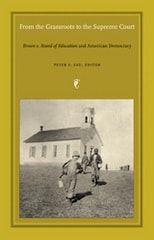
cover of From the Grassroots to the Supreme Court: Brown v. Board of Education and American Democracy

From the Grassroots to the Supreme Court

Brown v. Board of Education and American Democracy

Peter F. Lau, ed.

Duke University Press, 2004

Perhaps more than any other Supreme Court ruling, Brown v. Board of Education, the 1954 decision declaring the segregation of public schools unconstitutional, highlighted both the possibilities and the limitations of American democracy. This collection of sixteen original essays by historians and legal scholars takes the occasion of the fiftieth anniversary of Brown to reconsider the history and legacy of that landmark decision. From the Grassroots to the Supreme Court juxtaposes oral histories and legal analysis to provide a nuanced look at how men and women understood Brown and sought to make the decision meaningful in their own lives.

The contributors illuminate the breadth of developments that led to Brown, from the parallel struggles for social justice among African Americans in the South and Mexican, Asian, and Native Americans in the West during the late nineteenth century to the political and legal strategies implemented by the National Association for the Advancement of Colored People (naacp) in the twentieth century. Describing the decision’s impact on local communities, essayists explore the conflict among African Americans over the implementation of Brown in Atlanta’s public schools as well as understandings of the ruling and its relevance among Puerto Rican migrants in New York City. Assessing the legacy of Brown today, contributors analyze its influence on contemporary law, African American thought, and educational opportunities for minority children.

Contributors
Tomiko Brown-Nagin
Davison M. Douglas
Raymond Gavins
Laurie B. Green
Christina Greene
Blair L. M. Kelley
Michael J. Klarman
Peter F. Lau
Madeleine E. Lopez
Waldo E. Martin Jr.
Vicki L. Ruiz
Christopher Schmidt
Larissa M. Smith
Patricia Sullivan
Kara Miles Turner
Mark V. Tushnet
[more]
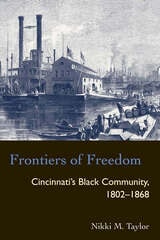
cover of Frontiers of Freedom: Cincinnati’s Black Community 1802–1868

Frontiers of Freedom

Cincinnati’s Black Community 1802–1868

Nikki M. Taylor

Ohio University Press, 2004
Nineteenth-century Cincinnati was northern in its geography, southern in its economy and politics, and western in its commercial aspirations. While those identities presented a crossroad of opportunity for native whites and immigrants, African Americans endured economic repression and a denial of civil rights, compounded by extreme and frequent mob violence. No other northern city rivaled Cincinnati’s vicious mob spirit. Frontiers of Freedom follows the black community as it moved from alienation and vulnerability in the 1820s toward collective consciousness and, eventually, political self-respect and self-determination. As author Nikki M. Taylor points out, this was a community that at times supported all-black communities, armed self-defense, and separate, but independent, black schools. Black Cincinnati’s strategies to gain equality and citizenship were as dynamic as they were effective. When the black community united in armed defense of its homes and property during an 1841 mob attack, it demonstrated that it was no longer willing to be exiled from the city as it had been in 1829. Frontiers of Freedom chronicles alternating moments of triumph and tribulation, of pride and pain; but more than anything, it chronicles the resilience of the black community in a particularly difficult urban context at a defining moment in American history.
[more]
cover of Future Medicine: Ethical Dilemmas, Regulatory Challenges, and Therapeutic Pathways to Health Care and Healing in Human Transformation

Future Medicine

Ethical Dilemmas, Regulatory Challenges, and Therapeutic Pathways to Health Care and Healing in Human Transformation

Michael H. Cohen

University of Michigan Press, 2002

Future Medicine is an investigation into the clinical, legal, ethical, and regulatory changes occurring in our health care system as a result of the developing field of Complimentary and Alternative Medicine (CAM). Here Michael H. Cohen describes the likely evolution of the legal system and the health care system at the crossroads of developments in the way human beings care for body, mind, emotions, environment, and soul.
Through the use of fascinating and relevant case studies, Cohen presents stimulating questions that will challenge academics, intellectuals, and all those interested in the future of health care. In concise, evocative strokes, the book lays the foundation for a novel synthesis of ideas from such diverse disciplines as transpersonal psychology, political philosophy, and bioethics. Providing an exploration of regulatory conundrums faced by many healing professionals, Cohen articulates the value of expanding our concept of health care regulation to consider not only goals of fraud control and quality assurance, but also health care freedom, integration of global medicine, and human transformation.
Future Medicine provides a fair-minded, illuminating, and honest discussion that will interest hospice workers, pastoral counselors, and psychotherapists, as well as bioethicists, physicians and allied health care providers, complementary and alternative medical providers (such as chiropractors, acupuncturists, naturopaths, massage therapists, homeopaths, and herbalists), and attorneys, hospital administrators, health care executives, and government health care workers.
Michael H. Cohen is Director for Legal Programs, the Center for Research and Education in Complementary and Integrative Medical Therapies, Beth Israel Deaconess Medical Center, Harvard Medical School.
[more]