Results by title
2817 books match the query 'Nature' and 165 start with f
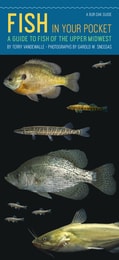
Fish in Your Pocket
A Guide to Fish of the Upper MidwestTerry VanDeWalle
University of Iowa Press, 2017
Terry VanDeWalle includes a thorough description of each species, and covers the Upper Midwest states of Kansas, Illinois, South Dakota, North Dakota, Iowa, Missouri, Indiana, Michigan, Minnesota, Ohio, Nebraska, and Wisconsin.
The careful descriptions and habitat and diet information in Fish inYour Pocket—enhanced with superb photographs by underwater photographer Garold Sneegas—make it extremely useful for anglers and naturalists alike.
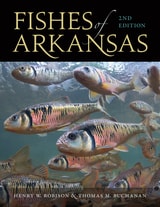
Fishes of Arkansas
Henry W. Robison
University of Arkansas Press, 2019
An invaluable reference for anyone interested in the state’s fish population—from professional ichthyologists, fisheries biologists, and managers of aquatic resources, to amateur naturalists and anglers—this new edition provides updated taxonomic keys as well as detailed descriptions, photographs, and line drawings to aid identification of the state’s 243 fish species. There is also much information on the distribution and biology of each species, including descriptions of habitat, foods eaten, reproductive biology, and conservation status.
This project and the preparation of this publication was funded in part by a grant from the Arkansas Game and Fish Commission.

Fishes of South Dakota
By Reeve M. Bailey and Marvin O. Allum
University of Michigan Press, 1962
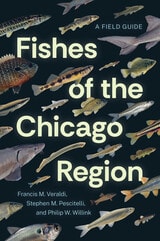
Fishes of the Chicago Region
A Field GuideFrancis M. Veraldi, Stephen M. Pescitelli, and Philip W. Willink
University of Chicago Press, 2025
“A must-have field guide for fans of Second City area fish.”—Robert Ito, The New York Times Book Review • “A treasure of hardcore fish intelligence and delightful tidbits of fish history.”—Dale Bowman, Chicago Sun-Times
Fish don’t heed state boundaries, and neither does this comprehensive, photo-filled guide to the diverse species of Chicago and beyond.
Encompassing southern Lake Michigan, northeastern Illinois, and adjacent areas of Indiana, Michigan, and Wisconsin, the Chicago Region is home to rare habitats supporting diverse fish populations. From small creeks to large rivers and from small ponds to one of the world’s largest freshwater ecosystems, Lake Michigan, these systems are home to some 164 fish species representing 31 families. In this essential field guide, the most complete and up-to-date reference for fishes in the Chicago Region, we meet them all—lampreys, sturgeon, paddlefish, gars, drum, darters, perches, sticklebacks, sculpins, and more. Written by leading local ecologists and featuring a pictorial family key, color photographs, detailed species distribution maps, and natural history observations unique to the region, this go-to guide belongs on the shelf—and in the boat—of every angler, naturalist, fisheries manager, and biologist.
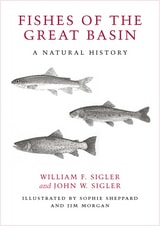
Fishes of the Great Basin
A Natural HistoryJohn W. Sigler
University of Nevada Press, 2014
Fishes of the Gulf of Mexico, Vol. 1
Myxiniformes to GasterosteiformesBy John McEachran and Janice D. Fechhelm
University of Texas Press, 1998
The Gulf of Mexico is the ninth largest body of water in the world and contains over 15 percent of all known species of marine fishes. This diverse fish fauna has been the subject of many publications, but, until now, no work has ever surveyed all known species, including the deep sea fishes and those of the southern Gulf.
This book is the first of two volumes that will cover the entire fish fauna of the Gulf of Mexico. An introductory section that outlines the Gulf's geographical setting, geological origin, current patterns, tides, sediments, meteorology, ecology, and biological exploration is followed by a key for the forty-four orders of fishes known from the Gulf. Keys and descriptions are provided for families, which are arranged phylogenetically, and for the species, which are arranged alphabetically, described, and distinguished from similar species. All but a few species are illustrated.
Fishes of the Gulf of Mexico, Volume 2
Scorpaeniformes to TetraodontiformesBy John D. McEachran and Janice D. Fechhelm
University of Texas Press, 2006
This book is the second of two volumes that cover the entire fish fauna of the Gulf of Mexico. It includes the orders Scorpaeniformes, Perciformes, Pleuronectiformes, and Tetraodontiformes. Keys and descriptions are provided for the families, which are arranged phylogenetically, and for the species, which are arranged alphabetically, described (including distribution and life history), and distinguished from similar species. All but a few species are illustrated. The volume also includes a biogeographical synopsis of the fishes of the Gulf of Mexico.

Fishes of the Minnesota Region
Gary L. Phillips, William D. Schmid, and James C. Underhill
University of Minnesota Press, 1982
Fishes of the Minnesota Region was first published in 1982. Minnesota Archive Editions uses digital technology to make long-unavailable books once again accessible, and are published unaltered from the original University of Minnesota Press editions.
From Northern Pike to the Walleye, this is the definitive guide to all of Minnesota's 149 kinds of fishes. Illustrated with over 80 color photographs, this book will appeal to enthusiastic anglers as well as curious naturalists.
Along with a guide to identification, the authors cover habitat, distribution, conservation, and even some recipes. If you catch a fish from one of Minnesota's 10,000 lakes you'll find a description of it in this book.
Fishes of the Open Ocean
A Natural History and Illustrated GuideJulian Pepperell
University of Chicago Press, 2010
Between the surface of the sea and depths of two hundred meters lies a remarkable range of fish, generally known as pelagics, or open-ocean dwellers. These creatures are among the largest, fastest, highest-leaping, and most migratory fish on the entire planet. Beautifully adapted to their world, they range from tiny drift fish and plankton-straining whale sharks to more streamlined predators such as tuna, marlin, sailfish, and wahoo.
Fishes of the Open Ocean, from leading marine biologist and world authority on the subject Julian Pepperell, is the first book to comprehensively describe these fishes and explore the complex and often fragile world in which they live. In what will be the definitive book on the subject for years to come—and, with over three hundred color images, the most lavishly produced as well—Pepperell details the environment and biology of every major species of fish that inhabits the open ocean, an expanse that covers 330 million cubic miles and is the largest aquatic habitat on the Earth. The first section of the book introduces the various evolutionary forms these fish have taken, as well as the ways in which specific species interact and coevolve with others in the food web. A chapter on commercial and sport fisheries explores the human element in this realm and considers such issues as sustainability, catch-and-release initiatives, and the risks of extinction.
The second section of the book provides species accounts of open ocean dwellers organized by group, with overviews and general descriptions that are inclusive of range and distribution, unique physiological and morphological attributes, and the role of each species within its ecosystem. Global distribution maps, original illustrations from renowned artist and scientist Guy Harvey, and truly stunning images from some of the world’s leading underwater photographers round out this copiously illustrated volume.
Fishing Arkansas
A Year-Round Guide to Angling Adventures in the Natural StateKeith Sutton
University of Arkansas Press, 2000
Enhanced by Sutton's excellent photographs, the guide includes twelve sections on popular game fish, such as largemouth and smallmouth bass, crappie, catfish, bluegill, and trout. It also provides an introduction to often-overlooked species like bowfin, gar, carp, paddlefish, and pickerel. Hundreds of valuable fishing tips gleaned from decades of on-the-water experience and interviews with dozens of guides, biologists, and expert anglers enhance the engaging narraive. From the glistening trout in the cold tailwaters of the White River, to feisty catfish on the muddy bayou bottoms of the Delta region, Keith Sutton has served up a tempting array of the fish that can be sought and caught on hook and line in the teeming waters of Arkansas.
Fishing Lessons
Artisanal Fisheries and the Future of Our OceansKevin M. Bailey
University of Chicago Press, 2018
Bailey knows these waters, the artisanal fisheries, and their relationship with larger ocean ecology intimately. In a series of place-based portraits, he shares stories of decline and success as told by those at the ends of the long lines and hand lines, channeling us through the changing dynamics of small-scale fisheries and the sustainability issues they face—both fiscal and ecological. We encounter Paolo Vespoli and his tiny boat, the Giovanni Padre,in the Gulf of Naples; Wenche, a sea Sámi, one of the indigenous fisherwomen of Norway; and many more. From salmon to abalone, the Bay of Fundy to Monterey and the Amazon, Bailey’s catch is no fish tale. It is a global story, casting a net across waters as vast and distinct as Puget Sound and the Chilean coast. Sailing across the world, Bailey explores the fast-shifting current of how we gather food from the sea, what we gain and what we lose with these shifts, and potential solutions for the murky passage ahead.
Fishing for Gold
The Story of Alabama's Catfish IndustryKarni R. Perez
University of Alabama Press, 2006
A captivating story of the industry's rise in Alabama.
With a wonderful ear for dialogue and in flowing narrative style, Karni Perez weaves together oral histories collected from early hatchery owners, catfish farmers, processors, and researchers to recount the important contributions made by Alabamians to the channel catfish industry. Perez describes the struggles and glories of fish culture from its early days as an experimental venture to the thriving present-day commercial enterprise that supplies warmwater fish for the American food industry.
As Perez states, "The catfish industry started out in Alabama as a do-it-yourself and figure-it out-yourself kind of enterprise." We hear how men who were mostly cattle farmers learned to nudge male and female fish into spawning in crudely constructed aquaria, how growers discovered the dissolved oxygen needs of their "herd" when big die-offs occurred, how Lenson Montz and Otis Breland designed the first paddle aerator to remedy the problem, how farmers eventually trained a bottomfeeding species to rise to the water surface to eat so their numbers could be better estimated. In one dramatic story, we learn how a man experimenting with the first skinning machine lost a piece of his hand in front of a crowd of horrified locals. (After it was retrieved from the skin basket, it was reattached by a town doctor and healed perfectly.) Ironically, the man was a representative of the engineering firm tasked with designing the machine; he had never before seen a catfish in his life. The machine was modified and became an essential component of modern fish processing.
In addition to telling the remarkable stories of individual contributions by farmers and researchers, Perez explains the positive effects played by improved public infrastructure, continued biological research, state legislation, and federal recognition of aquaculture as agriculture.
Fishing the Great Lakes
An Environmental History, 1783–1933Margaret Beattie Bogue
University of Wisconsin Press, 2000
Fishing the Great Lakes is a sweeping history of the destruction of the once-abundant fisheries of the great "inland seas" that lie between the United States and Canada. Though lake trout, whitefish, freshwater herring, and sturgeon were still teeming as late as 1850, Margaret Bogue documents here how overfishing, pollution, political squabbling, poor public policies, and commercial exploitation combined to damage the fish populations even before the voracious sea lamprey invaded the lakes and decimated the lake trout population in the 1940s.
From the earliest records of fishing by native peoples, through the era of European exploration and settlement, to the growth and collapse of the commercial fishing industry, Fishing the Great Lakes traces the changing relationships between the fish resources and the people of the Great Lakes region. Bogue focuses in particular on the period from 1783, when Great Britain and the United States first politically severed the geographic unity of the Great Lakes, through 1933, when the commercial fishing industry had passed from its heyday in the late nineteenth century into very serious decline. She shows how fishermen, entrepreneurial fish dealers, the monopolistic A. Booth and Company (which distributed and marketed much of the Great Lakes catch), and policy makers at all levels of government played their parts in the debacle. So, too, did underfunded scientists and early conservationists unable to spark the interest of an indifferent public. Concern with the quality of lake habitat and the abundance of fish increasingly took a backseat to the interests of agriculture, lumbering, mining, commerce, manufacturing, and urban development in the Great Lakes region. Offering more than a regional history, Bogue also places the problems of Great Lakes fishing in the context of past and current worldwide fishery concerns.
Fishy Business
Rik Scarce
Temple University Press, 2000
About Pacific salmon -- a game fish and food source that is protected and manages for economic and environmental abundance -- Scarce writes, "What other living thing receives such extensive attention from science and society, is used in so many ways, yet retains so much of what we would like to think is its 'wild' character?" He shows how political, bureaucratic, and economic forces have directed salmon science for their own purposes and how control remains a central feature in salmon biology.
Identifying a countertrend rooted in environmental activism, Scarce also argues that an ecocentric perspective is gaining ground even as pressures mount simultaneously to save endangered salmon populations and to bring every last salmon to market. Thus, while external forces control much of the biologists' work, a movement is underway to free biology from political and economic pressures. In rich, ethnographic detail, Scarce develops this portrait of a science struggling with nature and itself. The old-line "fisheries biologists" tell how they work under immense pressure to unravel the unknowns of salmon existence to fulfill objectives of politically-motivated funding agencies. In contrast, the new breed of "conservation biology" researchers struggles to maintain the genetic diversity of salmon populations while minimizing the ways humans determine the fate of the salmon.
Fishy Business provides new ways for regarding about human interactions with other species, from appealing ones like wolves, whales, and redwood tress to less popular ones like snail darters and kangaroo rats. Society struggles to decide what parts of nature matter and why. Ultimately, Scarce argues, nature is a social product: what shall we make of it?
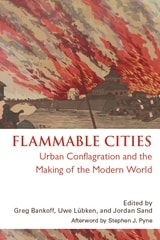
Flammable Cities
Urban Conflagration and the Making of the Modern WorldGreg Bankoff
University of Wisconsin Press, 2012
In most cities today, fire has been reduced to a sporadic and isolated threat. But throughout history the constant risk of fire has left a deep and lasting imprint on almost every dimension of urban society. This volume, the first truly global study of urban conflagration, shows how fire has shaped cities throughout the modern world, from Europe to the imperial colonies, major trade entrepôts, and non-European capitals, right up to such present-day megacities as Lagos and Jakarta. Urban fire may hinder commerce or even spur it; it may break down or reinforce barriers of race, class, and ethnicity; it may serve as a pretext for state violence or provide an opportunity for displays of state benevolence. As this volume demonstrates, the many and varied attempts to master, marginalize, or manipulate fire can turn a natural and human hazard into a highly useful social and political tool.
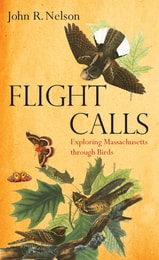
Flight Calls
Exploring Massachusetts through BirdsJohn R. Nelson
University of Massachusetts Press, 2019
With style, humor, and a sense of wonder, Nelson blends his field adventures with a history of the birding community; natural and cultural history; bird stories from authors such as Henry David Thoreau, Emily Dickinson, and Mary Oliver; current scientific research; and observations about the fascinating habits of birds and their admirers. These essays are capped off with a plea for bird conservation, in Massachusetts and beyond.
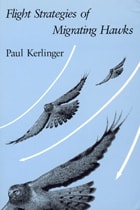
Flight Strategies of Migrating Hawks
Paul Kerlinger
University of Chicago Press, 1989
Kerlinger begins with an overview, discussing ecology and geography, research methods, natural history, and evolution, and atmospheric structure. He then addresses specific aspects of flight behavior: aerodynamics, morphology, mechanics, direction, altitude, flocking, water crossing, speed selection, daily distance traveled, and flight strategies. Kerlinger describes each aspect of behavior quantitatively, testing mechanistic hypotheses. In conclusion, he examines how migrants integrate these behavioral components. Throughout the text he draws comparisons between the migratory flight behavior of hawks and that of other taxa. By means of such comparisons, researchers can gain insight into the selective pressures that shape the behavior of migrant species.
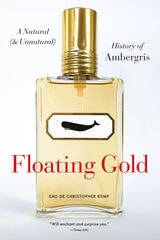
Floating Gold
A Natural (and Unnatural) History of AmbergrisChristopher Kemp
University of Chicago Press, 2012
A fascinating natural history of an incredibly curious substance.
“Preternaturally hardened whale dung” is not the first image that comes to mind when we think of perfume, otherwise a symbol of glamour and allure. But the key ingredient that makes the sophisticated scent linger on the skin is precisely this bizarre digestive by-product—ambergris. Despite being one of the world’s most expensive substances (its value is nearly that of gold and has at times in history been triple it), ambergris is also one of the world’s least known. But with this unusual and highly alluring book, Christopher Kemp promises to change that by uncovering the unique history of ambergris.
A rare secretion produced only by sperm whales, which have a fondness for squid but an inability to digest their beaks, ambergris is expelled at sea and floats on ocean currents for years, slowly transforming, before it sometimes washes ashore looking like a nondescript waxy pebble. It can appear almost anywhere but is found so rarely, it might as well appear nowhere. Kemp’s journey begins with an encounter on a New Zealand beach with a giant lump of faux ambergris—determined after much excitement to nothing more exotic than lard—that inspires a comprehensive quest to seek out ambergris and its story. He takes us from the wild, rocky New Zealand coastline to Stewart Island, a remote, windswept island in the southern seas, to Boston and Cape Cod, and back again. Along the way, he tracks down the secretive collectors and traders who populate the clandestine modern-day ambergris trade.
Floating Gold is an entertaining and lively history that covers not only these precious gray lumps and those who covet them, but presents a highly informative account of the natural history of whales, squid, ocean ecology, and even a history of the perfume industry. Kemp’s obsessive curiosity is infectious, and eager readers will feel as though they have stumbled upon a precious bounty of this intriguing substance.
Flora Zambesiaca Volume 13 (3) Hyancinthaceae
Edited by Benoit Loeuille
Royal Botanic Gardens, Kew, 2023
The Flora Zambesiaca series provides comprehensive descriptive accounts of the flowering plants and ferns native and naturalized in Zambia, Malawi, Mozambique, Zimbabwe, Botswana, and the Caprivi Strip. Volume 14 covers the Hyancinthaceae in its entirety, including detailed plant descriptions and botanical illustrations to aid identification.

Flora Zambesiaca Volume 3 Part 4
Papilionoideae: IndigofereaeEdited by J. R. Timberlake and E. S. Martins
Royal Botanic Gardens, Kew, 2013

Flora Zambesiaca Volume 8 Part 5
Acanthaceae: Pseudocalyx to CrossandraEdited by J. R. Timberlake and E. S. Martins
Royal Botanic Gardens, Kew, 2013

Flora Zambesiaca Volume 8 Part 8
Labiatae, Pogostemonoideae to Nepetoideae Tribe MentheaeEdited by J. R. Timberlake and E. S. Martins
Royal Botanic Gardens, Kew, 2013
Published in paperback following a modified Bentham & Hooker system, as parts or as whole volumes as and when they are complete.
Flora of Iraq Volume 6
CompositaeEdited by Shahina A. Ghazanfar, John R. Edmondson, D. J. Nicholas Hind
Royal Botanic Gardens, Kew, 2019
Flora of the Guianas Series A
Phanerogams Fascicle 29: 127 SapindaceaeEdited by Sylvia Mota de Oliveira
Royal Botanic Gardens, Kew, 2013
Flora of the Guianas
Series A: Phanerogams Fascicle 30: 139 GentianaceaeEdited by Sylvia Mota de Oliveira
Royal Botanic Gardens, Kew, 2014

Florida
A Fire SurveyStephen J. Pyne
University of Arizona Press, 2016
In this important new collection of essays on the region, Stephen J. Pyne colorfully explores the ways the region has approached fire management. Florida has long resisted national models of fire suppression in favor of prescribed burning, for which it has ideal environmental conditions and a robust culture. Out of this heritage the fire community has created institutions to match. The Tallahassee region became the ignition point for the national fire revolution of the 1960s. Today, it remains the Silicon Valley of prescription burning. How and why this happened is the topic of a fire reconnaissance that begins in the panhandle and follows Floridian fire south to the Everglades.
Florida is the first book in a multivolume series describing the nation’s fire scene region by region. The volumes in To the Last Smoke will also cover California, the Northern Rockies, the Great Plains, the Southwest, and several other critical fire regions. The series serves as an important punctuation point to Pyne’s fifty-year career with wildland fire—both as a firefighter and a fire scholar. These unique surveys of regional pyrogeography are Pyne’s way of “keeping with it to the end,” encompassing the directive from his rookie season to stay with every fire “to the last smoke.”
Flow
The Life and Times of Philadelphia's Schuylkill RiverBeth Kephart
Temple University Press, 2014
Flower Chronicles
E. Buckner Hollingsworth
University of Chicago Press, 2004
A tremendously entertaining and charming book, not only for its richness of information but because Hollingsworth clearly enjoys her material, Flower Chronicles has an antiquarian feel about it-with line drawings, woodcuts, and translations from the Greek—but the text never feels dated. Out of print for nearly thirty years, Flower Chronicles reemerges as a garden literature classic.
"With humor and literary taste, Mrs. Hollingworth has compiled an astonishing amount of scholarly yet entertaining material from her studies in archaeology and mythology and her researches in ancient pharmacopeias, botanies, cookbooks, herbals, and stillroom books."-New Yorker
"Mrs. Hollingsworth writes gaily and quotes from old books, with a wonderful taste for the curious English of Elizabethan gardeners, and sharp notice of what poets and translators of talent have set down. To this she has added the excitement of discovery of forms not noticed by her predecessors."-New York Herald Tribune Book Review

Flower Day
A Story of 24 Hours and 24 Floral LivesSandra Knapp
University of Chicago Press, 2025
Is it 4 AM or chicory o’clock? In this short book, botanist and award-winning author Sandra Knapp walks us through a day in a global garden. Each chapter of Flower Day introduces a single flower during a single hour, highlighting twenty-four different species from around the world.
Beginning at midnight in the Americas, we spot the long tubular flowers of the moonflower, Ipomoea alba; they attract a frenzy of hawk moths before the dawn arrives and the flowers wither and collapse. As day breaks, dandelions and chicory open their heads—actually made up of many individual flowers tightly packed together—and flies and bees visit to get the energy they need to lay eggs and raise their young. Later, at eight o’clock in the morning, the sun rises over the watery Amazon basin, and we meet the giant waterlily, slowly turning from white to pink and purple. Trapped inside are the beetles who feasted on the flowers during the night. That evening, at seven o’clock, we travel to the Caribbean to smell night-blooming jessamine’s powerful—some may say nauseating—sweet scent. But this member of the nightshade family isn’t just a thing of beauty—it has a reputation as both a poison and invasive species, crowding out endangered native trees.
For each hour in our flower day, celebrated artist Katie Scott has depicted these scenes with gorgeous pen-and-ink illustrations. Working closely together to narrate and illustrate these unique moments in time, Knapp and Scott have created an engaging read that is a perfect way to spend an hour or two—and a true gift for amateur botanists, gardeners, and anyone who wants to stop and appreciate the flowers.
Flowering Plants
Asteraceae, Part 1Robert H. Mohlenbrock
Southern Illinois University Press, 2015
This, the first of three volumes on the aster family planned for the Illustrated Flora of Illinois series, recognizes 388 species in 119 genera, as well as 20 hybrids and 73 lesser taxa. In Asteraceae, Part 1, author Robert Mohlenbrock presents new and historic information in a clear and easy-to-read style. The volume provides an easy-to-use key to the genera and species and a complete description and nomenclatural and habitat notes for each plant, including its usefulness, if applicable. New nomenclatural combinations are shown for several species. The precise illustrations and detailed information allow for the identification of some of the most difficult to identify plants in the state—goldenrods, asters, artemisias, and fleabanes, among others. Includes 128 original illustrations by Paul Nelson.
Flowering Plants
Asteraceae, Part 2Robert H. Mohlenbrock
Southern Illinois University Press, 2019
In addition, Mohlenbrock has identified the overall range for each species in Illinois, compiled from various sources, including examinations of herbarium material and Mohlenbrock’s own field studies. The range is given from the northeastern to the northwestern extremities, south to the southwestern limit, and then eastward to the southeastern limit.
As important to amateurs interested in wildflower identification as to botanists and land planners, this second volume of Mohlenbrock’s Asteraceae is an essential addition to the esteemed Illustrated Flora of Illinois series.
Flowering Plants
Asteraceae, Part 3Robert H. Mohlenbrock
Southern Illinois University Press, 2017
In addition, Mohlenbrock has identified the overall range for each species in Illinois, compiled from various sources, including examinations of herbarium material and Mohlenbrock’s own field studies. The overall range for each species is given from the northeastern to the northwestern extremities, south to the southwestern limit, then eastward to the southeastern limit.
As important to amateurs interested in wildflower identification as to professional botanists and land planners, this last volume of Mohlenbrock’s Asteraceae is an essential addition to the esteemed Illustrated Flora of Illinois series.
Flowering Plants
Basswoods to SpurgesRobert H. Mohlenbrock
Southern Illinois University Press, 1982
This is the fourth volume in The Illustrated Flora of Illinois devoted to dicotyledons, or dicot plants. Dicots are the greatest group of flowering plants, exceeding the monocotyledons, or monocots. Dicots produce a pair of seed leaves during germination while monocots produce only a single seed leaf.
This volume contains four orders and ten families of dicots. The orders included in this volume are Malvales, Urticales, Rhamnales, and Euphorbiales. Within the Malvales are the families Tiliaceae, Sterculiaceae, and Malvaceae. The families Ulmaceae, Moraceae, and Urticaceae comprise the Urticales. Rhamnaceae and Elaeagnaceae make up the Rhamnales. The Euphorbiales include only the Thymelaeceae and the Euphorbiaceae.
Flowering Plants
Lilies to OrchidsRobert H. Mohlenbrock
Southern Illinois University Press, 1970
A continuation of “The Illustrated Flora of Illinois” series, this volume features Illinois flowering plants. This series is designed to provide a working reference for the identification and classification of all the plant forms found in the state. This series is the first of its kind, as no other study of this sort has been undertaken in any other state, and as such, is an unparalleled contribution to its field.
In his introduction to this volume, Mr. Mohlenbrock discusses some of the terms and procedures used in the identification and classification of the plants. He outlines the life histories and morphologies of some of the representative monocots, and also illustrates some of their habits and frequencies in Illinois. Since these volumes are meant to be used by the amateur as well as the professional botanist, the methods and terms used in the text are explained. The directions for the use of the various identification keys are given so that even the novice plant lover will be able to identify the species encountered. For the uninitiated, a glossary is provided which gives definitions for all terms that might be unfamiliar.
All necessary aids to identification are included in the text itself. The identification keys make it initially possible to classify the plants according to order, family, genus and finally, species and the identifying characteristics of each descending class are given in detail. The morphology of each species is outlined, along with data on frequency of occurrence, related soil and climate conditions and history of past collections, and history of past collections. An illustration showing the more important features of the species in detail is included with the description, as well as a map indicating its geographical locations in Illinois.
This book will be invaluable to students, teachers and professionals; particularly those who are interested in observing the plants in their natural habitat. Those who use it will find it possible to obtain a broad view of changing plant forms as they relate to soil and climate variations throughout the state. And it will provide a delightful diversion for all who enjoy viewing beautiful forms in nature. A walk through the forest will become an opportunity for discovery and appreciation.
Flowering Plants
Magnolias to Pitcher PlantsRobert H. Mohlenbrock
Southern Illinois University Press, 1981
This volume, the eighth devoted to flowering plants in the Illustrated Flora of Illinois series, is the third of several devoted to dicotyledons, which include such well-known plants as roses, peas, mustards, mints, nightshades, milkweeds, and asters. Mohlenbrock here represents four orders (Annonales, Berberidales, Nymphaeales, and Sarraceniales) and fifteen families of plants. As in previous volumes in this series, the common names are those used locally in Illinois. An illustration of each species depicts the distinguishing features and the habitat in Illinois.
Flowering Plants
Nightshades to MistletoeRobert H. Mohlenbrock
Southern Illinois University Press, 1990
This sixth volume of dicots contains three orders and eight families. The orders included are Solanales, Campanulales, and Santalales. Within the Solanales are the families Solanaceae, Convolvulaceae, Cuscutaceae, and Polemoniaceae. The Campanulales contain only the family Campanulaceae. The Santalales include the families Celastraceae, Santalaceae, and Viscaceae. As with each volume in this series Mohlenbrock includes a complete plant description, illustrations showing diagnostic features, distribution maps, and ecological notes.
Flowering Plants
Pokeweeds, Four-o'clocks, Carpetweeds, Cacti, Purslanes, Goosefoots, Pigweeds, and PinksRobert H. Mohlenbrock
Southern Illinois University Press, 2001
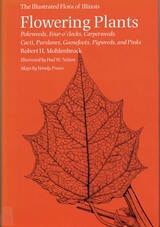
Robert H. Mohlenbrock provides a definitive account of the pokeweed, four-o'clock, carpetweed, cactus, purslane, goosefoot, pigweed, and pink families in Illinois.
Flowering Plants: Pokeweeds, Four-o’clocks, Carpetweeds, Cacti, Purslanes, Goosefoots, Pigweeds, and Pinks is the fifteenth volume of the Illustrated Flora of Illinois series and the ninth devoted to dicots, or plants that have two seed-leaves, or cotyledons, upon germination. Each of the 141 plants is beautifully illustrated by Paul W. Nelson.
Nelson shows the full habitat of the plant and close-ups of various vegetative and reproductive structures that are crucial for the identification of individual species. Each illustration includes detailed drawings of the flowers, fruits, and seeds of the plant covered. Mohlenbrock provides a complete description of each species as well as a discussion of the nomenclature and habitats, and his fifty-three years of experience enable him to present little-known diagnostic features for many species. Range maps show the county distribution of each species in Illinois. Mohlenbrock includes a statement giving the overall range of each species in the United States as well as a detailed key for the identification of the species.
Flowering Plants contains many plants whose obscure flower parts make them exceedingly difficult to identify. The close-up illustrations of these parts will aid the user of the book immensely in identification of the species. Included are several species previously unknown in Illinois.
New illustrations, which include detailed drawings of the flowers, fruits, and seeds are presented for each species covered in this book. Mohlenbrock’s fifty-three years of experience enable him to present little-known diagnostic features for many species.
Flowering Plants
Smartweeds to HazelnutsRobert H. Mohlenbrock and Paul M. Thomson Jr.
Southern Illinois University Press, 2009
Since the publication of the first edition of Smartweeds to Hazelnuts in 1987, thirteen additional species and one hybrid have been discovered in Illinois. In addition, numerous nomenclatural changes have occurred for plants already known.
This second edition updates the status of the Polygonaceae, Hamamelidaceae, Platanaceae, Fagaceae, Betulaceae, and Corylaceae in Illinois. Each of the newly discovered species has been added and is fully illustrated. Updated nomenclature as well as Illinois distributional data are included for each species. In addition to the fourteen new plant illustrations, the appendix contains new information on the descriptions and the geographical locations of plants in the first edition, and revised identification keys.
Robert H. Mohlenbrock and Paul M. Thomson Jr. have included a complete description, illustrations showing diagnostic features, distribution maps, and ecological notes for each plant included in this volume.
This new edition will be invaluable to scholars of botany as well as laypersons interested in observing plants in their natural habitat.
Flowering Plants
Willows to MustardsRobert H. Mohlenbrock
Southern Illinois University Press, 1980
This eighth volume in the comprehensive Illustrated Flora of Illinois series is the seventh volume devoted to flowering plants (the eighth volume is devoted to ferns) and the second treating dicotyledons, which include such well-known plants as roses, peas, mustards, mints, nightshades, milkweeds, and asters. The previous volume on dicots, Flowering Plants: Hollies to Loasas, was published in 1978.
In the present volume, Mohlenbrock includes three orders of vascular plants encompassing five families. The orders are Salicales and Tamaricales, of the Salicaceae and Tamaricaceae families, and Capparidales, of the Capparidaceae, Resedaceae, and Brassicaceae families. In all, 44 genera and 117species are treated in this volume, each species illustrated in detail.
Fluid Arguments
Five Centuries of Western Water ConflictEdited by Char Miller
University of Arizona Press, 2001
Seventeen contributors—representing history, geography, ethnography, political science, law, and urban studies—provide an interdisciplinary perspective on the many dimensions of water in the West: Spanish colonial water law, Native American water rights, agricultural concerns, and dam building. A concluding essay looks toward the future by examining the impact of cities on water and of water marketing on the western economy.
As farmers and ranchers from Kansas to California compete for water with powerful urban economies, the West will continue to be reshaped by this scarce and precious resource. Fluid Arguments clearly shows that many of the current disputes over water take place without a real appreciation for the long history of the debate. By shedding new light on how water allocation is established—and who controls it—this book makes a vital contribution to our understanding of water and growth in the region.
CONTENTS
Divining the Past: An Introduction / Char Miller
Part 1. Land and Water on New Spain’s Frontiers
1. "Only Fit for Raising Stock": Spanish and Mexican Land and Water Rights in the Tamaulipan Cession / Jesús F. de la Teja
2. Water, the Gila River Pimas, and the Arrival of the Spanish / Shelly C. Dudley
3. "Between This River and That": Establishing Water Rights in the Chama Basin of New Mexico / Sandra K. Mathews-Lamb
Part 2. The Native American Struggle for Water
4. Maggot Creek and Other Tales: Kiowa Identity and Water, 1870-1920 / Bonnie Lynn-Sherow
5. The Dilemmas of Indian Water Policy, 1887-1928 / Donald J. Pisani
6. First in Time: Tribal Reserved Water Rights and General Adjudications in New Mexico / Alan S. Newell
7. Winters Comes Home to Roost / Daniel McCool
Part 3. Agricultural Conundrums
8. Water, Sun, and Cattle: The Chisholm Trail as an Ephemeral Ecosystem / James E. Sherow
9. Private Irrigation in Colorado’s Grand Valley / Brad F. Raley
10. A Rio Grande "Brew": Agriculture, Industry, and Water Quality in the Lower Rio Grande Valley / John P. Tiefenbacher
11. Specialization and Diversification in the Agricultural System of Southwestern Kansas, 1887-1980 / Thomas C. Schafer
12. John Wesley Powell Was Right: Resizing the Ogallala High Plains / John Opie
Part 4. Dam those Waters!
13. Private Initiative, Public Works: Ed Fletcher, the Santa Fe Railway, and Phoenix’s Cave Creek Flood Control Dam / Donald C. Jackson
14. The Changing Fortunes of the Big Dam Era in the American West / Mark Harvey
15. Building Dams and Damning People in the Texas-Mexico Border Region: Mexico’s El Cuchillo Dam Project / Raúl M. Sánchez
Part 5. The Coming Fight
16. Water and the Western Service Economy: A New Challenge / Hal K. Rothman
Fluorspar Mining
Photos from Illinois and Kentucky, 1905-1995Herbert K. Russell
Southern Illinois University Press, 2019
This first-ever pictorial record of the people and methods of the Illinois-Kentucky Fluorspar District from the 1900s to the 1990s covers early and modern means of extracting, hoisting, processing, and transporting the mineral from mine mouth to end user. Nearly one hundred images carefully selected by author Herbert K. Russell show early pick-and-shovel extraction and open-flame lighting as well as primitive drilling methods and transportation by barrels, buckets, barges, mule teams, and trams, in addition to the use of modern equipment and sophisticated refinement procedures such as froth flotation. Russell also provides an overview of the many industrial uses of fluorspar, from metal work by ancient Romans to the processing of uranium by scientists seeking to perfect the atomic bomb. Preserving what is known about the industry by miners, managers, and museums, this detailed and fascinating pictorial history looks both above and below ground at fluorspar mining.
Fly Fishing in Fast-Flowing Water
A Coming of Age in Michigan's Upper PeninsulaBruce C. Petersen
Michigan State University Press, 2027
With its rugged forests and swift rivers, Michigan’s Upper Peninsula offers the perfect setting for fly fishing. Following in the footsteps of Ernest Hemingway’s character Nick Adams, Bruce C. Petersen creates a unique coming-of-age memoir that departs from the typical story of growing from teen to adulthood. Instead, Petersen explores his seventh decade, chasing trout in the challenging waters of Northern Michigan while grappling with what it means to grow old. In this absorbing memoir, he relives his most memorable days as a fly fisher and offers thoughtful reflections on the healing power of nature, aging gracefully, and the unstoppable passage of time.
Fly-Fishing
Christopher Schaberg
Duke University Press, 2023
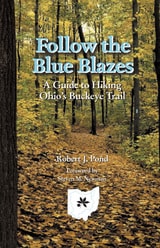
Follow the Blue Blazes
A Guide To Hiking Ohio's Buckeye TrailRobert J. Pond
Ohio University Press, 2003
Unique among hiking trails is the one that forms a complete loop around the state of Ohio. That 1,200-mile trail is called the Buckeye Trail. Showing the way on tree trunks, rocks, and other natural signposts are the blue painted markings called “the blue blazes.” In Follow the Blue Blazes, the reader embarks on a journey to discover a part of Ohio largely unseen except along this great path.
Beginning with the startling rock formations and graceful waterfalls of Old Man’s Cave in southern Ohio, and leading clockwise around the state to visit expansive forests, lovely parks, ancient mounds, historic canals and battlefields, and scenic river trails, experienced trailsman Robert J. Pond provides a captivating look at each section of the trail.
Each chapter features an overview of a 100-mile section of the trail and three self-guided featured hikes. The overviews, with accompanying maps, may be read consecutively to acquaint the reader with the entire course of the blue blazes. But most readers will best enjoy the Buckeye Trail by taking the guide along on featured hikes. Each hike is supported by a detailed but easy-to-follow map and includes explicit directions to trailheads and approximate hiking times.
In addition to many outlying areas, the extensive Buckeye Trail is accessible in or near Cincinnati, Dayton, Toledo, Cleveland, and Akron. Robert Pond has supplemented each description with interesting details about the geology and the diverse habitats of flora and fauna. Readers, too, can enjoy the beauty and wonders of Ohio if they Follow the Blue Blazes.
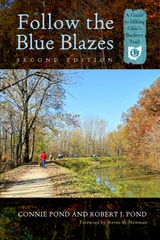
Follow the Blue Blazes
A Guide to Hiking Ohio’s Buckeye TrailConnie Pond
Ohio University Press, 2014
Many changes have taken place in the decade since Follow the Blue Blazes was first published, changes in the trails themselves and in the way we hike them. The Buckeye Trail still wends its way around the state of Ohio, following the course marked out by the characteristic blue blazes on trees and signposts along the way. In the intervening years, however, sections of the trail have changed their route, added amenities, or just grown more interesting. From the startling rock formations and graceful waterfalls of Old Man’s Cave, to Native American mounds, battlefields, and scenic rivers, Connie and Robert J. Pond provide a captivating guide to often-overlooked treasures around the state.
Each chapter features an overview of a 100-mile section of the trail and three self-guided featured hikes. The overviews and the accompanying maps may be read consecutively to acquaint the reader with the entire course of the trail. But most readers will best enjoy the trail by taking the guide along on one of the featured hikes. Each route is outlined on an easy-to-read map with GPS coordinates and waypoints to guide the hiker, as well as explicit directions from parking lot to trailhead.
The Buckeye Trail is readily accessible from Cincinnati, Dayton, Toledo, Cleveland, and Akron. Even a short trip can lead to an adventure near your own backyard.
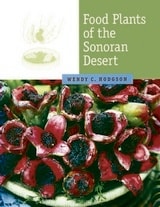
Food Plants of the Sonoran Desert
Wendy C. Hodgson
University of Arizona Press, 2001
The seemingly inhospitable Sonoran Desert has provided sustenance to indigenous peoples for centuries. Although it is to all appearances a land bereft of useful plants, fully one-fifth of the desert's flora are edible.
This volume presents information on nearly 540 edible plants used by people of more than fifty traditional cultures of the Sonoran Desert and peripheral areas. Drawing on thirty years of research, Wendy Hodgson has synthesized the widely scattered literature and added her own experiences to create an exhaustive catalog of desert plants and their many and varied uses.
Food Plants of the Sonoran Desert includes not only plants such as gourds and legumes but also unexpected food sources such as palms, lilies, and cattails, all of which provided nutrition to desert peoples. Each species entry lists recorded names and describes indigenous uses, which often include nonfood therapeutic and commodity applications. The agave, for example, is cited for its use as food and for alcoholic and nonalcoholic beverages, syrup, fiber, cordage, clothing, sandals, nets, blankets, lances, fire hearths, musical instruments, hedgerows, soap, and medicine, and for ceremonial purposes. The agave entry includes information on harvesting, roasting, and consumption—and on distinguishing between edible and inedible varieties.
No other source provides such a vast amount of information on traditional plant uses for this region. Written to be easily accessible to general readers, the book is an invaluable compendium for anyone interested in the desert's hidden bounty.
Food Webs
Stuart L. Pimm
University of Chicago Press, 2002
Although it was first published twenty years ago, Stuart Pimm's Food Webs remains the clearest introduction to the study of food webs. Reviewing various hypotheses in the light of theoretical and empirical evidence, Pimm shows that even the most complex food webs follow certain patterns and that those patterns are shaped by a limited number of biological processes, such as population dynamics and energy flow. Pimm provides a variety of mathematical tools for unravelling these patterns and processes, and demonstrates their application through concrete examples. For this edition, he has written a new foreword covering recent developments in the study of food webs and demonstrates their continuing importance to conservation biology.
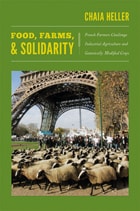
Food, Farms, and Solidarity
French Farmers Challenge Industrial Agriculture and Genetically Modified CropsChaia Heller
Duke University Press, 2012

Foodloose in Washtenaw
A Foodie's Guide to Washtenaw CountyTaylor Landeryou and Raymond De Young
Michigan Publishing Services, 2018
Inspired by a classic walking guidebook of the area, Foodloose in Washtenaw County takes readers on tours to discover food-related treasures throughout the county. What better way to get to know this place—or experience something new—than to bike, bus, carpool, walk, even kayak your way through food-filled Washtenaw County?
From centennial farms to trendy upscale restaurants, the self-guided tours of Foodloose offer an opportunity to explore where our food is grown, produced, distributed, and enjoyed in Washtenaw County. Within these pages lies a chance to celebrate the local food community, learn more about our unique food system, and maybe even find a new favorite place to dine.

For All Seasons
A Big Bend JournalBy Roland H. Wauer
University of Texas Press, 1997
Something about Big Bend National Park draws visitors again and again. Maybe it's the spare beauty of the mountains and desert, the dawn chorus of birds, or the vivid stars in the velvet night. All of these things have made it Roland Wauer's favorite place. In this book, he shares his love of the Big Bend through journal entries that chronicle a year in the life of the park.
Wauer worked as Chief Park Naturalist from 1966 to 1972 and has visited the park frequently ever since. His journal entries span these thirty years, providing not only a composite portrait of a typical year but also a clear sense of how the park's natural history has changed over three decades. He spices his account with anecdotes, often humorous, ranging from stumbling across a herd of javelinas to being trailed by a mountain lion in the dark to discovering new species of plants and animals.
Few authors know the Big Bend as Roland Wauer does or have written about it in a more engaging way. This beautifully illustrated book is the perfect companion for a visit to the park, whether in person or by armchair.