Results by title
4917 books match the query 'Philosophy' and 136 start with f
For an Ontology of Morals
A Critique of Contemporary Ethical TheoryHenry B. Veatch
Northwestern University Press, 1971
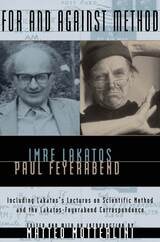
For and Against Method
Including Lakatos's Lectures on Scientific Method and the Lakatos-Feyerabend CorrespondenceImre Lakatos and Paul Feyerabend
University of Chicago Press, 1999
For and Against Method opens with an imaginary dialogue between Lakatos and Feyerabend, which Matteo Motterlini has constructed, based on their published works, to synthesize their positions and arguments. Part one presents the transcripts of the last lectures on method that Lakatos delivered. Part two, Feyerabend's response, consists of a previously published essay on anarchism, which began the attack on Lakatos's position that Feyerabend later continued in Against Method. The third and longest section consists of the correspondence Lakatos and Feyerabend exchanged on method and many other issues and ideas, as well as the events of their daily lives, between 1968 and Lakatos's death in 1974.
The delight Lakatos and Feyerabend took in philosophical debate, and the relish with which they sparred, come to life again in For and Against Method, making it essential and lively reading for anyone interested in these two fascinating and controversial thinkers and their immense contributions to philosophy of science.
"The writings in this volume are of considerable intellectual importance, and will be of great interest to anyone concerned with the development of the philosophical views of Lakatos and Feyerabend, or indeed with the development of philosophy of science in general during this crucial period."—Donald Gillies, British Journal for the Philosophy of Science (on the Italian edition)
"A stimulating exchange of letters between two philosophical entertainers."—Tariq Ali, The Independent
Imre Lakatos (1922-1974) was professor of logic at the London School of Economics. He was the author of Proofs and Refutations and the two-volume Philosophical Papers. Paul Feyerabend (1924-1994) was educated in Europe and held numerous teaching posts throughout his career. Among his books are Against Method; Science in a Free Society; Farewell to Reason; and Killing Time: The Autobiography of Paul Feyerabend, the last published by the University of Chicago Press.
For the Sake of Argument
Practical Reasoning, Character, and the Ethics of BeliefEugene Garver
University of Chicago Press, 2004
Garver roots deliberation and persuasion in political friendship instead of a neutral, impersonal framework of justice. Through incisive readings of examples in modern legal and political history, from Brown v. Board of Education to the South African Truth and Reconciliation Commission, he demonstrates how acts of deliberation and persuasion foster friendship among individuals, leading to common action amid diversity. In an Aristotelian sense, there is a place for pathos and ethos in rational thought. Passion and character have as pivotal a role in practical reasoning as logic and language.
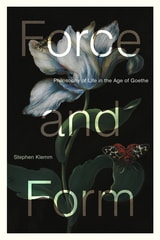
Force and Form
Philosophy of Life in the Age of GoetheStephen Klemm
Bucknell University Press, 2027
This book offers a bold rethinking of how modern ideas of life, nature, and subjectivity took shape in late-eighteenth- and early-nineteenth-century German thought. Moving beyond familiar narratives based on Kantian autonomy or Romantic irrationalism, it uncovers a vitalist tradition stretching from Herder to Schiller and Goethe, one that understood nature as dynamic, self-forming, and internally animated by life-force. Drawing on philosophy, the life sciences, and aesthetics, this innovative study reveals how these thinkers challenged mechanistic models of matter and resisted strict divisions between mind and nature. In doing so, they developed a historically contingent and embodied concept of subjectivity in which reason emerges from natural, cultural, and physiological processes rather than standing outside them. By situating this tradition within debates about epigenesis, form, and development, the book not only reshapes our understanding of German intellectual history but also sheds new light on contemporary debates about naturalism, posthumanism, and theories of life.
Published by Bucknell University Press. Distributed worldwide by Rutgers University Press.
Force, Drive, Desire
A Philosophy of PsychoanalysisRudolf Bernet, Translated from the French by Sarah Allen
Northwestern University Press, 2019
Rereading the long history of metaphysics (or at least a few of its key moments) in light of psychoanalytic inquiries into the nature and function of drive and desire also allows for a rewriting of the history of philosophy. Specifically, it allows Bernet to bring to light a different history of metaphysics, one centered less on Aristotelian substance (ousia) and more on the concept of dunamis—a power or potentiality for a realization toward which it strives with all its might. Relating human drives to metaphysical forces also bears fruit for a renewed philosophy of life and subjectivity.
Foreplay
Hannah Arendt, the Two Adornos, and Walter BenjaminCarl Djerassi
University of Wisconsin Press, 2011
Hannah Arendt, Walter Benjamin, and Theodor W. Adorno were intellectual giants of the first half of the twentieth century. The drama Foreplay explores their deeply human and psychologically intriguing private lives, focusing on professional and personal jealousies, the mutual dislike of Theodor Adorno and Hannah Arendt, the association between Walter Benjamin and Georges Bataille, and the border between erotica and pornography.
Forgiveness
Vladimir Jankélévitch
University of Chicago Press, 2005
Forgiveness & Reconciliation
Public Policy & Conflict TransformationRaymond G. Helmick
Templeton Press, 2001
This book brings together a unique combination of experts in conflict resolution and focuses on the role forgiveness can play in the process. It deals with theology, public policy, psychological and social theory, and social policy implementation of forgiveness. This book is essential for libraries, scholars, conflict negotiators, and all people who hope to understand the role of forgiveness in the peace process.
The book's first section explores how ideas like "forgiveness" and "reconciliation" are moving out from the seminary and academy into the world of public policy and how these terms have been used and defined in the past. The second section looks at forgiveness and public policy. One of the chapters, by Donald W. Shriver Jr., addresses forgiveness in a secular political forum.
The third section of the book draws us to a more thorough analysis of the relationship between forgiveness and reconciliation from voices in the academic and theological community, and the final section highlights the work of practitioners currently working with religion, public policy, and conflict transformation, particularly in areas such as Ireland and Africa.
Contributors include Desmond M. Tutu, Rodney L. Petersen, Miroslav Volf, Stanley S. Harakas, Raymond G. Helmick, SJ, Joseph V. Montville, Douglas M. Johnston, Donna Hicks, Donald W. Shriver, Jr., Everett L. Worthington, Jr., John Paul Lederach, Ervin Staub, Laurie Anne Pearlman, John Dawson, Audrey R. Chapman, Olga Botcharova, Anthony da Silva, SJ, Geraldine Smythe, OP, Andrea Bartoli, Ofelia Ortega, and George F. R. Ellis.
Form and Being
Studies in Thomistic Metaphysics (Studies in Philosophy and the History of Philosophy, Volume 45)Lawrence Dewan, O.P.
Catholic University of America Press, 2006
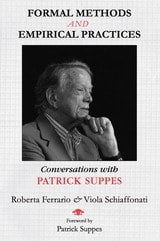
Formal Methods and Empirical Practices
Conversations with Patrick SuppesRoberta Ferrario and Viola Schiaffonati
CSLI, 2012
Formal Objects
On Beauty and SustainabilityRobert Hariman
University of Chicago Press, 2027
A bold invitation to learn sustainability from the aesthetic forms that pattern our world.
If we are to survive the ecological crisis, we must develop a new orientation to the world that draws us into better relationships with nature and one another. Robert Hariman believes that, as a first step, we must cultivate a renewed appreciation for the beauty at the center of reality. We must learn again, he argues, to see forms: the rhythms, shapes, and textures that evoke connection and pleasure. To that end, Formal Objects applies literary, philosophical, and art historical concepts to reimagine an often-ignored theory called formalism. This perspective is developed through visual motifs that are found in nature and the decorative arts, and it invites us to become attuned to rich patterns of reciprocity. Once we recognize the beauty in the world, we can move in step with its abundance to design more just and sustainable communities.
Formalism in Ethics and Non-Formal Ethics of Values
A New Attempt toward the Foundation of an Ethical PersonalismMax Scheler
Northwestern University Press, 1973
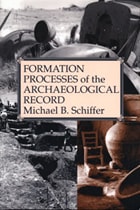
Formation Processes of the Archaeological Record
Michael Brian Schiffer
University of Utah Press, 1987
This handbook synthesizes the most important principles of cultural and environmental formation processes for both students and practicing archaeologists.
Formation Process of the Archaeological Record embodies a vision that the cultural past is knowable, but only when the nature of the evidence is thoroughly understood. It shows how the past is accessible in practice by identifying variability introduced by the diverse effects of people and nature that in some sum, form the archaeological record.
For students, it is intended as both an introduction and guide in method and theory, field work, and analysis. Practicing archaeologists will find it a valuable checklist of sources of variability when observations on the archaeological record are used to justify inferences.
Formerly God
Rethinking God after GodRick Benjamins
Amsterdam University Press, 2026
This book begins with the controversial work of Dutch theologian Harry Kuitert, who bid farewell to old representations of God but got stuck finding new ones. It turns back to the important and indispensable insights of Hegel and Heidegger. It presents contemporary post-theistic thinking about God, using German, French, and American thinkers, distinguishing interpretive theologians, deconstructionists, and constructive theologians, finally formulating a new position.
Forming Humanity
Redeeming the German Bildung TraditionJennifer A. Herdt
University of Chicago Press, 2019
Kant’s proclamation of humankind’s emergence from “self-incurred immaturity” left his contemporaries with a puzzle: What models should we use to sculpt ourselves if we no longer look to divine grace or received authorities? Deftly uncovering the roots of this question in Rhineland mysticism, Pietist introspection, and the rise of the bildungsroman, Jennifer A. Herdt reveals bildung, or ethical formation, as the key to post-Kantian thought. This was no simple process of secularization, in which human beings took responsibility for something they had earlier left in the hands of God. Rather, theorists of bildung, from Herder through Goethe to Hegel, championed human agency in self-determination while working out the social and political implications of our creation in the image of God. While bildung was invoked to justify racism and colonialism by stigmatizing those deemed resistant to self-cultivation, it also nourished ideals of dialogical encounter and mutual recognition. Herdt reveals how the project of forming humanity lives on in our ongoing efforts to grapple with this complicated legacy.
Forms in the Abyss
A Philosophical Bridge Between Sartre and DerridaSteve Martinot
Temple University Press, 2007
Martinot argues that a bridge between these two thinkers can be constructed. He demonstrates that one can use the critical tools provided by Derrida, and the forms of discourse and reasoning developed by Sartre, to set the two in dialogue with each other. In the process, Martinot develops a theory of dialogue that incorporates both ethics and form and contributes a new way of thinking about critical and social theory. More importantly, he adds a new ethical and political imperative to postmodern thought that many dritics have often found missing in the works of thinkers like Derrida.
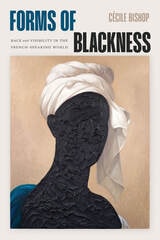
Forms of Blackness
Race and Visibility in the French-Speaking WorldCécile Bishop
Duke University Press, 2025
Considering race as form across literature, theory, painting, and photography, Cécile Bishop’s Forms of Blackness explores the formal devices that make blackness both visible and recognizable. In keeping with black Francophone theorists like Édouard Glissant and Frantz Fanon, Bishop uses the ambiguities these aesthetic forms carry to explore a range of identity concepts like opacity, formlessness, and doubleness. Bishop puts blackness-as-race and blackness-as-form in dialogue, showing how race disrupts the concept of artistic autonomy and how the aesthetic challenges race as a self-evident visual phenomenon. When thought together, form does not isolate blackness from race but rather calls attention to the material substrate that turns race into a phenomenon that can be experienced through sense perception. Moving between careful analysis and experimental modes of critique, Forms of Blackness offers a new way of thinking about the politics of visibility and offers a pressing invitation to question the ways we interpret what we see.
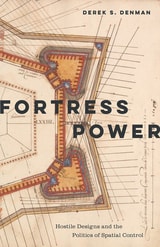
Fortress Power
Hostile Designs and the Politics of Spatial ControlDerek S. Denman
University of Minnesota Press, 2025
A compelling treatise on the relationship between power and enclosure
Fortress Power presents a genealogy of fortification as a material and political technology intent on obstruction, tracing its implementation across battlefields, borders, and urban environments. Drawing on the influential work of philosophers Michel Foucault and Giorgio Agamben, Derek S. Denman places the fortress alongside the archetypes of the prison and the camp, citing them as paradigmatic of how space is transformed into a tool of domination and control.
Focusing on the defensive architecture of bastion fortresses, urban design, and border landscapes, Fortress Power charts the rise of a form of governance grounded in hostility, extending the scope of its subject from a piece of military construction to a much broader political concept. Detailing how power manifests in everything from city centers to international boundaries, the book analyzes the logic of fortification as it moves through various contexts in the advancement of surveillance, exploitation, warfare, and political authority.
Through a unique blend of architecture and design studies, political theory, international relations, geography, and migration studies, Denman outlines the disquieting legacy of the fortress to highlight its role in the formation of modern government and the enactment of violence. In an era marked by the increasing prevalence of authoritarian power and conflicting geopolitical boundaries, he presents an insightful investigation of the weaponization of the built environment.
Forty-Nine Steps
Roberto Calasso
University of Minnesota Press, 2001

Foucault
Gilles Deleuze
University of Minnesota Press, 1988
Foucault And Heidegger
Critical EncountersAlan Milchman
University of Minnesota Press, 2003
Foucault and Feminist Philosophy of Disability
Shelley L. Tremain
University of Michigan Press, 2017

Foucault and His Interlocutors
Edited by Arnold I. Davidson
University of Chicago Press, 1997
This volume also includes several important works by Foucault previously unpublished in English. The other contributors are Georges Canguilhem, Gilles Deleuze, Jacques Derrida, Pierre Hadot, Michel Serres, and Paul Veyne.
Here for the first time is the French Foucault.
This volume offers lucid and important texts that will appeal to students and professors at every level of study. It is essential reading for all scholars of twentieth-century philosophy and critical theory.
Foucault and the Government of Disability
Shelley Tremain, Editor
University of Michigan Press, 2005
Foucault and the Government of Disability is the first book-length investigation of the relevance and importance of the ideas of Michel Foucault to the field of disability studies-and vice versa. Over the last thirty years, politicized conceptions of disability have precipitated significant social change, including the landmark Americans with Disabilities Act in 1990, the redesign of urban landscapes, the appearance of closed-captioning on televisions, and the growing recognition that disabled people constitute a marginalized and disenfranchised constituency.
The provocative essays in this volume respond to Foucault's call to question what is regarded as natural, inevitable, ethical, and liberating, while they challenge established understandings of Foucault's analyses and offer fresh approaches to his work. The book's roster of distinguished international contributors represents a broad range of disciplines and perspectives, making this a timely and necessary addition to the burgeoning field of disability studies.
Foucault and the Government of Disability
Shelley Tremain, Editor
University of Michigan Press, 2005
“[A]n important, prescient, and necessary contribution…a kind of litmus test for the efficacy of Foucault’s concepts in the study of disability, concepts that lead to a refusal of the biological essentialism implied in the disability/impairment binary.”
—Foucault Studies
“Tremain has done an exceptional job at organizing and procuring important, rigorously argued, and entertaining essays…. This book should be a mandatory read for anyone interested in contemporary philosophical debates surrounding the experience of disability."
—Essays in Philosophy
“A beautiful exploration of how Foucault’s analytics of power and genealogies of discursive knowledges can open up new avenues for thinking critically about phenomena that many of us take to be inevitable and thus new ways of resisting and possibly at times redirecting the forces that shape our lives. Every scholar, every person with an interest in Foucault or in political theory generally, needs to read this book.”
—Ladelle McWhorter, University of Richmond
Foucault and the Iranian Revolution
Gender and the Seductions of IslamismJanet Afary and Kevin B. Anderson
University of Chicago Press, 2005
In this important and controversial account, Janet Afary and Kevin B. Anderson illuminate Foucault's support of the Islamist movement. They also show how Foucault's experiences in Iran contributed to a turning point in his thought, influencing his ideas on the Enlightenment, homosexuality, and his search for political spirituality. Foucault and the Iranian Revolution informs current discussion on the divisions that have reemerged among Western intellectuals over the response to radical Islamism after September 11. Foucault's provocative writings are thus essential for understanding the history and the future of the West's relationship with Iran and, more generally, to political Islam. In their examination of these journalistic pieces, Afary and Anderson offer a surprising glimpse into the mind of a celebrated thinker.
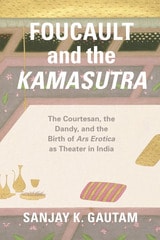
Foucault and the Kamasutra
The Courtesan, the Dandy, and the Birth of Ars Erotica as Theater in IndiaSanjay K. Gautam
University of Chicago Press, 2016
Gautam shows how closely intertwined the history of erotics in Indian culture is with the history of theater-aesthetics grounded in the discourse of love, and Foucault provides the framework for opening up an intellectual horizon of Indian thought. To do this, Gautam looks to the history of three inglorious characters in classical India: the courtesan and her two closest male companions—her patron, the dandy consort; and her teacher and advisor, the dandy guru. Foucault’s distinction between erotic arts and the science of sexuality drives Gautam’s exploration of the courtesan as a symbol of both sexual-erotic and aesthetic pleasure. In the end, by entwining together Foucault’s works on the history of sexuality in the West and the classical Indian texts on eros, Gautam transforms our understanding of both, even as he opens up new ways of investigating erotics, aesthetics, gender relations, and subjectivity.
Foucault in Iran
Islamic Revolution after the EnlightenmentBehrooz Ghamari-Tabrizi
University of Minnesota Press, 2016
Were the thirteen essays Michel Foucault wrote in 1978–1979 endorsing the Iranian Revolution an aberration of his earlier work or an inevitable pitfall of his stance on Enlightenment rationality, as critics have long alleged? Behrooz Ghamari-Tabrizi argues that the critics are wrong. He declares that Foucault recognized that Iranians were at a threshold and were considering if it were possible to think of dignity, justice, and liberty outside the cognitive maps and principles of the European Enlightenment.
Foucault in Iran centers not only on the significance of the great thinker’s writings on the revolution but also on the profound mark the event left on his later lectures on ethics, spirituality, and fearless speech. Contemporary events since 9/11, the War on Terror, and the Arab Uprisings have made Foucault’s essays on the Iranian Revolution more relevant than ever. Ghamari-Tabrizi illustrates how Foucault saw in the revolution an instance of his antiteleological philosophy: here was an event that did not fit into the normative progressive discourses of history. What attracted him to the Iranian Revolution was precisely its ambiguity.
Theoretically sophisticated and empirically rich, this interdisciplinary work will spark a lively debate in its insistence that what informed Foucault’s writing was not an effort to understand Islamism but, rather, his conviction that Enlightenment rationality has not closed the gate of unknown possibilities for human societies.
Foucault's Askesis
An Introduction to the Philosophical LifeEdward McGushin
Northwestern University Press, 2007
Through a detailed study of Foucault's last courses, McGushin demonstrates that this new way of practicing philosophical askēsis evokes Foucault's ethical resistance to modern relations of power and knowledge. In order to understand Foucault's later project, then, it is necessary to see it within the context of his earlier work. If his earlier projects represented an attempt to bring to light the relations of power and knowledge that narrowed and limited freedom, then this last project represents his effort to take back that freedom by redefining it in terms of care of the self. Foucault always stressed that modern power functions by producing individual subjects. This book shows how his excavation of ancient philosophical practices gave him the tools to counter this function-with a practice of self-formation, an askēsis.
Foucault's Discipline
The Politics of SubjectivityJohn S. Ransom
Duke University Press, 1997
Foucault’s Discipline demonstrates how Foucault’s valorization of descriptive critique over prescriptive plans of action can be applied to the decisively altered political landscape of the end of this millennium. By reconstructing the philosopher’s arguments concerning the significance of disciplinary institutions, biopower, subjectivity, and forms of resistance in modern society, Ransom shows how Foucault has provided a different way of looking at and responding to contemporary models of government—in short, a new depiction of the political world.
Foucault, Politics, and Violence
Johnanna Oksala
Northwestern University Press, 2012
Foundations and Methods from Mathematics to Neuroscience
Essays Inspired by Patrick SuppesEdited by Colleen E Crangle, Adolfo García de la Sienra, and Helen E. Longino
CSLI, 2014
Foundations of Black Epistemology
Knowledge Discourse in Africana PhilosophyAdebayo Oluwayomi
Temple University Press, 2025
Foundations of Black Epistemology examines writings by Phillis Wheatley, Frederick Douglass, Ida B. Wells, W.E.B. DuBois, Frantz Fanon, Steve Bantu Biko, Huey P. Newton, and Kathleen Neal Cleaver. Each chapter addresses issues of self-knowledge, self-assertion, Black consciousness, or anticolonialism and its relation to personal and political epistemologies.
Oluwayomi offers innovative perspectives on the formulation, deduction, and interrogation of epistemological themes within Black Africana philosophy. By considering the important epistemological theories and arguments in Black philosophy particularly in the last 150 to 200 years, Foundations of Black Epistemology promises to generate new discussions around this necessary field of Black Africana philosophy.
Foundations of Logic
Completeness, Incompleteness, ComputabilityDag Westerståhl
CSLI, 2023
This book provides a concise but detailed account of modern logic's three cornerstones: the completeness of first-order logic, Gödel's Incompleteness Theorems, and Turing's analysis of computability. In addition to the central text, an appendix explains the required technical terminology and facts. The main ideas behind the three cornerstones are explained in a simple, easy-to-grasp manner, and it is possible to select among the chapters and sections so that the reader becomes familiar with these ideas, even if some technicalities are skipped or postponed. A wealth of exercises accompany a wide selection of materials, including the histories and philosophical implications of the three main premises, making it useful as a textbook for undergraduate or graduate courses focusing on any of the three main themes. The material is rigorous and detailed but keeps the main ideas in sight, and there are numerous excursions into more advanced material for curious readers to explore.
Fragile Finitude
A Jewish Hermeneutical TheologyMichael Fishbane
University of Chicago Press, 2021
In Fragile Finitude, Fishbane clears new ground for a theological life through a novel reinterpretation of the Book of Job. On this basis, he offers a contemporary engagement with the four classical types of Jewish Scriptural exegesis. The first focuses on worldly experience, the second on communal forms of practice and thought in the rabbinical tradition, the third on personal development, and the fourth on transcendent, cosmic orientations. Through these four modes, Fishbane manages to transform Jewish theology from within, at once reinvigorating a long tradition and moving beyond it. What he offers is nothing short of a way to reorient our lives in relation to the divine and our fellow humans. Written from within the Jewish tradition, Fragile Finitude is intended for readers across the religious spectrum.
Fragments for a History of a Vanishing Humanism
Edited by Myra Seaman and Eileen A. Joy
The Ohio State University Press, 2016
This volume, edited by Myra Seaman and Eileen A. Joy, insists on the always provisional and contingent formations of the human, and of various humanisms, over time, while also aiming to demonstrate the different ways these formations emerge (and also disappear) in different times and places, from the most ancient past to the most contemporary present. The essays are offered as “fragments” because the authors do not believe there can ever be a “total history” of either the human or the post/human as they play themselves out in differing historical contexts. At the same time, the volume as a whole argues that defining what “the human” (or “post/human”) is has always been an ongoing, never finished cultural project.
Fragments of Development
Nation, Gender, and the Space of ModernitySuzanne Bergeron
University of Michigan Press, 2005
---Isabella C. Bakker, York University
"Bergeron's pathbreaking analysis challenges orthodox development theories, questions current feminist economic thinking and highlights crucial new gendered challenges to globalization."
---Jane Parpart, Dalhousie University
"Cutting-edge scholarship. Bergeron deftly engages the complexity of current debates while retaining clarity, improving analyses, and illuminating alternatives."
---V. S. Peterson, University of Arizona
By tracing out the intersection between the imagined space of the national economy and the gendered construction of "expert" knowledge in development thought, Suzanne Bergeron provides a provocative analysis of development discourse and practice. By elaborating a framework of including/excluding economic subjects and activities in development economics, she provides a rich account of the role that economists have played in framing the contested political and cultural space of development.
Bergeron's account of the construction of the national economy as an object of development policy follows its shifting meanings through modernization and growth models, dependency theory, structural adjustment, and contemporary debates about globalization and highlights how intersections of nation and economy are based on gendered and colonial scripts. The author's analysis of development debates effectively demonstrates that critics of development who ignore economists' nation stories may actually bolster the formation they are attempting to subvert. Fragments of Development is essential reading for those interested in development studies, feminist economics, international political economy, and globalization studies.
Fragments of an Anarchist Anthropology
David Graeber
Prickly Paradigm Press, 2004
This pamphlet ponders what that response would be, and explores the implications of linking anthropology to anarchism. Here, David Graeber invites readers to imagine this discipline that currently only exists in the realm of possibility: anarchist anthropology.
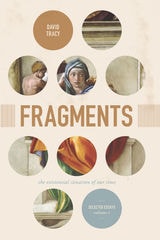
Fragments
The Existential Situation of Our Time: Selected Essays, Volume 1David Tracy
University of Chicago Press, 2020
In the first volume, Fragments, Tracy gathers his most important essays on broad theological questions, beginning with the problem of suffering across Greek tragedy, Christianity, and Buddhism. The volume goes on to address the Infinite, and the many attempts to categorize and name it by Plato, Aristotle, Rilke, Heidegger, and others. In the remaining essays, he reflects on questions of the invisible, contemplation, hermeneutics, and public theology. Throughout, Tracy evokes the potential of fragments (understood both as concepts and events) to shatter closed systems and open us to difference and Infinity. Covering science, literature, philosophy, psychoanalysis, and non-Western religious traditions, Tracy provides in Fragments a guide for any open reader to rethink our fragmenting contemporary culture.
Framing Public Memory
Edited by Kendall R. Phillips
University of Alabama Press, 2007
A collection of essays by prominent scholars from many disciplines on the construction of public memories
The study of public memory has grown rapidly across numerous disciplines in recent years, among them American studies, history, philosophy, sociology, architecture, and communications. As scholars probe acts of collective remembrance, they have shed light on the cultural processes of memory. Essays contained in this volume address issues such as the scope of public memory, the ways we forget, the relationship between politics and memory, and the material practices of memory.Stephen Browne’s contribution studies the alternative to memory erasure, silence, and forgetting as posited by Hannah Arendt in her classic Eichmann in Jerusalem. Rosa Eberly writes about the Texas tower shootings of 1966, memories of which have been minimized by local officials. Charles Morris examines public reactions to Larry Kramer’s declaration that Abraham Lincoln was homosexual, horrifying the guardians of Lincoln’s public memory. And Barbie Zelizer considers the impact on public memory of visual images, specifically still photographs of individuals about to perish (e.g., people falling from the World Trade Center) and the sense of communal loss they manifest.
Whether addressing the transitory and mutable nature of collective memories over time or the ways various groups maintain, engender, or resist those memories, this work constitutes a major contribution to our understanding of how public memory has been and might continue to be framed.
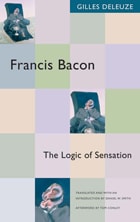
Francis Bacon
The Logic of SensationGilles Deleuze
University of Minnesota Press, 2005
Afterword by Tom Conley
Gilles Deleuze had several paintings by Francis Bacon hanging in his Paris apartment, and the painter’s method and style as well as his motifs of seriality, difference, and repetition influenced Deleuze’s work. This first English translation shows us one of the most original and important French philosophers of the twentieth century in intimate confrontation with one of that century’s most original and important painters.
In considering Bacon, Deleuze offers implicit and explicit insights into the origins and development of his own philosophical and aesthetic ideas, ideas that represent a turning point in his intellectual trajectory. First published in French in 1981, Francis Bacon has come to be recognized as one of Deleuze’s most significant texts in aesthetics. Anticipating his work on cinema, the baroque, and literary criticism, the book can be read not only as a study of Bacon’s paintings but also as a crucial text within Deleuze’s broader philosophy of art.
In it, Deleuze creates a series of philosophical concepts, each of which relates to a particular aspect of Bacon’s paintings but at the same time finds a place in the “general logic of sensation.” Illuminating Bacon’s paintings, the nonrational logic of sensation, and the act of painting itself, this work—presented in lucid and nuanced translation—also points beyond painting toward connections with other arts such as music, cinema, and literature. Francis Bacon is an indispensable entry point into the conceptual proliferation of Deleuze’s philosophy as a whole.
Gilles Deleuze (1925–1995) was professor of philosophy at the University of Paris, Vincennes–St. Denis. He coauthored Anti-Oedipus and A Thousand Plateaus with Félix Guattari. These works, as well as Cinema 1, Cinema 2, The Fold, Proust and Signs, and others, are published in English by Minnesota.
Daniel W. Smith teaches in the Department of Philosophy at Purdue University.
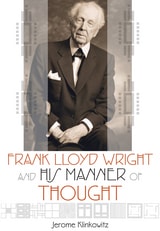
Frank Lloyd Wright and His Manner of Thought
Jerome Klinkowitz
University of Wisconsin Press, 2014
Klinkowitz presents a critical biography driven by the architect's own work and intellectual growth, focusing on the evolution of Wright's thinking and writings from his first public addresses in 1894 to his last essay in 1959. Did Wright reject all of Victorian thinking about the home, or do his attentions to a minister's sermon on "the house beautiful" deserve closer attention? Was Wright echoing the Transcendentalism of Ralph Waldo Emerson, or was he more in step with the philosophy of William James? Did he reject the Arts and Crafts movement, or repurpose its beliefs and practices for new times? And, what can be said of his deep dissatisfaction with architectural concepts of his own era, the dominant modernism that became the International Style? Even the strongest advocates of Frank Lloyd Wright have been puzzled by his objections to so much that characterized the twentieth century, from ideas for building to styles of living.
In Frank Lloyd Wright and His Manner of Thought, Klinkowitz, a widely published authority on twentieth-century literature, thought, and culture, examines the full extent of Wright's books, essays, and lectures to show how he emerged from the nineteenth century to anticipate the twenty-first.
Outstanding Book, selected by the American Association of School Librarians
Best Books for General Audiences, selected by the Public Library Reviewers

Franklin's Thrift
The Lost History of an American VirtueDavid Blankenhorn
Templeton Press, 2009
Americans today often think of thrift as a negative value—a miserly hoarding of resources and a denial of pleasure. Even more telling, many Americans don’t even think of thrift at all anymore. Franklin’s Thrift challenges this state of mind by recovering the rich history of thrift as a quintessentially American virtue.
The contributors to this volume trace how the idea and practice of thrift have been a vital part of the American vision of economic freedom and social abundance. For Benjamin Franklin, who personified and promoted the idea, thrift meant working productively, consuming wisely, saving proportionally, and giving generously. Franklin’s thrift became the cornerstone of a new kind of secular faith in the ordinary person’s capacity to shape his lot and fortune in life. Later chapters document how thrift moved into new domains in the nineteenth and twentieth centuries. It became the animating idea behind social movements to promote children’s school savings, create mutual savings banks and credit unions for working men and women, establish a federal savings bond program, and galvanize the nation to conserve resources during two world wars.
Historians, enthusiasts of Americana or traditional American virtues, and anyone interested in resolving our society’s current financial woes will find much to treasure in this diverse collection, with topics ranging from the inspirational lessons we can learn from the film It’s a Wonderful Life to a history of the roles played by mutual savings banks, credit unions, and thrift stores in America’s national thrift movement. It also includes actual policy recommendations for our present situation.
Fredric Jameson and Film Theory
Marxism, Allegory, and Geopolitics in World CinemaKeith B. Wagner
Rutgers University Press, 2022

Fredric Jameson
The Project of Dialectical CriticismRobert T. Tally
Pluto Press, 2014
Fredric Jameson is the most important Marxist critic in the world today. While consistently operating at the cutting edge of literary and cultural studies, Jameson has remained committed to seemingly old-fashioned philosophical discourses, most notably dialectical criticism and utopian thought.
In Fredric Jameson: The Project of Dialectical Criticism, Robert Tally surveys Jameson’s entire oeuvre, from his early studies of Sartre and formal criticism through his engagements with postmodernism and globalisation to his recent readings of Hegel, Marx and the valences of the dialectic.
The book is both a comprehensive critical guide to Jameson’s theoretical project and itself a convincing argument for the power of dialectical criticism to understand the world today.
Free Up Yuhself
Transgressive Bodies and Contestations in the CarnivalesqueNikoli A. Attai
Rutgers University Press, 2025
Free Up Yuhself explores and theorizes what it means to embody and be empowered by the chaos of transgression, evaluating the implications for people who destabilize the Caribbean region’s dominant gender and sexuality politics within the Caribbean and the Caribbean diaspora. This book examines how people actively utilize the carnivalesque—spaces of festivity and places of excitement, the extraordinary, the ritualistic—to confront, negotiate, disrupt, and transgress normative trends, boundaries, and perspectives in the Caribbean and Caribbean diaspora communities. This book is particularly concerned with the ways that Caribbean people contest sexual and gendered expectations through their bodily performances across regional and diasporic festival spaces. Through illustrative, analytical, evaluative, and reflective chapters, the collection contemplates the themes of freedom, belonging, acceptance, and recognition as these affect the experience of people’s sense of being. The authors reflect on “freeing up” as a contentious politics, understanding that people have the capacity to enact their freedom through transgressive movements and performances that persistently grapple with notions of respectability, agency, empowerment, disruption, and the meanings and consequences of their varied social and political locations.
Freedom
Zygmunt Bauman
University of Minnesota Press, 1989
Freedom Beyond Sovereignty
Reconstructing Liberal IndividualismSharon R. Krause
University of Chicago Press, 2015
In Freedom Beyond Sovereignty, Sharon R. Krause shows that individual agency is best conceived as a non-sovereign experience because our ability to act and affect the world depends on how other people interpret and respond to what we do. The intersubjective character of agency makes it vulnerable to the effects of social inequality, but it is never in a strict sense socially determined. The agency of the oppressed sometimes surprises us with its vitality. Only by understanding the deep dynamics of agency as simultaneously non-sovereign and robust can we remediate the failed freedom of those on the losing end of persistent inequalities and grasp the scope of our own responsibility for social change. Freedom Beyond Sovereignty brings the experiences of the oppressed to the center of political theory and the study of freedom. It fundamentally reconstructs liberal individualism and enables us to see human action, personal responsibility, and the meaning of liberty in a totally new light.

Freedom In Our Lifetime
The Collected Writings Of Anton Muziwakhe LembedeAnton Muziwakhe Lembede
Ohio University Press, 1996
When a group of young political activists met in 1944 to launch the African National Congress Youth League, it included the nucleus of a remarkable generation of leaders who forged the struggle for freedom and equality in South Africa for the next half century: Nelson Mandela, Oliver Tambo, Walter Sisulu, Jordan Ngubane, Ellen Kuzwayo, Albertina Smith, A. P. Mda, Dan Tloome, and David Bopape. It was Anton Lembede, however whom they chose as their first president.
Lembede, who had just begun practicing law in Johannesburg, was known for his sharp intellect, fiery personality, and unwavering commitment to the struggle at hand. The son of farm laborers from the district of Georgedale, Natal, Lembede had worked tirelessly to put himself through school and college, and then to qualify for the bachelor of laws degree. When he began law practice in 1943, he had also earned the respect of his fellows, not only for his intellectual achievements (which were many), but also for his dedication to the cause of freedom in South Africa. “I am,” he explained, “Africa’s own child.”
His untimely death in 1947 at the age of 33 sent a wave of grief through the Congress Youth, who had looked to him for moral as well as political leadership. With the publication of Freedom In Our Lifetime, the editors acknowledge Lembede’s early contribution to the freedom movement, in particular his passionate and eloquent articulation of the African-centered philosophy he called “Africanism.”
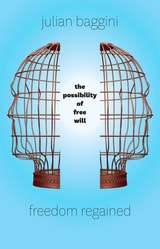
Freedom Regained
The Possibility of Free WillJulian Baggini
University of Chicago Press, 2015
Freedom Regained brings the issues raised by the possibilities—and denials—of free will to thought-provoking life, drawing on scientific research and fascinating encounters with everyone from artists to prisoners to dissidents. He looks at what it means for us to be material beings in a universe of natural laws. He asks if there is any difference between ourselves and the brains from which we seem never able to escape. He throws down the wildcards and plays them to the fullest: What about art? What about addiction? What about twins? And he asks, of course, what this all means for politics.
Ultimately, Baggini challenges those who think free will is an illusion. Moving from doubt to optimism to a hedged acceptance of free will, he ultimately lands on a satisfying conclusion: it is something we earn. The result is a highly engaging, new, and more positive understanding of our sense of personal freedom, a freedom that is definitely worth having.