Results by title
5159 books match the query 'Biography' and 245 start with f
Flying Against the Arrow
An Intellectual in Ceausescu's RomaniaHoria-Roman Patapievici
Central European University Press, 2003
The ‘unbearable 80s’, as the last decade of the Ceauşescu era has been called in Romania, are in the focus of this quasi-autobiographical work. The book vividly portrays the difficulties encountered by a young intellectual trying to shape himself under the oppressive regime and provides a stark depiction of a man’s intellectual suffocation under hard-line socialist rule.

Flying for the Air Service
The Hughes Brothers in World War IDavid K. Vaughan
University of Wisconsin Press, 1998

Flying with the Fifteenth Air Force
A B-24 Pilot's Missions from Italy during World War IITom Faulkner
University of North Texas Press, 2018

Foggy Mountain Troubadour
The Life and Music of Curly SecklerPenny Parsons
University of Illinois Press, 2016
Written in close collaboration with Mr. Seckler and those who know him, Foggy Mountain Troubadour is the first full-length biography of an American original. Penny Parsons follows a journey from North Carolina schoolhouses to the Grand Ole Opry stage and the Bluegrass Hall of Fame, from boarding houses to radio studios and traveling five to a car on two-lane roads to make the next show. Throughout, she captures the warm humor, hard choices, and vivid details of a brilliant artist's life as he criss-crosses a nation and a century making music.

Folding Paper Cranes
An Atomic MemoirLeonard Bird
University of Utah Press, 2005
Among the monuments to tragedy and hope in Hiroshima’s Peace Park stands a statue of Sadako Sasaki holding a crane in her outstretched arms. Sadako was two years old when the atomic bomb was dropped on her city; she was diagnosed with leukemia ten years later. According to popular Japanese belief, folding a thousand paper cranes brings good fortune. Sadako spent the last months of her young life folding hundreds of paper cranes. She folded 644 before she died.
As he journeys from the Geiger counters, radioactive dust, and mushroom clouds of the Nevada desert to the bronze and ivory memorials for the dead in Japan, Bird—himself a survivor of radiation-induced cancer—seeks to make peace with his past and with a future shadowed by nuclear proliferation. His paper cranes are the poetry and prose of this haunting memoir.

Folklore in Utah
A History and Guide to ResourcesDavid Stanley
Utah State University Press, 2004
Over thirty scholars examine the development of folklore studies through the lens of over one hundred years of significant activity in a state that has provided grist for the mills of many prominent folklorists. In the past the Folklore Society of Utah has examined the work of such scholars in biographical and other essays published in its newsletters. This book incorporates those essays and goes well beyond them to include many other topices, offering a thorough history of folklore studies and a guide to resources for those pursuing research in Utah now and in the future.
The essays survey the development and contributions of folklore studies in Utah from 1892 to 2004 but also represent developments in both academic and public-sector folklore throughout the United States. Following a thorough historical introduction, part I profiles the first folklorists working in the state, including Hector Lee, Thomas Cheney, Austin and Alta Fife, Wayland Hand, and Lester Hubbard. Part II looks at the careers of prominent Utah folklorists Jan Harold Brunvand, Barre Toelken, and William B. Wilson, as well as the works of the next, current generation of folklorists. Part III covers studies in major folklore genres, with essays on the study of material culture, vernacular architecture, and Mormon, ethnic, Native American, and Latino folklore. Part IV examines public folklore programs including organizations, conferences, and tourism. Back matter describes academic programs at Utah institutions of higher education, summarizes the holdings of the various folklore archives in the state, and provides a complete cross-indexed bibliography of articles, books, and recordings of Utah folklore.
Follow Your Heart
Moving with the Giants of Jazz, Swing, and Rhythm and BluesJoe Evans with Christopher Brooks
University of Illinois Press, 2008
Detailing the fascinating career of Joe Evans, Follow Your Heart chronicles the nearly thirty years that he spent immersed in one of the most exciting times in African American music history. An alto saxophonist who between 1939 and 1965 performed with some of America's greatest musicians, including Louis Armstrong, Cab Calloway, Charlie Parker, Jay McShann, Andy Kirk, Billie Holiday, Bill "Bojangles" Robinson, Lionel Hampton, and Ivory Joe Hunter, Evans warmly recounts his wide range of experience in the music industry. Readers follow Evans from Pensacola, Florida, where he first learned to play, to such exotic destinations as Tel Aviv and Paris, which he visited while on tour with Lionel Hampton. Evans also comments on popular New York City venues used for shaping and producing black music, such as the Apollo Theater, the Savoy, Minton's Playhouse, and the Rhythm Club.
Revealing Evans as a master storyteller, Follow Your Heart describes his stints as a music executive, entrepreneur, and musician. Evans provides rich descriptions of jazz, swing, and rhythm and blues culture by highlighting his experiences promoting tracks to radio deejays under Ray Charles's Tangerine label and later writing, arranging, and producing hits for the Manhattans and the Pretenders. Leading numerous musical ventures that included a publishing company and several labels--Cee Jay Records (with Jack Rags), Revival, and Carnival Records--Evans remained active in the music industry even after he stopped performing regularly. As one of the few who enjoyed success as both performer and entrepreneur, he offers invaluable insight into race relations within the industry, the development of African American music and society from the 1920s to 1970s, and the music scene of the era.

Follow the Signs
Searching for Linda Goodman, America’s Forgotten Astrology QueenCourtney Ann LaFaive
University of Iowa Press, 2026
In 1973, Goodman’s daughter was found dead and the police declared it a suicide; Goodman believed otherwise. She spent years depleting her fortune, chasing down leads that might uncover the real truth about her beloved daughter’s death. Headlines criticized and discredited Goodman, ultimately overshadowing the revolutionary nature of her work.
Courtney Ann LaFaive first discovered Goodman’s books as a teenager. Reading her astrological wisdom decades after its heyday, LaFaive contemplates the redemption of Goodman as a literary and spiritual figure, all the while reckoning with her own impulsive forays into love and relationships. Follow the Signs asks what it means when facts become stranger than fiction and who we become when we must walk away from those we love.
Following Father Chiniquy
Immigration, Religious Schism, and Social Change in Nineteenth-Century IllinoisCaroline B. Brettell
Southern Illinois University Press, 2015
Winner, ISHS Certificate of Excellence, 2016
In the late 1850s and early 1860s, the attention of the Catholic and Protestant religious communities around the world focused on a few small settlements of French Canadian immigrants in northeastern Illinois. Soon after arriving in their new home, a large number of these immigrants, led by Father Charles Chiniquy, the charismatic Catholic priest who had brought them there, converted to Protestantism. In this anthropological history, Caroline B. Brettell explores how Father Chiniquy took on both the sacred and the secular authority of the Catholic Church to engineer the religious schism and how the legacy of this rift affected the lives of the immigrants and their descendants for generations. This intriguing study of a nineteenth-century migration of French Canadians to the American Midwest offers an innovative perspective on the immigrant experience in America.
Brettell chronicles how Chiniquy came to lead approximately one thousand French Canadian families to St. Anne, Illinois, in the early 1850s and how his conflict with the Catholic hierarchy over the ownership and administration of church property, delivery of the mass in French instead of Latin, and access to the Bible by laymen led to his excommunication. Drawing on the concept of social drama—a situation of intensely lived conflict that emerges within social groups—Brettell explains the religious schism in terms of larger ethnic and religious disagreements that were happening elsewhere in the United States and in Canada. Brettell also explores legal disputes, analyzes the reemergence of Catholicism in St. Anne in the first decade of the twentieth century, addresses the legacy of Chiniquy in both the United States and Quebec, and closely examines the French Canadian immigrant communities, focusing on the differences between the people who converted to Protestantism and those who remained Catholic.
Occurring when nativism was pervasive and the anti-immigrant Know-Nothing Party was at its height, Chiniquy’s religious schism offers an opportunity to examine a range of important historical and anthropological issues, including immigration, ethnicity, and religion; changes in household and family structure; the ways social identities are constructed and reconstructed through time; and the significance of charismatic leadership in processes of social and religious change. Through its multidisciplinary approach, Brettell’s enlightening study provides a pioneering assessment of larger national tensions and social processes, some of which are still evident in modern immigration to the United States.

Food in the American Gilded Age
Helen Zoe Veit
Michigan State University Press, 2017

Food, Feminisms, Rhetorics
Edited by Melissa A. Goldthwaite
Southern Illinois University Press, 2017
Contributors analyze messages about food and bodies—from what a person watches and reads to where that person shops—taken from sources mundane and literary, personal and cultural. This collection begins with analyses of the historical, cultural, and political implications of cookbooks and recipes; explores definitions of feminist food writing; and ends with a focus on bodies and cultures—both self-representations and representations of others for particular rhetorical purposes. The genres, objects, and practices contributors study are varied—from cookbooks to genre fiction, from blogs to food systems, from product packaging to paintings—but the overall message is the same: food and its associated practices are worthy of scholarly attention.

Fool for Love
F. Scott FitzgeraldScott Donaldson
University of Minnesota Press, 2012
Fool for Love is Scott Donaldson’s masterful biography of F. Scott Fitzgerald—written from a fresh and highly intimate perspective. Fool for Love follows Fitzgerald from his birthplace in St. Paul, Minnesota, to Princeton and upward into the highest reaches of literary and public success—and ultimately to Fitzgerald’s untimely death in Hollywood at the age of forty-four, broke and nearly forgotten. This engrossing, definitive study explores two classic Fitzgerald themes throughout—love and class—and the result is a striking portrayal of one of the twentieth century’s greatest writers, whose legacy and influence only continue to grow.
Foothold on a Hillside
Memories of a Southern IllinoisanCharless Caraway. Foreword by Paul Simon
Southern Illinois University Press, 1986
In a style reminiscent of the master storytellers of yore, Charless Caraway recounts the story of his life, as a man and a boy, on small farms in Saline and Jackson counties, particularly around Eldorado, Makanda, and Etherton Switch. He makes no bones about the hardships of those "old days," first helping his father eke out a living from the land, then scrambling for a living as a sharecropper and fruit picker, as he scrimped and saved for the day when he and his young wife, Bessie Mae Rowan Caraway, could buy a piece of land of their own.
The one-room school, the general store, the trips by wagon over roads that choked you in summer and swallowed you in winter, the home that burned: all are described in a matter-of-fact yet moving way. Many of the locations, buildings, and people are represented in equally unromanticized photographs from the family’s collection. Some of the stories and photos recall the common disasters of the frontier: drought, flood, and the tornado of 1925.
It is clear from these stories that each aspect of life exacted a price, but the Caraways paid that price without regret and rallied to go on their way. Charless and his family and friends fill this book with courage, strength, and an unshakable faith in the value of human endeavor.
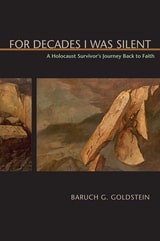
For Decades I Was Silent
A Holocaust Survivor's Journey Back to FaithBaruch G. Goldstein
University of Alabama Press, 2008
A survivor's powerful testament to faith, memory, and the triumph of the human spirit.
A fascinating memoir about a Holocaust survivor's loss of and journey back to faith. In 1939, Baruch Goldstein was a religiously observant adolescent resident of the Jewish community in Mlawa, a town that was then in East Prussia. After war broke out, the Jewish community there was relatively sheltered, as that region was incorporated into the German Reich rather than into the General Government (the German run-fragment of pre-war Poland, where conditions were harsh for everyone). However in 1942, Goldstein was sent to Auschwitz, where he stayed two-and-a-half years. His family was scattered all to their deaths, but he survived the war--barely. For Decades I Was Silent is an account of life in a small Polish-German town and provides information on the religious life of the Jewish citizens. This book creates a direct sense of the random, mystifying personal violence individuals felt at the hands of Germans--not the anonymous industrial death machine, but immediate, face-to-face violence.
After the war, Goldstein drifted as a refugee to UNRR camps in Italy. Over time, young Goldstein had to face the fact that all of his extended family was lost and he had only the possibilities of Palestine or help from distant relatives in the United States as a future. His American relatives urged him to enter the United States as a yeshiva student, and eventually he became a rabbi and started a family. As a young rabbinical student, and then as a rabbi, Goldstein was forced to confront the events of the Holocaust and the damage done to his faith.
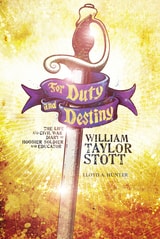
For Duty and Destiny
The Life and Civil War Diary of William Taylor Stott, Hoosier Soldier and EducatorLloyd A. Hunter
Indiana Historical Society Press, 2011

For Fear of the Fire
Joan of Arc and the Limits of SubjectivityFrançoise Meltzer
University of Chicago Press, 2001
Engaging a number of theorists, and alternating between Joan's historical and cultural context, Meltzer also explores the ways in which postmodern thinkers question subjectivity. She argues that the way masculine subjects imagine Joan betrays their fear of death and necessitates the role of women as cultural others: enigmatic, mysterious, dark, and impossible. As such, Joan serves as a useful model of the limits and risks of subjectivity. For Meltzer, she is both the first modern and the last medieval figure. From the ecclesial jury that burned her, to the theorists of today who deny their attraction to the supernatural, the philosophical assumptions that inform Joan's story, as Meltzer ultimately shows, have changed very little.

For Freedom's Sake
The Life of Fannie Lou HamerChana Kai Lee
University of Illinois Press, 1999
The youngest of twenty children of sharecroppers in rural Mississippi, Fannie Lou Hamer witnessed throughout her childhood the white cruelty, political exclusion, and relentless economic exploitation that defined African American existence in the Delta.
In this intimate biography, Chana Kai Lee documents Hamer's lifelong crusade to empower the poor through collective action, her rise to national prominence as a civil rights activist, and the personal costs of her ongoing struggle to win a political voice and economic self-sufficiency for blacks in the segregated South. Lee looks at Hamer's early work as a field secretary for the Student Nonviolent Coordinating Committee in Mississippi, her dramatic appearance at the 1964 Democratic National Convention, and her ongoing work as a militant grassroots leader in her own community.

For Glory and Bolívar
The Remarkable Life of Manuela SáenzBy Pamela S. Murray
University of Texas Press, 2008
She was a friend, lover, and confidante of charismatic Spanish American independence hero Simón Bolívar and, after her death, a nationalist icon in her own right. Yet authors generally have chosen either to romanticize Manuela Sáenz or to discount her altogether. For Glory and Bolivar: The Remarkable of Life of Manuela Sáenz, by contrast, offers a comprehensive and clear-eyed biography of her. Based on unprecedented archival research, it paints a vivid portrait of the Quito-born "Libertadora," revealing both an exceptional figure and a flesh-and-blood person whose life broadly reflected the experiences of women during Spanish America's turbulent Age of Revolution.
Already married at the time of her meeting with the famous Liberator, Sáenz abandoned her husband in order to become not only Bolívar's romantic companion, but also his official archivist, a member of his inner circle, and one of his most loyal followers. She played a central role in Spanish South America's independence drama and eventually in developments leading to the consolidation of new nations. Pamela Murray, for the first time, closely examines Sáenz's political trajectory including her vital, often-overlooked years in exile. She exposes the myths that still surround her. She offers, in short, a nuanced and much-needed historical perspective, one that balances recognition of Sáenz's uniqueness with awareness of the broader forces that shaped this dynamic nineteenth-century woman.
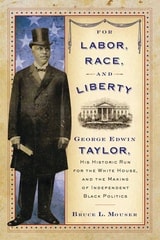
For Labor, Race, and Liberty
George Edwin Taylor, His Historic Run for the White House, and the Making of Independent Black PoliticsBruce L. Mouser
University of Wisconsin Press, 2010
More than one hundred years before Barack Obama, George Edwin Taylor made presidential history. Born in the antebellum South to a slave and a freed woman, Taylor became the first African American ticketed as a political party’s nominee for president of the United States, running against Theodore Roosevelt in 1904.
Orphaned as a child at the peak of the Civil War, Taylor spent several years homeless before boarding a Mississippi riverboat that dropped him in La Crosse, Wisconsin. Taken in by an African American farm family, Taylor attended a private school and eventually rose to prominence as the owner/editor of a labor newspaper and as a vocal leader in Wisconsin’s People’s Party. At a time when many African Americans felt allegiance to the Republican Party for its support of abolition, Taylor’s sympathy with the labor cause drew him first to the national Democratic Party and then to an African American party, the newly formed National Liberty Party, which in 1904 named him its presidential candidate. Bruce L. Mouser follows Taylor’s life and career in Arkansas, Illinois, Wisconsin, Iowa, and Florida, giving life to a figure representing a generation of African American idealists whose initial post-slavery belief in political and social equality in America gave way to the despair of the Jim Crow decades that followed.
Best Books for Special Interests, selected by the American Association for School Libraries
Best Books for Professional Use, selected by the American Association for School Libraries
Best Books for General Audiences, selected by the Public Library Association
Second Place, Biography, Society of Midland Authors
Honorable Mention, Benjamin F. Shambough Award, the State Historical Society of Iowa

For Single Mothers Working as Train Conductors
Laura Esther Wolfson
University of Iowa Press, 2018
Laura Esther Wolfson’s literary debut draws on years of immersion in the Russian and French languages; struggles to gain a basic understanding of Judaism, its history, and her place in it; and her search for a form to hold the stories that emerge from what she has lived, observed, overheard, and misremembered.
In “Proust at Rush Hour,” when her lungs begin to collapse and fail, forcing her to give up an exciting and precarious existence as a globetrotting simultaneous interpreter, she seeks consolation by reading Proust in the original while commuting by subway to a desk job that requires no more than a minimal knowledge of French. In “For Single Mothers Working as Train Conductors” she gives away her diaphragm and tubes of spermicidal jelly to a woman in the Soviet Union who, with two unwanted pregnancies behind her, needs them more than she does. “The Husband Method” has her translating a book on Russian obscenities and gulag slang during the dissolution of her marriage to the Russian-speaker who taught her much of what she knows about that language.
In prose spangled with pathos and dusted with humor, Wolfson transports us to Paris, the Republic of Georgia, upstate New York, the Upper West Side, and the corridors of the United Nations, telling stories that skewer, transform, and inspire.
For Women and the Nation
FUNMILAYO RANSOME-KUTI OF NIGERIACheryl Johnson-Odim and Nina Emma Mba
University of Illinois Press, 1997
For Women and the Nation is the story of this courageous woman. One of a handful of full-length biographies of African women, let alone of African women activists, it will be welcomed by students of women's studies, African history, and biography, as well as by those interested in exploring the historical background of Nigeria.
For You, Lili Marlene
A Memoir Of World War IIRobert Peters
University of Wisconsin Press, 1996
For the Good of Humanity
Ludwik Rajchman, Medical StatesmanMarta A. Balinska
Central European University Press, 1998

For the Love of It
Amateuring and Its RivalsWayne C. Booth
University of Chicago Press, 1999
"If, in truth, Booth is an amateur player now in his fifth decade of amateuring, he is certainly not an amateur thinker about music and culture. . . . Would that all of us who think and teach and care about music could be so practical and profound at the same time."—Peter Kountz, New York Times Book Review
"[T]his book serves as a running commentary on the nature and depth of this love, and all the connections it has formed in his life. . . . The music, he concludes, has become part of him, and that is worth the price."—Clea Simon, Boston Globe
"The book will be read with delight by every well-meaning amateur who has ever struggled. . . . Even general readers will come away with a valuable lesson for living: Never mind the outcome of a possibly vain pursuit; in the passion that is expended lies the glory."—John von Rhein, Chicago Tribune
"Hooray for amateurs! And huzzahs to Wayne Booth for honoring them as they deserve. For the Love of It celebrates amateurism with genial philosophizing and pointed cultural criticism, as well as with personal reminiscences and self-effacing wit."—James Sloan Allen, USA Today
"Wayne Booth, the prominent American literary critic, has written the only sustained study of the interior experience of musical amateurism in recent years, For the Love of It. [It] succeeds as a meditation on the tension between the centrality of music in Booth's life, both inner and social, and its marginality. . . . It causes the reader to acknowledge the heterogeneity of the pleasures involved in making music; the satisfaction in playing well, the pride one takes in learning a difficult piece or passage or technique, the buzz in one's fingertips and the sense of completeness with the bow when the turn is done just right, the pleasure of playing with others, the comfort of a shared society, the joy of not just hearing, but making, the music, the wonder at the notes lingering in the air."—Times Literary Supplement
For the Sake of the Song
Essays on Townes Van ZandtAnn Norton Holbrook
University of North Texas Press, 2022

Forbes Burnham
The Life and Times of the Comrade LeaderLinden F. Lewis
Rutgers University Press, 2024
Forbes Burnham: The Life and Times of the Comrade Leader is the first political biography of this complex and influential figure. It charts how the political party he founded, the People’s National Congress, combined nationalist rhetoric, socialist policies, and Pan-Africanist philosophies. It also explores how, in a country already deeply divided between the descendants of African slaves and Indian indentured servants, Burnham consolidated political power by intensifying ethnic polarizations. Drawing from historical archives as well as new interviews with the people who knew Burnham best, sociologist Linden F. Lewis examines how his dictatorial tendencies coexisted with his progressive convictions. Forbes Burnham is a compelling study of the nature of postcolonial leadership and its pitfalls.
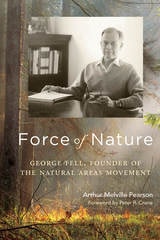
Force of Nature
George Fell, Founder of the Natural Areas MovementArthur Melville Pearson
University of Wisconsin Press, 2020
Force of Nature reveals how a failed civil servant, with few assets apart from his tenacity and vision, initiated the natural areas movement. In the boom years following World War II, as undeveloped lands were being mined, drained, or bulldozed, Fell transformed a loose band of ecologists into The Nature Conservancy, drove the passage of the influential Illinois Nature Preserves Act, and helped spark allied local and national conservation organizations in the United States and beyond.
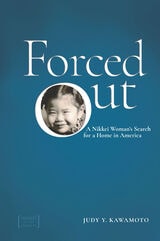
Forced Out
A Nikkei Woman's Search for a Home in AmericaJudy Y. Kawamoto
University Press of Colorado, 2020
Forced Out: A Nikkei Woman’s Search for a Home in America offers insight into “voluntary evacuation,” a little-known Japanese American experience during World War II, and the lasting effects of cultural trauma. Of the roughly 120,000 people forced from their homes by Executive Order 9066, around 5,000 were able to escape incarceration beforehand by fleeing inland. In a series of beautifully written essays, Judy Kawamoto recounts her family’s flight from their home in Washington to Wyoming, their later moves to Montana and Colorado, and the influence of those experiences on the rest of her life. Hers is a story shared by the many families who lost everything and had to start over in often suspicious and hostile environments.
Kawamoto vividly illustrates the details of her family’s daily life, the discrimination and financial hardship they experienced, and the isolation that came from experiencing the horrors of the 1940s very differently than many other Japanese Americans. Chapters address her personal and often unconscious reactions to her parents’ trauma, as well as her own subsequent travels around much of the world, exploring, learning, enjoying, but also unconsciously acting out a continual search for a home.
Showing how the impacts of traumatic events are collective and generational, Kawamoto draws
interconnections between her family’s displacement and later aspects of her life and juxtaposes the impact of her early experiences and questions of identity, culture, and assimilation. Forced Out will be of great interest to the general reader as well as students and scholars of ethnic studies, Asian American studies, history, education, and mental health.
2022 Asian/Pacific American Award for Literature, Honor Title, Adult Non-Fiction Literature
2022 Evans Handcart Award Winner
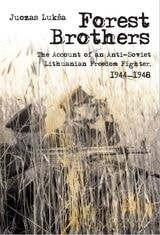
Forest Brothers
The Account of an Anti-Soviet Lithuanian Freedom Fighter, 1944–1948Translated and with an Introduction by Laima Vincė
Central European University Press, 2009

Forged under the Sun/Forjada bajo el sol
The Life of Maria Elena LucasEdited and with an Introduction by Fran Leeper Buss
University of Michigan Press, 1993

Forget Burial
HIV Kinship, Disability, and Queer/Trans Narratives of CareMarty Fink
Rutgers University Press, 2021
Queers and trans people in the 1980s and early ‘90s were dying of AIDS and the government failed to care. Lovers, strangers, artists, and community activists came together take care of each other in the face of state violence. In revisiting these histories alongside ongoing queer and trans movements, this book uncovers how early HIV care-giving narratives actually shape how we continue to understand our genders and our disabilities. The queer and trans care-giving kinships that formed in response to HIV continue to inspire how we have sex and build chosen families in the present. In unearthing HIV community newsletters, media, zines, porn, literature, and even vampires, Forget Burial bridges early HIV care-giving activisms with contemporary disability movements. In refusing to bury the legacies of long-term survivors and of those we have lost, this book brings early HIV kinships together with ongoing movements for queer and trans body self-determination.

Forging Deaf Education in Nineteenth-Century France
Biographical Sketches of Bébian, Sicard, Massieu, and ClercFerdinand Berthier
Gallaudet University Press, 2009
In 1811, deaf student Ferdinand Berthier commenced his education at the National Institute for the Deaf in Paris under its director Abbé Sicard and his teachers Auguste Bébian, Jean Massieu, and Laurent Clerc. Their tutelage eventually led Berthier to join the faculty at the Institute and become a life-long proponent of sign language and Deaf culture. Berthier earned fame for instituting the famous silent banquets in Paris in 1834. He also learned to advance his agenda by writing biographies of important figures who advocated sign over oralism to educate deaf French students. Forging Deaf Education in Nineteenth-Century France offers the first translation of Berthier’s biographical sketches of the four men above who influenced him most.
Berthier wrote first about Bébian in 1839, timed to advocate sign language for teaching deaf students after the death of the pro-oralism Institute Director Désiré Ordinaire. Berthier extolled Bébian’s linguistic acumen and his educational philosophy. In later sketches, however, he described Sicard and Massieu in positive terms, but also criticized them for supporting “methodical” signing that conformed to spoken language conventions. In contrast, he lauded Clerc in his portrayal for using “natural” signing to teach deaf students. The clarity of these translations will introduce a brand new audience to Berthier’s biographies shaped by his unswerving beliefs about Deaf French education.

Forging Identity
The Story of Carlos Nielbock's DetroitPaul J Draus
Michigan State University Press, 2025
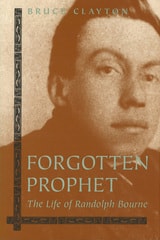
Forgotten Prophet
The Life of Randolph BourneBruce Clayton
University of Missouri Press, 1998
Rarely has an individual's life been so inseparable from his writing as was Randolph Bourne's. His work reveals not only his political viewpoints but also his humanistic personality and the tumultuous era during which he lived. Forgotten Prophet carefully examines the intellect and personality of the "born essayist" who saw clearly both his century's potential for harmony and the danger that it faced from the lingering tides of nineteenth-century European nationalism.
Disfigured and hunchbacked, Bourne reacted to his disability not with bitterness or self-pity, but rather with an exuberant love for beauty and a compassion for humanity that created in him a longing for a truly cosmopolitan society—a "trans-national America" that would draw its strength from ethnic diversity and political pluralism. Nearly alone among American intellectuals, Bourne actively denounced involvement in World War I. He foresaw that, beyond the horrible cost in young lives, the war would bring in its wake the spiritual impoverishment of the nation and the disillusionment of its youth; it would strangle reform and social tolerance, exacerbate racism and nativism, and plant the seeds for further international instability. Although derided and largely ignored at the time they were written, Bourne's fearful predictions would all too quickly be confirmed in the dissolute frenzy of the jazz age, the turmoil of the 1930s, and the social chaos that brought about the rise of fascism in Europe and, soon, an even more destructive war.
Bourne did not live to witness this terrifying unfolding of events. His career as a social critic was brief but prolific. When he died in 1918 at the age of thirty-two, a victim of the flu epidemic, he had completed three books and more than a hundred essays. His first book, Youth and Life, is considered by some to be the original manifesto of the counterculture. From his earliest years as a writer, Bourne was identified as a voice for youth, idealism, and progress in human relations. Forgotten Prophet characterizes Bourne not just as a foreseer of this century's bloodshed but, equally important, as an apostle of hope—a champion of what was best, most truthful in the arts, in politics, and in the conduct of our daily lives.

Fort Worth Characters
Richard F. Selcer
University of North Texas Press, 2009
Fort Worth Characters 2
Richard F. Selcer
University of North Texas Press, 2025

Fortune and Faith in Old Chicago
A Dual Biography of Mayor Augustus Garrett and Seminary Founder Eliza Clark GarrettCharles H. Cosgrove
Southern Illinois University Press, 2020
This engaging biography of Augustus Garrett and Eliza Clark Garrett tells two equally compelling stories: an ambitious man’s struggle to succeed and the remarkable spiritual journey of a woman attempting to overcome tragedy. By contextualizing the couple’s lives within the rich social, political, business, and religious milieu of Chicago’s early urbanization, author Charles H. Cosgrove fills a gap in the history of the city in the mid-nineteenth century.
The Garretts moved from the Hudson River Valley to a nascent Chicago, where Augustus made his fortune in the land boom as an auctioneer and speculator. A mayor during the city’s formative period, Augustus was at the center of the first mayoral election scandal in Chicago. To save his honor, he resigned dramatically and found vindication in his reelection the following year. His story reveals much about the inner workings of Chicago politics and business in the antebellum era.
The couple had lost three young children to disease, and Eliza arrived in Chicago with deep emotional scars. Her journey exemplifies the struggles of sincere, pious women to come to terms with tragedy in an age when most people attributed unhappy events to divine punishment. Following Augustus’s premature death, Eliza developed plans to devote her estate to founding a women’s college and a school for ministerial training, and in 1853 she endowed a Methodist theological school, the Garrett Biblical Institute (now the Garrett-Evangelical Theological Seminary), thereby becoming the first woman in North America to found an institution of higher learning.
In addition to illuminating our understanding of Chicago from the 1830s to the 1850s, Fortune and Faith in Old Chicago explores American religious history, particularly Presbyterianism and Methodism, and its attention to gender shows how men and women experienced the same era in vastly different ways. The result is a rare, fascinating glimpse into old Chicago through the eyes of two of its important early residents.

Fortune's Favored Child
Raouf Mama
Northwestern University Press, 2014
Raouf Mama is widely beloved by children and adults alike for his books and especially for his African and multicultural storytelling, which incorporates poetry, song, music, and dance.
In Fortune’s Favored Child, the master storyteller tells his own story, beginning in the West African country of Benin. Through a harrowing experience with sickness, an encounter with a clairvoyant traditional healer, and astonishing twists of fortune, the protagonist struggles to uncover his real identity, to get an education, and to make his own way in the world. His journey takes him to the shores of the United States to attend graduate school at the University of Michigan and begin a new chapter in his life.
.
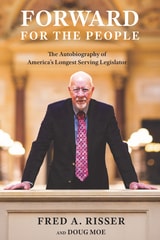
Forward for the People
The Autobiography of America's Longest Serving LegislatorFred A. Risser and Doug Moe
Wisconsin Historical Society Press, 2025
When Fred Risser retired from the Wisconsin Senate in 2021, his sixty-four years in state government made him the longest serving legislator in US history. Now, in this candid and illuminating autobiography, Risser shares his singular perspective on events that transformed the state and the nation over the course of his remarkable career. From his role in the “Joe Must Go” drive to recall US Senator Joseph McCarthy in the 1950s to his position as the senior senator among the “Fab Fourteen” Wisconsin Democrats who opposed Governor Scott Walker’s Act 10 legislation against collective bargaining in 2011, Risser was a leader in state politics for decades, always maintaining an unwavering belief that political action can change people’s lives for the better.
Forward for the People provides a unique peek behind the political curtain from the viewpoint of someone who saw it all. Risser worked with thirteen governors and authored more than 240 bills that became law, championing public health and safety, environmental protection, women’s and reproductive rights, organized labor, civil rights, and social justice, among many other causes. Risser also recounts interactions with prominent national politicians, including Robert La Follette Jr., Hubert Humphrey, Jimmy Carter, and Bill Clinton. More than forty photographs from Risser’s personal collection and the Wisconsin Senate paint a vivid picture of his six-decade journey through Wisconsin politics.
Forward for the People details Risser’s experiences out of state, from a stint in the Panama Canal Zone as a navy hospital corpsman to his undergraduate debate-team days at Minnesota’s Carleton College to his years studying law at the University of Oregon and his travels to all seven continents. The book also depicts the quirky habits that made Risser a memorable and beloved politician: biking his age in miles every birthday and never taking the elevator in his sixty-four years at the Wisconsin State Capitol. Enhanced with details sourced from correspondence, personal notes, newspaper accounts, and recollections from friends and former colleagues, Risser and coauthor Doug Moe have crafted an engaging account of an extraordinary life in public service.

Four Germanys
A Chronicle of the Schorcht FamilyDonald S. Pitkin
Temple University Press, 2016
In this last book by the late Donald Pitkin, author of The House that Giacomo Built, comes a story of the Schorcht family, through whose fortunes and struggles one can see the transformations of Germany through the long twentieth century.
Each chapter of Four Germanys is reflective of generational rather than historical time. In 1922, Edwin Schorcht inherited his family farm, and in Part One, Pitkin traces the derivation of this farmstead. Part Two focuses on Schorcht’s children who came of age in Hitler’s Germany. Part Three has the Schorchts growing up in the Ulbricht years (1950–73) of the German Democratic Republic. The book concludes with the great-granddaughter, Maria, looking back to the past in relation to the new Germany that history had bequeathed her.
Ultimately, Four Germanys reflects the impact of critical historical events on ordinary East Germans while it also reveals how one particular family managed its own historical adaptation to these events.

Four Jazz Lives
A. B. Spellman
University of Michigan Press, 2004
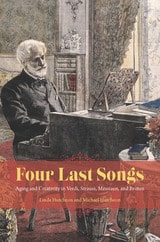
Four Last Songs
Aging and Creativity in Verdi, Strauss, Messiaen, and BrittenLinda Hutcheon and Michael Hutcheon
University of Chicago Press, 2015
Giuseppe Verdi (1813–1901), Richard Strauss (1864–1949), Olivier Messiaen (1908–92), and Benjamin Britten (1913–76) all wrote operas late in life, pieces that reveal unique responses to the challenges of growing older. Verdi’s Falstaff, his only comedic success, combated Richard Wagner’s influence by introducing young Italian composers to a new model of national music. Strauss, on the other hand, struggling with personal and political problems in Nazi Germany, composed the self-reflexive Capriccio, a “life review” of opera and his own legacy. Though it exhausted him physically and emotionally, Messiaen at the age of seventy-five finished his only opera, Saint François d’Assise, which marked the pinnacle of his career. Britten, meanwhile, suffering from heart problems, refused surgery until he had completed his masterpiece, Death in Venice. For all four composers, age, far from sapping their creative power, provided impetus for some of their best accomplishments.
With its deft treatment of these composers’ final years and works, Four Last Songs provides a valuable look at the challenges—and opportunities—that present themselves as artists grow older.
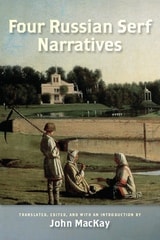
Four Russian Serf Narratives
Translated, edited, and with an introduction by John MacKay
University of Wisconsin Press, 2009
Four Russian Serf Narratives contains four of these accounts and is the first translated collection of autobiographies by serfs. Scholar and translator John MacKay brings to light for an English-language audience a diverse sampling of Russian serf narratives, ranging from an autobiographical poem to stories of adventure and escape. “Autobiography” (1785) recounts a highly educated serf’s attempt to escape to Europe, where he hoped to study architecture. The long testimonial poem “News About Russia” (ca. 1849) laments the conditions under which the author and his fellow serfs lived. In “The Story of My Life and Wanderings” (1881) a serf tradesman tells of his attempt to simultaneously escape serfdom and captivity from Chechen mountaineers. The fragmentary “Notes of a Serf Woman” (1911) testifies to the harshness of peasant life with extraordinary acuity and descriptive power.
These accounts offer readers a glimpse, from the point of view of the serfs themselves, into the realities of one of the largest systems of unfree labor in history. The volume also allows comparison with slave narratives produced in the United States and elsewhere, adding an important dimension to knowledge of the institution of slavery and the experience of enslavement in modern times.
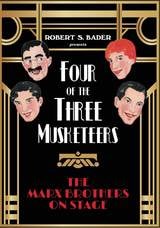
Four of the Three Musketeers
The Marx Brothers on StageRobert S. Bader
Northwestern University Press, 2022
An updated paperback version of the book heralded as “a new benchmark in Marx scholarship” by the Los Angeles Times
Before film made them international comedy legends, the Marx Brothers developed their comic skills on stage for twenty-five years. In Four of the Three Musketeers: The Marx Brothers on Stage, Robert S. Bader offers the first comprehensive history of the foursome’s hardscrabble early years honing their act in front of live audiences.
From Groucho’s debut in 1905 to their final live performances of scenes from A Night in Casablanca in 1945, the brothers’ stage career shows how their characters and routines evolved before their arrival in Hollywood. Four of the Three Musketeers draws on an unmatched array of sources, many not referenced elsewhere. Bader’s detailed portrait of the struggling young actors both brings to vivid life a typical night on the road for the Marx Brothers and illuminates the inner workings of the vaudeville business, especially during its peak in the 1920s.
As Bader traces the origins of the characters that would later come to be beloved by filmgoers, he also skillfully scrapes away the accretion of rumors and mythology perpetuated not only by fans and writers but by the Marx Brothers themselves. Revealing, vital, and entertaining, Four of the Three Musketeers has taken its place as an essential reference for this legendary American act. Now, the updated edition adds newly discovered performances—some submitted by readers—and additional information provided by descendants of long-departed vaudevillians mentioned in the book.

Fractured Borders
Reading Women's Cancer LiteratureMary K. DeShazer
University of Michigan Press, 2010
Fractured Borders: Reading Women's Cancer Literature surveys a wide range of contemporary writing about breast, uterine, and ovarian cancer, including works by Marilyn Hacker, Margaret Edson, Carole Maso, Audre Lorde, Eve Sedgwick, Mahasweta Devi, Lucille Clifton, Alicia Ostriker, Jayne Anne Phillips, Terry Tempest Williams, and Jeanette Winterson, among many others. DeShazer's readings bring insights from body theory, performance theory, feminist literary criticism, French feminisms, and disability studies to bear on these works, shining new light on a literary subject that is engaging more and more writers.
"An important and useful book that will appeal to people in a variety of fields and walks of life, including scholars, teachers, and anyone interested in this subject."
--Suzanne Poirier, University of Illinois at Chicago
"A book on a timely and important topic, wisely written beyond scholarly boundaries and crossing many theoretical and disciplinary lines."
--Patricia Moran, University of California, Davis

Fragments of a World
William of Auvergne and His Medieval LifeLesley Smith
University of Chicago Press, 2023
Today, William of Auvergne (1180?–1249) is remembered for his scholarship about the afterlife as well as the so-called Trial of the Talmud. But the medieval bishop of Paris also left behind nearly 600 sermons delivered to all manner of people—from the royal court to the poorest in his care. In Fragments of a World, Lesley Smith uses these sermons to paint a vivid picture of this extraordinary cleric, his parishioners, and their bustling world. The first modern biography of the influential teacher, bishop, and theologian, Fragments of a World casts a new image of William of Auvergne for our times—deeply attuned to both the spiritual and material needs of an ever-changing populace in the medieval city.

Fran and Frederick Hamerstrom
Wildlife Conservation PioneersSusan Tupper
Wisconsin Historical Society Press, 2016
Learn how Fran and Frederick Hamerstrom worked to save the greater prairie chicken from extinction in the Wisconsin Historical Society Press’s new book for young readers, "Fran and Frederick Hamerstrom: Wildlife Conservation Pioneers." Fran and Frederick grew up in New England, and married in 1935. They both loved nature and wanted to dedicate their lives to understanding and preserving wildlife. As students of the famous naturalist, Aldo Leopold, they learned about new ways for humans to think about saving land for animals. Fran was a brave, outgoing woman who cared more about interacting with animals than wearing pretty dresses. Frederick was a calm, thoughtful man who loved to study and conduct research. Together, they spent over thirty years mentoring many future scientists, and working to save the greater prairie chicken, and other animals, from extinction. "Fran and Frederick Hamerstrom: Wildlife Conservation Pioneers" is the newest addition to the Society Press’s Badger Biographies Series.
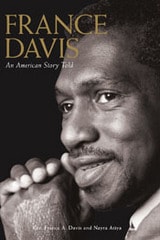
France Davis
An American Story ToldDavis, France
University of Utah Press, 2007
As I was coming up, it was painful to me not to have been given my own nickname. It made me feel different, or rather that I was being treated differently from other family members. I wondered why everybody else was spoken to in terms of their identity, their character, their behavior, and I was simply identified by the 'tag,' my given name. But then, when I read in a book that France meant free, I began to think of it as imbuing me with a sense of flight, of movement. Ultimately, I came to believe my name spoke for itself and that I did not need any other.'—from the book
Imbued with rich detail of family life in a rural community, as well as a system of values at a time of transition in American history, this is the life story of France Davis, the dynamic pastor of the Calvary Baptist Church in Salt Lake City. It is an engaging story of courage and vision that describes coming of age in the segregation-era South, of dreaming, enduring with honor, and living at the forefront of major issues within the United States.
Recorded and skillfully written by Nayra Atiya, France Davis: An American Story Told, is an oral history, ethnography, memoir, perhaps even a life-enhancing sermon delivered with the strong voice of a preacher. The gathered strands of a life lived with conviction and grace will appeal to a broad spectrum of readers from the curious to those seeking inspiration.
Winner of the Utah Book Award in Nonfiction.

Frances Burney
The Life in the WorksDoody, Margaret A
Rutgers University Press, 1988

Frances Burney
The Life in the WorksDoody, Margaret A
Rutgers University Press, 1988