Results by title
4038 books match the query 'Social aspects' and 176 start with f
Food in the Civil War Era
The SouthHelen Zoe Veit
Michigan State University Press, 2015
Foodways and Daily Life in Medieval Anatolia
A New Social HistoryBy Nicolas Trépanier
University of Texas Press, 2014
Byzantine rule over Anatolia ended in the eleventh century, leaving the population and its Turkish rulers to build social and economic institutions throughout the region. The emerging Anatolian society comprised a highly heterogeneous population of Christians and Muslims whose literati produced legal documents in Arabic, literary texts in Persian, and some of the earliest written works in the Turkish language. Yet the cultural landscape that emerged as a result has received very little attention—until now.
Investigating daily life in Anatolia during the fourteenth century, Foodways and Daily Life in Medieval Anatolia draws on a creative array of sources, including hagiographies, archaeological evidence, Sufi poetry, and endowment deeds, to present an accessible portrait of a severely under-documented period. Grounded in the many ways food enters the human experience, Nicolas Trépanier’s comprehensive study delves into the Anatolian preparation of meals and the social interactions that mealtime entails—from a villager’s family supper to an elaborately arranged banquet—as well as the production activities of peasants and gardeners; the marketplace exchanges of food between commoners, merchants, and political rulers; and the religious landscape that unfolded around food-related beliefs and practices. Brimming with enlightening details on such diverse topics as agriculture, nomadism, pastoralism, medicine, hospitality, and festival rituals, Foodways and Daily Life in Medieval Anatolia presents a new understanding of communities that lived at a key juncture of world history.
Foodways of the Ancient Andes
Transforming Diet, Cuisine, and SocietyMarta P Alfonso-Durruty
University of Arizona Press, 2023
Exploring the multiple social, ecological, cultural, and ontological dimensions of food in the Andean past, the contributors of Foodways of the Ancient Andes offer diverse theoretical perspectives and methodological approaches that reveal the richness, sophistication, and ingenuity of Andean peoples. The volume spans time periods and localities in the Andean region to reveal how food is intertwined with multiple aspects of the human experience, from production and consumption to ideology and sociopolitical organization. It illustrates the Andean peoples’ resilience in the face of challenges brought about by food scarcity and environmental change. Chapters dissect the intersection of food, power, and status in early states and empires; examine the impact of food during times of conflict and instability; and illuminate how sacred and high-status foods contributed to the building of the Inka Empire.
Featuring forty-six contributors from ten countries, the chapters employ new analytical methods, integrating different food data and interdisciplinary research to show that food can provide not only simple nutrition but also a multitude of strategies, social and political relationships, and ontologies that are otherwise invisible in the archaeological record.
Contributors
Aleksa K. Alaica
Sonia Alconini
Marta Alfonso-Durruty
Sarah I. Baitzel
Véronique Bélisle
Carolina Belmar
Carrie Anne Berryman
Matthew E. Biwer
Deborah E. Blom
Tamara L. Bray
Matthew T. Brown
Maria C. Bruno
José M. Capriles
Katherine L. Chiou
Susan D. deFrance
Lucia M. Diaz
Richard P. Evershed
Maureen E. Folk
Alexandra Greenwald
Chris Harrod
Christine A. Hastorf
Iain Kendall
Kelly J. Knudson
BrieAnna S. Langlie
Cecilia Lemp
Petrus le Roux
Marcos Martinez
Anahí Maturana-Fernández
Weston C. McCool
Melanie J. Miller
Nicole Misarti
Flavia Morello
Patricia Quiñonez Cuzcano
Omar Reyes
Arturo F. Rivera Infante
Manuel San Román
Francisca Santana-Sagredo
Beth K. Scaffidi
Augusto Tessone
Andrés Troncoso
Tiffiny A. Tung
Mauricio Uribe
Natasha P. Vang
Sadie L. Weber
Kurt M. Wilson
Michelle E. Young

Football U.
Spectator Sports in the Life of the American UniversityJ. Douglas Toma
University of Michigan Press, 2003
The Big Ten . . . the SEC . . . the Final Four . . . sometimes it seems that American higher education is more about sports than studies. Not so, says this well-researched, evenhanded study of athletics in university life. Sports--particularly football--play a key role in defining institutions that might otherwise be indistinguishable and are an indispensable tool in building a sense of community on campus, as well as an important factor in mustering alumni and political support. While abuses exist, the "football school" is not only a legitimate member of the academic community but an inevitable one as well--and football provides much-needed identity at every level from the local to the national scale. Pointing out that universities compete as much academically as athletically, J. Douglas Toma argues that fielding a winning sports team is a quick, effective way to win recognition and that doing so pays dividends across the board, by raising public awareness (thereby making a school more attractive to potential students and faculty) and by creating a wider constituency of "fans" whose loyalties pay off in increased contributions and appropriations that support academic programs as well. He notes that universities like Harvard and Yale, now eclipsed on the gridiron, were "football powers" in the era when America's westward expansion spawned new schools unable to challenge older institutions academically but able to win acclaim through sports. This fosters a campus and alumni culture based on "football Saturday"--a bonding experience that helped forge a larger community whose support, both personal and financial, has become integral to the life of the institution. Football U. brings welcome impartiality to a subject all too often riven by controversy, pitting football boosters against critics who complain that academic achievement takes second place to athletic success. But as a tool for creating "brand awareness" as well as local loyalty and widespread support, high-profile athletic programs meet a variety of institutional needs in ways no other aspect of university life can. This, Toma observes, is a two-edged sword, for even as it fosters collegiality, it discourages reform when the pendulum swings too far in the direction of athletic dominance. Nevertheless, Football U. is here to stay.

Football and Colonialism
Body and Popular Culture in Urban MozambiqueNuno Domingos
Ohio University Press, 2017
In articles for the newspaper O Brado Africano in the mid-1950s, poet and journalist José Craveirinha described the ways in which the Mozambican football players in the suburbs of Lourenço Marques (now Maputo) adapted the European sport to their own expressive ends. Through gesture, footwork, and patois, they used what Craveirinha termed “malice”—or cunning—to negotiate their places in the colonial state. “These manifestations demand a vast study,” Craveirinha wrote, “which would lead to a greater knowledge of the black man, of his problems, of his clashes with European civilization, in short, to a thorough treatise of useful and instructive ethnography.”
In Football and Colonialism, Nuno Domingos accomplishes that study. Ambitious and meticulously researched, the work draws upon an array of primary sources, including newspapers, national archives, poetry and songs, and interviews with former footballers. Domingos shows how local performances and popular culture practices became sites of an embodied history of Mozambique. The work will break new ground for scholars of African history and politics, urban studies, popular culture, and gendered forms of domination and resistance.

Football and Manliness
An Unauthorized Feminist Account of the NFLThomas P. Oates
University of Illinois Press, 2017

Footnotes
On ShoesEdited by Shari Benstock and Suzanne Ferriss
Rutgers University Press, 2002

Footsteps in the Dark
The Hidden Histories of Popular MusicGeorge Lipsitz
University of Minnesota Press, 2007
Most pop songs are short-lived. They appear suddenly and, if they catch on, seem to be everywhere at once before disappearing again into obscurity. Yet some songs resonate more deeply—often in ways that reflect broader historical and cultural changes.
In Footsteps in the Dark, George Lipsitz illuminates these secret meanings, offering imaginative interpretations of a wide range of popular music genres from jazz to salsa to rock. Sweeping changes that only remotely register in official narratives, Lipsitz argues, can appear in vivid relief within popular music, especially when these changes occur outside mainstream white culture. Using a wealth of revealing examples, he discusses such topics as the emergence of an African American techno music subculture in Detroit as a contradictory case of digital capitalism and the prominence of banda, merengue, and salsa music in the 1990s as an expression of changing Mexican, Dominican, and Puerto Rican nationalisms. Approaching race and popular music from another direction, he analyzes the Ken Burns PBS series Jazz as a largely uncritical celebration of American nationalism that obscures the civil rights era’s challenge to racial inequality, and he takes on the infamous campaigns to censor hip-hop and the radical black voice in the early 1990s.
Teeming with astute observations and brilliant insights about race and racism, deindustrialization, and urban renewal and their connections to music, Footsteps in the Dark puts forth an alternate history of post–cold war America and shows why in an era given to easy answers and clichéd versions of history, pop songs matter more than ever.
George Lipsitz is professor of black studies and sociology at the University of California, Santa Barbara. Among his many books are Life in the Struggle, Dangerous Crossroads, and American Studies in a Moment of Danger (Minnesota, 2001).
For Better or For Worse
Vietnamese International Marriages in the New Global EconomyThai, Hung Cam
Rutgers University Press, 2008
In For Better or For Worse, Hung Cam Thai takes a closer look at marriage and migration, with a specific focus on the unions between Vietnamese men living in the United States and the women who marry them. Weaving together a series of personal stories, he underscores the ironies and challenges that these unions face. He includes the voices of working-class immigrant men dealing with marginalization in their adopted country. These men speak about wanting "traditional" wives who they hope will recognize their gendered authority. Meanwhile, young Vietnamese college-educated women, undesirable to bachelors in their own country who are seeking subservient wives, express a preference for men of the same ethnicity but with a more liberal outlook on gender-men they imagine they will find in the United States.
A sense of foreboding pervades the book as Thai captures the incompatible viewpoints of the couples who appear to be separated not only geographically but ideologically.
For the Culture
Hip-Hop and the Fight for Social JusticeLakeyta M. Bonnette-Bailey and Adolphus G. Belk, Jr., Editors
University of Michigan Press, 2022

For the Sake of the Children
The Social Organization of Responsibility in the Hospital and the HomeCarol A. Heimer and Lisa R. Staffen
University of Chicago Press, 1998
Rather than treating responsibility as an ethical issue, the authors focus on how responsibility is socially produced and sustained. The authors ask: How do staff members encourage parents to take responsibility, but keep them from interfering in medical matters, and how do parents encourage staff vigilance when they are novices attempting to supervise the experts?
The authors conclude that it is not sufficient simply to be responsible individuals. Instead, we must learn how to be responsible in an organizational world, and organizations must learn how to support responsible individuals.

Forced Marches
Soldiers and Military Caciques in Modern MexicoEdited by Ben Fallaw and Terry Rugeley
University of Arizona Press, 2012
When Mexico first became a nation, its military and militias were two of the country’s few major institutions besides the Catholic Church. The army and local provincial militias functioned both as political pillars, providing institutional stability of a crude sort, and as springboards for the ambitions of individual officers. Military service provided upward social mobility, and it taught a variety of useful skills, such as mathematics and bookkeeping.
In the postcolonial era, however, militia units devoured state budgets, spending most of the national revenue and encouraging locales to incur debts to support them. Men with rifles provided the principal means for maintaining law and order, but they also constituted a breeding-ground for rowdiness and discontent. As these chapters make clear, understanding the history of state-making in Mexico requires coming to terms with its military past.
Forensics of Capital
Michael Ralph
University of Chicago Press, 2015
Ralph examines Senegal’s crucial and pragmatic decisions related to its development and how they garnered international favor, decisions such as its opposition to Soviet involvement in African liberation—despite itself being a socialist state—or its support for the US-led war on terror—despite its population being predominately Muslim. He shows how such actions have given Senegal an inflated political and economic position and status as a highly credit-worthy nation even as its domestic economy has faltered. Exploring these and many other aspects of Senegal’s political economy and its interface with the international community, Ralph demonstrates that the international reputation of any nation—not just Senegal—is based on deep structural biases.

Forever Vietnam
How a Divisive War Changed American Public MemoryDavid Kieran
University of Massachusetts Press, 2014
Kieran focuses his analysis on the recent remembrance of six events, three of which occurred before the Vietnam War and three after it ended. The first group includes the siege of the Alamo in 1836, the incarceration of Union troops at Andersonville during the Civil War, and the experience of American combat troops during World War II. The second comprises the 1993 U.S. intervention in Somalia, the crash of United Airlines Flight 93 on September 11, 2001, and the Iraq and Afghanistan wars.
In each case a range of actors—military veterans, policymakers, memorial planners, and the general public—used memorial practices associated with the Vietnam War to reinterpret the contemporary significance of past events. A PBS program about Andersonville sought to cultivate a sense of national responsibility for the My Lai massacre. A group of Vietnam veterans occupied the Alamo in 1985, seeing themselves as patriotic heirs to another lost cause. A World War II veteran published a memoir in 1980 that reads like a narrative of combat in Vietnam. Through these and other examples, Forever Vietnam reveals not only the persistence of the past in public memory but also its malleability in the service of the political present.
Forging Communities in Colonial Alta California
Edited by Kathleen L. Hull and John G. Douglass
University of Arizona Press, 2018
Forging Communities in Colonial Alta California reorients understandings of this dynamic period, which challenged both Native and non-Native people to reimagine communities not only in different places and spaces but also in novel forms and practices. The contributors draw on archaeological and historical archival sources to analyze the generative processes and nature of communities of belonging in the face of rapid demographic change and perceived or enforced difference.
Contributors provide important historical background on the effects that colonialism, missions, and lives lived beyond mission walls had on Indigenous settlement, marriage patterns, trade, and interactions. They also show the agency with which Indigenous peoples make their own decisions as they construct and reconstruct their communities. With nine different case studies and an insightful epilogue, this book offers analyses that can be applied broadly across the Americas, deepening our understanding of colonialism and community.
Contributors:
Julienne Bernard
James F. Brooks
John Dietler
Stella D’Oro
John G. Douglass
John Ellison
Glenn Farris
Heather Gibson
Kathleen L. Hull
Linda Hylkema
John R. Johnson
Kent G. Lightfoot
Lee M. Panich
Sarah Peelo
Seetha N. Reddy
David W. Robinson
Tsim D. Schneider
Christina Spellman
Benjamin Vargas

Forgive and Remember
Managing Medical Failure, 2nd EditionCharles L. Bosk
University of Chicago Press, 2003

Forming the Public
A Critical History of Journalism in the United StatesFrank D. Durham and Thomas P. Oates
University of Illinois Press, 2024
Weaving eyewitness history through US history, Forming the Public reveals what understanding the journalism landscape can teach us about the nature of journalism’s own interests in race, gender, and class while tracing the factors that shaped the contours of dominant American culture.

Forty Miles from the Sea
Xalapa, the Public Sphere, and the Atlantic World in Nineteenth-Century MexicoRachel A. Moore
University of Arizona Press, 2011
Over the course of the nineteenth century, despite its inland location, Xalapa became an important Atlantic community as it came to represent both a haven and a place of fortification for residents of Veracruz. Yellow fever, foreign invasion, and domestic discord drove thousands of residents of Veracruz, as well as foreign travelers, to seek refuge in Xalapa. At the same time, these adverse circumstances prompted the Mexican government to use Xalapa as a bulwark against threats originating in the Atlantic.
The influence of the Atlantic world thus stretched far into central Mexico, thanks to both the instability of the coastal region and the desire of government officials to “protect” central Mexico from volatile Atlantic imports. The boundaries established at Xalapa, however, encouraged goods, information, and people to collect in the city and thereby immerse the population in the developments of the Atlantic sphere. Thus, in seeking to protect the center of the country, government authorities more firmly situated Xalapa in the Atlantic world. This connection would be trumped by national affiliation only when native residents of Xalapa became more comfortable with their participation in the Mexican public sphere later in the nineteenth century.
The interdisciplinary and comparative nature of this study will make it appeal to those studying Atlantic history, including historians of Britain, the United States, Latin America, and Africa, as well as those studying communication, print culture, and postal history more broadly.
Foundations of New World Cultural Astronomy
A Reader with CommentaryAnthony Aveni
University Press of Colorado, 2008
Cultural astronomy, first called archaeoastronomy, has evolved at ferocious speed since its genesis in the 1960s, with seminal essays and powerful rebuttals published in far-flung, specialized journals. Until now, only the most closely involved scholars could follow the intellectual fireworks. In Foundations of New World Cultural Astronomy, Anthony Aveni, one of cultural astronomy's founders and top scholars, offers a selection of the essays that built the field, from foundational works to contemporary scholarship.
Including four decades of research throughout the Americas by linguists, archaeologists, historians, ethnologists, astronomers, and engineers, this reader highlights the evolution of the field through thematic organization and point-counterpoint articles. Aveni - an award-winning author and former National Professor of the Year - serves up incisive commentary, background for the uninitiated, and suggested reading, questions, and essay topics. Students, readers, and scholars will relish this collection and its tour of a new field in which discoveries about ancient ways of looking at the skies cast light on our contemporary views.

Four Germanys
A Chronicle of the Schorcht FamilyDonald S. Pitkin
Temple University Press, 2016
In this last book by the late Donald Pitkin, author of The House that Giacomo Built, comes a story of the Schorcht family, through whose fortunes and struggles one can see the transformations of Germany through the long twentieth century.
Each chapter of Four Germanys is reflective of generational rather than historical time. In 1922, Edwin Schorcht inherited his family farm, and in Part One, Pitkin traces the derivation of this farmstead. Part Two focuses on Schorcht’s children who came of age in Hitler’s Germany. Part Three has the Schorchts growing up in the Ulbricht years (1950–73) of the German Democratic Republic. The book concludes with the great-granddaughter, Maria, looking back to the past in relation to the new Germany that history had bequeathed her.
Ultimately, Four Germanys reflects the impact of critical historical events on ordinary East Germans while it also reveals how one particular family managed its own historical adaptation to these events.
Fourth Revolution and the Bottom Four Billion
Making Technologies Work for the PoorNir Kshetri
University of Michigan Press, 2023
Products and services based on advanced technologies such as artificial intelligence and blockchain are normally considered to be for rich consumers in advanced countries. Fourth Revolution and the Bottom Four Billion demonstrates how marginalized and vulnerable groups with limited resources can also benefit from these technologies. Nir Kshetri suggests that the falling costs and the increased ease of developing and deploying applications based on these technologies are making them more accessible. He illustrates how key emerging technologies are transforming major industries and application areas such as healthcare and pandemic preparedness, agriculture, finance, banking, and insurance. The book also looks at how these transformations are affecting the lives of low-income people in low- and middle-income countries and highlights the areas needing regulatory attention to adequately protect marginalized and vulnerable groups from the abuse and misuse of these technologies. Kshetri discusses how various barriers such as the lack of data, low resource languages, underdeveloped technology infrastructures, lack of computing power and shortage of skill and talent have hindered the adoption of these technologies among marginalized and vulnerable groups. Fourth Revolution and the Bottom Four Billion suggests that it is the responsibility of diverse stakeholders—governments, NGOs, international development organizations, academic institutions, the private sector, and others—to ensure that marginal groups also benefit from these transformative innovations.

Foxboy
Intimacy and Aesthetics in Andean StoriesBy Catherine J. Allen
University of Texas Press, 2011
Once there was a Quechua folktale. It begins with a trickster fox's penis with a will of its own and ends with a daughter returning to parents who cannot recognize her until she recounts the uncanny adventures that have befallen her since she ran away from home. Following the strange twists and turnings of this tale, Catherine J. Allen weaves a narrative of Quechua storytelling and story listening that links these arts to others—fabric weaving, in particular—and thereby illuminates enduring Andean strategies for communicating deeply felt cultural values.
In this masterful work of literary nonfiction, Allen draws out the connections between two prominent markers of ethnic identity in Andean nations—indigenous language and woven cloth—and makes a convincing case that the connection between language and cloth affects virtually all aspects of expressive culture, including the performing arts. As she explores how a skilled storyteller interweaves traditional tales and stock characters into new stories, just as a skilled weaver combines traditional motifs and colors into new patterns, she demonstrates how Andean storytelling and weaving both embody the same kinds of relationships, the same ideas about how opposites should meet up with each other. By identifying these pervasive patterns, Allen opens up the Quechua cultural world that unites story tellers and listeners, as listeners hear echoes and traces of other stories, layering over each other in a kind of aural palimpsest.

Foxconned
Imaginary Jobs, Bulldozed Homes, and the Sacking of Local GovernmentLawrence Tabak
University of Chicago Press, 2021
When Wisconsin governor Scott Walker stood shoulder to shoulder with President Trump and Speaker of the House Paul Ryan at the White House in July 2017, they painted a glorious picture of his state’s future. Foxconn, the enormous China-based electronics firm, was promising to bring TV manufacturing back to the United States with a $10 billion investment and 13,000 well-paying jobs. They actually were making America great again, they crowed.
Two years later, the project was in shambles. Ten thousand construction workers were supposed to have been building what Trump had promised would be “the eighth wonder of the world.” Instead, land had been seized, homes had been destroyed, and hundreds of millions of municipal dollars had been committed for just a few hundred jobs—nowhere near enough for Foxconn to earn the incentives Walker had shoveled at them. In Foxconned, journalist Lawrence Tabak details the full story of this utter collapse, which was disturbingly inevitable.
As Tabak shows, everything about Foxconn was a disaster. But worse, he reveals how the economic incentive infrastructure across the country is broken, leading to waste, cronyism, and the steady transfer of tax revenue to corporations. Tabak details every kind of financial chicanery, from eminent domain abuse to good old-fashioned looting—all to benefit a coterie of consultants, politicians, and contractors. With compassion and care, he also reports the distressing stories of the many individuals whose lives were upended by Foxconn.

Fractured Communities
Risk, Impacts, and Protest Against Hydraulic Fracking in U.S. Shale RegionsLadd, Anthony E.
Rutgers University Press, 2017
Fragments of Death, Fables of Identity
An Athenian AnthropographyEleni Panourgia
University of Wisconsin Press, 1996
The death of her grandfather sets Neni Panourgiá and her readers on a path through the rituals of mourning and memory in modern urban Greece. Blending emotional richness and intellectual rigor, the anthropologist returns home in this exploration of kinship and identity within her own family and native city of Athens. What emerges is not only a new anthropological view of contemporary Greek culture, but also a reflective consideration of the self and subject.
Following men and women grappling with questions of mortality, Panourgiá moves through the streets and neighborhoods of Athens, seaside resorts and pistachio groves, the corridors and rooms of the Cancer Institute, wakes in apartments and observances in cemeteries. She mingles popular culture, venerable traditions, and contemporary theory as she considers how individuals define their identity as Athenians, as members of a family, as subjects of a polity, in sickness and in health, in death or in mourning. Memory is their guide as it negotiates their relationships with a personal, collective, and cultural past—and the memory of many deaths challenges and reaffirms, deconstructs and reconstructs who they are.
As intellectually ambitious as it is moving, Fragments of Death, Fables of Identity reconfigures the subject and object of anthropological study and recasts the line where experience ends and analysis begins.
Framing Fan Fiction
Literary and Social Practices in Fan Fiction CommunitiesKristina Busse
University of Iowa Press, 2017
Framing Fan Fiction deploys personal history and the interpretations of specific stories to contextualize fan fiction culture and its particular forms of intertextuality and performativity. In doing so, it highlights the way fans use fan fiction’s reimagining of the source material to explore issues of identities and peformativities, gender and sexualities, within a community of like-minded people. In contrast to the celebration of originality in many other areas of artistic endeavor, fan fiction celebrates repetition, especially the collective creation and circulation of tropes.
An essential resource for scholars, Framing Fan Fiction is also an ideal starting point for those new to the study of fan fiction and its communities of writers.
Framing Fat
Competing Constructions in Contemporary CultureKwan, Samantha
Rutgers University Press, 2013
Alongside public health officials at the Centers for Disease Control and Prevention are advertisers of the fashion-beauty complex, food industry advocates at the Center for Consumer Freedom, and activists at the National Association to Advance Fat Acceptance.
Framing Fat takes a bird’s-eye view of how these multiple actors construct the fat body by identifying the messages these groups put forth, particularly where issues of beauty, health, choice and responsibility, and social justice are concerned. Samantha Kwan and Jennifer Graves examine how laypersons respond to these conflicting messages and illustrate the gendered, raced, and classed implications within them. In doing so, they shed light on how dominant ideas about body fat have led to the moral indictment of body nonconformists, essentially “framing” them for their fat bodies.
Framing Finance
The Boundaries of Markets and Modern CapitalismAlex Preda
University of Chicago Press, 2009
As Preda discovers through extensive research, the public was once much more skeptical. For investing to become accepted, a deep-seated prejudice against speculation had to be overcome, and Preda reveals that over the course of the eighteenth and nineteenth centuries groups associated with stock exchanges in New York, London, and Paris managed to redefine finance as a scientific pursuit grounded in observational technology. But Preda also notes that as the financial data in which they trafficked became ever more difficult to understand, charismatic speculators emerged whose manipulations of the market undermined the benefits of widespread investment. And so, Framing Finance ends with an eye on the future, proposing a system of public financial education to counter the irrational elements that still animate the appeal of finance.
Framing Monsters
Fantasy Film and Social AlienationJoshua David Bellin
Southern Illinois University Press, 2005
The canon of popular cinema has long been rife with fantastic tales, yet critical studies have too often expediently mixed the fantasy genre with its kindred science fiction and horror films or dismissed it altogether as escapist fare. Framing Monsters: Fantasy Film and Social Alienation reconsiders the cultural significance of this storytelling mode by investigating how films seemingly divorced from reality and presented in a context of timelessness are, in fact, encoded with the social practices and beliefs of their era of production.
Situating representative fantasy films within their cultural moments, Joshua David Bellin illustrates how fantastic visions of monstrous others seek to propagate negative stereotypes of despised groups and support invidious hierarchies of social control. In constructing such an argument, Framing Monsters not only contests dismissive attitudes toward fantasy but also challenges the psychoanalytic criticism that has thus far dominated its limited critical study.
Beginning with celebrated classics, Bellin locates King Kong (1933) within the era of lynching to evince how the film protects whiteness against supposed aggressions of a black predator and reviews The Wizard of Oz (1939) as a product of the Depression’s economic anxieties. From there, the study moves to the cult classic animated Sinbad Trilogy (1958–1977) of Ray Harryhausen, films rampant with xenophobic fears of the Middle East as relevant today as when the series was originally produced.
Advancing to more recent subjects, Bellin focuses on the image of the monstrous woman and the threat of reproductive freedom found in Aliens (1986), Jurassic Park (1993), and Species (1995) and on depictions of the mentally ill as dangerous deviants in 12 Monkeys (1996) and The Cell (2000). An investigation into physical freakishness guides his approach to Edward Scissorhands (1990) and Beauty and the Beast (1991). He concludes with a discussion of X-Men (2000) and Lord of the Rings (2001–2003), commercial giants that extend a recent trend toward critical self-reflection within the genre while still participating in the continuity of social alienation.
Written to enhance rather than undermine our understanding of fantastic cinema, Framing Monsters invites filmmakers, critics, and fans alike to reassess this tremendously popular and influential film type and the monsters that populate it.

Framing Public Memory
Edited by Kendall R. Phillips
University of Alabama Press, 2007
A collection of essays by prominent scholars from many disciplines on the construction of public memories
The study of public memory has grown rapidly across numerous disciplines in recent years, among them American studies, history, philosophy, sociology, architecture, and communications. As scholars probe acts of collective remembrance, they have shed light on the cultural processes of memory. Essays contained in this volume address issues such as the scope of public memory, the ways we forget, the relationship between politics and memory, and the material practices of memory.Stephen Browne’s contribution studies the alternative to memory erasure, silence, and forgetting as posited by Hannah Arendt in her classic Eichmann in Jerusalem. Rosa Eberly writes about the Texas tower shootings of 1966, memories of which have been minimized by local officials. Charles Morris examines public reactions to Larry Kramer’s declaration that Abraham Lincoln was homosexual, horrifying the guardians of Lincoln’s public memory. And Barbie Zelizer considers the impact on public memory of visual images, specifically still photographs of individuals about to perish (e.g., people falling from the World Trade Center) and the sense of communal loss they manifest.
Whether addressing the transitory and mutable nature of collective memories over time or the ways various groups maintain, engender, or resist those memories, this work constitutes a major contribution to our understanding of how public memory has been and might continue to be framed.
Frankie and Johnny
Race, Gender, and the Work of African American Folklore in 1930s AmericaBy Stacy I. Morgan
University of Texas Press, 2017
Winner, Wayland D. Hand Prize, American Folklore Society, 2018
Originating in a homicide in St. Louis in 1899, the ballad of “Frankie and Johnny” became one of America’s most familiar songs during the first half of the twentieth century. It crossed lines of race, class, and artistic genres, taking form in such varied expressions as a folk song performed by Huddie Ledbetter (Lead Belly); a ballet choreographed by Ruth Page and Bentley Stone under New Deal sponsorship; a mural in the Missouri State Capitol by Thomas Hart Benton; a play by John Huston; a motion picture, She Done Him Wrong, that made Mae West a national celebrity; and an anti-lynching poem by Sterling Brown.
In this innovative book, Stacy I. Morgan explores why African American folklore—and “Frankie and Johnny” in particular—became prized source material for artists of diverse political and aesthetic sensibilities. He looks at a confluence of factors, including the Harlem Renaissance, the Great Depression, and resurgent nationalism, that led those creators to engage with this ubiquitous song. Morgan’s research uncovers the wide range of work that artists called upon African American folklore to perform in the 1930s, as it alternately reinforced and challenged norms of race, gender, and appropriate subjects for artistic expression. He demonstrates that the folklorists and creative artists of that generation forged a new national culture in which African American folk songs featured centrally not only in folk and popular culture but in the fine arts as well.

Fratricide in the Holy Land
A Psychoanalytic View of the Arab-Israeli ConflictAvner Falk
University of Wisconsin Press, 2004
Falk suggests that a way to understand and explain such irrational matters is to examine the unconscious aspects of the conflict. He examines large-group psychology, nationalism, group narcissism, psychogeography, the Arab and Israeli minds, and suicidal terrorism, and he offers psychobiographical studies of Ariel Sharon and Yasser Arafat, two key players in this tragic conflict today.

Freak Performances
Dissidence in Latin American TheaterAnalola Santana
University of Michigan Press, 2018

Freaks Talk Back
Tabloid Talk Shows and Sexual NonconformityJoshua Gamson
University of Chicago Press, 1998
"This entertaining, accessible, sobering discussion should make every viewer sit up and ponder the effects and possibilities of America's daily talk-fest with newly sharpened eyes."—Publishers Weekly
"Bold, witty. . . . There's a lot of empirical work behind this deceptively easy read, then, and it allows for the most sophisticated and complex analysis of talk shows yet."—Elayne Rapping, Women's Review of Books
"Funny, well-researched, fully theorized. . . . Engaged and humane scholarship. . . . A pretty inspiring example of what talking back to the mass media can be."—Jesse Berrett, Village Voice
"An extraordinarily well-researched volume, one of the most comprehensive studies of popular media to appear in this decade."—James Ledbetter, Newsday
Free Labor
The Civil War and the Making of an American Working ClassMark A. Lause
University of Illinois Press, 2015
Mark A. Lause describes how the working class radicalized during the war as a response to economic crisis, the political opportunity created by the election of Abraham Lincoln, and the ideology of free labor and abolition. His account moves from battlefield and picket line to the negotiating table, as he discusses how leaders and the rank-and-file alike adapted tactics and modes of operation to specific circumstances. His close attention to women and African Americans, meanwhile, dismantles notions of the working class as synonymous with whiteness and maleness.
In addition, Lause offers a nuanced consideration of race's role in the politics of national labor organizations, in segregated industries in the border North and South, and in black resistance in the secessionist South, creatively reading self-emancipation as the largest general strike in U.S. history.

Free to All
Carnegie Libraries & American Culture, 1890-1920Abigail A. Van Slyck
University of Chicago Press, 1996
"The whole story is told here in this book. Carnegie's wishes, the conflicts among local groups, the architecture, development of female librarians. It's a rich and marvelous story, lovingly told."—Alicia Browne, Journal of American Culture
"This well-written and extensively researched work is a welcome addition to the history of architecture, librarianship, and philanthropy."—Joanne Passet, Journal of American History
"Van Slyck's book is a tremendous contribution for its keenness of scholarship and good writing and also for its perceptive look at a familiar but misunderstood icon of the American townscape."—Howard Wight Marshall, Journal of the Society of Architectural Historians
"[Van Slyck's] reading of the cultural coding implicit in the architectural design of the library makes a significant contribution to our understanding of the limitations of the doctrine 'free to all.'"—Virginia Quarterly Review

French Thinking about Animals
Louisa Mackenzie
Michigan State University Press, 2015
Friending the Past
The Sense of History in the Digital AgeAlan Liu
University of Chicago Press, 2018
In Friending the Past, Alan Liu proposes fresh answers to these innovative questions of connection. He explores how we can learn from the relationship between past societies whose media forms fostered a communal and self-aware sense of history—such as prehistorical oral societies with robust storytelling cultures, or the great print works of nineteenth-century historicism—and our own instantaneous present. He concludes with a surprising look at how the sense of history exemplified in today’s JavaScript timelines compares to the temporality found in Romantic poetry.
Interlaced among these inquiries, Liu shows how extensive “network archaeologies” can be constructed as novel ways of thinking about our affiliations with time and with each other. These conceptual architectures of period and age are also always media structures, scaffolded with the outlines of what we mean by history. Thinking about our own time, Liu wonders if the digital, networked future can sustain a similar sense of history.
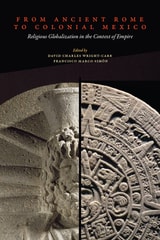
From Ancient Rome to Colonial Mexico
Religious Globalization in the Context of EmpireDavid Charles Wright-Carr
University Press of Colorado, 2023
An international team of specialists in classical scholarship and Mesoamerican studies engage in an interdisciplinary discussion involving ideas from history, anthropology, archaeology, art history, iconography, and philology. Key themes include the role of religion in processes of imperial domination; religion’s use as an instrument of resistance or the imposition, appropriation, incorporation, and adaptation of various elements of religious systems by hegemonic groups and subaltern peoples; the creative misunderstandings that can arise on the “middle ground”; and Christianity’s rejection of ritual violence and its use of this rejection as a pretext for inflicting other kinds of violence against peoples classified as “barbarian,” “pagan,” or “diabolical.”
From Ancient Rome to Colonial Mexico presents a sympathetic vantage point for discussing and attempting to decipher past processes of social communication in multicultural contexts of present-day realities. It will be significant for scholars and specialists in the history of religions, ethnohistory, classical antiquity, and Mesoamerican studies.
Publication supported, in part, by Spain’s Ministry of Economy and Competitiveness.
Contributors: Sergio Botta,Maria Celia Fontana Calvo, Martin Devecka, György Németh, Guilhem Olivier, Francisco Marco Simón, Paolo Taviani, Greg Woolf, David Charles Wright-Carr, Lorenzo Pérez Yarza
Translators: Emma Chesterman, Benjamin Adam Jerue, Layla Wright-Contreras
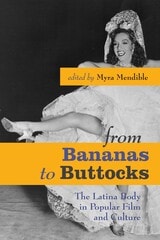
From Bananas to Buttocks
The Latina Body in Popular Film and CultureEdited by Myra Mendible
University of Texas Press, 2007
From the exuberant excesses of Carmen Miranda in the "tutti frutti hat" to the curvaceous posterior of Jennifer Lopez, the Latina body has long been a signifier of Latina/o identity in U.S. popular culture. But how does this stereotype of the exotic, erotic Latina "bombshell" relate, if at all, to real Latina women who represent a wide spectrum of ethnicities, national origins, cultures, and physical appearances? How are ideas about "Latinidad" imagined, challenged, and inscribed on Latina bodies? What racial, class, and other markers of identity do representations of the Latina body signal or reject?
In this broadly interdisciplinary book, experts from the fields of Latina/o studies, media studies, communication, comparative literature, women's studies, and sociology come together to offer the first wide-ranging look at the construction and representation of Latina identity in U.S. popular culture. The authors consider such popular figures as actresses Lupe Vélez, Salma Hayek, and Jennifer Lopez; singers Shakira and Celia Cruz; and even the Hispanic Barbie doll in her many guises. They investigate the media discourses surrounding controversial Latinas such as Lorena Bobbitt and Marisleysis González. And they discuss Latina representations in Lupe Solano's series of mystery books and in the popular TV shows El Show de Cristina and Laura en América. This extensive treatment of Latina representation in popular culture not only sheds new light on how meaning is produced through images of the Latina body, but also on how these representations of Latinas are received, revised, and challenged.
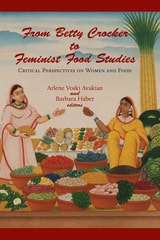
From Betty Crocker to Feminist Food Studies
Critical Perspectives on Women and FoodArlene Voski Avakian
University of Massachusetts Press, 2005
Applying the insights of feminist scholarship to the study of food, the thirteen essays in this volume are arranged under four headings—the marketplace, histories, representations, and resistances. The editors open the book with a substantial introduction that traces the history of scholarly writing on food and maps the terrain of feminist food studies. In the essays that follow, contributors pay particular attention to the ways in which gender, race, ethnicity, class, colonialism, and capitalism have both shaped and been shaped by the production and consumption of food.
In the first section, four essays analyze the influence of large corporations in determining what came to be accepted as proper meals in the United States, including what mothers were expected to feed their babies. The essays in the second section explore how women have held families together by keeping them nourished, from the routines of an early nineteenth-century New Englander to the plight of women who endured the siege of Leningrad.
The essays in the third section focus on the centrality of gender and race in the formation of identities as enacted through food discourse and practices. These case studies range from the Caribbean to the San Luis Valley of Colorado. The final section documents acts of female resistance within the contexts of national or ethnic oppression. From women in colonial India to Armenian American feminists, these essays show how food has served as a means to assert independence and personal identity.
In addition to the editors, contributors include Amy Bentley, Carole M. Counihan, Darra Goldstein, Nancy Jenkins, Alice P. Julier, Leslie Land, Laura Lindenfield, Beheroze F. Shroff, Sharmila Sen, Laura Shapiro, and Jan Whitaker.
From Blue Mills to Columbia
Cedar Falls and the Civil WarKenneth L. Lyftogt
University of Iowa Press, 1993
From Bureaucracy to Bullets
Extreme Domicide and the Right to HomeBree Akesson
Rutgers University Press, 2022

From Class to Identity
The politics of education reforms in former YugoslaviaJana Bacevic
Central European University Press, 2014
From Counterculture to Cyberculture
Stewart Brand, the Whole Earth Network, and the Rise of Digital UtopianismFred Turner
University of Chicago Press, 2006
In the early 1960s, computers haunted the American popular imagination. Bleak tools of the cold war, they embodied the rigid organization and mechanical conformity that made the military-industrial complex possible. But by the 1990s—and the dawn of the Internet—computers started to represent a very different kind of world: a collaborative and digital utopia modeled on the communal ideals of the hippies who so vehemently rebelled against the cold war establishment in the first place.
From Counterculture to Cyberculture is the first book to explore this extraordinary and ironic transformation. Fred Turner here traces the previously untold story of a highly influential group of San Francisco Bay–area entrepreneurs: Stewart Brand and the Whole Earth network. Between 1968 and 1998, via such familiar venues as the National Book Award–winning Whole Earth Catalog, the computer conferencing system known as WELL, and, ultimately, the launch of the wildly successful Wired magazine, Brand and his colleagues brokered a long-running collaboration between San Francisco flower power and the emerging technological hub of Silicon Valley. Thanks to their vision, counterculturalists and technologists alike joined together to reimagine computers as tools for personal liberation, the building of virtual and decidedly alternative communities, and the exploration of bold new social frontiers.
Shedding new light on how our networked culture came to be, this fascinating book reminds us that the distance between the Grateful Dead and Google, between Ken Kesey and the computer itself, is not as great as we might think.

From Curlers to Chainsaws
Women and Their MachinesJoyce Dyer
Michigan State University Press, 2016
From Curlers to Chainsaws is a groundbreaking collection of lyrical and illuminating essays about the serious, silly, seductive, and sometimes sorrowful relationships between women and their machines. This collection explores in depth objects we sometimes take for granted, focusing not only on their functions but also on their powers to inform identity.
For each writer, the device moves beyond the functional to become a symbolic extension of the writer’s own mind—altering and deepening each woman’s concept of herself.

From Dead Ends to Cold Warriors
Constructing American Boyhood in Postwar Hollywood FilmsPeter W.Y. Lee
Rutgers University Press, 2021

From Doctor to Healer
The Transformative JourneySt. John, Gloria
Rutgers University Press, 1998
Why would a successful physician who has undergone seven years of rigorous medical training take the trouble to seek out and learn to practice alternative methods of healing such as homeopathy and Chinese medicine? From Doctor to Healer answers this question as it traces the transformational journeys of physicians who move across the philosophical spectrum of American medicine from doctor to healer. Robbie Davis-Floyd and Gloria St. John conducted extensive interviews to discover how and why physicians make the move to alternative medicine, what sparks this shift, and what beliefs they abandon or embrace in the process.
After outlining the basic models of American health care-the technocratic, humanistic, and holistic-the authors follow the thoughts and experiences of forty physicians as they expand their horizons in order to offer effective patient care. The book focuses on the radical shift from one end of the spectrum to the other-from the technocratic approach to holism-made by most of the interviewees. Because many American physicians find such a drastic change too threatening, the authors also address the less radical transition to humanism-a movement toward compassionate care arising from within the medical system.
From Football to Soccer
The Early History of the Beautiful Game in the United StatesBrian D. Bunk
University of Illinois Press, 2021
Across North America, native peoples and colonists alike played a variety of kicking games long before soccer's emergence in the late 1800s. Brian D. Bunk examines the development and social impact of these sports through the rise of professional soccer after World War I. As he shows, the various games called football gave women an outlet as athletes and encouraged men to form social bonds based on educational experience, occupation, ethnic identity, or military service. Football also followed young people to college as higher education expanded in the nineteenth century. University play, along with the arrival of immigrants from the British Isles, helped spark the creation of organized soccer in the United States—and the beautiful game's transformation into a truly international sport.
A multilayered look at one game’s place in American life, From Football to Soccer refutes the notion of the U.S. as a land outside of football history.

From Home Guards to Heroes
The 87th Pennsylvania and Its Civil War CommunityDennis W. Brandt
University of Missouri Press, 2007