Results by title
22279 books match the query 'Social Science' and 955 start with f
Felix Longoria's Wake
Bereavement, Racism, and the Rise of Mexican American ActivismBy Patrick Carroll
University of Texas Press, 2003
Winner, Tullis Prize, Texas State Historical Association, 2004
Private First Class Felix Longoria earned a Bronze Service Star, a Purple Heart, a Good Conduct Medal, and a Combat Infantryman's badge for service in the Philippines during World War II. Yet the only funeral parlor in his hometown of Three Rivers, Texas, refused to hold a wake for the slain soldier because "the whites would not like it." Almost overnight, this act of discrimination became a defining moment in the rise of Mexican American activism. It launched Dr. Héctor P. García and his newly formed American G.I. Forum into the vanguard of the Mexican civil rights movement, while simultaneously endangering and advancing the career of Senator Lyndon B. Johnson, who arranged for Longoria's burial with full military honors in Arlington National Cemetery.
In this book, Patrick Carroll provides the first fully researched account of the Longoria controversy and its far-reaching consequences. Drawing on extensive documentary evidence and interviews with many key figures, including Dr. García and Mrs. Longoria, Carroll convincingly explains why the Longoria incident, though less severe than other acts of discrimination against Mexican Americans, ignited the activism of a whole range of interest groups from Argentina to Minneapolis. By putting Longoria's wake in a national and international context, he also clarifies why it became such a flash point for conflicting understandings of bereavement, nationalism, reason, and emotion between two powerful cultures—Mexicanidad and Americanism.
Female Body Image and Beauty Politics in Contemporary Indian Literature and Culture
Edited by Srirupa Chatterjee and Shweta Rao Garg
Temple University Press, 2024
Influences from the colonial period through the age of the internet and globalization have reinforced Eurocentric ideals about femininity and womanhood. This long overdue volume addresses the pressures of beautification that Indian women face as they struggle with body acceptance and are often denied pride in their natural bodies.
Contributors: Annika Taneja, Anurima Chanda, Aratrika Bose, Kavita Daiya, Ketaki Chowkhani, Nishat Haider, Samrita Sinha, Shailendra Kumar Singh, Shubhra Ray, Sucharita Sarkar, Sukshma Vedere, Swatie, Tanupriya, Turni Chakrabarti, and the editors.
Female Fertility and the Body Fat Connection
Rose E. Frisch
University of Chicago Press, 2002
Rose E. Frisch explains here how, in women, a certain amount of body fat is crucial to the reproductive system and sexual maturation. Women who are too lean are infertile and cannot conceive children; young girls who are too thin have a delayed onset of their first period. Female Fertility and the Body-Fat Connection illuminates how and why a "critical fitness" level underlies a woman's reproductive health. In the process Frisch gives readers a comprehensive view of the research done to date on the relationship between body composition and fertility and also describes her own journey as a woman scientist working to advance her critical-fitness hypothesis both to the general public and the scientific community. Frisch answers the questions every woman has about the desirable weight for health and fertility and even includes tables to help women find their own best weight. She also demonstrates how important diet and exercise are for the long-term reproductive health of women, and shows what factors influence the onset of puberty in girls.
Each milestone of the reproductive life span is affected by food intake and energy output, the factors affecting the storage of fat. Female Fertility and the Body-Fat Connection is a cornerstone to understanding the health of girls and women.

Female Gladiators
Gender, Law, and Contact Sport in AmericaSarah K. Fields
University of Illinois Press, 2004
Female Gladiators is the first book to examine legal and social battles over the right of women to participate with men in contact sports. The impetus to begin legal proceedings was the 1972 enactment of Title IX, which prohibited discrimination in educational settings, but it was the Equal Protection Clause of the U.S. Constitution and the equal rights amendments of state constitutions that ultimately opened doors. Despite court rulings, however, many in American society resisted—and continue to resist—allowing girls in dugouts and other spaces traditionally defined as male territories.
Inspired, women and girls began to demand access to the contact sports which society had previously deemed too strenuous or violent for them to play. When the leagues continued to bar girls simply because they were not boys, the girls went to court. Sarah K. Fields's Female Gladiators is the only book to examine the legal and social battles over gender and contact sport that continue to rage today.
Female Masculinity
Jack Halberstam
Duke University Press, 1998
Through detailed textual readings as well as empirical research, Halberstam uncovers a hidden history of female masculinities while arguing for a more nuanced understanding of gender categories that would incorporate rather than pathologize them. She rereads Anne Lister’s diaries and Radclyffe Hall’s The Well of Loneliness as foundational assertions of female masculine identity. She considers the enigma of the stone butch and the politics surrounding butch/femme roles within lesbian communities. She also explores issues of transsexuality among “transgender dykes”—lesbians who pass as men—and female-to-male transsexuals who may find the label of “lesbian” a temporary refuge. Halberstam also tackles such topics as women and boxing, butches in Hollywood and independent cinema, and the phenomenon of male impersonators.
Female Masculinity signals a new understanding of masculine behaviors and identities, and a new direction in interdisciplinary queer scholarship. Illustrated with nearly forty photographs, including portraits, film stills, and drag king performance shots, this book provides an extensive record of the wide range of female masculinities. And as Halberstam clearly demonstrates, female masculinity is not some bad imitation of virility, but a lively and dramatic staging of hybrid and minority genders.
Female Masculinity
Jack Halberstam
Duke University Press, 1998
Through detailed textual readings as well as empirical research, Halberstam uncovers a hidden history of female masculinities while arguing for a more nuanced understanding of gender categories that would incorporate rather than pathologize them. He rereads Anne Lister's diaries and Radclyffe Hall's The Well of Loneliness as foundational assertions of female masculine identity; considers the enigma of the stone butch and the politics surrounding butch/femme roles within lesbian communities; and explores issues of transsexuality among “transgender dykes”—lesbians who pass as men—and female-to-male transsexuals who may find the label of “lesbian” a temporary refuge. Halberstam also tackles such topics as women and boxing, butches in Hollywood and independent cinema, and the phenomenon of male impersonators.
Featuring a new preface by the author, this twentieth anniversary edition of Female Masculinity remains as insightful, timely, and necessary as ever.
Female Monarchs and Merchant Queens in Africa
Nwando Achebe
Ohio University Press, 2020
Female SS Guards and Workaday Violence
The Majdanek Concentration Camp, 1942-1944Elissa Mailänder
Michigan State University Press, 2015
Feminine Endings
Music, Gender, and SexualitySusan Mcclary
University of Minnesota Press, 2002

Feminine Feminists
Cultural Practices in ItalyGiovanna Miceli Jeffries, Editor
University of Minnesota Press, 1994
Feminine Feminists was first published in 1994. Minnesota Archive Editions uses digital technology to make long-unavailable books once again accessible, and are published unaltered from the original University of Minnesota Press editions.
What does it mean to be a woman today in Italy, a country with the lowest birthrate in the world and the heaviest maternal stereotype? Does being a feminist exclude practices of cultural femininity? What are Italian women's cultural productions? These questions are at the center of this volume, which looks at how feminism and femininity are embedded in a broad spectrum of Italian cultural practices.
In recent years, several books have introduced the American public to Italian women's voices. This volume goes beyond others in its range of theoretical topics and modes, considering cultural practices not only in their popular, material appearance, but also in the disciplines and forms of knowledge that order information and circumscribe behavior.The essays, all by well-known scholars in Italian studies, reflect the authors' specific critical interests in cinema, fashion, literary texts, feminist theory, and popular culture, past and present. Some address the culture of everyday life, while others examine feminism and femininity in the context of philosophy, ethics, or national identity within a global culture. Some begin with the conviction that performing "femininity"—whether in appearance or in nurturing practices—can be culturally liberating. Others put this notion to the critical test. By situating the problem of femininity within the discussion of feminism, this volume takes on larger issues within feminist discourse. Its bold examination of the component of femininity within the context of women's experiences offers readers rare insight into Italian women's culture and into the multicultural possibilities of feminism.Contributors: Beverly Allen,
Serena Anderlini-D'Onofrio, Lucia Chiavola Birnbaum, Renate Holub, Carol Lazzaro-Weis, Maria Marotti, Áine O'Healy, Graziella Parati, Eugenia Paulicelli, Robin Pickering-Iazzi, Maurizio Viano.Giovanna Miceli Jeffries is a lecturer in the department of French and Italian at the University of Wisconsin, Madison.
Feminine Frequencies
Gender, German Radio, and the Public Sphere 1923-1945Kate Lacey
University of Michigan Press, 1996

Femininity in Flight
A History of Flight AttendantsKathleen M. Barry
Duke University Press, 2007
From the moment the first stewardesses took flight in 1930, flight attendants became glamorous icons of femininity. For decades, airlines hired only young, attractive, unmarried white women. They marketed passenger service aloft as an essentially feminine exercise in exuding charm, looking fabulous, and providing comfort. The actual work that flight attendants did—ensuring passenger safety, assuaging fears, serving food and drinks, all while conforming to airlines’ strict rules about appearance—was supposed to appear effortless; the better that stewardesses performed by airline standards, the more hidden were their skills and labor. Yet today flight attendants are acknowledged safety experts; they have their own unions. Gone are the no-marriage rules, the mandates to retire by thirty-two. In Femininity in Flight, Kathleen M. Barry tells the history of flight attendants, tracing the evolution of their glamorized image as ideal women and their activism as trade unionists and feminists.
Barry argues that largely because their glamour obscured their labor, flight attendants unionized in the late 1940s and 1950s to demand recognition and respect as workers and self-styled professionals. In the 1960s and 1970s, flight attendants were one of the first groups to take advantage of new laws prohibiting sex discrimination. Their challenges to airlines’ restrictive employment policies and exploitive marketing practices (involving skimpy uniforms and provocative slogans such as “fly me”) made them high-profile critics of the cultural mystification and economic devaluing of “women’s work.” Barry combines attention to the political economy and technology of the airline industry with perceptive readings of popular culture, newspapers, industry publications, and first-person accounts. In so doing, she provides a potent mix of social and cultural history and a major contribution to the history of women’s work and working women’s activism.

Feminism And Anthropology
Henrietta Moore
University of Minnesota Press, 1989

Feminism And Documentary
Diane Waldman
University of Minnesota Press, 1999
The first book of essays to explore the intersection of these two vital disciplines.
Documentary and feminist film studies have long been separate or parallel universes that need to converse or collide. The essays in this volume, written by prominent scholars and filmmakers, demonstrate the challenges that feminist perspectives pose for documentary theory, history, and practice. They also show how fuller attention to documentary enriches and complicates feminist theory, especially regarding the relationship between gender and sexuality, race and ethnicity, class and nation.
Feminism and Documentary begins with a substantial historical introduction that highlights several of the specific areas that contributors address: debates over realism, the relationship between filmmaker and subject, historical thinking about documentary and thinking about the historical documentary, biography and autobiography, and the use of psychoanalysis. Other essays, most of which appear here for the first time, range from broad overviews to close analyses of particular films and videos and from discussions of well-known works such as Roger and Me and Don’t Look Back to lesser known texts that might revise the canon. The collection includes an extensive filmography and videography with useful distribution information and a bibliography of work in this neglected area of scholarship. Lucid, sophisticated, and eye-opening, this book will galvanize documentary studies and demonstrate the need for women’s and cultural studies to grapple with visual media. Contributors: Michelle Citron, Northwestern U; Gloria J. Gibson, Indiana U; Chris Holmlund, U of Tennessee; Alexandra Juhasz, Pitzer College; Ann Kaneko; Anahid Kassabian, Fordham U; David Kazanjian, U of California, Berkeley; Susan Knobloch; Silvia Kratzer-Juilfs; Deborah Lefkowitz; Julia Lesage, U of Oregon; Laura U. Marks, Carleton U, Ottawa; Paula Rabinowitz, U of Minnesota; Michael Renov, USC; Patricia R. Zimmermann, Ithaca College.
Feminism Beyond Modernism
Elizabeth Flynn
Southern Illinois University Press, 2002
Misunderstanding and denigration of postmodern feminism are widespread. Elizabeth Flynn’s Feminism Beyond Modernism comes to its defense in a cogent and astute manner by first distinguishing between postmodern and antimodern feminisms and then reclaiming postmodern feminism by reconfiguring its relationship to modernism.
Too often postmodern feminism is unfairly identified as opposed to modernism and associated with subjectivism and relativism. Flynnaddresses these problems by provisionally defining postmodern feminism as problematizing and critiquing modernism without directly opposing it. Flynn also suggests that feminist traditions that reject modernism, such as radical and cultural feminisms, are antimodern rather than postmodern.
In this interdisciplinary study, Flynn defines feminist traditions broadly, situating her discussions within the contexts of literary studies and rhetoric and composition while simultaneously exploring the troubled relationship between these fields. Departing from accepted definitions of modernism, Flynn distinguishes between aesthetic modernism and Enlightenment modernism and uses the work of John Locke, Sigmund Freud, Charlotte Perkins Gilman, Michel Foucault, Donna Haraway, and others as benchmarks for historical placement. In addition, rereadings of works by Virginia Woolf, Adrienne Rich, Alice Walker, Louise Rosenblatt, and others demonstrate the complex ways in which they respond to modernist pressures and tendencies. From this context, Flynn’s Feminism Beyond Modernism reconfigures feminist traditions by defining postmodern feminism as a critique of modernism rather than as an antimodern opponent.

Feminism against Cisness
Emma Heaney, editor
Duke University Press, 2024
Contributors. Cameron Awkward-Rich, Marquis Bey, Kay Gabriel, Jules Gill-Peterson, Emma Heaney, Margaux L. Kristjansson, Greta LaFleur, Grace Lavery, Durba Mitra, Beans Velocci, Joanna Wuest

Feminism and Affect at the Scene of Argument
Beyond the Trope of the Angry FeministAuthored by Barbara Tomlinson
Temple University Press, 2010
Are feminists really angry, unreasoning, man-haters who argue only from an emotional perspective as some claim? Does the incessant repetition of this trope make anti-feminism and misogyny a routine element in everyday speech? And does this repetition work towards delegitimizing feminist arguments and/or undermining feminist politics? How do skilled feminist writers deploy affect to advance feminist ideas? In Feminismand Affect at the Scene of Argument, Barbara Tomlinson addresses these questions, providing a lucid examination of the role of affect in feminist and antifeminist academic arguments.
Using case studies from controversies in socio-legal studies, musicology, and science studies, among other disciplines, Tomlinson examines the rhetorics of anger, contempt, betrayal, intensification, and ridicule. She employs a set of critical tools—feminist “socio-forensic” discursive analysis—that will prove indispensible for understanding and countering tropes like that of the angry feminist. Moreover, these tools will advance feminism, which, she argues, is generated in and by arguments with allies and antagonists.
In an era of debates that generate more heat than light, Feminism and Affectat the Scene of Argument offers a timely provocation for transforming the terms of reading and writing in scholarship and civic life.

Feminism and American Literary History
EssaysBaym, Nina
Rutgers University Press, 1992
Feminism and Community
edited by Penny A. Weiss and Marilyn Friedman
Temple University Press, 1995
Feminism and Motherhood in Germany, 1800-1914
Ann Taylor Allen
Rutgers University Press, 1991
European historians have noted the prominent role of the maternal ethic -- the idea that woman's role as mother extends into society as a whole -- in the theory and practice of German feminism from 1840 to 1914. This body of ideas, however, has seldom been taken seriously. German feminism has been interpreted as a political strategy, not as an intellectual tradition. Historians have portrayed German feminists as conservative, in contrast to their liberal counterparts in other countries who were more likely to campaign for equal rights. Ann Allen revises these views by analyzing German feminism as an attempt to create a symbolic framework for understanding the world rather than simply to attain practical results. She examines the relationship between the experiences of individual female activists and the evolving intellectual traditions of German culture and of international feminism.
Women thought their maternal role led to empowerment and ethical authority. The role gave them the legitimacy to give speeches, to organize reform movements, and to build feminist institutions. They campaigned for infant welfare and the expansion of state responsibility for the welfare of mothers and children. German feminists responded to central public issues, including revolution, national unification, and urbanization. They worked to transform both public and private worlds by extending their ethical values, developed in the family, to political and social issues.
To make her argument, Allen examines the lives and work of the women who were important to the history of German feminism. They centered their careers on issues relating to motherhood and childcare. Allen relates their stories to a broader theme: the relationship of women's experience, under specific historical conditions, to the development of feminist ideology and practice.
Allen assesses the historical significance of German feminism in the context of German history and of similar feminist movements in other countries, particularly the U.S. Allen calls for the ideas of German feminists to be judged with reference to the specific, local conditions under which they developed, rather than to essentialist notions of feminism. Some historians have identified equal rights ideologies as progressive and maternalist ones as conservative. But the women themselves did not perceive the antithesis between these two forms of ideology.

Feminism and Political Theory
Edited by Cass R. Sunstein
University of Chicago Press, 1990
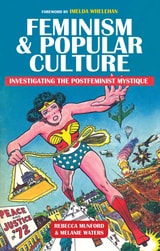
Feminism and Popular Culture
Investigating the Postfeminist MystiqueMunford, Rebecca
Rutgers University Press, 2014
In Feminism and Popular Culture, Rebecca Munford and Melanie Waters consider why the twenty-first century media landscape is so haunted by the ghosts of these traditional figures that feminism otherwise laid to rest. Why, over fifty years since Betty Friedan’s critique, does the feminine mystique exert such a strong spectral presence, and how has it been reimagined to speak to the concerns of a postfeminist audience?
To answer these questions, Munford and Waters draw from a rich array of examples from contemporary film, fiction, music, and television, from the shadowy cityscapes of Homeland to the haunted houses of American Horror Story. Alongside this comprehensive analysis of today’s popular culture, they offer a vivid portrait of feminism’s social and intellectual history, as well as an innovative application of Jacques Derrida’s theories of “hauntology.” Feminism and Popular Culture thus not only considers how contemporary media is being visited by the ghosts of feminism’s past, it raises vital questions about what this means for feminism’s future.

Feminism and Postmodernism
Margaret Ferguson and Jennifer Wicke, eds.
Duke University Press, 1994
Multidisciplinary and international in their collective focus, the essays range from a study of Madonna as an Italian American woman who is revising the cultural meanings of an ethnic feminism to a unique interview with Mairead Keane, the national head of the Women’s Department of the Irish political party Sinn Fein. Turning the prism of postmodern feminism onto such diverse cultural objects as literary and literary critical texts, contemporary film, and music, these essays intervene in debates regarding technology, sexuality, and politics. Challenging modern feminisms to articulate their inescapable relation to postmodern society, this expanded edition of a special issue of boundary 2 also explores ways in which feminism can work as the cutting edge of a global postmodernism.
Contributors. Salwa Bakr, Claire Detels, Margaret Ferguson, Carla Freccero, Marjorie Garber, Barbara Harlow, Laura E. Lyons, Anne McClintock, Toril Moi, Linda Nicholson, Mary Poovey, Andrew Ross, David Simpson, Kathyrn Bond Stockton, Jennifer Wicke
Feminism and the Abyss of Freedom
Linda M. G. Zerilli
University of Chicago Press, 2005
Offering both a discussion of feminism in its postmodern context and a critique of contemporary theory, Zerilli here challenges feminists to move away from a theory-based approach, which focuses on securing or contesting "women" as an analytic category of feminism, to one rooted in political action and judgment. She revisits the democratic problem of exclusion from participation in common affairs and elaborates a freedom-centered feminism as the political practice of beginning anew, world-building, and judging.
In a series of case studies, Zerilli draws on the political thought of Hannah Arendt to articulate a nonsovereign conception of political freedom and to explore a variety of feminist understandings of freedom in the twentieth century, including ones proposed by Judith Butler, Monique Wittig, and the Milan Women's Bookstore Collective. In so doing, Zerilli hopes to retrieve what Arendt called feminism's lost treasure: the original and radical claim to political freedom.

Feminism and the Biological Body
Birke, Lynda
Rutgers University Press, 2000
What is a body? What are our perceptions of our inner bodies? How are these perceptions influenced?
In recent years, thinking about the body has become highly fashionable. However, the renewed focus, while certainly welcome, seems to always end at the corporeal surface. While recent sociological and feminist theory has made important claims about the process of cultural inscription on the body, and about the cultural representation of the body, what actually appears in this new theory seems to be, ironically, disembodied. If this newly theorized form has interiority, it is one that is explained predominantly through psychoanalysis. The physiological processes remain a mystery to be explained, if at all, only in the esoteric language of biomedicine.
As a trained biologist, Lynda Birke was frustrated by the gap between feminist cultural analysis and her own scientific background. In this book, she seeks to bridge this gap using ideas in anatomy and physiology to develop the feminist view that the biological body is socially and culturally constructed. Birke rejects the assumption that bodily function is somehow fixed and unchanging, claiming that biology offers more than just a deterministic narrative of how nature works. Feminism and the Biological Body brings natural science and feminist theory together and suggests that we need a new politics that includes, rather than denies, our flesh.
Feminism and the Cinema of Experience
Lori Jo Marso
Duke University Press, 2024
Feminism and the Legacy of Revolution
Nicaragua, El Salvador, ChiapasKaren Kampwirth
Ohio University Press, 2004
In many Latin American countries, guerrilla struggle and feminism have been linked in surprising ways. Women were mobilized by the thousands to promote revolutionary agendas that had little to do with increasing gender equality. They ended up creating a uniquely Latin American version of feminism that combined revolutionary goals of economic equality and social justice with typically feminist aims of equality, nonviolence, and reproductive rights.
Drawing on more than two hundred interviews with women in Nicaragua, El Salvador, and the Mexican state of Chiapas, Karen Kampwirth tells the story of how the guerrilla wars led to the rise of feminism, why certain women became feminists, and what sorts of feminist movements they built. Feminism and the Legacy of Revolution: Nicaragua, El Salvador, Chiapas explores how the violent politics of guerrilla struggle could be related to the peaceful politics of feminism. It considers the gains, losses, and internal conflicts within revolutionary women’s organizations.
Feminism and the Legacy of Revolution challenges old assumptions regarding revolutionary movements and the legacy of those movements for the politics of daily life. It will appeal to a broad, interdisciplinary audience in political science, sociology, anthropology, women’s studies, and Latin American studies as well as to general readers with an interest in international feminism.
Feminism and the Politics of Childhood
Friends or Foes?Edited by Rachel Rosen and Katherine Twamley
University College London, 2018
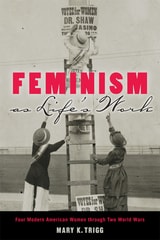
Feminism as Life's Work
Four Modern American Women through Two World WarsTrigg, Mary K
Rutgers University Press, 2014
Through these women’s intertwined stories, Mary Trigg traces the changing nature of the women’s movement across turbulent decades rent by world war, revolution, global depression, and the rise of fascism. Criticizing the standard division of feminist activism as a series of historical waves, Trigg exposes how Irwin, Beard, Stevens, and Pruette helped push the U.S. feminist movement to victory and continued to propel it forward from the 1920s to the 1960s, decades not included in the “wave” model. At a time widely viewed as the “doldrums” of feminism, the women in this book were in fact taking the cause to new sites: the National Women’s Party; sexuality and relations with men; marriage; and work and financial independence. In their utopian efforts to reshape work, sexual relations, and marriage, modern feminists ran headlong into the harsh realities of male power, the sexual double standard, the demands of motherhood, and gendered social structures.
In Feminism as Life’s Work, Irwin, Beard, Stevens, and Pruette emerge as the heirs of the suffrage movement, guardians of a long feminist tradition, and catalysts of the belief in equality and difference. Theirs is a story of courage, application, and perseverance—a story that revisits the “bleak and lonely years” of the U.S. women’s movement and emerges with a fresh perspective of the history of this pivotal era.
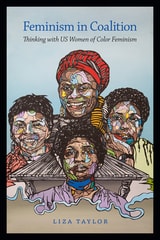
Feminism in Coalition
Thinking with US Women of Color FeminismLiza Taylor
Duke University Press, 2022

Feminism in Revolt
An AnthologyCarla Lonzi
Seagull Books, 2023
Recently rediscovered in Italy and abroad, the works of Carla Lonzi tend to fall under the remit of art history or feminist theory. Art historians focus on the texts written in the 1960s, when Lonzi was still actively working as a critic, whereas feminist scholars engage with her more openly political interventions, published after her declared embrace of a separatist feminism. In 1970 Lonzi decided to leave the art world for good and dedicate herself to her newly founded feminist collective, Rivolta Femminile. While recognizing the break in Lonzi’s life and work, this anthology maps the overall arc of her intellectual and political production, giving equal weight to her seminal contributions to art criticism and her trailblazing feminist writings. A comprehensive collection of texts from the most influential and iconic figure of Italian second-wave feminism, Feminism in Revolt seeks to shed light on Lonzi’s versatile approach to literary genres and compositions by juxtaposing essayistic texts, poems, diary excerpts, and manifestos.

Feminism in Twentieth-Century Science, Technology, and Medicine
Edited by Angela N. H. Creager, Elizabeth Lunbeck, and Londa Schiebinger
University of Chicago Press, 2001
Contributors:
Ruth Schwartz Cowan
Linda Marie Fedigan
Scott Gilbert
Evelynn M. Hammonds
Evelyn Fox Keller
Pamela E. Mack
Michael S. Mahoney
Emily Martin
Ruth Oldenziel
Nelly Oudshoorn
Carroll Pursell
Karen Rader
Alison Wylie
Feminism without Borders
Decolonizing Theory, Practicing SolidarityChandra Talpade Mohanty
Duke University Press, 2003
Feminism without Borders opens with Mohanty's influential critique of western feminism ("Under Western Eyes") and closes with a reconsideration of that piece based on her latest thinking regarding the ways that gender matters in the racial, class, and national formations of globalization. In between these essays, Mohanty meditates on the lives of women workers at different ends of the global assembly line (in India, the United Kingdom, and the United States); feminist writing on experience, identity, and community; dominant conceptions of multiculturalism and citizenship; and the corporatization of the North American academy. She considers the evolution of interdisciplinary programs like Women's Studies and Race and Ethnic Studies; pedagogies of accommodation and dissent; and transnational women's movements for grassroots ecological solutions and consumer, health, and reproductive rights. Mohanty's probing and provocative analyses of key concepts in feminist thought—"home," "sisterhood," "experience," "community"—lead the way toward a feminism without borders, a feminism fully engaged with the realities of a transnational world.
Feminism, Interrupted
Disrupting PowerLola Olufemi
Pluto Press, 2020
"Reading her is to believe that another world is possible."—The Guardian
More than just a slogan on a t-shirt, feminism is a radical tool for fighting back against structural violence and injustice. Feminism, Interrupted is a bold call to seize feminism back from the cultural gatekeepers and return it to its radical roots.
Writer and organizer Lola Olufemi explores state violence against women, the fight for reproductive justice, transmisogyny, gendered Islamophobia and solidarity with global struggles, showing that the fight for gendered liberation can change the world for everybody when we refuse to think of it solely as women's work. Chapters include:
*Know your history
*The sexist state
*The fight for reproductive justice
*The savior complex: Muslim women and gendered Islamophobia
*Complicated consent: How to support sex workers
*The answer to sexual violence is not more prisons
*Feminism and food
*Solidarity is a doing word
Including testimonials from Sisters Uncut, migrant groups working for reproductive justice, prison abolitionists and activists involved in the international fight for Kurdish and Palestinian rights, Olufemi emphasizes the link between feminism and grassroots organizing. Reclaiming feminism from the clutches of the consumerist, neoliberal model, Feminism, Interrupted shows that when “feminist” is more than a label, it holds the potential for radical transformative work.
Olufemi writes in her Introduction, "Feminism is a political project about what could be. It’s always looking forward, investing in future we can’t quite grasp yet. It’s a way of swishing, hoping, aiming at everything that has been deemed impossible. It’s a task that has to be approached seriously. This book is for anyone who is beginning to think critically….If this book makes you pick up another book, or watch a documentary, search the archive, reach for a poetry book—if it spars or reignites your interest in feminism, then it has served its purpose."

Feminism
A Brief Introduction to the Ideas, Debates, and Politics of the MovementDeborah Cameron
University of Chicago Press, 2019
In the era of #MeToo, Trump, and online harassment, innovative progressive feminist voices are more essential than ever. With her latest book, Deborah Cameron considers feminism from all sides—as an idea, as a theoretical approach, and as a political movement. Written in the succinct, sharp style that has made Cameron’s feminist linguistics blog so popular, this short book lays out past and present debates on seven key topics: domination, rights, work, femininity, sex, culture, and the future. Feminism emphasizes the diversity of feminist thought, including queer, women-of-color, and trans perspectives. Cameron’s clear and incisive account untangles the often confusing strands of one of history’s most important intellectual and political movements.
Broad in scope but refreshingly concise, this book is perfect for anyone who needs a straightforward primer on the complex history of feminism, a nuanced explanation of key issues and debates, or strategic thinking about the questions facing activists today.

Feminisms Redux
An Anthology of Literary Theory and CriticismWarhol-Down, Robyn
Rutgers University Press, 2009
Now, at the dawn of a new century of thought and action, it is important once again to revisit the canon of feminist literary criticism and theory and re-establish the measure for representing the latest developments in the field. Robyn Warhol-Down and Diane Price Herndl have joined together once more to provide academics and general readers with a newly revised and indispensable collection of essays representing the range of feminist literary criticism.
Feminisms Redux, presented in a concise format, includes many essays from the second edition that continue to speak to current concerns and also provides readers with new contributions that address work in postcolonial studies, queer theory, and disability studies. As in the earlier volumes, the editors have gathered the full text of original articles and book chapters, with no edited excerpts. The range of essays focuses not only on gender and sex, but also on sexuality, race, class, nationality, and (dis)ability, and the intersections among these categories as they play out in writing by and about women. More than a revision of archetypal work, Feminisms Redux represents the dawning of a new classic.
Feminisms and Politics in the Interwar Balkans and East-Central Europe
Katerina Dalakoura
Central European University Press, 2026
Feminisms at a Millennium
Edited by Judith A. Howard and Carolyn Allen
University of Chicago Press, 2001

Feminisms
A Global HistoryLucy Delap
University of Chicago Press, 2020
Feminism’s origins have often been framed around a limited cast of mostly white and educated foremothers, but the truth is that feminism has been and continues to be a global movement. For centuries, women from all walks of life have been mobilizing for gender justice. As the last decade has reminded even the most powerful women, there is nothing “post-feminist” about our world. And there is much to be learned from the passion and protests of the past.
Historian Lucy Delap looks to the global past to give us a usable history of the movement against gender injustice—one that can help clarify questions of feminist strategy, priority and focus in the contemporary moment. Rooted in recent innovative histories, the book incorporates alternative starting points and new thinkers, challenging the presumed priority of European feminists and ranging across a global terrain of revolutions, religions, empires and anti-colonial struggles.
In Feminisms, we find familiar stories—of suffrage, of solidarity, of protest—yet there is no assumption that feminism looks the same in each place or time. Instead, Delap explores a central paradox: feminists have demanded inclusion but have persistently practiced their own exclusions. Some voices are heard and others are routinely muted. In amplifying the voices of figures at the grassroots level, Delap shows us how a rich relationship to the feminist past can help inform its future.

Feminisms
An AnthologyWarhol-Down, Robyn
Rutgers University Press, 1991

Feminist Accused of Sexual Harassment
Jane Gallop
Duke University Press, 1997
Comparing “still new” feminism—as she first encountered it in the early 1970s—with the more established academic discipline that women’s studies has become, Gallop makes a case for the intertwining of learning and pleasure. Refusing to acquiesce to an imperative of silence that surrounds such issues, Gallop acknowledges—and describes—her experiences with the eroticism of learning and teaching. She argues that antiharassment activism has turned away from the feminism that created it and suggests that accusations of harassment are taking aim at the inherent sexuality of professional and pedagogic activity rather than indicting discrimination based on gender—that antiharassment has been transformed into a sensationalist campaign against sexuality itself.
Feminist Accused of Sexual Harassment offers a direct and challenging perspective on the complex and charged issues surrounding the intersection of politics, sexuality, feminism, and power. Gallop’s story and her characteristically bold way of telling it will be compelling reading for anyone interested in these issues and particularly to anyone interested in the ways they pertain to the university.
Feminist Agendas and Democracy in Latin America
Jane S. Jaquette, ed.
Duke University Press, 2009
The book is organized around three broad topics. The first, women’s access to political power at the national level, is addressed by essays on the election of Michelle Bachelet in Chile, gender quotas in Argentina and Brazil, and the responses of the women’s movement to the “Bolivarian revolution” in Venezuela. The second topic, the use of legal strategies, is taken up in essays on women’s rights across the board in Argentina, violence against women in Brazil, and gender in the work of the Truth and Reconciliation Commission in Peru. Finally, the international impact of Latin American feminists is explored through an account of their participation in the World Social Forum, an assessment of a Chilean-led project carried out by women’s organizations in several countries to hold governments to the promises they made at international conferences in Cairo and Beijing, and an account of cross-border organizing to address femicides and domestic abuse in the Juárez-El Paso border region. Jane S. Jaquette provides the historical and political context of women’s movement activism in her introduction, and concludes the volume by engaging contemporary debates about feminism, civil society, and democracy.
Contributors. Jutta Borner, Mariana Caminotti, Alina Donoso, Gioconda Espina, Jane S. Jaquette, Beatriz Kohen, Julissa Mantilla Falcón, Jutta Marx, Gabriela L. Montoya, Flávia Piovesan, Marcela Ríos Tobar, Kathleen Staudt, Teresa Valdés, Virginia Vargas
Feminist Book Work
Reading with the Women's PressRosy Mack
Duke University Press, 2027
Feminist Coalitions
Historical Perspectives on Second-Wave Feminism in the United StatesEdited by Stephanie Gilmore. Foreword by Sara Evans.
University of Illinois Press, 2007
Much of the scholarship on second-wave feminism has focused on divisions within the women's movement and its narrow conception of race and class, but the contributors to this volume remind readers that feminists in the 1960s and 1970s also formed many strong partnerships, often allying themselves with a diverse range of social justice efforts on a local grassroots level. These essays focus on coalitions and alliances in which feminists and other activists joined forces to address crucial social justice issues such as reproductive rights, the peace movement, women's health, Christianity and other religions, and neighborhood activism, as well as alliances crossing boundaries of race, class, political views, and sexual identity. The contributors bring fresh perspectives to feminist history by calling attention to how women struggled to include and represent diverse women without minimizing the difficulties of conceptualizing a singular feminism.
Contributors are Maria Bevacqua, Tamar Carroll, Marisa Chappell, Andrea Estepa, Sara M. Evans, Amy Farrell, Stephanie Gilmore, Cynthia Harrison, Elizabeth Kaminski, Wendy Kline, Premilla Nadasen, Caryn Neumann, Anne M. Valk, and Emily Zuckerman.
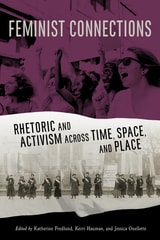
Feminist Connections
Rhetoric and Activism across Time, Space, and PlaceEdited by Katherine Fredlund, Kerri Hauman, and Jessica Ouellette
University of Alabama Press, 2020
Tracing the rhetoric of feminist activism across generations, cultures, and movements.
In 1917, Alice Paul and other suffragists famously picketed in front of the White House while holding banners with short, pithy sayings such as “Mr. President: How long must women wait for Liberty?” Their juxtaposition of this short phrase with the image of the White House (a symbol of liberty and justice) relies on the same rhetorical tactics as memes, a genre contemporary feminists use frequently to make arguments about reproductive rights, Black Lives Matter, sex-positivity, and more. Many such connections between feminists of different spaces, places, and eras have yet to be considered, let alone understood. Feminist Connections: Rhetoric and Activism across Time, Space, and Place reconsiders feminist rhetorical strategies as linked, intergenerational, and surprisingly consistent despite the emergence of new forms of media and intersectional considerations.
Contributors to this volume highlight continuities in feminist rhetorical practices that are often invisible to scholars, obscured by time, new media, and wildly different cultural, political, and social contexts. Thus, this collection takes a nonchronological approach to the study of feminist rhetoric, grouping chapters by rhetorical practice rather than time, content, or choice of media.
By connecting historical, contemporary, and future trajectories, this collection develops three feminist rhetorical frameworks: revisionary rhetorics, circulatory rhetorics, and response rhetorics. A theorization of these frameworks explains how feminist rhetorical practices (past and present) rely on similar but diverse methods to create change and fight oppression. Identifying these strategies not only helps us rethink feminist rhetoric from an academic perspective but also allows us to enact feminist activist rhetorics beyond the academy during a time in which feminist scholarship cannot afford to remain behind its hallowed yet insular walls.
Feminist Digital Humanities
Intersections in PracticeEdited by Lisa Marie Rhody and Susan Schreibman
University of Illinois Press, 2025
The editors divide the works into three categories. In the first section, contributors offer readings that demonstrate how feminist thought can be put into operation through digital practice or via analytical approaches, methodologies, and interpretations. A second section structured around infrastructure considers how technologies of knowledge creation, publication, access, and sharing can be formed or reformed through feminist values. The final section focuses on pedagogies and proposes feminist strategies for preparing students to become critical and confident readers with and against technologies.
Aimed at readers in and out of the classroom, Feminist Digital Humanities reveals the many ways scholars have pushed beyond critique to practice digital humanities in new ways.
Contributors: Daniela Agostinho, Monika Barget, Jenny Bergenmar, Susan Brown, Tanya E Clement, Katrine Dirckinck-Holmfeld, Jaime Lee Kirtz, Cecilia Lindhé, Laura Mandell, Lisa Marie Rhody, Mark Sample, Susan Schreibman, Andie Silva, Nikki L. Stevens, Ravynn K. Stringfield, Dhanashree Thorat, Nanna Bonde Thylstrup, Kristin Veel, Astrid von Rosen, and Jacqueline Wernimont

Feminist Economics Today
Beyond Economic ManEdited by Marianne A. Ferber and Julie A. Nelson
University of Chicago Press, 2003

Feminist Ethics in Film
Reconfiguring Care through CinemaJoseph H. Kupfer
Intellect Books, 2012
Popular films can do more than merely entertain us; they can contribute to our understanding of human nature and the ethical theory that informs it. Feminist Ethics in Film explores a varied group of cinematic narratives from the perspective of care-based ethics. The interpersonal relationships they portray disclose important dimensions of care that have been overlooked in less contextualized discussions. In particular, the book examines the relationships between care and community, autonomy, family, and self transformation. Interpreting films from the perspective of the feminist ethics of care both expands our knowledge of this burgeoning area of philosophy and adds depth to our appreciation of the films.

Feminist Fabulation
Space/Postmodern FictionMarleen S. Barr
University of Iowa Press, 1992
Feminist Generations
The Persistence of the Radical Women's MovementNancy Whittier
Temple University Press, 1995
The radical feminist movement has undergone significant transformation over the past four decades—from the direct action of the 1960s and 1970s to the backlash against feminism in the 1980s and 1990s. Drawing on organizational documents and interviews with both veterans of the women's movement and younger feminists in Columbus, Ohio, Nancy Whittier traces the changing definitions of feminism as the movement has evolved. She documents subtle variations in feminist identity and analyzes the striking differences, conflicts, and cooperation between longtime and recent activists.
The collective stories of the women—many of them lesbians and lesbian feminists whom the author shows to be central to the women's movement and radical feminism—illustrate that contemporary radical feminism is very much alive. It is sustained through protests, direct action, feminist bookstores, rape crisis centers, and cultural activities like music festivals and writers workshops, which Whittier argues are integral—and political—aspects of the movement's survival.
Her analysis includes discussions of a variety of both liberal and radical organizations, including the Women's Action Collective, Women Against Rape, Fan the Flames Bookstore, the Ohio ERA Task Force, and NOW. Unlike many studies of feminist organizing, her study also considers the difference between Columbus, a Midwest, medium-sized city, and feminist activities in major cities like New York, San Francisco, and Chicago, as well as the roles of radical feminists in the development of women's studies departments and other social movements like AIDS education and self-help.
In the series Women in the Political Economy, edited by Ronnie J. Steinberg.