Results by title
159 books match the query 'Academic writing' and 5 start with g
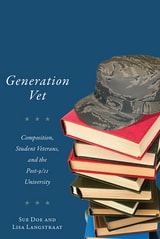
Generation Vet
Composition, Student Veterans, and the Post-9/11 UniversitySue Doe
Utah State University Press, 2014
Institutions of higher education are experiencing the largest influx of enrolled veterans since World War II, and these student veterans are transforming post-secondary classroom dynamics. While many campus divisions like admissions and student services are actively moving to accommodate the rise in this demographic, little research about this population and their educational needs is available, and academic departments have been slower to adjust. In Generation Vet, fifteen chapters offer well-researched, pedagogically savvy recommendations for curricular and programmatic responses to student veterans for English and writing studies departments.
In work with veterans in writing-intensive courses and community contexts, questions of citizenship, disability, activism, community-campus relationships, and retention come to the fore. Moreover, writing-intensive courses can be sites of significant cultural exchanges—even clashes—as veterans bring military values, rhetorical traditions, and communication styles that may challenge the values, beliefs, and assumptions of traditional college students and faculty.
This classroom-oriented text addresses a wide range of issues concerning veterans, pedagogy, rhetoric, and writing program administration. Written by diverse scholar-teachers and written in diverse genres, the essays in this collection promise to enhance our understanding of student veterans, composition pedagogy and administration, and the post-9/11 university.
Genre Across The Curriculum
edited by Anne Herrington and Charles Moran
Utah State University Press, 2005
Genre across the Curriculum will function as a "good" textbook, one not for the student, but for the teacher, and one with an eye on the context of writing. Here you will find models of practice, descriptions written by teachers who have integrated the teaching of genre into their pedagogy in ways that both support and empower the student writer.
While authors here look at courses across disciplines and across a range of genres, they are similar in presenting genre as situated within specific classrooms, disciplines, and institutions. Their assignments embody the pedagogy of a particular teacher, and student responses here embody students' prior experiences with writing. In each chapter, the authors define a particular genre, define the learning goals implicit in assigning that genre, explain how they help their students work through the assignment, and, finally, discuss how they evaluate the writing their students do in response to their teaching.
Genre and Graduate-Level Research Writing
An Cheng
University of Michigan Press, 2018
Genre and Graduate-Level Research Writing is grounded in genre-based theory and full of best practices examples. The book opens by presenting the case for the use of genre in graduate-level research writing and by examining rhetorical consciousness-raising and its ties to genre. Unique to the volume is a thorough analysis of the materials designed to teach genre and research writing—focused on the textbooks of Swales & Feak (e.g., Academic Writing for Graduate Students) and similar texts. Other chapters provide examples of discovery-based genre tasks, evaluative methods for assessing discipline-specific writing, and techniques for becoming a more confident instructor of graduate-level research writing.
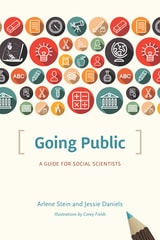
Going Public
A Guide for Social ScientistsArlene Stein and Jessie Daniels
University of Chicago Press, 2017
While there has been an increasing call for social scientists to engage more broadly with the public, concrete advice for starting the conversation has been in short supply. Arlene Stein and Jessie Daniels seek to change this with Going Public, the first guide that truly explains how to be a public scholar. They offer guidance on writing beyond the academy, including how to get started with op-eds and articles and later how to write books that appeal to general audiences. They then turn to the digital realm with strategies for successfully building an online presence, cultivating an audience, and navigating the unique challenges of digital world. They also address some of the challenges facing those who go public, including the pervasive view that anything less than scholarly writing isn’t serious and the stigma that one’s work might be dubbed “journalistic.”
Going Public shows that by connecting with experts, policymakers, journalists, and laypeople, social scientists can actually make their own work stronger. And by learning to effectively add their voices to the conversation, researchers can help make sure that their knowledge is truly heard above the digital din.
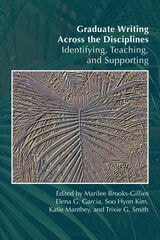
Graduate Writing Across the Disciplines
Identifying, Teaching, and SupportingMarilee Brooks-Gillies
University Press of Colorado, 2020