Results by title
1218 books match the query 'African Americans' and 17 start with g
Gathering Ground
A Reader Celebrating Cave Canem's First DecadeToi Derricotte and Cornelius Eady, Editors
University of Michigan Press, 2006
To mark the first decade of this pathbreaking project, Gathering Ground presents more than one hundred poems by Cave Canem participants and faculty. It embraces an impressive and eclectic gathering of forms, including sonnets, a bop (a new form created by a Cave Canem faculty member), blues, sestinas, prose poems, centos, free verse, and more. The roster of distinguished contributors includes Lucille Clifton, Yusef Komunyakaa, Marilyn Nelson, Sonya Sanchez, Al Young, and many others.
For newcomers and aficionados alike, Gathering Ground assembles in one place the most innovative voices in contemporary African American poetry and boldly attests to the important position it holds in verse-making today.
Toi Derricotte is author of the memoir The Black Notebooks and of four books of poetry: Tender, Captivity, Natural Birth, and The Empress of the Death House. She is Professor of English at the University of Pittsburgh. Cornelius Eady is the author of Brutal Imagination, Autobiography of a Jukebox, You Don't Miss Your Water, The Gathering of My Name, and Victims of the Latest Dance Craze. He is Associate Professor of English at the University of Notre Dame.
Gender and the Civil Rights Movement
Ling, Peter J
Rutgers University Press, 2004
Ghosts in the Schoolyard
Racism and School Closings on Chicago's South SideEve L. Ewing
University of Chicago Press, 2018
That’s how Eve L. Ewing opens Ghosts in the Schoolyard: describing Chicago Public Schools from the outside. The way politicians and pundits and parents of kids who attend other schools talk about them, with a mix of pity and contempt.
But Ewing knows Chicago Public Schools from the inside: as a student, then a teacher, and now a scholar who studies them. And that perspective has shown her that public schools are not buildings full of failures—they’re an integral part of their neighborhoods, at the heart of their communities, storehouses of history and memory that bring people together.
Never was that role more apparent than in 2013 when Mayor Rahm Emanuel announced an unprecedented wave of school closings. Pitched simultaneously as a solution to a budget problem, a response to declining enrollments, and a chance to purge bad schools that were dragging down the whole system, the plan was met with a roar of protest from parents, students, and teachers. But if these schools were so bad, why did people care so much about keeping them open, to the point that some would even go on a hunger strike?
Ewing’s answer begins with a story of systemic racism, inequality, bad faith, and distrust that stretches deep into Chicago history. Rooting her exploration in the historic African American neighborhood of Bronzeville, Ewing reveals that this issue is about much more than just schools. Black communities see the closing of their schools—schools that are certainly less than perfect but that are theirs—as one more in a long line of racist policies. The fight to keep them open is yet another front in the ongoing struggle of black people in America to build successful lives and achieve true self-determination.
Globetrotting
African American Athletes and Cold War PoliticsDamion L. Thomas
University of Illinois Press, 2012
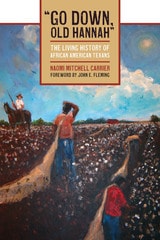
Go Down, Old Hannah
The Living History of African American TexansBy Naomi Mitchell Carrier
University of Texas Press, 2010
Living history is a style of instructive and entertaining performance that seeks to bring history to life with the use of costumes, tools, and reenactments appropriate to a specific time period. Done well, living history performances illuminate human experience in powerful, unforgettable ways.
The fifteen living history plays in this collection were commissioned by museums and historic sites in Texas to show the interdependence of African American experiences and contributions to the living history of Texas. The plays cover subject matter ranging from slave celebrations, family breakups, and running away, to the Civil War, emancipation, and Reconstruction. Each play is research based and performed by Talking Back Living History Theatre as a festival production. These scripts are easily performed, and author Naomi Mitchell Carrier has included production notes in the overviews that precede each play. Lesson plans are also included, which add to the collection's appeal as a classroom tool.
Carrier's talent for bringing historical figures to life is exceptional. The names of most primary characters in these plays are real. By giving them faces, feelings, intelligence, and dignity, Carrier aims to give them new life.

Go to the Store with Shakur!
A Shakur Series Board BookAndrea Sonnier
Gallaudet University Press, 2024
About the Shakur Series:
The Shakur Series features Black deaf characters who use American Sign Language, offering a unique and inclusive reading experience for children. The vibrant illustrations showcase a signing family and will captivate young minds, while the engaging text reinforces learning. These charming board books contain positive messages and practical lessons, support early childhood development, and encourage children to explore the world with Shakur. This series honors and celebrates Black deaf experiences through everyday adventures that will resonate with young children and their families.
Published in partnership with The Laurent Clerc National Deaf Education Center.
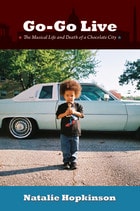
Go-Go Live
The Musical Life and Death of a Chocolate CityNatalie Hopkinson
Duke University Press, 2012
Go-Go Live is a social history of black Washington told through its go-go music and culture. Encompassing dance moves, nightclubs, and fashion, as well as the voices of artists, fans, business owners, and politicians, Natalie Hopkinson's Washington-based narrative reflects the broader history of race in urban America in the second half of the twentieth century and the early twenty-first. In the 1990s, the middle class that had left the city for the suburbs in the postwar years began to return. Gentrification drove up property values and pushed go-go into D.C.'s suburbs. The Chocolate City is in decline, but its heart, D.C.'s distinctive go-go musical culture, continues to beat. On any given night, there's live go-go in the D.C. metro area.

Goin' Viral
Uncontrollable Black PerformanceGabriel A. Peoples
University of Illinois Press, 2025
Peoples’s analysis ranges from abolitionist and proslavery visual culture to Do the Right Thing to “Bed Intruder Song” and the cellphone video of Derrion Albert’s murder. After identifying these moments, he considers how performances go viral in Black ways. He also thinks through the ways Black virality circulates ideas that materially affect Black life. As he shows, an interacting person’s vulnerability to racialized gender and racialized sexuality knowledge inspires how they spread a performance. Non-iconic elements of viral moments reveal hard-to-find nuances of Black life while the artists and others represented in viral moments promote both collective and individual liberation by harnessing their visibility and audibility.
Rigorous and expansive, Goin’ Viral uses Black virality as a new way to understand and frame Black performances.
Going Home
Black Representatives and Their ConstituentsRichard F. Fenno
University of Chicago Press, 2003
Fenno follows the careers of four black representatives—Louis Stokes, Barbara Jordan, Chaka Fattah, and Stephanie Tubbs Jones—from their home districts to the halls of the Capitol. He finds that while these politicians had different visions of how they should represent their districts (in part based on their individual preferences, and in part based on the history of black politics in America), they shared crucial organizational and symbolic connections to their constituents. These connections, which draw on a sense of "linked fates," are ones that only black representatives can provide to black constituents.
His detailed portraits and incisive analyses will be important for anyone interested in the workings of Congress or in black politics.
Going Underground
Race, Space, and the Subterranean in the Nineteenth-Century United StatesLara Langer Cohen
Duke University Press, 2023
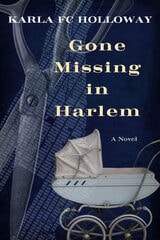
Gone Missing in Harlem
A NovelKarla FC Holloway
Northwestern University Press, 2021
The family arrives as Harlem staggers under the flu pandemic that follows the First World War. DeLilah Mosby and her daughter, Selma, meet difficulties with backbone and resolve to make a home for themselves in the city, and Selma has a baby, Chloe. As the Great Depression creeps across the world at the close of the twenties, however, the farsighted see hard times coming.
The panic of the early thirties is embodied in the kidnapping and murder of the infant son of the nation’s dashing young aviator, Charles Lindbergh. A transfixed public follows the manhunt in the press and on the radio. Then Chloe goes missing—but her disappearance does not draw the same attention. Wry and perceptive Weldon Haynie Thomas, the city’s first “colored” policeman, takes the case.
The urgent investigation tests Thomas’s abilities to draw out the secrets Harlem harbors, untangling the color-coded connections and relationships that keep company with greed, ghosts, and grief. With nuanced characters, lush historical detail, and a lyrical voice, Gone Missing in Harlem affirms the restoring powers of home and family.

Good Morning, Shakur!
A Shakur Series Board BookAndrea Sonnier
Gallaudet University Press, 2024
About the Shakur Series:
The Shakur Series features Black deaf characters who use American Sign Language, offering a unique and inclusive reading experience for children. The vibrant illustrations showcase a signing family and will captivate young minds, while the engaging text reinforces learning. These charming board books contain positive messages and practical lessons, support early childhood development, and encourage children to explore the world with Shakur. This series honors and celebrates Black deaf experiences through everyday adventures that will resonate with young children and their families.
Published in partnership with The Laurent Clerc National Deaf Education Center.
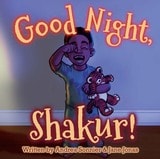
Good Night, Shakur!
A Shakur Series Board BookAndrea Sonnier
Gallaudet University Press, 2024
About the Shakur Series:
The Shakur Series features Black deaf characters who use American Sign Language, offering a unique and inclusive reading experience for children. The vibrant illustrations showcase a signing family and will captivate young minds, while the engaging text reinforces learning. These charming board books contain positive messages and practical lessons, support early childhood development, and encourage children to explore the world with Shakur. This series honors and celebrates Black deaf experiences through everyday adventures that will resonate with young children and their families.
Published in partnership with The Laurent Clerc National Deaf Education Center.
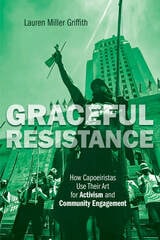
Graceful Resistance
How Capoeiristas Use Their Art for Activism and Community EngagementLauren Miller Griffith
University of Illinois Press, 2023
Capoeira began as a martial art developed by enslaved Afro-Brazilians. Today, the practice incorporates song, dance, acrobatics, and theatrical improvisation—and leads many participants into activism.
Lauren Miller Griffith’s extensive participant observation with multiple capoeira groups informs her ethnography of capoeiristas--both individuals and groups--in the United States. Griffith follows practitioners beyond their physical training into social justice activities that illuminate capoeira’s strong connection to resistance and subversion. As both individuals and communities of capoeiristas, participants march against racial discrimination, celebrate Martin Luther King Jr. Day and Juneteenth, organize professional clothing drives for job seekers, and pursue economic and environmental justice in their neighborhoods. For these people, capoeira becomes a type of serious leisure that contributes to personal growth, a sense of belonging, and an overall sense of self, while also imposing duties and obligations.
An innovative look at capoeira in America, Graceful Resistance reveals how the practicing of an art can catalyze action and transform communities.
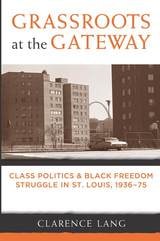
Grassroots at the Gateway
Class Politics and Black Freedom Struggle in St. Louis, 1936-75Clarence Lang
University of Michigan Press, 2010
"This is a theoretically sophisticated and thoroughly documented historical case study of the movements for African American liberation in St. Louis. Through detailed analysis of black working class mobilization from the depression years to the advent of Black Power, award-winning historian Clarence Lang describes how the advances made in earlier decades were undermined by a black middle class agenda that focused on the narrow aims of black capitalists and politicians. The book is a major contribution to our understanding of the black working class insurgency that underpinned the civil rights and Black Power campaigns of the twentieth century."
---V. P. Franklin, University of California, Riverside
"A major work of scholarship that will transform historical understanding of the pivotal role that class politics played in both civil rights and Black Power activism in the United States. Clarence Lang's insightful, engagingly written, and well-researched study will prove indispensable to scholars and students of postwar American history."
---Peniel Joseph, Brandeis University
Breaking new ground in the field of Black Freedom Studies, Grassroots at the Gateway reveals how urban black working-class communities, cultures, and institutions propelled the major African American social movements in the period between the Great Depression and the end of the Great Society. Using the city of St. Louis in the border state of Missouri as a case study, author Clarence Lang undermines the notion that a unified "black community" engaged in the push for equality, justice, and respect. Instead, black social movements of the working class were distinct from---and at times in conflict with---those of the middle class. This richly researched book delves into African American oral histories, records of activist individuals and organizations, archives of the black advocacy press, and even the records of the St. Louis' economic power brokers whom local black freedom fighters challenged. Grassroots at the Gateway charts the development of this race-class divide, offering an uncommon reading of not only the civil rights movement but also the emergence and consolidation of a black working class.
Clarence Lang is Assistant Professor in African American Studies and History at the University of Illinois at Urbana-Champaign.
Photo courtesy Western Historical Manuscript Collection, University of Missouri, St. Louis

Grime, Glitter, and Glass
The Body and the Sonic in Contemporary Black ArtNikki A. Greene
Duke University Press, 2024
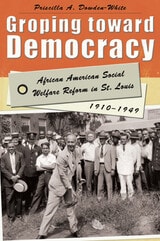
Groping toward Democracy
African American Social Welfare Reform in St. Louis, 1910-1949Priscilla A. Dowden-White
University of Missouri Press, 2011
In Groping toward Democracy: African American Social Welfare Reform in St. Louis, 1910–1949, historian Priscilla A. Dowden-White presents an on-the-ground view of local institution building and community organizing campaigns initiated by African American social welfare reformers. Through extensive research, the author places African American social welfare reform efforts within the vanguard of interwar community and neighborhood organization, reaching beyond the “racial uplift” and “behavior” models of the studies preceding hers. She explores one of the era’s chief organizing principles, the “community as a whole” idea, and deliberates on its relationship to segregation and the St. Louis black community’s methods of reform. Groping toward Democracy depicts the dilemmas organizers faced in this segregated time, explaining how they pursued the goal of full, uncontested black citizenship while still seeking to maximize the benefits available to African Americans in segregated institutions. The book’s nuanced mapping of the terrain of social welfare offers an unparalleled view of the progress brought forth by the early-twentieth-century crusade for democracy and equality.
By delving into interrelated developments in health care, education, labor, and city planning, Dowden-White deftly examines St. Louis’s African American interwar history. Her in-depth archival research fills a void in the scholarship of St. Louis’s social development, and her compelling arguments will be of great interest to scholars and teachers of American urban studies and social welfare history.