Results by title
138 books match the query 'Appreciation' and 3 start with g
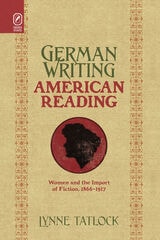
German Writing, American Reading
Women and the Import of Fiction, 1866–1917Lynne Tatlock
The Ohio State University Press, 2012
In postbellum America, publishers vigorously reprinted books that were foreign in origin, and Americans thus read internationally even at a moment of national consolidation. A subset of Americans’ international reading—nearly 100 original texts, approximately 180 American translations, more than 1,000 editions and reprint editions, and hundreds of thousands of books strong—comprised popular fiction written by German women and translated by American women. German Writing, American Reading: Women and the Import of Fiction, 1866–1917 by Lynne Tatlock examines the genesis and circulation in America of this hybrid product over four decades and beyond. These entertaining novels came to the consumer altered by processes of creative adaptation and acculturation that occurred in the United States as a result of translation, marketing, publication, and widespread reading over forty years. These processes in turn de-centered and disrupted the national while still transferring certain elements of German national culture. Most of all, this mass translation of German fiction by American women trafficked in happy endings that promised American readers that their fondest wishes for adventure, drama, and bliss within domesticity and their hope for the real power of love, virtue, and sentiment could be pleasurably realized in an imagined and quaintly old-fashioned Germany—even if only in the time it took to read a novel.
[more]
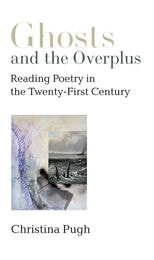
Ghosts and the Overplus
Reading Poetry in the Twenty-First CenturyChristina Pugh
University of Michigan Press, 2024
Ghosts and the Overplus is a celebration of lyric poetry in the twenty-first century and how lyric poetry incorporates the voices of our age as well as the poetic “ghosts” from the past. Acclaimed poet and award-winning teacher Christina Pugh is fascinated by how poems continually look backward into literary history. Her essays find new resonance in poets ranging from Emily Dickinson to Gwendolyn Brooks to the poetry of the present. Some of these essays also consider the way that poetry interacts with the visual arts, dance, and the decision to live life as a nonconformist. This wide-ranging collection showcases the critical discussions around poetry that took place in America over the first two decades of our current millennium. Essay topics include poetic forms continually in migration, such as the sonnet; poetic borrowings across visual art and dance; and the idiosyncrasies of poets who lived their lives against the grain of literary celebrity and trend. What unites all of these essays is a drive to dig more deeply into the poetic word and act: to go beyond surface reading in order to reside longer with poems. In essays both discursive and personal, Pugh shows that poetry asks us to think differently—in a way that gathers feeling into the realm of thought, thereby opening the mysteries that reside in us and in the world around us.
[more]
Gogol's Afterlife
The Evolution of a Classic in Imperial and Soviet RussiaCaryl Emerson
Northwestern University Press, 2002
Gogol's claim to the title of national literary classic is incontestable. An exemplar of popular audiences no less than for the intelligentsia, Gogol was pressed into service under the tsarist and Soviet regimes for causes both aesthetic and political, official and unofficial. In Gogol's Afterlife, Stephen Moeller-Sally explores how he achieved this peculiar brand of cultural authority and later maintained it, despite dramatic shifts in the organization of Russian literature and society.
Part I charts the historical and cultural currents that shaped Gogol's reputation, devoting particular attention to the models of authorship Gogol himself devised in response to his changing audience and developing authorial mission. Part II takes a panoramic view of the social milieu in which Gogol's status evolved. Finally, Part III examines the place of the classics in Soviet culture, with a focus on Gogol's role in the cultural revolution and his peculiar relationship with state power under Stalinism.
Part I charts the historical and cultural currents that shaped Gogol's reputation, devoting particular attention to the models of authorship Gogol himself devised in response to his changing audience and developing authorial mission. Part II takes a panoramic view of the social milieu in which Gogol's status evolved. Finally, Part III examines the place of the classics in Soviet culture, with a focus on Gogol's role in the cultural revolution and his peculiar relationship with state power under Stalinism.
[more]