109 books match the query 'Artificial intelligence' and 5 start with g
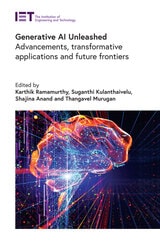
cover of Generative AI Unleashed: Advancements, transformative applications and future frontiers

Generative AI Unleashed

Advancements, transformative applications and future frontiers

Karthik Ramamurthy

The Institution of Engineering and Technology, 2025
Today's generative AI has been marked by the advent of neural networks, inspired by the human brain, which are trained to recognize patterns in a dataset. Once the network is trained, it can make decisions or predictions without being programmed to perform tasks. Generative AI learns from a set of data without explicit instructions and can create and generate new digital content such as text, audio and art. Recent models are beginning to overcome challenges such as computational power, data quality and training stability.
[more]
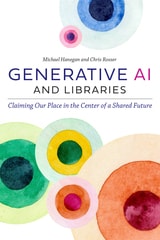
cover of Generative AI and Libraries: Claiming Our Place in the Center of a Shared Future

Generative AI and Libraries

Claiming Our Place in the Center of a Shared Future

Michael Hanegan and Chris Rosser

American Library Association, 2025

In the form of generative AI, libraries are facing technological transformation of unprecedented speed and scale. Both controversial and disruptive, the sudden ubiquity of AI has already triggered uncertainty as well as the need for rapid adaptation. As AI reshapes how humans learn, work, and interact with information, libraries across the ecosystem—from public to academic, from school to special libraries—must resist the temptation to merely serve as static support and instead claim the center by becoming a dynamic, positive influence. Because, as the authors of this book persuasively argue, libraries are uniquely positioned to lead AI’s ethical and human-centered integration within communities. Blending theory and concepts with an unswervingly pragmatic approach, from this book readers will
  • be introduced to foundational principles and frameworks for navigating the so-called “Age of Intelligence” that provide useful guiderails no matter how AI technology actively evolves;
  • delve into the complex ethical considerations of AI, including bias, equity, privacy, misinformation, and the potential impact on human agency and dignity;
  • receive guidance related to stakeholder engagement, resource allocation, and the need for continuous learning and adaptation;
  • discover practical models for evaluating and implementing AI tools thoughtfully and effectively in ways that align with libraries’ values and mission;
  • become familiar with STACKS, an approach for learning, problem solving, and innovation with generative AI;
  • explore AI literacy as an expression of metaliteracy using seven frames for instruction and learning; and
  • walk away with a sense of how libraries can actively define their essential role as leaders and shapers of the AI landscape, ensuring their continued value and preventing marginalization.
As this book demonstrates, by embracing their unique position as ethical stewards and trusted guides, libraries have an unprecedented opportunity to shape how AI transforms society—not from the margins, but from the center of a shared future.
[more]
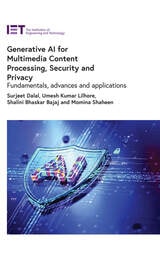
cover of Generative AI for Multimedia Content Processing, Security and Privacy: Fundamentals, advances and applications

Generative AI for Multimedia Content Processing, Security and Privacy

Fundamentals, advances and applications

Surjeet Dalal

The Institution of Engineering and Technology, 2026
Exploring the field of generative artificial intelligence (GenAI) and its use in the processing and security of multimedia content, this co-authored book addresses the critical needs and emerging challenges in the rapidly evolving intersection of artificial intelligence, multimedia content, and cybersecurity. The capabilities of sophisticated GenAI models in generating, improving, and manipulating multimedia information, including images, videos, and audio are thoroughly explored. Coverage also extends to technical innovations including advanced neural network topologies, novel training methods, and methods for boosting GenAI-generated content quality and authenticity.
[more]
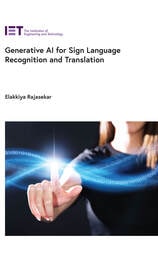
cover of Generative AI for Sign Language Recognition and Translation

Generative AI for Sign Language Recognition and Translation

Elakkiya Rajasekar

The Institution of Engineering and Technology, 2025

Sign languages differ fundamentally from spoken and written languages, with their own grammar, syntax, and three-dimensional expression involving hand gestures, facial expressions, body movements, and spatial relationships. These non-manual elements are crucial in conveying grammatical structures, nuances, and emotional tones, making sign languages uniquely complex communication systems.
[more]
cover of Genesis Redux: Essays in the History and Philosophy of Artificial Life

Genesis Redux

Essays in the History and Philosophy of Artificial Life

Edited by Jessica Riskin

University of Chicago Press, 2007

Since antiquity, philosophers and engineers have tried to take life’s measure by reproducing it. Aiming to reenact Creation, at least in part, these experimenters have hoped to understand the links between body and spirit, matter and mind, mechanism and consciousness. Genesis Redux examines moments from this centuries-long experimental tradition: efforts to simulate life in machinery, to synthesize life out of material parts, and to understand living beings by comparison with inanimate mechanisms.

Jessica Riskin collects seventeen essays from distinguished scholars in several fields. These studies offer an unexpected and far-reaching result: attempts to create artificial life have rarely been driven by an impulse to reduce life and mind to machinery.  On the contrary, designers of synthetic creatures have generally assumed a role for something nonmechanical. The history of artificial life is thus also a history of theories of soul and intellect.

Taking a historical approach to a modern quandary, Genesis Redux is essential reading for historians and philosophers of science and technology, scientists and engineers working in artificial life and intelligence, and anyone engaged in evaluating these world-changing projects.

[more]