Results by title
9 books match the query 'Hands'
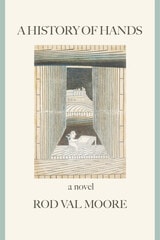
A History of Hands
A NovelRod Val Moore
University of Massachusetts Press, 2014
Soon, however, an elderly and possibly criminal doctor, offering free therapy, moves in, much to the dismay of bedridden Virge. While the physician endeavors to restore the patient's hands with a series of highly suspect injections, Virge recovers his sense of autonomy and an urge to escape the suffocating domestic circumstances that have perhaps caused his illnesses in the first place.
A History of Hands is a novel that invites the reader into a richly and eccentrically detailed world where fevered imaginations and dark comedy prevail, but where the determination to escape the ambiguities of illness leads to the equal ambiguities of health and freedom.
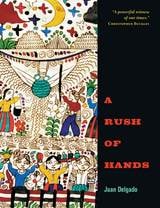
A Rush of Hands
Juan Delgado
University of Arizona Press, 2003
These poems deal honestly with the realities of urban life, whether dramatizing the effects of drive-by shootings, unfolding a labor protest that "spreads across the city like a prayer," or summoning a ghostlike immigrant damned to retrace his journey across the border. Daily and historical struggles are elevated to the level of myth. Yet, amid these poems there are images of life and love: a girl leaving hickeys rich as chocolate, a boy pledging to rescue his mother from poverty, a man studying the desert ground for tracks signaling immigrants in distress.
Delgado is unflinching in showing us the harshness surrounding the lives he cherishes, and with resonant details and lyrical language he urges us to examine those lives-and ultimately our own. A Rush of Hands is a spellbinding book that will captivate both the ear and the heart.
Blessings for the Hands
Matthew Schwartz
University of Chicago Press, 2008
What you feel
reveals you.
Watch
for the sustenance
inclined to a source,
enamored of singularity,
quickly here and quickly
gone, shadow from which
the body's courage comes.
Fireflies
apparently stumbling.
I slapped one on my leg.
Its blood glowed.
Blessings for the Hands follows various speakers—often disabled speakers, who never once figure themselves as objects of complaint or self-pity—through the haunted dreamscape of “normalcy.” Indeed, dreams are continuous presences in this unusually subtle and elegant debut collection that juxtaposes physical circumstances with the vast interior life of the imagination. The subjects of Blessings for the Hands are real and imagined confrontations—and reconciliations—between family members, friends, strangers, and animals. Matthew Schwartz’s quasi-autobiographical verse complicates and clarifies the emotions waiting just underneath the patterns and expectations of the speakers’ daylight lives, where anger, joy, corporeality, and mortality all seem to collide. For Schwartz, poetry is a sleight of hand that keeps the reader guessing through nearly imperceptible shifts between present vision and absent reality. Blessings for the Hands is a lyric reckoning of the tension between the life we are given and the life we are determined to lead.
“Blessings for the Hands is emotionally strong and imaginatively wild, distinctive, deeply moving, without an ort of self-pity, and pervaded by ‘compassion down to your fingertips’ (which Chekhov said is ‘the only method’ both to write and to live). This angle of vision is sharp enough to unify much disparate material. The poems are clear and musical and consequently a pleasure to read and reread despite their gravity. I think this may be lasting work.”—Michael Ryan
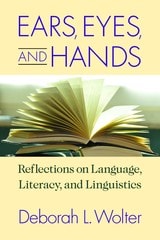
Ears, Eyes, and Hands
Reflections on Language, Literacy, and LinguisticsDeborah L. Wolter
Gallaudet University Press, 2018
Wolter reveals and rectifies the impact of deficit mindsets in the educational system regarding race, ethnicity, economic status, gender, and disability. As a literacy specialist, she works with students who fall through the cracks in a system that strives to embrace the diverse backgrounds and abilities found in the classroom. Her passion for engaging students and cultivating literacy shines in the stories she tells, which serve as parables that allow readers to evaluate their own attitudes and assumptions. Educators, parents, and community members will benefit from Wolter’s examination of sociolinguistics and language privilege as she identifies how ethnocentrism and ableism are contributing to negative educational outcomes for some students. With humor and warmth, she offers a path toward approaching language and listening as a gateway to connection and understanding, both inside the classroom and beyond.
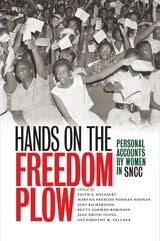
Hands on the Freedom Plow
Personal Accounts by Women in SNCCFaith S. Holsaert
University of Illinois Press, 2012
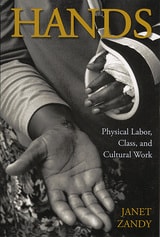
Hands
Physical Labor, Class, and Cultural WorkZandy, Janet
Rutgers University Press, 2004
In linking forms of cultural expression to labor, occupational injuries, and deaths, Hands: Physical Labor, Class, and Cultural Work centers what is usually decentered--the complex culture of working-class people. Janet Zandy begins by examining the literal loss of lives to unsafe jobs and occupational hazards. She asks critical and timely questions about worker representation--who speaks for employees when the mills, mines, factories, and even white-collar cubicles shut down? She presents the voices of working-class writers and artists, and discusses their contribution to knowledge and culture.
This innovative study reveals the flesh and bone beneath the abstractions of labor, class, and culture. It is an essential contribution to the emerging field of working-class studies, offering a hybrid model for bridging communities and non-academic workers to scholars and institutions of knowledge.
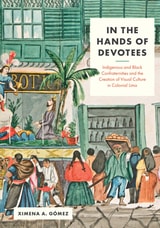
In the Hands of Devotees
Indigenous and Black Confraternities and the Creation of Visual Culture in Colonial LimaXimena A. Gómez
University of Texas Press, 2025
An exploration of how Indigenous and Black communities shaped religious imagery and navigated life in colonial Lima.
Colonial Lima was steeped in Christian devotional imagery. While Spaniards set the norms for these works, it was the city’s Black and Indigenous majority that engaged with them most. As members of lay societies of worshippers called confraternities, subalterns were Lima’s key promoters of religious art, surpassing the colonial hierarchy.
Ximena Gómez argues that, by commissioning and exhibiting sacred images—in chapels and urban processions, adorned with clothing and accessories—Indigenous and Black confraternities created Lima’s visual culture. In one case study, the Indigenous confraternity of the Virgin of Copacabana "invisibly" transforms a sculpture into an object that reflected its multiethnic Andean caretakers. Another case study, that of the confraternity of the Virgin of the Antigua, finds Black worshippers initially united in their interpretation of a Spanish image and later fracturing when some of its members applied a West African interpretive lens. Taking advantage of Lima’s rich documentary record, In the Hands of Devotees centers the ritual practices of Black and Indigenous people and opens possibilities for incorporating subalterns into the history of Lima’s art when limited extant visual evidence has survived.
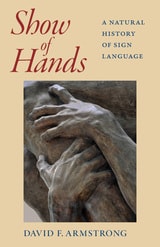
Show of Hands
A Natural History of Sign LanguageDavid F. Armstrong
Gallaudet University Press, 2011
Most scholarly speculation on the origin of human language has centered around speech. However, the growing understanding of sign languages on human development has transformed the debate on language evolution. David F. Armstrong’s new book Show of Hands: A Natural History of Sign Language casts a wide net in history and geography to explain how these visible languages have enriched human culture in general and how their study has expanded knowledge of the human condition.
Armstrong addresses the major theories of language evolution, including Noam Chomsky’s thesis of an innate human “organ” for language and Steven Pinker’s contention that there is language and not-language without any gradations between gesture and language. This engrossing survey proceeds with William C. Stokoe’s revival of the early anthropological cognitive-linguistic model of gradual development through the iconicity of sign languages. Armstrong ranges far to reveal the nature of sign languages, from the anatomy of early human ancestors to telling passages by Shakespeare, Dickens, and Pound, to the astute observations of Socrates, Lucretius, and Abbé de l’Epée on sign communication among deaf people. Show of Hands illustrates the remarkable development of sign languages in isolated Bedouin communities and among Australian indigenous peoples. It also explores the ubiquitous benefits of “Deaf Gain” and visual communication as they dovetail with the Internet and its mushrooming potential for the future.
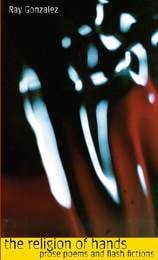
The Religion of Hands
Prose Poems and Flash FictionsRay Gonzalez
University of Arizona Press, 2005
The Religion of Hands does not foster sleep. Look quickly and you will catch the hint of a fox streaking in front of your car’s headlights at night. Look more carefully out your bedroom window and you may see your life going by, lost loved ones waving hello.
"Who were you when the stars were misinterpreted as the fingertips of God?"
Ray Gonzalez blends symbolic play with lyrical beauty as he works from a vast and complex palette to infuse popular culture with myth. The Religion of Hands is imbued with magical realism: a suffocating dream of tamales, mysterious reptilian allusions, a man who "finds God walking down the stairs to hand him an old, tattered phonebook from the year he was born." It offers strange prophecies: "A steady vegetation will grow across the empire as more homeboys are killed in drive-bys. . . . Microscopic scratches on an old vinyl record will form a message discovered in twenty more years when the album is bought at a garage sale." And in 14 flash fictions, it tells of a tiny old man kept in a glass jar, an accordion stored in an old family trunk, tales of sharks and bandits. The religion of hands has its own unspoken sacraments. "The fingers take over, teaching whoever holds the moment that the rapid weight of the open hands is a dangerous way to live."
Seamlessly, effortlessly, multi-dexterously, Ray Gonzalez spins words that speak our very dreams.