Results by title
63 books match the query 'Bolivia' and 3 start with g
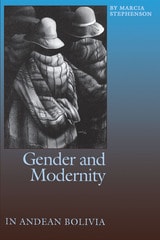
Gender and Modernity in Andean Bolivia
By Marcia Stephenson
University of Texas Press, 1999
In Andean Bolivia, racial and cultural differences are most visibly marked on women, who often still wear native dress and speak an indigenous language rather than Spanish. In this study of modernity in Bolivia, Marcia Stephenson explores how the state's desire for a racially and culturally homogenous society has been deployed through images of womanhood that promote the notion of an idealized, acculturated female body.
Stephenson engages a variety of texts—critical essays, novels, indigenous testimonials, education manuals, self-help pamphlets, and position papers of diverse women's organizations—to analyze how the interlocking tropes of fashion, motherhood, domestication, hygiene, and hunger are used as tools for the production of dominant, racialized ideologies of womanhood. At the same time, she also uncovers long-standing patterns of resistance to the modernizing impulse, especially in the large-scale mobilization of indigenous peoples who have made it clear that they will negotiate the terms of modernity, but always "as Indians."

Gods and Vampires
Return to ChipayaNathan Wachtel
University of Chicago Press, 1994
Wachtel discovered that a series of recent deaths and misfortunes in Chipaya had been attributed to the evil powers of the Urus, a group usually regarded with suspicion by the other ethnic groups. Those incarcerated were believed to be the chief sorcerers and vampires whose paganistic practices had brought death to Chipaya by upsetting the social order. Wachtel's investigation, told in Gods and Vampires: Back to Chipaya, reveals much about relations between the Urus and the region's dominant ethnic groups and confronts some of the most trenchant issues in contemporary anthropology. His analysis shows that the Urus had become victims of the same set of ideals the Spanish had used, centuries before, to establish their hegemony in the region.
Presented as a personal detective story, Gods and Vampires is Wachtel's latest work in a series studying the ongoing impact of the Spanish conquest on the Andean consciousness and social system. Its insight into Bolivian society and the legacy of hegemony confronts some of the most trenchant issues in contemporary anthropologyand will be of great interest to scholars of anthropology, Latin American studies, and Native American studies.
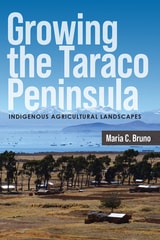
Growing the Taraco Peninsula
Indigenous Agricultural LandscapesMaria C. Bruno
University Press of Colorado, 2024
Beginning with the first small-scale communities of the Formative period (1500 BCE–500 CE) through the development of the Tiwanaku state (500–1100 CE), Bruno draws upon ethnographic insights from modern-day Indigenous farming practices on the peninsula as well as archaeological evidence from excavations at four sites to explore the landscapes and human-plant relationships that Taraco communities created through their agricultural practices. Through evaluation of environmental data on climate and land-use dynamics—rainfall, lake level, and soil character and distribution—she proposes a new hypothesis of how raised-field agriculture may have emerged in the region. With a detailed analysis of foodways at the Kala Uyuni site, her study reveals how Indigenous Taraco communities sustainably incorporated crops and wild plants into their daily and special-occasion meals, connecting the agricultural landscapes to local and regional social and political dynamics.
Bringing together several indicators of the region’s long-term history and demonstrating that shifts in agriculture do not neatly correspond to the changes traditionally highlighted by archaeological culture histories, Growing the Taraco Peninsula reveals Indigenous landscape creation through farming on the Taraco peninsula as a critical example of sustainability. This valuable contribution to Andean archaeology is also of interest to scholars, students, and the general reader concerned about the environment, sustainable farming, sustainability, Andean history, and the Indigenous peoples of the Americas.