Results by title
282 books match the query 'Caribbean & West Indies' and 2 start with g

Gender and Violence in Haiti
Women’s Path from Victims to AgentsBenedetta Faedi Duramy
Rutgers University Press, 2014
Women in Haiti are frequent victims of sexual violence and armed assault. Yet an astonishing proportion of these victims also act as perpetrators of violent crime, often as part of armed groups. Award-winning legal scholar Benedetta Faedi Duramy visited Haiti to discover what causes these women to act in such destructive ways and what might be done to stop this tragic cycle of violence.
Gender and Violence in Haiti is the product of more than a year of extensive firsthand observations and interviews with the women who have been caught up in the widespread violence plaguing Haiti. Drawing from the experiences of a diverse group of Haitian women, Faedi Duramy finds that both the victims and perpetrators of violence share a common sense of anger and desperation. Untangling the many factors that cause these women to commit violence, from self-defense to revenge, she identifies concrete measures that can lead them to feel vindicated and protected by their communities.
Faedi Duramy vividly conveys the horrifying conditions pervading Haiti, even before the 2010 earthquake. But Gender and Violence in Haiti also carries a message of hope—and shows what local authorities and international relief agencies can do to help the women of Haiti.
[more]
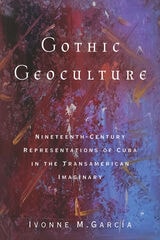
Gothic Geoculture
Nineteenth-Century Representations of Cuba in the Transamerican ImaginaryIvonne M. García
The Ohio State University Press, 2019
In the nineteenth century, the island of Cuba was a popular site for US travelers, who wrote dozens of travelogues about their experiences. At the same time, Cuban exiles living in the United States, escaping from Spanish colonial repression, wrote about their island and about their US experiences. Within the trove of writings about Cuba in relation to slavery and a rising US empire in the region, Ivonne M. García’s Gothic Geoculture: Nineteenth-Century Representations of Cuba in the Transamerican Imaginary shows how a group of writers, on both sides, used the language of fear to construct gothicizations of the island (and of the United States) through tropes of corruption, doubleness, and monstrosity. García coins the term “gothic geoculture” to show Cuba’s identity in the nineteenth century as existing at the crossroads between colonialism, slavery, and transamericanity. Specifically looking at a period of colonial anxiety between 1830 and 1890, García exposes the ways some writers code Cuba as dangerous and destructive, demonstrating how these transamerican figurations created a series of uncanny simultaneities that expand on and complicate the ways we understand how Cuba and the hemisphere were imagined at that time.
[more]