Results by title
617 books match the query 'Civil War Period (1850-1877)' and 14 start with g
Gangrene and Glory
Medical Care during the American Civil WarFrank R. Freemon
University of Illinois Press, 1998
A medical doctor and a credentialed historian, Frank R. Freemon combines poignant, sometimes horrifying anecdotes of amputation, infection, and death with a clearheaded discussion of the state of medical knowledge, the effect of the military bureaucracy on medical supplies, and the members of the medical community who risked their lives, their health, and even their careers to provide appropriate care to the wounded. Freemon examines the impact on major campaigns--Manassas, Gettysburg, Vicksburg, Shiloh, Atlanta--of ignorance, understaffing, inexperience, overcrowded hospitals, insufficient access to ambulances, and inadequate supplies of essentials such as quinine.
Presenting the medical side of the war from a variety of perspectives--the Union, the Confederacy, doctors, nurses, soldiers, and their families--Gangrene and Glory achieves a peculiar immediacy by restricting its scope to the knowledge and perceptions available to its nineteenth-century subjects. Now available for the first time in paperback, this important volume takes a hard, close look at a neglected and crucial aspect of this bloody conflict.

Gendered Strife and Confusion
The Political Culture of ReconstructionLaura F. Edwards
University of Illinois Press, 1997

General John Pope
A LIFE FOR THE NATIONPeter Cozzens
University of Illinois Press, 2000
Renowned Civil War scholar Peter Cozzens has mined Pope's own memoirs and a wealth of other primary sources to provide a complete picture of this gifted strategist. Uncovering new information about Pope's pre- and postwar career and his path to power, Cozzens delineates the political environment that surrounded Pope and provided the context for his actions.
Cozzens examines Pope's early career first as commander of the Army of the Mississippi and then as leader of a hastily formed Army of Virginia against Robert E. Lee. After his famous defeat at the Second Battle of Bull Run, Pope was sent to the frontier. There he held important commands on the western plains over the next twenty-four years, all the while struggling to clear his reputation of the events at Second Bull Run. A principal architect of the Red River War, which broke the resistance of the Southern Plains Indians, Pope espoused humanitarian treatment of subjugated tribes and was recognized as one of the army's leading authorities on Indian affairs.
In place of the simplistic caricature that has satisfied most historians, Cozzens has crafted an accurate, humane, balanced portrait of a complex man involved with the most complex issues of his day. A monumental work on a long-neglected figure, General John Pope offers a fresh look at a key nineteenth-century military leader as well as the most detailed analysis available of Federal leadership during the Second Bull Run campaign.

Georgia Civil War Manuscript Collections
An Annotated BibliographyDavid H. Slay
University of Alabama Press, 2011
German Americans on the Middle Border
From Antislavery to Reconciliation, 1830–1877Zachary Stuart Garrison
Southern Illinois University Press, 2020
Liberal German immigrants, having escaped the European aristocracy who undermined their revolution and the formation of a free nation, viewed slaveholders as a specter of European feudalism. During the antebellum years, many liberal German Americans feared slavery would inhibit westward progress, and so they embraced the Free Soil and Free Labor movements and the new Republican Party. Most joined the Union ranks during the Civil War.
After the war, in a region largely opposed to black citizenship and Radical Republican rule, German Americans were seen as dangerous outsiders. Facing a conservative resurgence, liberal German Republicans employed the same line of reasoning they had once used to justify emancipation: A united nation required the end of both federal occupation in the South and special protections for African Americans. Having played a role in securing the Union, Germans largely abandoned the freedmen and freedwomen. They adopted reconciliation in order to secure their place in the reunified nation. Garrison’s unique transnational perspective to the sectional crisis, the Civil War, and the postwar era complicates our understanding of German Americans on the middle border.
Getting Used to Being Shot At
Mark K. Christ
University of Arkansas Press, 2002
Gettysburg, Time and Again
Restaging America and Its Civil Wars TodayMads Daugbjerg
University of Massachusetts Press, 2027
Tracing how the Civil War continues to shape the landscapes, politics, and culture of today
Every year, thousands of Americans don Civil War uniforms and restage the bloodiest battle ever fought on American soil. In Gettysburg, Time and Again, Mads Daugbjerg explores how the Civil War continues to inhabit the present. Bringing together reenactors, National Park Service rangers, ghost hunters, tourists, and local residents, this study examines how Americans across social and political divides engage the past through the landscapes, institutions, and everyday practices of public history.
At once historically grounded and urgently contemporary, this book speaks directly to current struggles over the meaning of America and its values. Rather than treating time and history as abstract concepts, Daugbjerg approaches them as lived, material forces produced through commemorative landscapes, interpretive labor, and the relentless restaging of 1863 for contemporary audiences. Studying reenactment illuminates not only a distinctive cultural practice but also the broader processes through which the past is continuously reshaped, repeated, and felt in the present. He argues that present-day American unrest can be understood, in part, as a conflict over how the past is curated. He further suggests that Americans today often occupy profoundly different temporal worlds.
Daugbjerg traces these tensions through landscapes, material culture, tourism infrastructures, and social life at Gettysburg. Challenging the commonsense notion of history as linear progression, Gettysburg, Time and Again reveals repetition as a defining feature of American historical experience. By offering a finely grained anthropology of the “present past,” Daugbjerg shows how history’s afterlives remain powerfully out of sync and why those temporal disjunctions matter now.

Gettysburg
The Living and the DeadKent Gramm. Photographs by Chris Heisey
Southern Illinois University Press, 2019
Creative nonfiction, fiction, dramatic dialogue, and poetry combine with full-color photographs to convey the essential reality of the famous battlefield as a place both terrible and beautiful. The living and the dead contained here include Confederates and Yankees, soldiers and civilians, male and female, young and old. Visitors to the battlefield after 1863, both well known and obscure, provide the voices of the living. They include a female admiral in the U.S. Navy and a man from rural Virginia who visits the battlefield as a way of working through the death of his son in Iraq. The ghostly voices of the dead include actual participants in the battle, like a fiery colonel and a girl in Confederate uniform, as well as their representatives, such as a grieving widow who has come to seek her husband.
Utilizing light as a central motif and fourscore and seven voices to evoke how Gettysburg continues to draw visitors and resound throughout history, alternately wounding and stitching the lives it touches, Gramm’s words and Heisey’s photographs meld for a historical experience unlike any other. Gettysburg: The Living and the Dead offers a panoramic view wherein the battle and battlefield of Gettysburg are seen through the eyes of those who lived through it and died on it as well as those who have sought meaning at the site ever since.
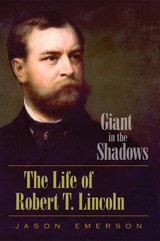
Giant in the Shadows
The Life of Robert T. LincolnJason Emerson
Southern Illinois University Press, 2012
University Press Books for Public and Secondary Schools, 2013 edition
Book of the Year by the Illinois State historical Society, 2013
Although he was Abraham and Mary Lincoln’s oldest and last surviving son, the details of Robert T. Lincoln’s life are misunderstood by some and unknown to many others. Nearly half a century after the last biography about Abraham Lincoln’s son was published, historian and author Jason Emerson illuminates the life of this remarkable man and his achievements in Giant in the Shadows: The Life of Robert T. Lincoln. Emerson, after nearly ten years of research, draws upon previously unavailable materials to offer the first truly definitive biography of the famous lawyer, businessman, and statesman who, much more than merely the son of America’s most famous president, made his own indelible mark on one of the most progressive and dynamic eras in United States history.
Born in a boardinghouse but passing his last days at ease on a lavish country estate, Robert Lincoln played many roles during his lifetime. As a president’s son, a Union soldier, an ambassador to Great Britain, and a U.S. secretary of war, Lincoln was indisputably a titan of his age. Much like his father, he became one of the nation’s most respected and influential men, building a successful law practice in the city of Chicago, serving shrewdly as president of the Pullman Car Company, and at one time even being considered as a candidate for the U.S. presidency.
Along the way he bore witness to some of the most dramatic moments in America’s history, including Robert E. Lee’s surrender at Appomattox Courthouse; the advent of the railroad, telephone, electrical, and automobile industries; the circumstances surrounding the assassinations of three presidents of the United States; and the momentous presidential election of 1912. Giant in the Shadows also reveals Robert T. Lincoln’s complex relationships with his famous parents and includes previously unpublished insights into their personalities. Emerson reveals new details about Robert’s role as his father’s confidant during the brutal years of the Civil War and his reaction to his father’s murder; his prosecution of the thieves who attempted to steal his father’s body in 1876 and the extraordinary measures he took to ensure it would never happen again; as well as details about the painful decision to have his mother committed to a mental facility. In addition Emerson explores the relationship between Robert and his children, and exposes the actual story of his stewardship of the Lincoln legacy—including what he and his wife really destroyed and what was preserved. Emerson also delves into the true reason Robert is not buried in the Lincoln tomb in Springfield but instead was interred at Arlington National Cemetery.
Meticulously researched, full of never-before-seen photographs and new insight into historical events, Giant in the Shadows is the missing chapter of the Lincoln family story. Emerson’s riveting work is more than simply a biography; it is a tale of American achievement in the Gilded Age and the endurance of the Lincoln legacy.
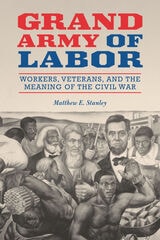
Grand Army of Labor
Workers, Veterans, and the Meaning of the Civil WarMatthew E. Stanley
University of Illinois Press, 2021
From the Gilded Age through the Progressive era, labor movements reinterpreted Abraham Lincoln as a liberator of working people while workers equated activism with their own service fighting for freedom during the war. Matthew E. Stanley explores the wide-ranging meanings and diverse imagery used by Civil War veterans within the sprawling radical politics of the time. As he shows, a rich world of rituals, songs, speeches, and newspapers emerged among the many strains of working class cultural politics within the labor movement. Yet tensions arose even among allies. Some people rooted Civil War commemoration in nationalism and reform, and in time, these conservative currents marginalized radical workers who tied their remembering to revolution, internationalism, and socialism.
An original consideration of meaning and memory, Grand Army of Labor reveals the complex ways workers drew on themes of emancipation and equality in the long battle for workers’ rights.
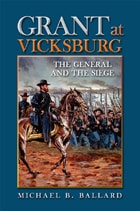
Grant at Vicksburg
The General and the SiegeMichael B. Ballard
Southern Illinois University Press, 2013
After an overview of Grant’s early Civil War career from his first battle through the early stages of the attacks on Vicksburg, Ballard describes in detail how Grant conducted the siege, examining his military decisions, placement of troops, strategy and tactics, engineering objectives, and relationships with other officers. Grant’s worried obsession with a perceived danger of a rear attack by Joseph Johnston’s Confederate army, Ballard shows, affected his decision making, and shows how threats of Confederate action occupied more of Grant’s time than did the siege itself.
In addition, Ballard soundly dispels a false story about Grant’s alleged drinking binge early in the siege that has been taken as truthful by many historians, examines how racism in Grant’s army impacted the lives of freed black people and slaves in the Vicksburg area, and explores Grant’s strained relationship with John McClernand, a politically appointed general from Illinois. The book concludes with the surrender of Vicksburg on July 4, 1863, the expulsion of Johnston and his army from the region, and demonstrates the impact of the siege on the outcome on the short and long-terms of Grant’s military career.
By analyzing Grant’s personality during the siege and how he dealt with myriad issues as both a general and an administrator, Grant at Vicksburg offers a revealing rendering of the legendary general.
Guerrillas, Unionists, and Violence on the Confederate Home Front
Daniel E. Sutherland
University of Arkansas Press, 1999
Guide to Missouri Confederate Units, 1861-1865
James E. McGhee
University of Arkansas Press, 2010
Gunboats, Muskets, and Torpedoes
Coastal North Carolina, 1861–1865Michael G. Laramie
Westholme Publishing, 2027
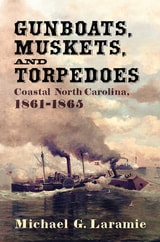
From the first shots at Cape Hatteras in the summer of 1861 to the fall of Fort Fisher in early 1865, the contest for coastal North Carolina during the American Civil War was crucial to the Union victory. With a clear naval superiority over the South, the North conducted blockading and amphibious operations from Virginia to Texas, including the three-hundred-mile seacoast of North Carolina. With its Pamlico and Albemarle Sounds—fed by navigable rivers that reached deep into the interior—and major Confederate port of Wilmington, the Carolina coast was essential for the distribution of foreign goods and supplies to Confederate forces in Virginia and elsewhere. If the Union was able to capture Wilmington or advance on the interior waters, they would cripple the South’s war efforts.
In Gunboats, Muskets, and Torpedoes: Coastal North Carolina, 1861–1865, award-winning historian Michael G. Laramie chronicles both the battle over supplying the South by sea as well as the ways this region proved to be a fertile ground for the application of new technologies. With the advent of steam propulsion, the telegraph, rifled cannon, repeating firearms, ironclads, and naval mines, the methods and tactics of the old wooden walls soon fell to those of this first major conflict of the industrial age. Soldiers and sailors could fire farther and faster than ever before. With rail transportation available, marches were no longer weeks but days or even hours, allowing commanders to quickly shift men and materials to meet an oncoming threat or exploit an enemy weakness. Fortifications changed to meet the challenges imposed by improved artillery, while the telegraph stretched the battlefield even further. Yet for all the technological changes, many of which would be harbingers of greater conflicts to come, the real story of this strategic coast is found in the words and actions of the soldiers and sailors who vied for this region for nearly four years. It is here, where the choices made—whether good or bad, misinformed, or not made at all—intersected with logistical hurdles, geography, valor, and fear to shape the conflict; a conflict thatwould ultimately set the postwar nation on track to becoming a modern naval power.