Results by title
122 books match the query 'Climatic changes' and 10 start with g
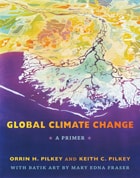
Global Climate Change
A PrimerOrrin H. Pilkey and Keith C. Pilkey
Duke University Press, 2011
After explaining the greenhouse effect, Pilkey, writing with son Keith, turns to the damage it is causing: sea level rise, ocean acidification, glacier and sea ice melting, changing habitats, desertification, and the threats to animals, humans, coral reefs, marshes, and mangroves. These explanations are accompanied by Mary Edna Fraser’s stunning batiks depicting the large-scale arenas in which climate change plays out.
The Pilkeys directly confront and rebut arguments typically advanced by global change deniers. Particularly valuable are their discussions of “Climategate,” a manufactured scandal that undermined respect for the scientific community, and the denial campaigns by the fossil fuel industry, which they compare to the tactics used by the tobacco companies a generation ago to obfuscate findings on the harm caused by cigarettes.
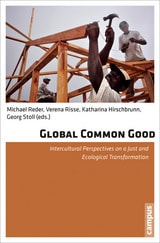
Global Common Good
Intercultural Perspectives on a Just and Ecological TransformationEdited by Michael Reder, Verena Risse, Katharina Hirschbrunn, and Georg Stoll
Campus Verlag, 2015
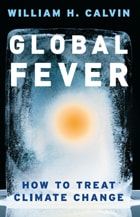
Global Fever
How to Treat Climate ChangeWilliam H. Calvin
University of Chicago Press, 2008
With Global Fever, William H. Calvin delivers both a clear-eyed diagnosis and a strongly worded prescription. In striking, straightforward language, he first clearly sets out the current state of the Earth’s warming climate and the disastrous possibilities ahead should we continue on our current path. Increasing temperatures will kill off vegetation and dry up water resources, and their loss will lead, in an increasingly destructive feedback loop, to even more warming. Resource depletion, drought, and disease will follow, leading to socioeconomic upheaval—and accompanying violence—on a scale barely conceivable.
It is still possible, Calvin argues, to avoid such a dire fate. But we must act now, aggressively funneling resources into jump-starting what would amount to a third industrial revolution, this one of clean technologies—while simultaneously expanding our use of existing low-emission technologies, from nuclear power to plug-in hybrid vehicles, until we achieve the necessary scientific breakthroughs.
Passionately written, yet thoroughly grounded in the latest climate science, Global Fever delivers both a stark warning and an ambitious blueprint for saving the future of our planet.
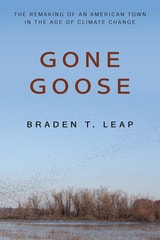
Gone Goose
The Remaking of an American Town in the Age of Climate ChangeBraden T. Leap
Temple University Press, 2019
Sumner, MO, pop. 102, near the Swan Lake National Wildlife Refuge, proclaims itself “The Wild Goose Capital of the World.” It even displays Maxie, the World’s largest goose: a 40-foot tall fiberglass statue with a wingspan stretching more than 60 feet. But while the 200,000 Canada geese that spent their falls and winters at Swan Lake helped generate millions of dollars for the local economy—with hunting and the annual Goose Festival—climate change, as well as environmental and land use issues, have caused the birds to disappear. The economic loss of the geese and the activities they inspired served as key building blocks in the rural identities residents had developed and treasured.
In his timely and topical book, Gone Goose, Braden Leap observes how members of this rural town adapted, reorganized, and reinvented themselves in the wake of climate change—and how they continued to cultivate respect and belonging in their community. Leap conducted interviews with residents and participated in various community events to explore how they reimagine their relationships with each other as well as their community’s relationship with the environment, even as they wish the geese would return.
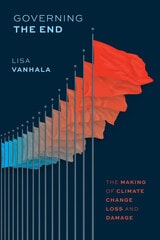
Governing the End
The Making of Climate Change Loss and DamageLisa Vanhala
University of Chicago Press, 2025
A searing account of how the international community is trying—and failing—to address the worst effects of climate change and the differential burdens borne by rich and poor countries.
Climate change is increasingly accepted as a global emergency creating irrevocable losses for the planet. Yet, each country experiences these losses differently, and reaching even inadequate political agreements is fraught with contestation. Governing the End untangles the complex relationship between deteriorating environmental conditions, high politics, and everyday diplomatic practices, focusing on the United Nations’ agreement to address “loss and damage” and subsequent battles over implementation.
Lisa Vanhala looks at the differing assumptions and strategic framings that poor and rich countries bring to bear and asks why some norms emerge and diffuse while others fail to do so. Governing the End is based on ethnographic observation of eight years of UN meetings and negotiations and more than one hundred and fifty interviews with diplomats, policymakers, UN secretariat staff, experts, and activists. It explores explicit political contestation, as well as the more clandestine politics that have stymied implementation and substantially reduced the scope of compensation to poor countries. In doing so, Governing the End elucidates the successes and failures of international climate governance, revealing the importance of how ideas are constructed and then institutionally embodied.
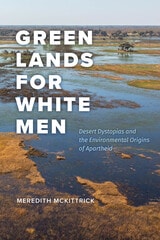
Green Lands for White Men
Desert Dystopias and the Environmental Origins of ApartheidMeredith McKittrick
University of Chicago Press, 2024
In 1918, South Africa’s climate seemed to be drying up. White farmers claimed that rainfall was dwindling, while nineteenth-century missionaries and explorers had found riverbeds, seashells, and other evidence of a verdant past deep in the Kalahari Desert. Government experts insisted, however, that the rains weren’t disappearing; the land, long susceptible to periodic drought, had been further degraded by settler farmers’ agricultural practices—an explanation that white South Africans rejected. So when the geologist Ernest Schwarz blamed the land itself, the farmers listened. Schwarz held that erosion and topography had created arid conditions, that rainfall was declining, and that agriculture was not to blame. As a solution, he proposed diverting two rivers to the Kalahari’s basins, creating a lush country where white South Africans could thrive. This plan, which became known as the Kalahari Thirstland Redemption Scheme, was rejected by most scientists. But it found support among white South Africans who worried that struggling farmers undermined an image of racial superiority.
Green Lands for White Men explores how white agriculturalists in southern Africa grappled with a parched and changing terrain as they sought to consolidate control over a Black population. Meredith McKittrick’s timely history of the Redemption Scheme reveals the environment to have been central to South African understandings of race. While Schwarz’s plan was never implemented, it enjoyed sufficient support to prompt government research into its feasibility, and years of debate. McKittrick shows how white farmers rallied around a plan that represented their interests over those of the South African state and delves into the reasons behind this schism between expert opinion and public perception. This backlash against the predominant scientific view, McKittrick argues, displayed the depth of popular mistrust in an expanding scientific elite.
A detailed look at the intersection of a settler society, climate change, white nationalism, and expert credibility, Green Lands for White Men examines the reverberations of a scheme that ultimately failed but influenced ideas about race and the environment in South Africa for decades to come.
Greening Africana Studies
Linking Environmental Studies with Transforming Black ExperiencesRubin Patterson
Temple University Press, 2014
In his original work, Patterson demonstrates the ways in which black communities are harmed by local environmental degradation and global climate change. He shows that many local unwanted land use sites (LULUs), such as brownfields and toxic release inventory facilities, are disproportionately located in close proximity to neighborhoods of color, but also to colleges and universities with Africana studies programs. Arguing that such communities are not aggressively engaging in environmental issues, Greening Africana Studies also provides examples of how Africana studies students as well as members of black communities can prepare for green careers.
Grief for the Green That Was
Jacob Shores-Argüello
University of Arizona Press, 2026
Moving tenderly across memory, continents, and literary forms, Jacob Shores-Argüello’s tightly woven cross-genre collection evolves a private family bereavement into an exploration of collective ecological grief. Following the death of his mother, the speaker navigates between his Costa Rican heritage and his Oklahoma upbringing, eventually arriving at something like healing on the banks of New Zealand’s Whanganui River—the first river in the world granted legal personhood.
Structured around a Spanish nursery rhyme, Grief for the Green That Was finds solace in the prospect of citizenship for a more-than-human world, a possibility it approaches through perspectival shifts and innovative forms—including footnoted poems, hybrid fiction, and an experimental choose-your-own-adventure sequence—that overturn lyric and storytelling conventions.
A book about what we inherit and what we leave behind, both in families and in landscapes, Grief for the Green That Was examines how climate change affects not just the physical world but also our emotional and spiritual relationships to place. Here Shores-Argüello creates a new language for twenty-first-century grief that refuses to separate the personal from the planetary.
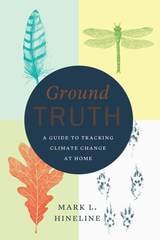
Ground Truth
A Guide to Tracking Climate Change at HomeMark L. Hineline
University of Chicago Press, 2018
We know that the Earth’s climate is changing, and that the magnitude of this change is colossal. At the same time, the world outside is still a natural world, and one we can experience on a granular level every day. Ground Truth is a guide to living in this condition of changing nature, to paying attention instead of turning away, and to gathering facts from which a fuller understanding of the natural world can emerge over time.
Featuring detailed guidance for keeping records of the plants, invertebrates, amphibians, birds, and mammals in your neighborhood, this book also ponders the value of everyday observations, probes the connections between seasons and climate change, and traces the history of phenology—the study and timing of natural events—and the uses to which it can be put. An expansive yet accessible book, Ground Truth invites readers to help lay the groundwork for a better understanding of the nature of change itself.
Gwich’in Climate Report
compiled and edited by Matt Gilbert
University of Alaska Press, 2022
These interview subjects are at a “ground zero” of climate change, and their voices are largely absent from popular research on and discussion of the topic. Their traditional knowledge of Arctic flora and fauna, forestation, landforms, meteorology, airstream behavior, and river hydrology makes a significant contribution to the documentation of climate change. In addition, Gilbert bridges the Gwich’in worldview and that of Western science by including factual substantiation and citations that corroborate key observations in the Gwich’in transcripts.
A text that matters for its cultural and historical significance—as well as its potential impact on the way science and policy are conducted in rural Alaska and on public lands—TheGwich’in Climate Report will be of interest to residents of and stakeholders in the communities it represents as well as researchers concerned with on-the-ground conditions of ecosystems and Indigenous peoples most directly affected by climate change.