161 books match the query 'Cuba' and 3 start with g

cover of Gay Cuban Nation

Gay Cuban Nation

Emilio Bejel

University of Chicago Press, 2001
With Gay Cuban Nation, Emilio Bejel looks at Cuba's markedly homoerotic culture through writings about homosexuality, placing them in the social and political contexts that led up to the Cuban Revolution. By reading against the grain of a wide variety of novels, short stories, autobiographies, newspaper articles, and films, Bejel maps out a fascinating argument about the way in which different attitudes toward power and nationalism struggle for an authoritative stance on homosexual issues. Through close readings of writers such as José Martí, Alfonso Hernández-Catá, Carlos Montenegro, José Lezama Lima, Leonardo Padura Fuentes, and Reinaldo Arenas, whose heartbreaking autobiography, Before Night Falls, has enjoyed renewed popularity, Gay Cuban Nation shows that the category of homosexuality is always lurking, ghostlike, in the shadows of nationalist discourse. The book stakes out Cuba's sexual battlefield, and will challenge the homophobia of both Castro's revolutionaries and Cuban exiles in the States.
[more]
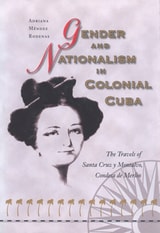
cover of Gender and Nationalism in Colonial Cuba: The Travels of Santa Cruz y Montalvo, Condesa de Merlin

Gender and Nationalism in Colonial Cuba

The Travels of Santa Cruz y Montalvo, Condesa de Merlin

Adriana Mendez Rodenas

Vanderbilt University Press, 1998

Author of novels, memoirs, and travel writings, Maria de las Mercedes Santa Cruz y Montalvo, better known as la Condesa de Merlin (1789-1852), is arguably one of Cuba's most engaging authors; yet until now her works have gone largely ignored.

Born in colonial Havana to an aristocratic Creole family, the future countess of Merlin left Cuba for Spain at an early age. Later, her marriage to the French count Antoine Christophe Merlin and the invasion of French Napoleonic troops precipitated another move to France, where she became one of the belle dames of Paris and began her literary career. She returned only once to Cuba after the death of her husband in 1840, a journey that produced Viaje a la Habana. Upon her return to Paris, Merlin expanded this into La Havane, an ambitious three-volume account of the political, social, and economic organization of the island.

From the viewpoint of feminist and psychoanalytical theory, Gender and Nationalism in Colonial Cuba brilliantly explores the many ways in which issues of gender have contributed to Merlin's virtual absence from the canons of literature and from the discourses on Cuban national identity. Merlin's double identity as both Cuban and French is symbolic of the Cuban exiled condition, a fact taken up by contemporary exiled Cuban writers who see the countess as an alter-ego.

Mendez Rodenas seeks to restore Merlin as the first woman writer in Cuban literary history to articulate a sense of national identity, as well as being Cuba's first female historian. She focuses on Merlin's travel writings because they examine such issues as slavery, independence, nationhood, the role of women, education, and local literature. Together her writings construct an alternative, gendered history of nineteenth-century Cuba that must be acknowledged as both functional and authentic.

By situating Merlin at the intersection of the discourses of gender and nationalism, Mendez Rodenas reveals not only her pioneering role but also the need to expand current critical categories to account for the specificity of the Latin American literary tradition. In the process of restoring Merlin to her appropriate place in the canon of Latin American literature, she broadens our understanding of colonial Cuban history and expands our knowledge of the ways in which travel writing can influence a country's national literature .
[more]
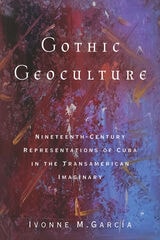
cover of Gothic Geoculture: Nineteenth-Century Representations of Cuba in the Transamerican Imaginary

Gothic Geoculture

Nineteenth-Century Representations of Cuba in the Transamerican Imaginary

Ivonne M. García

The Ohio State University Press, 2019

In the nineteenth century, the island of Cuba was a popular site for US travelers, who wrote dozens of travelogues about their experiences. At the same time, Cuban exiles living in the United States, escaping from Spanish colonial repression, wrote about their island and about their US experiences. Within the trove of writings about Cuba in relation to slavery and a rising US empire in the region, Ivonne M. García’s Gothic Geoculture: Nineteenth-Century Representations of Cuba in the Transamerican Imaginary shows how a group of writers, on both sides, used the language of fear to construct gothicizations of the island (and of the United States) through tropes of corruption, doubleness, and monstrosity. García coins the term “gothic geoculture” to show Cuba’s identity in the nineteenth century as existing at the crossroads between colonialism, slavery, and transamericanity. Specifically looking at a period of colonial anxiety between 1830 and 1890, García exposes the ways some writers code Cuba as dangerous and destructive, demonstrating how these transamerican figurations created a series of uncanny simultaneities that expand on and complicate the ways we understand how Cuba and the hemisphere were imagined at that time.
 
[more]