628 books match the query 'Democracy' and 7 start with g

cover of Georges Bataille: A Critical Introduction

Georges Bataille

A Critical Introduction

Benjamin Noys

Pluto Press, 2000

This is a guide to the life and work of the French intellectual Georges Bataille, best known as the author of the celebrated erotic novel, The Story of the Eye. Benjamin Noys introduces Bataille as a writer out of step with the dominant intellectual trends of his day - surrealism and existentialism - and shows that it was his very marginality that accounted in large part for his subsequent importance for the post-structuralists and the counterculture, in Europe and in the United States.

Treating Bataille's work as a whole rather than focusing, as other studies have done, on aspects of his work (i.e. as social theory or philosophy), Noys' study is intended to be sensitive to the needs of students new to Bataille's work  while at the same time drawing on the latest research on Bataille to offer new interpretations of Bataille's oeuvre for more experienced readers. This is the first clear, introductory reading of Bataille in English - challenging current reductive readings, and stressing the range of disciplines affected by Bataille's work, at a time when interest in Bataille is growing.

[more]
cover of Gettysburg, Time and Again: Restaging America and Its Civil Wars Today

Gettysburg, Time and Again

Restaging America and Its Civil Wars Today

Mads Daugbjerg

University of Massachusetts Press, 2027

Tracing how the Civil War continues to shape the landscapes, politics, and culture of today

Every year, thousands of Americans don Civil War uniforms and restage the bloodiest battle ever fought on American soil. In Gettysburg, Time and Again, Mads Daugbjerg explores how the Civil War continues to inhabit the present. Bringing together reenactors, National Park Service rangers, ghost hunters, tourists, and local residents, this study examines how Americans across social and political divides engage the past through the landscapes, institutions, and everyday practices of public history.

At once historically grounded and urgently contemporary, this book speaks directly to current struggles over the meaning of America and its values. Rather than treating time and history as abstract concepts, Daugbjerg approaches them as lived, material forces produced through commemorative landscapes, interpretive labor, and the relentless restaging of 1863 for contemporary audiences. Studying reenactment illuminates not only a distinctive cultural practice but also the broader processes through which the past is continuously reshaped, repeated, and felt in the present. He argues that present-day American unrest can be understood, in part, as a conflict over how the past is curated. He further suggests that Americans today often occupy profoundly different temporal worlds.

Daugbjerg traces these tensions through landscapes, material culture, tourism infrastructures, and social life at Gettysburg. Challenging the commonsense notion of history as linear progression, Gettysburg, Time and Again reveals repetition as a defining feature of American historical experience. By offering a finely grained anthropology of the “present past,” Daugbjerg shows how history’s afterlives remain powerfully out of sync and why those temporal disjunctions matter now.
[more]
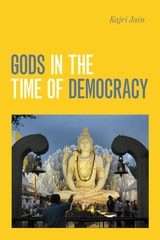
cover of Gods in the Time of Democracy

Gods in the Time of Democracy

Kajri Jain

Duke University Press, 2021

In 2018 India's prime minister, Narendra Modi, inaugurated the world's tallest statue: a 597-foot figure of nationalist leader Sardar Patel. Twice the height of the Statue of Liberty, it is but one of many massive statues built following India's economic reforms of the 1990s. In Gods in the Time of Democracy Kajri Jain examines how monumental icons emerged as a religious and political form in contemporary India, mobilizing the concept of emergence toward a radical treatment of art historical objects as dynamic assemblages. Drawing on a decade of fieldwork at giant statue sites in India and its diaspora and interviews with sculptors, patrons, and visitors, Jain masterfully describes how public icons materialize the intersections between new image technologies, neospiritual religious movements, Hindu nationalist politics, globalization, and Dalit-Bahujan verifications of equality and presence. Centering the ex-colony in rethinking key concepts of the image, Jain demonstrates how these new aesthetic forms entail a simultaneously religious and political retooling of the “infrastructures of the sensible.”
[more]
cover of Golden and Blue Like My Heart: Masculinity, Youth, and Power Among Soccer Fans in Mexico City

Golden and Blue Like My Heart

Masculinity, Youth, and Power Among Soccer Fans in Mexico City

Roger Magazine

University of Arizona Press, 2007

For fans of pro soccer in Mexico City, the four most popular teams represent distinct identities that embody such attributes as political power, nationalism, and working-class values. One of these teams, the Pumas, is associated with youthfulness, and its equally youthful fans take pride in the fact that their heroes have not yet been corrupted by corporate or political interests. This ethnographic study examines Puma fans’ understanding of the ideal that the team represents, considers the practices they employ to express and sometimes contradict this ideal, and reveals how soccer fandom in contemporary Mexico has emerged as a nexus of tensions among competing visions of state and society.

Roger Magazine takes readers inside Mexico’s soccer stadiums to explore young men’s participation in struggles over the future of that country’s urban society. His firsthand observations of the fan clubs—las porras—yield a unique inside look at confrontations in the stands over group organization, particularly at the emergence of rebel segments within the clubs. His study offers a close-up look at ground-level struggles over social organization in contemporary urban Mexico, showing how young male fans both blindly reproduce and consciously manipulate images of violence and disorder derived from national myths about typical urban Mexican men.

Golden and Blue Like My Heart offers a new way of understanding the dynamics of fandom while shedding new light on larger social processes and youth culture in Mexico. And with its insight into soccer culture, politico-economic transition, and masculinity, it has important and wide-reaching implications for all of Latin America.
[more]
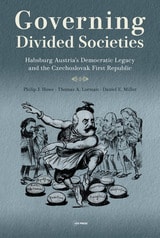
cover of Governing Divided Societies: Habsburg Austria’s Democratic Legacy and the Czechoslovak First Republic

Governing Divided Societies

Habsburg Austria’s Democratic Legacy and the Czechoslovak First Republic

Philip Howe

Central European University Press, 2026

The authors of this volume challenge conventional notions about Habsburg and Czechoslovak politics, arguing that they were more democratic than they often appear. They use the consociational model of democracy as a means of combining political science and history. The theory, associated with Arend Lijphart, asserts that consociationalism guarantees minorities a say in government and helps preserve democracy in societies that experience deep ideological, cultural, or ethnic divisions. Consociationalism enables the main segments to be isolated organizationally from each other, thus avoiding conflict but affording the leaders opportunities to make compromises for the good of the whole.
Consociationalism has proven its worth as a model for describing contemporary democracies and diagnosing their ills. By exploring the institutions and practices of the Habsburg Monarchy before 1918 and the Czechoslovak First Republic, Howe, Lorman, and Miller prove the value of the consociational theory in analyzing the past. They hold that a multitude of parties, frequent cabinet changes, and reliance on cabinets of experts do not necessarily signal flawed democracies. In fact, they are features of consociationalism. This volume challenges historians and social scientists to view the Austrian half of the Habsburg Monarchy before 1918 as evolving toward consociational democracy and the Czechoslovak First Republic as a fully consociational state.

[more]
cover of Gray is Beautiful: Confronting the Retreat of Democracy from the Radical Center

Gray is Beautiful

Confronting the Retreat of Democracy from the Radical Center

Jeffrey Goldfarb

Central European University Press, 2026

With “the age of democracy” apparently coming to an end, Jeffrey C. Goldfarb offers hope against hopelessness, turning away from the canned political perspectives of the left, right, and center to recognize the beauty of the less than perfect and to emphasize the centrality of free public life. In Gray is Beautiful, he reflects on a lifetime of political engagement and scholarship, drawing upon experiences as a radical New Leftist, participant observer of the democratic opposition “behind the iron curtain,” teacher in Afghanistan, and publisher of online public forums. Offering original insights, this book considers the promise rather than the problems of political uncertainty, uses Tocqueville’s mistakes to understand the present state of democracy in America, and considers the ironies of collaboration. Goldfarb helps readers confront today’s central challenges in fresh ways, demonstrating that the political gray is indeed beautiful and how this sensibility provides a way to confront the global retreat of democracy.
[more]
cover of Guns, Democracy, and the Insurrectionist Idea

Guns, Democracy, and the Insurrectionist Idea

Joshua Horwitz and Casey Anderson

University of Michigan Press, 2009

"Guns, Democracy, and the Insurrectionist Idea recasts the gun debate by showing its importance to the future of democracy and the modern regulatory state. Until now, gun rights advocates had effectively co-opted the language of liberty and democracy and made it their own. This book is an important first step in demonstrating how reasonable gun control is essential to the survival of democracy and ordered liberty."
---Saul Cornell, Ohio State University
When gun enthusiasts talk about constitutional liberties guaranteed by the Second Amendment, they are referring to freedom in a general sense, but they also have something more specific in mind---freedom from government oppression. They argue that the only way to keep federal authority in check is to arm individual citizens who can, if necessary, defend themselves from an aggressive government. In the past decade, this view of the proper relationship between government and individual rights and the insistence on a role for private violence in a democracy has been co-opted by the conservative movement. As a result, it has spread beyond extreme militia groups to influence state and national policy.
In Guns, Democracy, and the Insurrectionist Idea, Joshua Horwitz and Casey Anderson set the record straight. They challenge the proposition that more guns equal more freedom and expose Insurrectionism as a true threat to freedom in the United States today.
Joshua Horwitz received a law degree from George Washington University and is currently a visiting scholar at the Johns Hopkins Bloomberg School of Public Health.
Casey Anderson holds a law degree from Georgetown University and is currently a lawyer in private practice in Washington, D.C.
[more]