Results by title
230 books match the query 'Doctrines' and 6 start with g
Galileo, Science and the Church
Jerome J. Langford
University of Michigan Press, 1992
Jerome J. Langford's Galileo, Science, and the Church is widely recognized as a classic, balanced account of Galileo Galilei’s legendary 1633 confrontation with the Roman Catholic Inquisition. Moving past the overly polarized arguments of traditional polemicists and apologists, Langford contextualizes the "Galileo Affair" within its proper 17th-century historical, theological, and philosophical milieu. The book meticulously explores how the clash was less a fundamental war between science and faith, and more a complex dispute over scriptural interpretation, ecclesiastical authority, and the academic rigidities of Aristotelian philosophy. Through objective research, Langford demonstrates that this momentous historical drama still serves as a timeless case study on the enduring friction between institutional authority and the freedom of individual thought and expression.
[more]
Gay Rights and the Mormon Church
Intended Actions, Unintended ConsequencesGregory A. Prince
University of Utah Press, 2019
The Mormon Church entered the public square on LGBT issues by joining forces with traditional-marriage proponents in Hawaii in 1993. Since then, the church has been a significant player in the ongoing saga of LGBT rights within the United States and at times has carried decisive political clout.
Gregory Prince draws from over 50,000 pages of public records, private documents, and interview transcripts to capture the past half-century of the Mormon Church’s attitudes on homosexuality. Initially that principally involved only its own members, but with its entry into the Hawaiian political arena, the church signaled an intent to shape the outcome of the marriage equality battle. That involvement reached a peak in 2008 during California’s fight over Proposition 8, which many came to call the “Mormon Proposition.”
In 2015, when the Supreme Court made marriage equality the law of the land, the Mormon Church turned its attention inward, declaring same-sex couples “apostates” and denying their children access to key Mormon rites of passage, including the blessing (christening) of infants and the baptism of children.
Prince's interview with KUER: https://radiowest.kuer.org/post/gay-rights-and-mormon-church
Prince's Q-Talk with Equality Utah: https://www.youtube.com/watch?v=vcnVagLY-lM&feature=youtu.be
Prince's interview with the Press: https://conta.cc/2HHmeTm
Princes's event with Benchmark Books: https://youtu.be/Daz-TFldZDA
[more]
Giving One's Word
Interpersonal Love, Knowledge, and Self-Giving in Aquinas's Psychological Analogy for the TrinityMichael Joseph Higgins
Catholic University of America Press, 2025
According to the vast majority of recent Trinitarian theologians, to believe in the Trinity is to believe that God is Love: it is to believe in three divine Persons who know each other, love each other, and give themselves to each other. St. Thomas Aquinas is rarely invoked as a patron of such a social approach to the Trinity. Aquinas’s Trinitarian theology, after all, revolves around the immanent processions of a Word and Love within the unity of the divine essence. Many have assumed that this “psychological analogy” is removed from—or even incompatible with—interpersonal knowledge, love, and self-giving. Some have concluded that Aquinas is therefore unable to accommodate a social Trinity. Others have argued that he is open to a social Trinity, but that his psychological categories need to be complemented by a more overtly social framework. This study, however, shows that these psychological categories themselves are shot through with interpersonal knowledge, love, and self-giving.
More specifically, Aquinas’s psychological analogy is often accused of emphasizing the unity of the divine essence at the expense of the distinction of the divine Persons. In fact, it emphasizes distinction just as basically as it emphasizes unity, and it ensures that the distinction between the divine Persons is a radical one. Similarly, it is criticized for being a matter of self-knowledge instead of interpersonal knowledge, self-love instead of interpersonal love, and self-regard instead of self-giving. In fact, it is a matter of self-knowledge as interpersonal knowledge, self-love as interpersonal love, and self-regard as self-giving: it ensures that there can be no self-knowledge or self-love in God that is not just as basically interpersonal knowledge, interpersonal love, and interpersonal self-giving. Aquinas’s psychological analogy, then, does not shut down the possibility of interpersonal Trinity. Nor does it need to be complemented from the outside by an interpersonal Trinity. Instead, it contains within itself an intensely interpersonal Trinity.
[more]
Global Dynamics of Shi'a Marriages
Religion, Gender, and BelongingYafa Shanneik
Rutgers University Press, 2022
Muslim marriages have been the focus of considerable public debate in Europe and beyond, in Muslim-majority countries as well as in settings where Muslims are a minority. Most academic work has focused on how the majority Sunni Muslims conclude marriages. This volume, in contrast, focuses on Twelver Shi'a Muslims in Iran, Pakistan, Oman, Indonesia, Norway, and the Netherlands. The volume makes an original contribution to understanding the global dynamics of Shi'a marriage practices in a wide range of contexts--not only its geographical spread but also by providing a critical analysis of the socio-economic, religious, ethnic, and political discourses of each context. The book sheds light on new marriage forms presented through a bottom up approach focusing on the lived experiences of Shi'a Muslims negotiating a diverse range of relationships and forms of belonging.
[more]
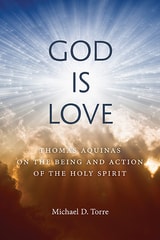
God Is Love
Thomas Aquinas on the Being and Action of the Holy SpiritMichael D. Torre
Catholic University of America Press, 2026
This book dedicates three essays each to three different theological problems regarding the Holy Spirit: In God and for Us (The "Filioque" and "Uncreated Grace"); Thomas's Understanding (Not His Commentators) of the Relation between nature and sanctifying grace; and our ability (and that of the angels at their creation) in fact to resist God' grace and thus be the first cause of sin. This later problem is developed in an "excursus" on the way God moves the free will, one that takes into consideration much recent work on this issue and situates the essays' position in relation to it. The book ends with a brief epilogue on the credibility of God, again giving Thomas's account of this.
The principal aim throughout is to understand the doctrine of Thomas Aquinas. It places his views in relation to three audiences: chiefly to the orthodox regarding the first issue; to Catholics in relation to the second; and to Protestants in relation to the third. Thus, its second aim is to join "ecumenical debate" about these matters. The essays were mostly written to be delivered orally, to an informed audience of philosophers and theologians., but one that consisted of "generalists" and serious students of Thomas, as well as of "professional" philosophers and theologians. All three of the debated issues discussed have generated an enormous amount of disagreement and debate, not a little of it being quite "technical." Thus, each issue would easily require a long and significant book to be addressed as it deserves. The essays do not do this, but they do indicate what Torre holds is the "directive line" of Thomas's thought that deserves to be defended and developed in each case, and, in each case, this line is held to be markedly different than many have thought it to be.
[more]
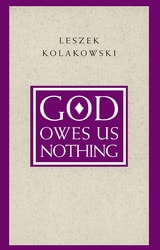
God Owes Us Nothing
A Brief Remark on Pascal's Religion and on the Spirit of JansenismLeszek Kolakowski
University of Chicago Press, 1995
God Owes Us Nothing reflects on the centuries-long debate in Christianity: how do we reconcile the existence of evil in the world with the goodness of an omnipotent God, and how does God's omnipotence relate to people's responsibility for their own salvation or damnation. Leszek Kolakowski approaches this paradox as both an exercise in theology and in revisionist Christian history based on philosophical analysis. Kolakowski's unorthodox interpretation of the history of modern Christianity provokes renewed discussion about the historical, intellectual, and cultural omnipotence of neo-Augustinianism.
"Several books a year wrestle with that hoary conundrum, but few so dazzlingly as the Polish philosopher's latest."—Carlin Romano, Washington Post Book World
"Kolakowski's fascinating book and its debatable thesis raise intriguing historical and theological questions well worth pursuing."—Stephen J. Duffy, Theological Studies
"Kolakowski's elegant meditation is a masterpiece of cultural and religious criticism."—Henry Carrigan, Cleveland Plain Dealer
[more]